
PARP [Poly(ADP-ribose) Polymerase], also known as ADPRT and PPOL, is a 118-kDa enzyme that uses NAD as a substrate to catalyze the covalent transfer of ADP-ribose to a variety of nuclear protein acceptors. ADP ribosyltransferase is required for cellular repair, and PARP expression is induced by single-strand breaks in DNA. PARP is proteolytically cleaved by Caspase-3 into two fragments of 89- and 24-kDa in one of the hallmark events of apoptosis.
PARP Universal Colorimetric Assay Kit
R&D Systems | Catalog # 4677-096-K
For the in vitro screening of candidate PARP-1 inhibitors

Loading...
Key Product Details
Features
Ideal for the in vitro screening of candidate PARP-1 inhibitors and determination of IC50 values.
Key Benefits
- Colorimetric readout
- 96 strip-well format
- Sensitive – detects 10 mU PARP /well
- Assay Time ~3 hrs
Species
Multi-Species
Product Summary for PARP Universal Colorimetric Assay Kit
Why Use the PARP/Apoptosis Colorimetric Assay Kit?
This ELISA based assay detects biotinylated poly (ADP-ribose) deposited by PARP-1 onto immobilized histones in a 96-well format. The addition of Strep-HRP (biotin-binding protein) and a colorimetric HRP substrate yields relative absorbance that correlates with PARP-1 activity.
Product Specifications
For the in vitro screening of candidate PARP-1 inhibitors and determination of IC50 values.
Loading...
Scientific Data Images for PARP Universal Colorimetric Assay Kit
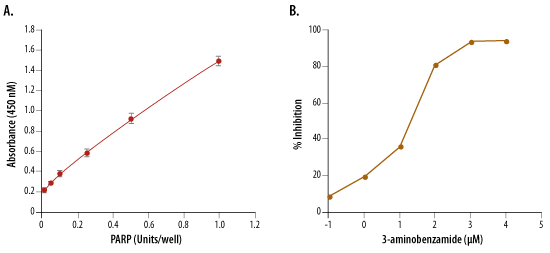
Inhibition of PARP Activity by 3-aminobenzamide.
Graphical representation of the colorimetric readout of a PARP standard curve (A) and an inhibition curve for the PARP inhibitor 3-aminobenzamide (provided in the kit). (B) The standard curve is used to translate absorbance values to activity units of PARP.Kit Contents for PARP Universal Colorimetric Assay Kit
- 3-Aminobenzamide
- PARP-HSA, 10 Units/µl
- 20X PARP Buffer
- 10X PARP Cocktail
- 10X Activated DNA
- 10X Strep-Diluent
- Histone-Coated Plate Natural Strip Well Plate
- Strep-HRP
- TACS-Sapphire
Formulation, Preparation, and Storage
Shipping
The components for this kit may require different storage/shipping temperatures and may arrive in separate packaging. Upon receipt, store products immediately at the temperature recommended on the product labels.
Storage
Store the unopened product at -20 to -70 °C. Use a manual defrost freezer and avoid repeated freeze-thaw cycles. Do not use past expiration date.
Background: PARP
Long Name
Poly [ADP-ribose] Polymerase
Alternate Names
ADPRT, PARP1, PPOL
Additional PARP Products
Product Documents for PARP Universal Colorimetric Assay Kit
Certificate of Analysis
To download a Certificate of Analysis, please enter a lot or batch number in the search box below.
Note: Certificate of Analysis not available for kit components.
Related Research Areas
Citations for PARP Universal Colorimetric Assay Kit
 Powered by Bioz
Customer Reviews for PARP Universal Colorimetric Assay Kit
There are currently no reviews for this product. Be the first to review PARP Universal Colorimetric Assay Kit and earn rewards!
Have you used PARP Universal Colorimetric Assay Kit?
Submit a review and receive an Amazon gift card!
$25/€18/£15/$25CAN/¥2500 for a review with an image
$10/€7/£6/$10CAN/¥1110 for a review without an image
Submit a review
FAQs for PARP Universal Colorimetric Assay Kit
Showing
1
-
4 of
4 FAQs
Showing All
-
Q: Is the kit capable of measuring PARP hyperactivation (ie. greater than 100% of the PARP positive control)?
A: With this kit, hyperactivation may be possible since it is a cell free system. It is possible that test molecules increase the binding of PARP to the activated DNA or inhibit its dissociation. We are unable to confirm if PARP may become bound to the DNA and trapped within the replication fork or if this would allow for hyperactivation.
-
Q: What is the ratio of NAD and activated DNA relative to the concentration of enzyme in the final well?
A: The ratio of PARP to DNA is 2:1 and NAD is in excess in the final well.
-
Q: What PARP isoform is detected in this kit?
A: This is a universal PARP kit. We expect that all 3 isoforms of PARP will be detected by this kit.
-
Q: With what species does this kit work?
A: This kit is not species specific. It is suitable for enzymes that will be conserved across all mammals and for tissue homogenates.
-
Q: Is the kit capable of measuring PARP hyperactivation (ie. greater than 100% of the PARP positive control)?
A: With this kit, hyperactivation may be possible since it is a cell free system. It is possible that test molecules increase the binding of PARP to the activated DNA or inhibit its dissociation. We are unable to confirm if PARP may become bound to the DNA and trapped within the replication fork or if this would allow for hyperactivation.
-
Q: What is the ratio of NAD and activated DNA relative to the concentration of enzyme in the final well?
A: The ratio of PARP to DNA is 2:1 and NAD is in excess in the final well.
-
Q: What PARP isoform is detected in this kit?
A: This is a universal PARP kit. We expect that all 3 isoforms of PARP will be detected by this kit.
-
Q: With what species does this kit work?
A: This kit is not species specific. It is suitable for enzymes that will be conserved across all mammals and for tissue homogenates.
-
Q: Is the kit capable of measuring PARP hyperactivation (ie. greater than 100% of the PARP positive control)?
A: With this kit, hyperactivation may be possible since it is a cell free system. It is possible that test molecules increase the binding of PARP to the activated DNA or inhibit its dissociation. We are unable to confirm if PARP may become bound to the DNA and trapped within the replication fork or if this would allow for hyperactivation.
-
Q: What is the ratio of NAD and activated DNA relative to the concentration of enzyme in the final well?
A: The ratio of PARP to DNA is 2:1 and NAD is in excess in the final well.
-
Q: What PARP isoform is detected in this kit?
A: This is a universal PARP kit. We expect that all 3 isoforms of PARP will be detected by this kit.
-
Q: With what species does this kit work?
A: This kit is not species specific. It is suitable for enzymes that will be conserved across all mammals and for tissue homogenates.
-
Q: Is the kit capable of measuring PARP hyperactivation (ie. greater than 100% of the PARP positive control)?
A: With this kit, hyperactivation may be possible since it is a cell free system. It is possible that test molecules increase the binding of PARP to the activated DNA or inhibit its dissociation. We are unable to confirm if PARP may become bound to the DNA and trapped within the replication fork or if this would allow for hyperactivation.
-
Q: What is the ratio of NAD and activated DNA relative to the concentration of enzyme in the final well?
A: The ratio of PARP to DNA is 2:1 and NAD is in excess in the final well.
-
Q: What PARP isoform is detected in this kit?
A: This is a universal PARP kit. We expect that all 3 isoforms of PARP will be detected by this kit.
-
Q: With what species does this kit work?
A: This kit is not species specific. It is suitable for enzymes that will be conserved across all mammals and for tissue homogenates.
Loading...