Mouse Cortical Stem Cells (2 x 10e6 cells/vial)

R&D Systems | Catalog # NSC002

R&D Systems
Loading...

Key Product Details

Species

Mouse

Product Summary for Mouse Cortical Stem Cells (2 x 10e6 cells/vial)

Kit Summary

For cortical stem cell expansion and differentiation into neurons, astrocytes, and oligodendrocytes.

Key Benefits

  • Confirmed multipotency reduces experimental variation
  • Highly pure cells that are ready to use
  • Each lot confirmed for high Nestin expression
 

Why use Pre-isolated Fully Characterized Mouse Cortical Stem Cells?

Although there are a number of protocols available to isolate mouse cortical stem cells, each isolation can yield cells that vary in their purity and ability to proliferate.   See Details

R&D Systems offers Mouse Cortical Stem Cells that are of high purity, isolated at a low passage number (Passage 1), and are free of mycoplasma and microbial contamination. Mouse primary cortical stem cells were isolated from the cortex of embryonic E14.5 CD-1 mice. Cells were cultured as a monolayer in media containing the N-2 Plus Media Supplement (Catalog # AR003) or N-2 MAX Media Supplement (Catalog # AR009), Recombinant Human FGF basic (Catalog # 233-FB or 4114-TC), and Recombinant Human EGF (Catalog # 236-EG). The cells were passaged once and the expanded progeny were cryopreserved. These cells are designated as passage 1 (P1) cells.

R&D Systems Rat Cortical Stem Cells:

  • Have been fully characterized to reduce experimental variation.
  • Differentiate into neurons, astrocytes, and oligodendrocytes.
  • Have been verified to be free of mycoplasma and microbial contamination.

Components

2 vials of Mouse Cortical Stem Cells containing 2 x 10⁶ cells.   See Details

Stability and Storage

Store Mouse Cortical Stem Cells in liquid nitrogen for up to one year.

Quality Control

  • The Mouse Cortical Stem Cells have been thawed and tested for their ability to proliferate using either a monolayer system (for up to 3 passages) or a neurosphere system (for up to 4 passages). Stem and progenitor cells expanded from the end of passage 3 (monolayer system) or passage 4 (neurosphere system) have been examined for Nestin and SOX2 expression as well as for their capacity to differentiate into astrocytes, neurons, and oligodendrocytes.
  • The cells tested negative for mycoplasma using the MycoProbe™ Mycoplasma Detection Kit (Catalog # CUL001B). The cells also tested negative for microbial contamination.
 

Data Examples

Characterization of Mouse Cortical Stem Cells
View Larger Image

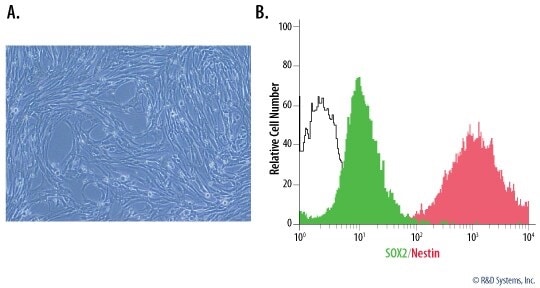
Characterization of Mouse Cortical Stem Cells.  A. Undifferentiated Mouse Cortical Stem Cells (Catalog # NSC002) cultured on Poly-L-ornithine and Fibronectin coated dishes. B. Mouse Cortical Stem Cells express Nestin and SOX2, a phenotype that is consistent with mouse cortical stem cells. Mouse Cortical Stem Cells were stained with a PE-conjugated Mouse Anti-Mouse/Rat Nestin Monoclonal Antibody (Catalog # IC2736P; red histogram), a PE-conjugated Mouse Anti-Human/Mouse SOX2 Monoclonal Antibody (Catalog # IC2018P; green histogram), or a PE-conjugated Mouse IgG2A Isotype Control Antibody (Catalog # IC003P; empty histogram).

Mouse Cortical Stem Cells Have Multi-lineage Potential
View Larger Image

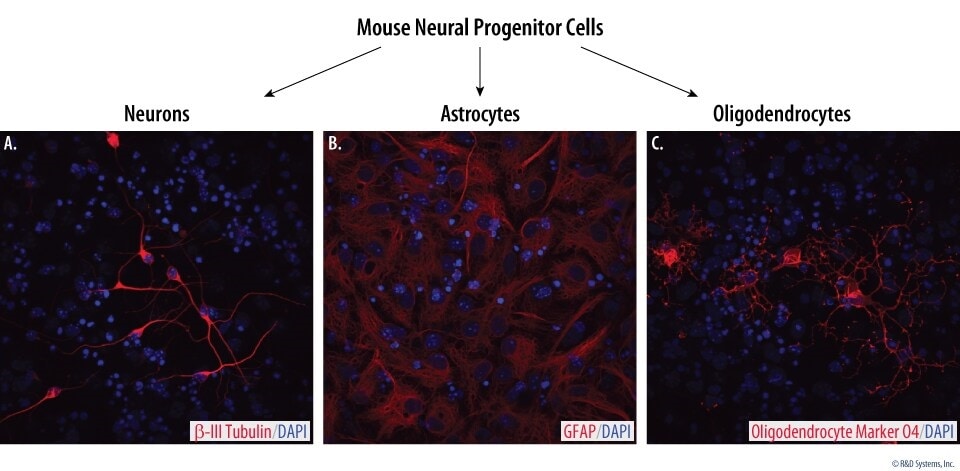
Mouse Cortical Stem Cells Have Multi-lineage Potential. A-C Differentiation of Mouse Cortical Stem Cells (Catalog # NSC002) was induced by culturing the cells in DMEM/F12 containing N2-Plus Media Supplement (Catalog # AR003) in the absence of EGF and FGF basic for 7 days. Neuronal lineage cells (A) were detected with a Mouse Anti-Neuron Specific beta-III Tubulin Monoclonal Antibody (Catalog # MAB1195) followed by the NorthernLights™ (NL)557-conjugated Donkey Anti-Mouse IgG Secondary Antibody (Catalog # NL007; red). Astrocyte lineage cells (B) were detected with a Sheep Anti-Human GFAP Antigen Affinity-purified Polyclonal Antibody (Catalog # AF2594) followed by the NL557-conjugated Donkey Anti-Sheep IgG Secondary Antibody (Catalog # NL010; red). Oligodendrocyte lineage cells (C) were detected with a Mouse Anti-Oligodendrocyte Marker O4 Monoclonal Antibody (Catalog # MAB1326) followed by the NL557-conjugated Goat Anti-Mouse IgM Secondary Antibody (Catalog # NL019; red). The nuclei were counterstained with DAPI (blue) in all panels. View our protocol for Fluorescent ICC Staining of Stem Cells on Coverslips.

Loading...

Scientific Data Images for Mouse Cortical Stem Cells (2 x 10e6 cells/vial)

Characterization of Mouse Cortical Stem Cells.

A. Undifferentiated Mouse Cortical Stem Cells (Catalog # NSC002) cultured on Poly-L-ornithine and Fibronectin coated dishes. B. Mouse Cortical Stem Cells express Nestin and SOX2, a phenotype that is consistent with mouse cortical stem cells. Mouse Cortical Stem Cells were stained with a PE-conjugated Mouse Anti-Mouse/Rat Nestin Monoclonal Antibody (Catalog # IC2736P; red histogram), a PE-conjugated Mouse Anti-Human/Mouse SOX2 Monoclonal Antibody (Catalog # IC2018P; green histogram), or a PE-conjugated Mouse IgG2A Isotype Control Antibody (Catalog # IC003P; empty histogram).

Mouse Cortical Stem Cells Have Multi-lineage Potential.

A-C Differentiation of Mouse Cortical Stem Cells (Catalog # NSC002) was induced by culturing the cells in DMEM/F12 containing N2-Plus Media Supplement (Catalog # AR003) in the absence of EGF and FGF basic for 7 days. Neuronal lineage cells (A) were detected with a Mouse Anti-Neuron Specific beta-III Tubulin Monoclonal Antibody (Catalog # MAB1195) followed by the NorthernLights™ (NL)557-conjugated Donkey Anti-Mouse IgG Secondary Antibody (Catalog # NL007; red). Astrocyte lineage cells (B) were detected with a Sheep Anti-Human GFAP Antigen Affinity-purified Polyclonal Antibody (Catalog # AF2594) followed by the NL557-conjugated Donkey Anti-Sheep IgG Secondary Antibody (Catalog # NL010; red). Oligodendrocyte lineage cells (C) were detected with a Mouse Anti-Oligodendrocyte Marker O4 Monoclonal Antibody (Catalog # MAB1326) followed by the NL557-conjugated Goat Anti-Mouse IgM Secondary Antibody (Catalog # NL019; red). The nuclei were counterstained with DAPI (blue) in all panels.

Formulation, Preparation, and Storage

Reconstitution Instructions

Reconstitution default not known

Shipping

The product is shipped with dry ice or equivalent. Upon receipt, store it immediately at the temperature recommended below.

Storage

Store in liquid nitrogen for up to 12 months from the date of receipt.

Calculators

The reconstitution calculator allows you to quickly calculate the volume of a reagent to reconstitute your vial. Simply enter the mass of reagent and the target concentration and the calculator will determine the rest.

=
÷

Background: Neural Stem Cells

Neural stem cells provide an excellent model for research focused on neural development and neurological disorders. R&D Systems offers ready-to-use primary cortical stem cells isolated from E14.5 Sprague-Dawley rats. In addition, primary mouse cortical stem cells isolated from E14.5 CD-1 mice are available. Every lot of R&D Systems Cortical Stem Cells is validated for a high level of Nestin expression and the capacity for multi-lineage differentiation into astrocytes, neurons, and oligodendrocytes. Our cortical stem cells are tested to ensure highest quality and lot to lot consistency. Both rat and mouse Cortical Stem Cells can be optimally expanded as monolayers or neurospheres.

To complement the use of primary neural stem cells, we offer a range of supportive products, including culture media which is specifically optimized for use with neural stem cells. We offer kits to promote the in vitro proliferation of neural precursors, and kits to differentiate neural stem cells into dopaminergic neurons or oligodendrocytes. In addition, kits are available which contain panels of antibodies designed to monitor the differentiation and identification of neural precursors, astrocytes, neurons, and oligodendrocytes.

Additional Neural Stem Cells Products

Product Documents for Mouse Cortical Stem Cells (2 x 10e6 cells/vial)

Certificate of Analysis

To download a Certificate of Analysis, please enter a lot or batch number in the search box below.

Note: Certificate of Analysis not available for kit components.

Product Specific Notices for Mouse Cortical Stem Cells (2 x 10e6 cells/vial)

For research use only

Citations for Mouse Cortical Stem Cells (2 x 10e6 cells/vial)

Customer Reviews for Mouse Cortical Stem Cells (2 x 10e6 cells/vial) (1)

5 out of 5
1 Customer Rating
5 Stars
100%
4 Stars
0%
3 Stars
0%
2 Stars
0%
1 Stars
0%

Have you used Mouse Cortical Stem Cells (2 x 10e6 cells/vial)?

Submit a review and receive an Amazon gift card!

$25/€18/£15/$25CAN/¥2500 Yen for a review with an image

$10/€7/£6/$10CAN/¥1110 Yen for a review without an image

Submit a review
Amazon Gift Card

Customer Images


Showing  1 - 1 of 1 review Showing All
Filter By:
  • Mouse Cortical Stem Cells (2 x 10e6 cells/vial)
    Name: Anonymous
    Verified Customer | Posted 05/13/2021
    Mouse Cortical Stem Cells (2 x 10e6 cells/vial) NSC002

There are no reviews that match your criteria.

Showing  1 - 1 of 1 review Showing All

Protocols

View specific protocols for Mouse Cortical Stem Cells (2 x 10e6 cells/vial) (NSC002):

Refer to the product datasheet for complete product details.

Briefly, Mouse Cortical Stem Cells can be thawed and expanded by the neurosphere or monolayer system using the following procedure:

  • Thaw the Mouse Cortical Stem Cells
  • Plate the cells in Completed NSC Base Media containing EGF and FGF basic
  • Expand the cells using the monolayer or neurosphere system


Reagents Provided

Reagents Supplied in Mouse Cortical Stem Cells (Catalog # NSC002):

  • 2 vials of Mouse Cortical Stem Cells containing 2 x 10⁶ cells

Other Supplies Required

Expanding Mouse Cortical Stem Cells Using the Neurosphere System

Reagents

  • Mouse Cortical Stem Cells (Catalog # NSC002)
  • N-2 Plus Media Supplement (Catalog # AR003)
  • Recombinant Human Fibroblast Growth Factor basic (FGF basic) (Catalog # 233-FB or 4114-TC)
  • Recombinant Human Epidermal Growth Factor (EGF) (Catalog # 236-EG)
  • PBS
  • DMEM/F12
  • Glucose
  • Glutamine
  • NaHCO3
  • Penicillin-Streptomycin, 100X
  • BSA, very low endotoxin
  • Acetic acid
  • Trypan Blue
  • Deionized water
 

Materials

  • 10 cm tissue culture dishes
  • 15 mL tubes
  • 50 mL Falcon tubes
  • 0.2 µm, 1000 mL filter unit
  • 0.2 µm, 500 mL filter unit
  • Plastic cell scraper
  • Pipettes and pipette tips
 

Equipment

  • 37 °C and 5% CO2 incubator
  • Centrifuge
  • Hemocytometer
  • Microscope
  • Water bath
 

Other Supplies Required

Expanding Mouse Cortical Stem Cells Using the Monolayer System

Reagents

  • Mouse Cortical Stem Cells (Catalog # NSC002)
  • N-2 Plus Media Supplement (Catalog # AR003)
  • Recombinant Human Fibroblast Growth Factor basic (FGF basic) (Catalog # 233-FB or 4114-TC)
  • Recombinant Human Epidermal Growth Factor (EGF) (Catalog # 236-EG)
  • Purified Bovine Fibronectin (Catalog # 1030-FN)
  • PBS
  • DMEM/F12
  • Glucose
  • Glutamine
  • NaHCO3
  • Poly-L-ornithine
  • Hank’s Balanced Salt Solution (HBSS) (Ca2+/Mg2+-free), 10X
  • HEPES
  • BSA, very low endotoxin
  • Acetic acid
  • Trypan Blue
  • Deionized (DI) water
 

Materials

  • 10 cm tissue culture dishes
  • 15 mL tubes
  • 50 mL Falcon tubes
  • Pipettes and pipette tips
  • 0.2 µm, 1000 mL filter unit
  • 0.2 µm, 500 mL filter unit
  • Plastic cell scraper
 

Equipment

  • 37 °C and 5% CO2 incubator
  • Centrifuge
  • Hemocytometer
  • Microscope
  • Water bath
 

Procedure Overview for Expanding Mouse Cortical Stem Cells Using the
Neurosphere System

Thawing Cryopreserved Mouse Cortical Stem Cells

Add 1 mL of fresh pre-warmed media to the vial of frozen mouse cortical stem cells
  • Pipette up and down and as cells thaw, transfer the thawed portion into a 50 mL tube containing pre-warmed Completed Base NSC Media supplemented with 20 ng/mL EGF and 20 ng/mL FGF basic.
  • Centrifuge the cells at 200 x g for 5 minutes.
 

Resuspend the cell pellet in 10 mL of Completed NSC Base Media containing EGF and FGF basic
  • Resuspend the cell pellet in 10 mL of Completed NSC Base Media containing EGF and FGF basic.
 

Neurosphere Expansion

Perform a cell count
  • Perform a cell count.
 

Plate cells at approximately 2.0 x 10⁵ NSCs in 5 mL of Completed NSC Base Media supplemented with EGF and FGF basic per well in a 6-well plate
  • Plate cells at approximately 2.0 x 10⁵ NSCs in 5 mL of Completed NSC Base Media supplemented with EGF and FGF basic per well in a 6-well plate.
  • Incubate the cells at 37 °C and 5% CO2.
  • Add fresh EGF and FGF basic daily to the media.
 

Replace the media every 4 days according to the number of neurospheres present
  • Replace the media every 4 days according to the number of neurospheres present:
    1. a. Less than 50 neurospheres:
      1. Transfer the neurospheres into one well of a 6-well plate using 2.5 mL of fresh media and 2.5 mL of spent/conditioned media.
    2. b. More than 50 neurospheres:
      1. Transfer the media containing the neurospheres to a 15 mL tube.
      2. Centrifuge for 5 minutes at 100 x g and remove the media.
      3. Resuspend the pellet using a small quantity of fresh Completed NSC Base Media containing EGF and FGF basic.
      4. Add the neurosphere suspension to 5 mL of fresh Completed Base Media containing EGF and FGF basic in one well of a 6-well plate.
  • Passage the cells at 5-7 days or when the neurospheres have a dark clump inside or ruffling on the outside.
 

Passing Neurosphere

Transfer the media containing the floating neurospheres to a 15 mL tube
  • Transfer the media containing the floating neurospheres to a 15 mL tube.
  • Centrifuge for 5 minutes at 100 x g.
 

Partially dissociate the neurospheres by pipetting up and down 20 times with a P200 pipette
  • Partially dissociate the neurospheres by pipetting up and down 20 times with a P200 pipette.
  • At passages 1 and 2 the cells should be split 1:1. After passage 2 the cells can be split 1:2.
 
  1. Add 1 mL of fresh pre-warmed media to the vial of frozen mouse cortical stem cells
  2. See Details

Procedural Overview for Expanding Mouse Cortical Stem Cells Using the
Monolayer System

Thawing Cryopreserved Mouse Cortical Stem Cells

Coat cell culture plates with Poly-L-ornithine and Fibronectin
  • Add 1 mL of fresh pre-warmed media to the vial of frozen mouse cortical stem cells.
  • Pipette up and down and as cells thaw, transfer the thawed portion into a 50 mL tube containing pre-warmed Completed Base NSC Media supplemented with 20 ng/mL EFG and 20 ng/mL FGF basic.
 

Mix 10 µL of the cell suspension with 10 µL of 0.4% Trypan Blue
  • Mix 10 μL of the cell suspension with 10 μL of 0.4% Trypan Blue
  • Perform a cell count.
 

Monolayer Expansion

Plate 2.0 x 10<sup>6</sup> NSCs in 10 mL of Completed NSC Base Media supplemented with EGF and FGF basic onto a Poly-L-ornithine/Fibronectin-coated 10 cm plate
  • Plate 2.0 x 10⁶ NSCs in 10 mL of Completed NSC Base Media supplemented with EGF and FGF basic onto a Poly-L-ornithine/Fibronectin-coated 10 cm plate.
  • Incubate the cells at 37 °C and 5% CO2.
 

Replace the media once cells become adherent. After 24 hours, add 10 µL of FGF basic stock (1000X) and 10 µL of EGF stock (1000X) to the culture
  • Replace the media once cells become adherent. After 24 hours, add 10 μL of FGF basic stock (1000X) and 10 μL of EGF stock (1000X) to the culture.
  • Replace the media with fresh Completed NSC Base Media every second day.
  • Supplement the media daily with EGF and FGF basic
  • Passage the cells when they reach 70-80% confluency.
 

Passaging Cells

Wash the cells once with pre-warmed HBSS
  • Wash the cells once with pre-warmed HBSS.
  • Add 5 mL of HBSS.
  • Incubate at room temperature until the cells round up.
 

Scrape the cells from the plate
  • Scrape the cells from the plate.
  • Transfer the cells to a 15 mL centrifuge tube.
  • Centrifuge for 5 minutes at 200 x g.
  • Remove the supernatant.
 

Resuspend the cells in 5 mL of Completed NSC Base Media containing EGF and FGF basic
  • Resuspend the cells in 5 mL of Completed NSC Base Media containing EGF and FGF basic
 

Mix 10 µL of the cell suspension with 10 µL of 0.4% Trypan Blue
  • Mix 10 μL of the cell suspension with 10 μL of 0.4% Trypan Blue
  • Perform a cell count.
 

Plate 2.0 x 10<sup>6</sup> viable cells in 10 mL of Completed NSC Base Media containing EGF and FGF basic onto a Poly-L-ornithine/Fibronectin-coated plate
  • Plate 2.0 x 10⁶ viable cells in 10 mL of Completed NSC Base Media containing EGF and FGF basic onto a Poly-L-ornithine/Fibronectin-coated plate
  • Incubate the cells at 37 °C and 5% CO2.
 

Replace the media with fresh Completed NSC Base Media every second day
  • Replace the media with fresh Completed NSC Base Media every second day
  • Supplement the media with EGF and FGF basic daily
  • Passage the cells after 3 days or when the cells reach 70-80% confluency.
 
  1. Coat cell culture plates with Poly-L-ornithine and Fibronectin.
  2. See Details

FAQs for Mouse Cortical Stem Cells (2 x 10e6 cells/vial)

Showing  1 - 2 of 2 FAQs Showing All
  • Q: How many times can Mouse Cortical Stem Cells (Catalog # NSC002) be passaged before they lose their multipotency?

    A: The Mouse Cortical Stem Cells are designated P1 cells as the supplied cells are passaged once. They can be expanded at least three more passages using the monolayer system or at least four more passages using the neurosphere system before their multipotency may be compromised.

  • Q: What is the gender of the mice from which Mouse Cortical Stem Cells are derived?

    A: Mouse cortical Stem cells are deived by harvesting brain tissue from embryos of pregnant females.Cortical Stem cells from each litter is combined giving a mixture of male and female cells.

  • Q: How many times can Mouse Cortical Stem Cells (Catalog # NSC002) be passaged before they lose their multipotency?

    A: The Mouse Cortical Stem Cells are designated P1 cells as the supplied cells are passaged once. They can be expanded at least three more passages using the monolayer system or at least four more passages using the neurosphere system before their multipotency may be compromised.

  • Q: What is the gender of the mice from which Mouse Cortical Stem Cells are derived?

    A: Mouse cortical Stem cells are deived by harvesting brain tissue from embryos of pregnant females.Cortical Stem cells from each litter is combined giving a mixture of male and female cells.

Showing  1 - 2 of 2 FAQs Showing All
View all FAQs for Stem Cell Products