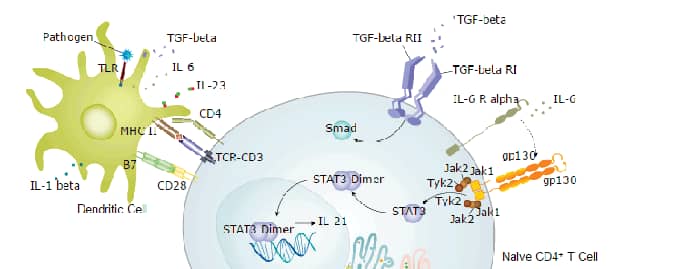
Interleukin-17F (also ML-1) is a 19 kDa member of the IL-17 family of cytokines. Members of this family are involved in tissue homeostasis and demonstrate a structural motif termed a cysteine knot that characterizes a large superfamily of growth factors. Although most cysteine knot superfamily members use three intrachain disulfide bonds to create a knot, IL-17 family molecules generate the same structural form with only two disulfide links (1, 2, 3, 4). Based on mouse, mature rat IL-17F is 133 amino acids (aa) in length (5, 6). Rat IL-17F is a presumably secreted, 38 kDa glycosylated disulfide-linked homodimer. It is also secreted as a 35 kDa disulfide-linked heterodimer with IL-17/17A (7, 8). The heterodimeric form represents about 30% of secreted IL-17F. Initially, IL-17F was also reported as IL-24. Since that time, the IL-24 designation has been reassigned to MDA-7, a member of the IL-10 family of molecules (note: IL-17E is synonymous with IL-25). Mature rat IL-17F shares 59% and 90% aa sequence identity with mature human and mouse IL-17F, respectively; it also shares 55% aa identity with rat IL-17. Interspecies studies suggest rat IL-17F is produced by activated Th17-type CD4+ T cells, mast cells, basophils and monocytes (1, 3, 9), and is inducible through the interaction of TGF-beta, IL-6 and IL-23 (9, 10, 11). Targets for IL-17F include respiratory epithelium, fibroblasts, macrophages and endothelial cells which produce proinflammatory cytokines such as GM-CSF, IL-6, IFN-gamma, IP-10, MIP-1 alpha and MCP-1 (2, 6, 12). This activity is found for both homodimeric and heterodimeric forms of IL-17F (7).

Scientific images may be resized, cropped, or adjusted for brightness or contrast for presentation purposes. These updates are limited to presentation and do not affect the underlying scientific interpretation of the data. Where available, additional source data may be provided upon request.
Key Product Details
Species Reactivity
Applications
Label
Antibody Source
Product Specifications
Immunogen
Ala27-Ala161
Accession # NP_001015011
Specificity
Clonality
Host
Isotype
Scientific Data Images for Rat IL-17F Antibody (716728)
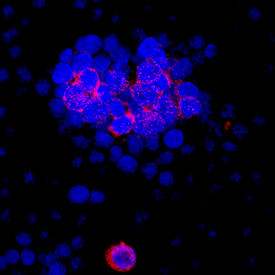
IL‑17F in Rat Splenocytes.
IL-17F was detected in immersion fixed Th17-differentiated rat splenocytes using Mouse Anti-Rat IL-17F Monoclonal Antibody (Catalog # MAB4437) at 10 µg/mL for 3 hours at room temperature. Cells were stained using the NorthernLights™ 557-conjugated Anti-Mouse IgG Secondary Antibody (red; Catalog # NL007) and counterstained with DAPI (blue). Specific staining was localized to cell surfaces and cytoplasm. View our protocol for Fluorescent ICC Staining of Non-adherent Cells.Applications for Rat IL-17F Antibody (716728)
Immunocytochemistry
Sample: Immersion fixed Th17-differentiated rat splenocytes
Formulation, Preparation, and Storage
Purification
Reconstitution
Sterile PBS to a final concentration of 0.5 mg/mL. For liquid material, refer to CoA for concentration.
Formulation
Shipping
Stability & Storage
- 12 months from date of receipt, -20 to -70 °C as supplied.
- 1 month, 2 to 8 °C under sterile conditions after reconstitution.
- 6 months, -20 to -70 °C under sterile conditions after reconstitution.
Calculators
Background: IL-17F
References
- Kawaguchi, M. et al. (2004) J. Allergy Clin. Immunol. 114:1265.
- Kolls, J.K. and A. Linden (2004) Immunity 21:467.
- Weaver, C.T. et al. (2007) Annu. Rev. Immunol. 25:801.
- Gaffen, S.H. et al. (2006) Vitam. Horm. 74:255.
- Genbank Accession # : NP_001015011.
- Oda, N. et al. (2005) Am. J. Respir. Cell Mol. Biol. 171:12.
- Chang, S.H. and C. Gong (2007) Cell Res. 17:435.
- Wright, J.F. et al. (2007) J. Biol. Chem. 282:13447.
- Kawaguchi, M. et al. (2001) J. Immunol. 167:4430.
- Langrish, C.L. et al. (2005) J. Exp. Med. 201:233.
- Yang, X.O. et al. (2007) J. Biol. Chem. 282:9358.
- Mcallister, F. et al. (2005) J. Immunol. 175:404.
Long Name
Alternate Names
Gene Symbol
UniProt
Additional IL-17F Products
Product Documents for Rat IL-17F Antibody (716728)
Certificate of Analysis
To download a Certificate of Analysis, please enter a lot or batch number in the search box below.
Note: Certificate of Analysis not available for kit components.
Product Specific Notices for Rat IL-17F Antibody (716728)
For research use only
Related Research Areas
Customer Reviews for Rat IL-17F Antibody (716728)
There are currently no reviews for this product. Be the first to review Rat IL-17F Antibody (716728) and earn rewards!
Have you used Rat IL-17F Antibody (716728)?
Submit a review and receive an Amazon gift card!
$25/€18/£15/$25CAN/¥2500 for a review with an image
$10/€7/£6/$10CAN/¥1110 for a review without an image
Submit a review
Protocols
Find general support by application which include: protocols, troubleshooting, illustrated assays, videos and webinars.
- Appropriate Fixation of IHC/ICC Samples
- Cellular Response to Hypoxia Protocols
- ClariTSA™ Fluorophore Kits
- Detection & Visualization of Antibody Binding
- ICC Cell Smear Protocol for Suspension Cells
- ICC Immunocytochemistry Protocol Videos
- ICC for Adherent Cells
- Immunocytochemistry (ICC) Protocol
- Immunocytochemistry Troubleshooting
- Immunofluorescence of Organoids Embedded in Cultrex Basement Membrane Extract
- Immunohistochemistry (IHC) and Immunocytochemistry (ICC) Protocols
- Preparing Samples for IHC/ICC Experiments
- Preventing Non-Specific Staining (Non-Specific Binding)
- Primary Antibody Selection & Optimization
- Protocol for VisUCyte™ HRP Polymer Detection Reagent
- Protocol for the Fluorescent ICC Staining of Cell Smears - Graphic
- Protocol for the Fluorescent ICC Staining of Cultured Cells on Coverslips - Graphic
- Protocol for the Preparation and Fluorescent ICC Staining of Cells on Coverslips
- Protocol for the Preparation and Fluorescent ICC Staining of Non-adherent Cells
- Protocol for the Preparation and Fluorescent ICC Staining of Stem Cells on Coverslips
- Protocol for the Preparation of a Cell Smear for Non-adherent Cell ICC - Graphic
- TUNEL and Active Caspase-3 Detection by IHC/ICC Protocol
- The Importance of IHC/ICC Controls
- View all Protocols, Troubleshooting, Illustrated assays and Webinars