


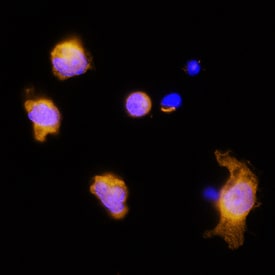
Rat interleukin-3 (IL-3; also multi-CSF) is a 26 kDa, variably glycosylated monomeric polypeptide that belongs to the alpha -helix family of hematopoietic cytokines (1, 2). IL-3 has pleiotrophic activies on a number of hematopoietic-related cells (1, 3). The rat molecule has two alternate splice forms. The first is termed IL-3 beta and is synthesized as a 169 amino acid (aa) precursor that contains a 27 aa signal sequence and a 142 aa mature segment (1, 2). The second is called IL-3 alpha, and is identical to IL-3 beta, save for a three amino acid (Tyr-Pro-Gln) deletion at positions 56-58 (1). The beta form is considered the most common form. Each form has an alpha -helical structure with two intrachain disulfide bonds and two potential N-linked glycosylation sites. Rat IL-3 is generally considered to be species-specific in its activity. In the mature region, rat IL-3 shares 55%, 30%, and 24% aa sequence identity with mouse, human, and bovine IL-3, respectively. Cells known to express IL-3 include connective tissue mast cells, astrocytes, microglia, megakaryocytes, eosinophils, T cells, keratinocytes and thymic epithelium.
IL-3 exerts its biological activities by binding to a 70 kDa, low affinity, ligand-binding IL-3 R alpha subunit, (6) which then recruits a 120 kDa, common beta -chain, signal transducing subunit (7) to form a functional IL-3 receptor (1, 6, 7). Receptors for IL-3 are present on bone marrow progenitors, macrophages, mast cells, eosinophils, megakaryocytes, basophils, and various myeloid leukemic cells. IL-3 can stimulate the proliferation and differentiation of pluripotent hematopoietic stem cells as well as various lineage committed progenitors including those for neutrophils, macrophages, magakaryocytes, and erythroid cells. IL-3 can stimulate the growth of early B cells and mature macrophages, mast cells, eosinophils, basophils, and megakaryocytes. IL-3 augments the function activity of basophils, mast cells, eosinophils, and macrophages (1, 8). In combination with other molecules such as CD40L and or IL-4, IL-3 can stimulate production of dendritic cells (1, 2, 9, 10).



