
Recombinant Human Caspr2 His-tag Protein, CF
R&D Systems | Catalog # 8207-CRB
Analyzed by SEC-MALS

Loading...
Key Product Details
- R&D Systems NS0-derived Recombinant Human Caspr2 His-tag Protein (8207-CRB)
- Quality control testing to verify active proteins with lot specific assays by in-house scientists
- All R&D Systems proteins are covered with a 100% guarantee
Source
NS0
Accession Number
Applications
Bioactivity
Loading...
Product Specifications
Source
Mouse myeloma cell line, NS0-derived human Caspr2 protein
Ala28-Ala1262, with a C-terminal 6-His tag
Ala28-Ala1262, with a C-terminal 6-His tag
Purity
>95%, by SDS-PAGE visualized with Silver Staining and quantitative densitometry by Coomassie® Blue Staining.
Endotoxin Level
<0.10 EU per 1 μg of the protein by the LAL method.
N-terminal Sequence Analysis
Ala 28
Predicted Molecular Mass
138 kDa
SDS-PAGE
130-150 kDa, under reducing conditions
Activity
Measured by its binding ability in a functional ELISA.
Recombinant Human Caspr2 His-tag binds to Recombinant Human Contactin-2/TAG1 Protein (Catalog # 1714-CN) with an ED50 of 0.400-4.00 μg/mL.
Recombinant Human Caspr2 His-tag binds to Recombinant Human Contactin-2/TAG1 Protein (Catalog # 1714-CN) with an ED50 of 0.400-4.00 μg/mL.
Scientific Data Images for Recombinant Human Caspr2 His-tag Protein, CF
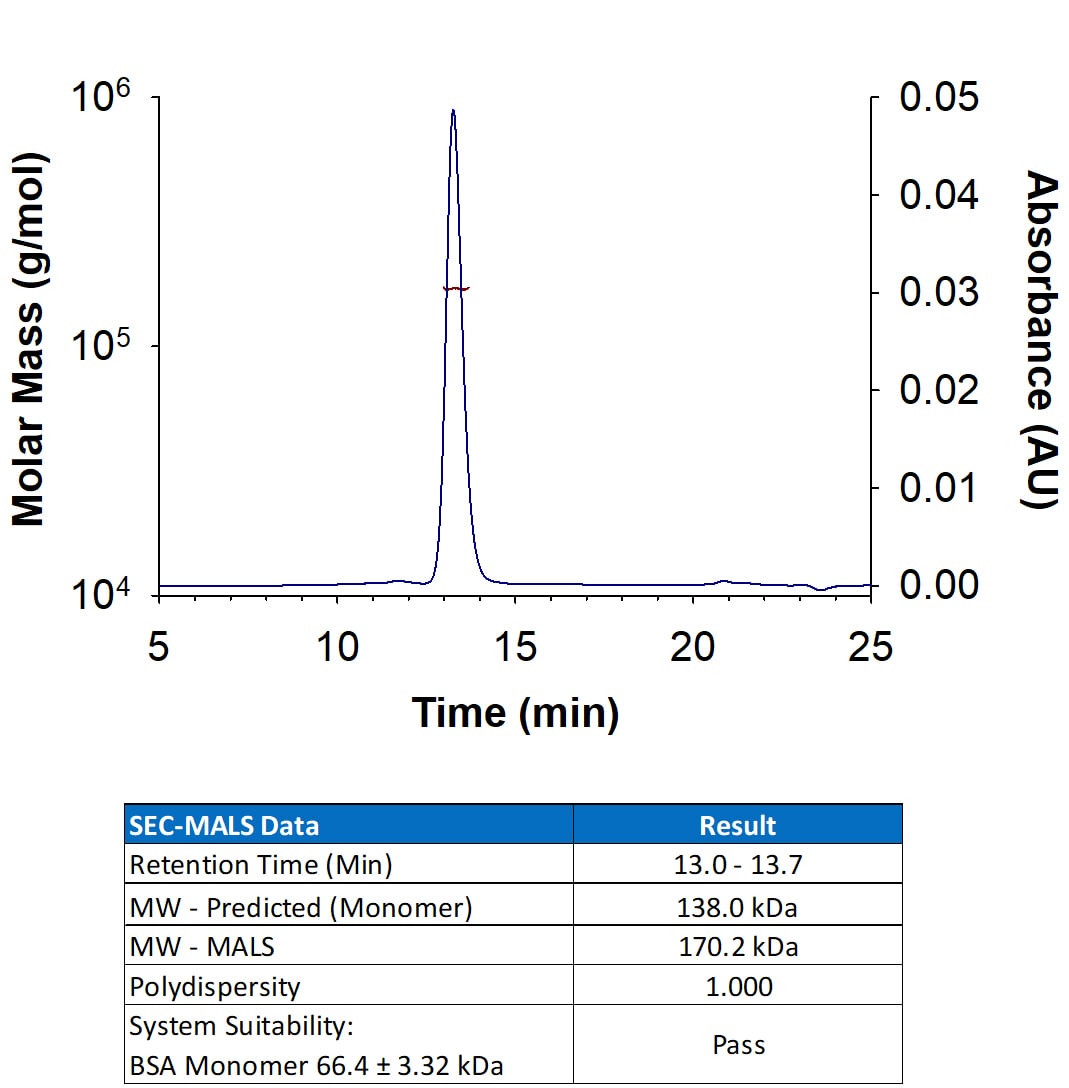
Recombinant Human Caspr2 His-tag Protein SEC-MALS.
Recombinant Human Caspr2 His-tag (Catalog # 8207-CRB ) has a molecular weight (MW) of 170.2 kDa as analyzed by SEC-MALS, suggesting that this protein is a monomer. MW may differ from predicted MW due to post-translational modifications (PTMs) present (e.g. Glycosylation).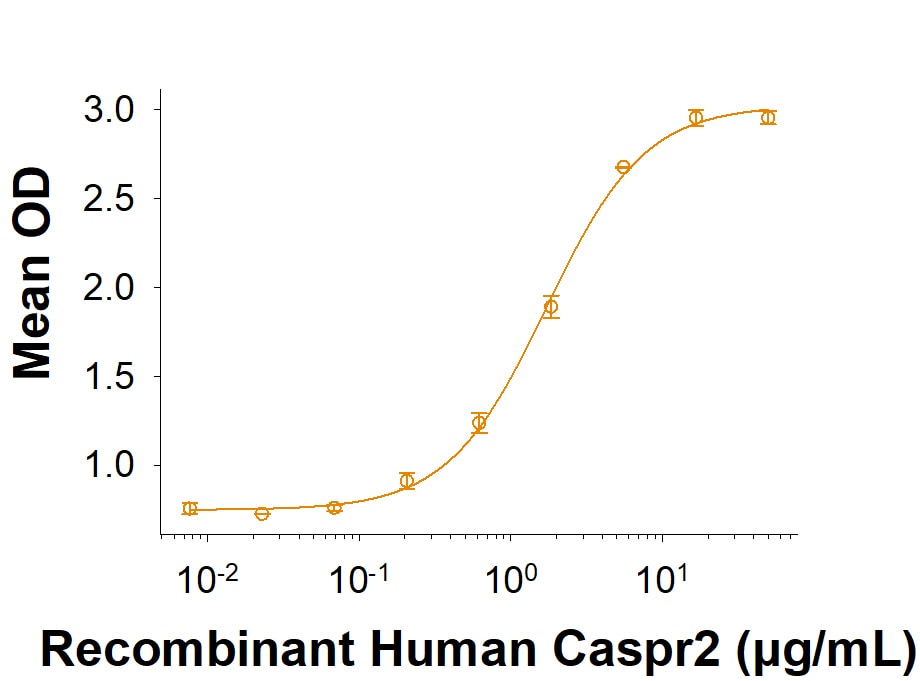
Recombinant Human Caspr2 His-tag Protein Binding Activity.
Measured by its binding ability in a functional ELISA. Recombinant Human Caspr2 His-tag Protein (Catalog # 8207-CRB) binds to Recombinant Human Contactin-2/TAG1 Protein ( 1714-CN) with an ED50 of 0.400-4.00 µg/mL.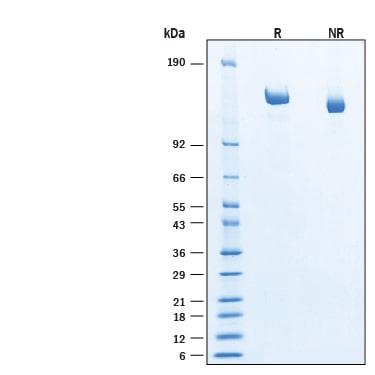
Recombinant Human Caspr2 His-tag Protein SDS-PAGE.
2 μg/lane of Recombinant Human Caspr2 His-tag Protein (Catalog # 8207-CRB) was resolved with SDS-PAGE under reducing (R) and non-reducing (NR) conditions and visualized by Coomassie® Blue staining, showing bands at 130-150 kDa, under reducing conditions.Formulation, Preparation, and Storage
8207-CRB
| Formulation | Lyophilized from a 0.2 μm filtered solution in PBS with Trehalose. |
| Reconstitution | Reconstitute at 100 μg/mL in water.
Loading...
|
| Shipping | The product is shipped at ambient temperature. Upon receipt, store it immediately at the temperature recommended below. |
| Stability & Storage | Use a manual defrost freezer and avoid repeated freeze-thaw cycles.
|
Calculators
Background: Caspr2
References
- Poliak, S. et al. (1999) Neuron 24:1037.
- Poliak, S. et al. (2001) J. Neurosci. 21:7568.
- Horresh, I. et al. (2010) J. Neurosci. 30:2480.
- Traka, M. et al. (2003) J. Cell Biol. 162:1161.
- Denisenko-Nehrbass, N. et al. (2003) Eur. J. Neurosci. 17:411.
- Poliak, S. et al. (2003) J. Cell Biol. 162:1149.
- Oiso, S. et al. (2009) J. Neurochem. 109:158.
- Anderson, G.R. et al. (2012) Proc. Natl. Acad. Sci. USA 109:18120.
- Penagarikano, O. and D.H. Geschwind (2012) Trends Mol. Med. 18:156.
- Friedman, J.I. et al. (2008) Mol. Psychiatry 13:261.
- Elia, J. et al. (2010) Mol. Psychiatry 15:637.
- Lancaster, E. et al. (2011) Ann. Neurol. 69:303.
- Balint, B. et al. (2013) J. Neurol. Sci. 327:73.
- Krogias, C. et al. (2013) JAMA Neurol. 70:1056.
Long Name
Contactin Associated Protein-like 2
Alternate Names
CDFE, CNTNAP2, NRXN4
Gene Symbol
CNTNAP2
UniProt
Additional Caspr2 Products
Product Documents for Recombinant Human Caspr2 His-tag Protein, CF
Certificate of Analysis
To download a Certificate of Analysis, please enter a lot or batch number in the search box below.
Note: Certificate of Analysis not available for kit components.
Product Specific Notices for Recombinant Human Caspr2 His-tag Protein, CF
For research use only
Customer Reviews for Recombinant Human Caspr2 His-tag Protein, CF
There are currently no reviews for this product. Be the first to review Recombinant Human Caspr2 His-tag Protein, CF and earn rewards!
Have you used Recombinant Human Caspr2 His-tag Protein, CF?
Submit a review and receive an Amazon gift card!
$25/€18/£15/$25CAN/¥2500 for a review with an image
$10/€7/£6/$10CAN/¥1110 for a review without an image
Submit a review
Loading...