
Cathepsin D is a lysosomal aspartic protease of the pepsin family (1). Human cathepsin D is synthesized as a precursor protein, consisting of a signal peptide (residues 1‑18), a propeptide (residues 19‑64), and a mature chain (residues 65‑412) (2‑4). The mature chain can be processed further to the light (residues 65‑161) and heavy (residues 169‑412) chains. It is expressed in most cells and overexpressed in breast cancer cells (5). It is a major enzyme in protein degradation in lysosomes, and also involved in the presentation of antigenic peptides. Mice deficient in this enzyme showed a progressive atrophy of the intestinal mucosa, a massive destruction of lymphoid organs, and a profound neuronal ceroid lipofucinosis, indicating that cathepsin D is essential for proteolysis of proteins regulating cell growth and tissue homeostasis (6). Cathepsin D secreted from human prostate carcinoma cells are responsible for the generation of angiostatin, a potent endogeneous inhibitor of angiogenesis (6).
Recombinant Human Cathepsin D Protein, CF
R&D Systems | Catalog # 1014-AS


Loading...
Key Product Details
- R&D Systems NS0-derived Recombinant Human Cathepsin D Protein (1014-AS)
- Quality control testing to verify active proteins with lot specific assays by in-house scientists
- All R&D Systems proteins are covered with a 100% guarantee
Source
NS0
Accession Number
Structure / Form
Pro form
Applications
Enzyme Activity
Loading...
Product Specifications
Source
Mouse myeloma cell line, NS0-derived human Cathepsin D protein
Leu21-Leu412, with a C-terminal 10-His tag
Leu21-Leu412, with a C-terminal 10-His tag
Purity
>95%, by SDS-PAGE under reducing conditions and visualized by silver stain.
Endotoxin Level
<1.0 EU per 1 μg of the protein by the LAL method.
N-terminal Sequence Analysis
Leu21
Predicted Molecular Mass
44 kDa
SDS-PAGE
50 kDa, reducing conditions
Activity
Measured by its ability to cleave the fluorogenic peptide substrate, Mca-PLGL-Dpa-AR-NH2 (Catalog # ES001).
The specific activity is >350 pmol/min/µg, as measured under the described conditions.
The specific activity is >350 pmol/min/µg, as measured under the described conditions.
Reviewed Applications
Read 1 review rated 4 using 1014-AS in the following applications:
Formulation, Preparation, and Storage
1014-AS
| Formulation | Supplied as a 0.2 μm filtered solution in MES and NaCl. |
| Shipping | The product is shipped with polar packs. Upon receipt, store it immediately at the temperature recommended below. |
| Stability & Storage | Use a manual defrost freezer and avoid repeated freeze-thaw cycles.
|
Background: Cathepsin D
References
- Conner et al. in Handbook of Proteolytic Enzymes Barrett (1998) Academic Press, San Diego, p. 828.
- Faust, et al. (1985) Proc. Natl. Acad. Sci. USA 82:4910.
- Westley and May (1987) Nucl. Acid Res. 15:3773.
- Redecker, et al. (1991) DNA Cell Biol. 10:423.
- Rochefort, et al. (2000) Clin. Chim. Acta. 291:157.
- Tsukuba, et al. (2000) Mol. Cells 10:601.
Alternate Names
CTSD
Gene Symbol
CTSD
UniProt
Additional Cathepsin D Products
Product Documents for Recombinant Human Cathepsin D Protein, CF
Certificate of Analysis
To download a Certificate of Analysis, please enter a lot or batch number in the search box below.
Note: Certificate of Analysis not available for kit components.
Product Specific Notices for Recombinant Human Cathepsin D Protein, CF
For research use only
Citations for Recombinant Human Cathepsin D Protein, CF
 Powered by Bioz
Customer Reviews for Recombinant Human Cathepsin D Protein, CF (1)
4 out of 5
1 Customer Rating
Have you used Recombinant Human Cathepsin D Protein, CF?
Submit a review and receive an Amazon gift card!
$25/€18/£15/$25CAN/¥2500 for a review with an image
$10/€7/£6/$10CAN/¥1110 for a review without an image
Submit a review
Customer Images
Showing
1
-
1 of
1 review
Showing All
Filter By:
-
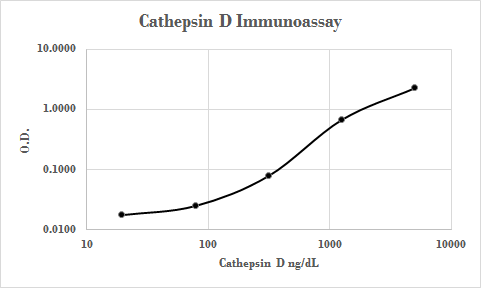
Application: Immunoassay StandardVerified Customer | Posted 06/17/2019

There are no reviews that match your criteria.
Protocols
View specific protocols for Recombinant Human Cathepsin D Protein, CF (1014-AS):
Materials
- Assay Buffer: 0.1 M NaOAc, 0.2 M NaCl, pH 3.5
- Recombinant Human Cathepsin D (rhCathepsin D) (Catalog # 1014-AS)
- Substrate: MCA-Pro-Leu-Gly-Leu-DPA-Ala-Arg-NH2 (Catalog # ES001), 2 mM stock in DMSO
- F16 Black Maxisorp Plate (Nunc, Catalog # 475515)
- Fluorescent Plate Reader (Model: SpectraMax Gemini EM by Molecular Devices) or equivalent
- Dilute rhCathepsin D to 20 µg/mL in Assay Buffer.
- Aliquot 50 µL of 20 µg/mL rhCathepsin D.
- Incubate at 37 °C for 30 minutes.
- Dilute incubated rhCathepsin D to 1 ng/µL in Assay Buffer.
- Dilute Substrate to 60 µM in Assay Buffer.
- Load 50 µL of 1 ng/µL rhCathepsin D in a plate, and start the reaction by adding 50 µL of 60 µM Substrate. Include a Substrate Blank containing 50 µL Assay Buffer and 50 µL of 60 µM Substrate.
- Read at excitation and emission wavelengths of 320 nm and 405 nm (top read), respectively in kinetic mode for 5 minutes.
- Calculate specific activity:
|
Specific Activity (pmol/min/µg) = |
Adjusted Vmax* (RFU/min) x Conversion Factor** (pmol/RFU) |
| amount of enzyme (µg) |
*Adjusted for Substrate Blank
**Derived using calibration standard MCA-Pro-Leu-OH (Bachem, Catalog # M-1975).
Per Well:
- rhCathepsin D: 0.050 µg
- Substrate: 30 µM
Loading...
Associated Pathways
