
Recombinant Human COX-2 His-tag Protein, CF
R&D Systems | Catalog # 10465-CX

Loading...
Key Product Details
- R&D Systems Sf 21 (baculovirus)-derived Recombinant Human COX-2 His-tag Protein (10465-CX)
- Quality control testing to verify active proteins with lot specific assays by in-house scientists
- All R&D Systems proteins are covered with a 100% guarantee
Source
Sf 21 (baculovirus)
Accession Number
Applications
Enzyme Activity
Loading...
Product Specifications
Source
Spodoptera frugiperda, Sf 21 (baculovirus)-derived human COX-2 protein
Ala18-Leu604
with a C-terminal 6-His tag
Ala18-Leu604
with a C-terminal 6-His tag
Purity
>90%, by SDS-PAGE visualized with Silver Staining and quantitative densitometry by Coomassie® Blue Staining.
Endotoxin Level
<1.0 EU per 1 μg of the protein by the LAL method.
N-terminal Sequence Analysis
Ala18
Predicted Molecular Mass
68 kDa
SDS-PAGE
65-71 kDa, under reducing conditions.
Activity
Measured by its ability to convert arachidonic acid to prostaglandin H2.
Scientific Data Images for Recombinant Human COX-2 His-tag Protein, CF
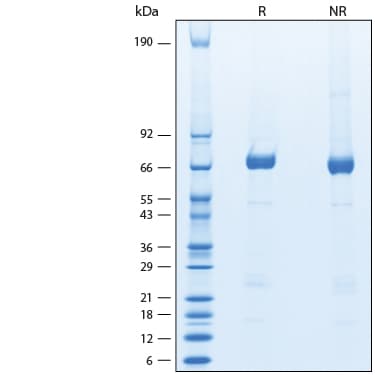
Recombinant Human COX-2 His-tag Protein SDS-PAGE.
2 μg/lane of Recombinant Human COX-2 His-tag Protein (Catalog # 10465-CX) was resolved with SDS-PAGE under reducing (R) and non-reducing (NR) conditions and visualized by Coomassie® Blue staining, showing bands at 65-71 kDa.Formulation, Preparation, and Storage
10465-CX
| Formulation | Supplied as a 0.2 μm filtered solution in Tris, NaCl, CHAPS and Glycerol. |
| Shipping | The product is shipped with polar packs. Upon receipt, store it immediately at the temperature recommended below. |
| Stability & Storage | Use a manual defrost freezer and avoid repeated freeze-thaw cycles.
|
Background: COX-2
References
- Orlando, B.J. et al. (2015) J. Struct. Biol. 189:62.
- Su, C.W. et al. (2016) Crit. Rev. Oncol. Hematol. 107:33.
- Gurram, B. et al. (2018) Anal. Chem. 90:5187.
- Montezuma, M.A.P. et al. (2018) Pathol. Res. Pract. 214:907.
- Hoing, B. et al. (2018) Oncotarget 9:8415.
- Dong, X.F. et al. (2018) Clin. Cancer Res. 24:3204.
- Hashemi Goradel, N. et al. (2019) J. Cell Physiol. 234:5683.
- Brizzolara, A. et al. (2017) Cancer Letters 400:9.
- Shi, L. et al. (2018) ACS Appl. Mater. Interfaces 10:8555.
- Ferrer, M.D. et al. (2019) Curr. Med. Chem. 26:3225.
- Carullo, G. et al. (2016) Medchemcomm. 8:492.
Long Name
Cyclooxygenase 2
Alternate Names
COX2, PGHS-2, PHS-II, PTGS2
Gene Symbol
PTGS2
UniProt
Additional COX-2 Products
Product Documents for Recombinant Human COX-2 His-tag Protein, CF
Certificate of Analysis
To download a Certificate of Analysis, please enter a lot or batch number in the search box below.
Note: Certificate of Analysis not available for kit components.
Product Specific Notices for Recombinant Human COX-2 His-tag Protein, CF
For research use only
Customer Reviews for Recombinant Human COX-2 His-tag Protein, CF
There are currently no reviews for this product. Be the first to review Recombinant Human COX-2 His-tag Protein, CF and earn rewards!
Have you used Recombinant Human COX-2 His-tag Protein, CF?
Submit a review and receive an Amazon gift card!
$25/€18/£15/$25CAN/¥2500 for a review with an image
$10/€7/£6/$10CAN/¥1110 for a review without an image
Submit a review
Protocols
View specific protocols for Recombinant Human COX-2 His-tag Protein, CF (10465-CX):
Materials
- Assay Buffer A: 50 mM Tris, 5 µM Hemin (Sigma, Catalog # H9039), pH 8.0
- Assay Buffer B: 50 mM Tris, pH 8.0
- Recombinant Human COX-2 (rhCOX-2) (Catalog # 10465-CX)
- Substrate Component 1: Arachidonic acid (Sigma, Catalog # 10931), 10 mM stock in DMSO
- Substrate Component 2: Amplex Ultra Red (AUR) (Molecular Probes, Catalog # A36006), 10 mM stock in DMSO
- F16 Black Maxisorp Plate (Nunc, Catalog # 475515)
- Fluorescent Plate Reader (Model: SpectraMax Gemini EM by Molecular Devices) or equivalent
- Dilute rhCOX-2 to 5 ng/µL in Assay Buffer A.
- Prepare Substrate Mixture 50 µM Arachidonic acid and 100 µM AUR in Assay Buffer B.
- Load into a plate 50 µL of diluted rhCOX-2. Also create a Substrate Blank by loading 50 µL of Assay Buffer A.
- Add 50 µL of Substrate Mixture to all wells and incubate at room temperature for 1 minute.
- Read at excitation and emission wavelengths of 540 nm and 585 nm (top read), respectively in endpoint mode.
- Calculate specific activity:
Specific Activity (pmol/min/µg) = | Adjusted Fluorescence* (RFU) x Conversion Factor** (pmol/RFU) |
| Incubation time (min) x amount of enzyme (µg) |
*Adjusted for Substrate Blank
**Derived using calibration standard Resorufin (Sigma, Catalog # R3257)
- rhCOX-2: 0.25 µg
- Arachidonic acid: 25 µM
- AUR: 50 µM
Loading...