Recombinant Human FAT10 Rhodamine Protein, CF
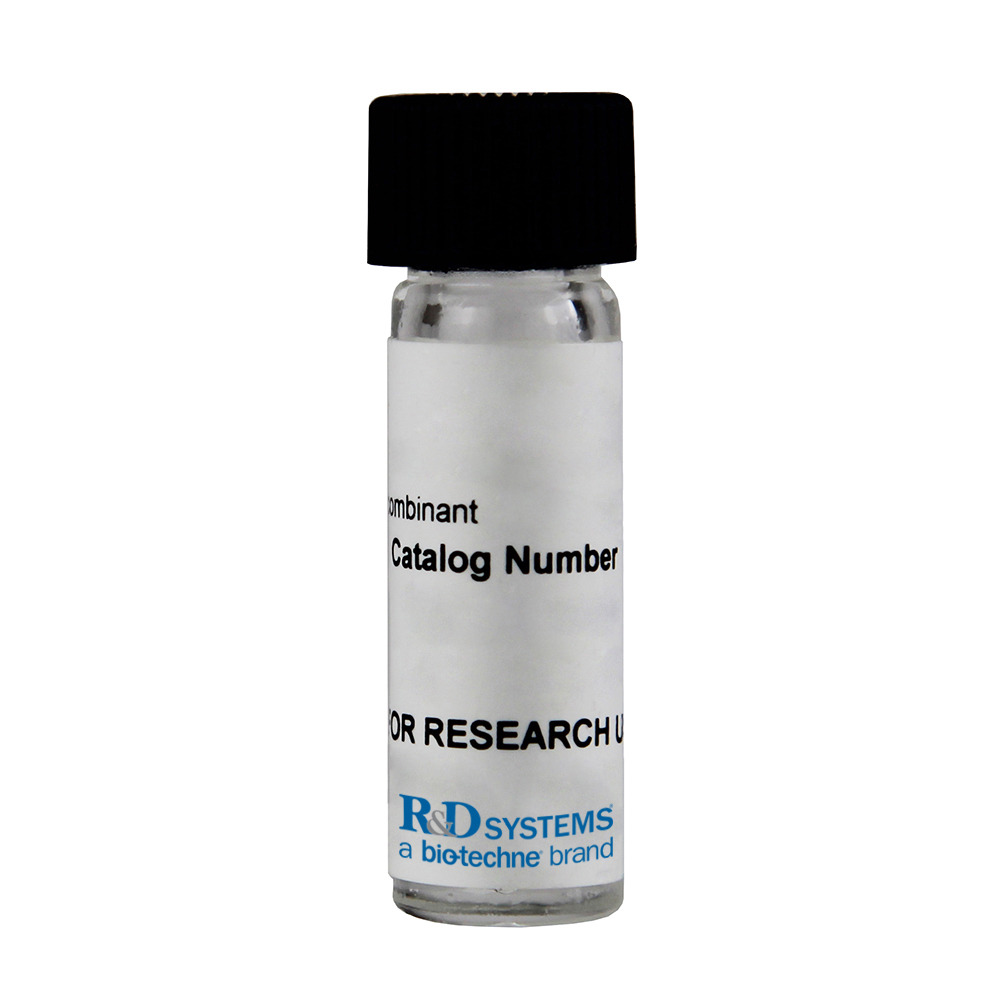
Recombinant Human FAT10 Rhodamine Protein, CF Summary
Product Specifications
Product Datasheets
Carrier Free
CF stands for Carrier Free (CF). We typically add Bovine Serum Albumin (BSA) as a carrier protein to our recombinant proteins. Adding a carrier protein enhances protein stability, increases shelf-life, and allows the recombinant protein to be stored at a more dilute concentration. The carrier free version does not contain BSA.
In general, we advise purchasing the recombinant protein with BSA for use in cell or tissue culture, or as an ELISA standard. In contrast, the carrier free protein is recommended for applications, in which the presence of BSA could interfere.
UL-914
| Formulation | Supplied as a solution in HEPES, NaCl, DTT and Glycerol. |
| Shipping | The product is shipped with dry ice or equivalent. Upon receipt, store it immediately at the temperature recommended below. |
| Stability & Storage: | Protect from light. Use a manual defrost freezer and avoid repeated freeze-thaw cycles.
|
Reconstitution Calculator
Background: FAT10
Human Leukocyte Antigen-F Associated Transcript 10 (FAT10), also known as Ubiquitin D (UBD), is a 165 amino acid (aa) member of the Ubiquitin-like family of proteins. Human FAT10 has a predicted molecular weight of 18.5 kDa and shares 69% aa sequence identity with mouse FAT10 (1). Human FAT10 mRNA is expressed as a single transcript in lymphoblastoid lines and dendritic cells, but more than one mRNA transcript has been identified for murine FAT10 (1,2). FAT10 can also be induced by IFN-gamma and TNF-alpha in some cell lines (1). Structurally, FAT10 consists of two Ubiquitin-like domains that are connected by a short linker. Like Ubiquitin, FAT10 has a C-terminal glycine residue that can be used to form isopeptide bonds with target proteins. FAT10-conjugated proteins are targeted to the proteasome where the 26S Proteasome subunit S5a/Angiocidin binds to FAT10 and enables subsequent degradation of the conjugated protein (3). In addition to S5a/Angiocidin, FAT10 has been shown to interact with Huntingtin, Ataxin-1, MAD2, and NUB1L (4,5). FAT10 has been implicated in a number of biological processes such as cell cycle control, antigen presentation, and cytokine response (1,6-8). This protein is modified with rhodamine red via primary amine coupling resulting in modification of lysine residues as well as the N-terminus. This labeled FAT10 allows for direct detection spectophotometrically with higher efficiency and sensitivity than with antibodies.
- Liu, Y.-C. et al. (1999) Proc. Natl. Acad. Sci. USA 96:4313.
- Canaan, A. et al. (2006) Mol. Cell. Biol. 26:5180.
- Rani, N. et al. (2012) Nat. Commun. 3:749.
- Hipp, M.S. et al. (2004) J. Biol. Chem. 279:16503.
- Nagashima, Y. et al. (2011) J. Biol. Chem. 286:29594.
- Ebstein, F. et al. (2012) Cell. Mol. Life Sci. 69:2443.
- Lukasiak, S. et al. (2008) Oncogene 27:6068.
- Ren, J. et al. (2011) J. Cell Sci. 124:3665.
Citation for Recombinant Human FAT10 Rhodamine Protein, CF
R&D Systems personnel manually curate a database that contains references using R&D Systems products. The data collected includes not only links to publications in PubMed, but also provides information about sample types, species, and experimental conditions.
1 Citation: Showing 1 - 1
-
Characterization of the deubiquitination activity and substrate specificity of the chicken ubiquitin-specific protease 1/USP associated factor 1 complex
Authors: H Zheng, M Wang, C Zhao, S Wu, P Yu, Y Lü, T Wang, Y Ai
PLoS ONE, 2017-11-01;12(11):e0186535.
Species: Human
Sample Types: Recombinant Protein
Applications: Bioassay
FAQs
No product specific FAQs exist for this product, however you may
View all Proteins and Enzyme FAQsReviews for Recombinant Human FAT10 Rhodamine Protein, CF
There are currently no reviews for this product. Be the first to review Recombinant Human FAT10 Rhodamine Protein, CF and earn rewards!
Have you used Recombinant Human FAT10 Rhodamine Protein, CF?
Submit a review and receive an Amazon gift card.
$25/€18/£15/$25CAN/¥75 Yuan/¥2500 Yen for a review with an image
$10/€7/£6/$10 CAD/¥70 Yuan/¥1110 Yen for a review without an image
