Recombinant Human IL-4 GMP Protein, CF Summary
- IL-4 Manufactured in Bio-Techne's new GMP facility
- Lot-to-lot consistency
- Stringent guidelines for patient safety
- Scalability necessary to support successful therapeutics
- Learn more about manufacturing in our new GMP facility
- Test it in your process! Request a sample of GMP IL-4
Product Specifications
The ED50 for this effect is 0.0400-0.320 ng/mL.
The specific activity of GMP Recombinant Human IL-4 is >1.0x10⁷ IU/mg, which is calibrated against the human IL-4 WHO International Standard (NIBSC code: 88/656).
His25-Ser153, with an N-terminal Met
Produced using non-animal reagents in an animal-free laboratory.
Analysis
Product Datasheets
Carrier Free
CF stands for Carrier Free (CF). We typically add Bovine Serum Albumin (BSA) as a carrier protein to our recombinant proteins. Adding a carrier protein enhances protein stability, increases shelf-life, and allows the recombinant protein to be stored at a more dilute concentration. The carrier free version does not contain BSA.
In general, we advise purchasing the recombinant protein with BSA for use in cell or tissue culture, or as an ELISA standard. In contrast, the carrier free protein is recommended for applications, in which the presence of BSA could interfere.
BT-004-GMP
| Formulation | Lyophilized from a 0.2 μm filtered solution in PBS with Trehalose. |
| Reconstitution | Reconstitute at 500 μg/mL in PBS. |
| Shipping | The product is shipped with polar packs. Upon receipt, store it immediately at the temperature recommended below. |
| Stability & Storage: | Use a manual defrost freezer and avoid repeated freeze-thaw cycles.
|
Scientific Data
View Larger
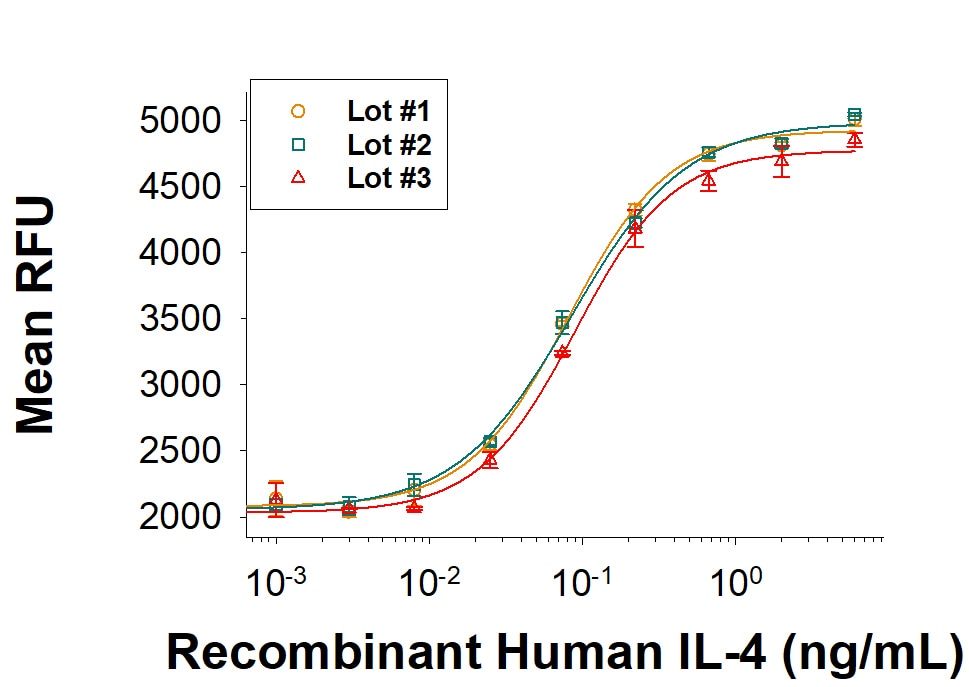
Recombinant Human IL-4 GMP Protein (Catalog # BT-004-GMP) as measured in a cell proliferation assay using TF-1 human erythroleukemic cells. Three independent lots were tested for activity and plotted on the same graph to show lot-to-lot consistency of Recombinant Human IL-4 GMP Protein.
View Larger
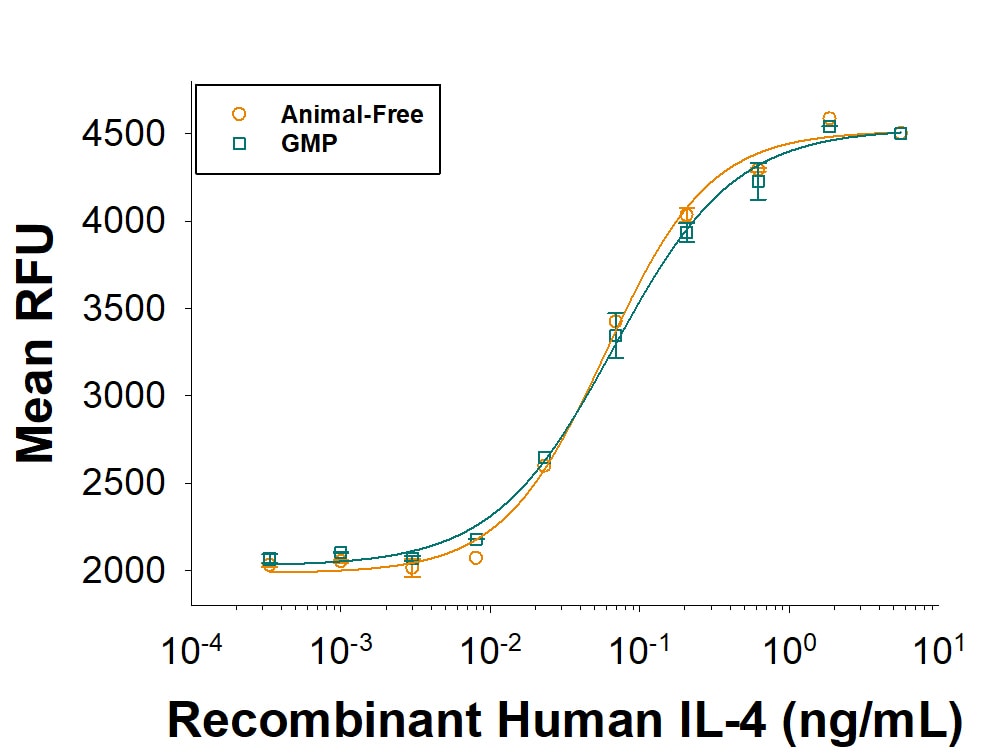
Equivalent bioactivity of GMP (BT-004-GMP) and Animal-Free (BT-004-AFL) grades of Recombinant Human IL-4 as measured in a cell proliferation assay using TF-1 human erythroleukemic cells (Green & Orange, respectively).
View Larger
2 μg/lane of Recombinant Human IL‑4 GMP Protein (Catalog # BT-004-GMP) was resolved with SDS-PAGE under reducing (R) and non-reducing (NR) conditions and visualized by Coomassie® Blue staining, showing bands at 13 kDa under reducing conditions.
Reconstitution Calculator
Background: IL-4
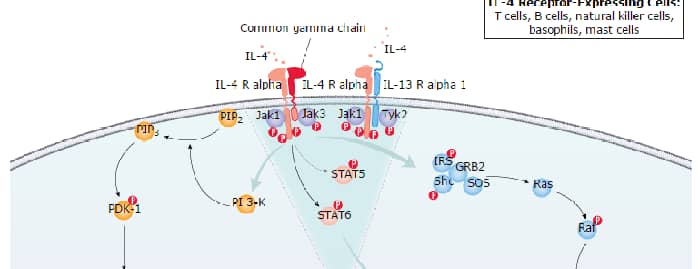
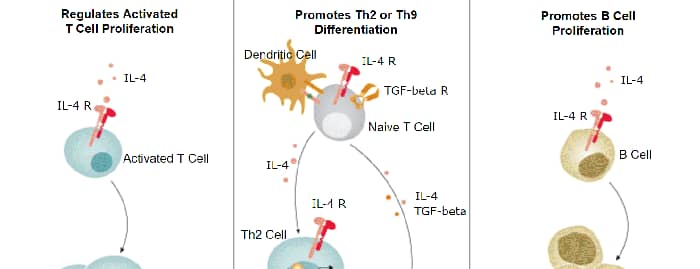
Interleukin-4 (IL-4), also known as B cell-stimulatory factor-1, is a monomeric, approximately 13 kDa‑18 kDa Th2 cytokine that shows pleiotropic effects during immune responses (1‑3). It is a glycosylated polypeptide that contains three intrachain disulfide bridges and adopts a bundled four alpha -helix structure (4). Human IL-4 is synthesized with a 24 aa signal sequence. Alternate splicing generates an isoform with a 16 aa internal deletion. Mature human IL-4 shares 55%, 39% and 43% aa sequence identity with bovine, mouse, and rat IL-4, respectively. Human, mouse, and rat IL-4 are species-specific in their activities (5‑7). IL-4 exerts its effects through two receptor complexes (8, 9). The type I receptor, which is expressed on hematopoietic cells, is a heterodimer of the ligand binding IL-4 R alpha and the common gamma chain (a shared subunit of the receptors for IL-2, -7, -9, -15, and ‑21). The type II receptor on nonhematopoietic cells consists of IL-4 R alpha and IL‑13 R alpha 1. The type II receptor also transduces IL-13 mediated signals. IL-4 is primarily expressed by Th2-biased CD4+ T cells, mast cells, basophils, and eosinophils (1, 2). It promotes cell proliferation, survival, and immunoglobulin class switch to IgG4 and IgE in human B cells, acquisition of the Th2 phenotype by naïve CD4+ T cells, priming and chemotaxis of mast cells, eosinophils, and basophils, and the proliferation and activation of epithelial cells (10‑13). IL-4 plays a dominant role in the development of allergic inflammation and asthma (12, 14).
Due to its role in the differentiation of certain immune cell types, IL-4 is commonly used in combination with other growth factors to transform induced pluripotent stem cells into dendritic cells in high numbers. These dendritic cells can then be used for research or clinical applications to improve disease modeling, for screening and cell therapies (15). Study of IL-4 signaling has led to the development of monoclonal antibodies that can block the signaling pathway at various steps to mitigate the inflammatory response in certain autoimmune diseases (16, 17). While IL-4 has the capacity to improve immune functions, treatments involving IL-4 have not been utilized due to the dangerous side effects that may result from IL-4 signaling in non-immune cells (16). Blockade of IL-4 signaling also has been studied as a therapeutic target to suppress inflammation in the tumor microenvironment (18). Use of IL-4 suppressors can also improve the efficacy of anti-tumor immunotherapies, as blocking IL-4 enhances activity of tumor-specific T lymphocytes (19, 20).

- Benczik, M. and S.L. Gaffen (2004) Immunol. Invest. 33:109.
- Chomarat, P. and J. Banchereau (1998) Int. Rev. Immunol. 17:1.
- Yokota, T. et al. (1986) Proc. Natl. Acad. Sci. 83:5894.
- Redfield, C. et al. (1991) Biochemistry 30:11029.
- Ramirez, F. et al. (1988) J. Immunol. Meth. 221:141.
- Leitenberg, D. and T.L. Feldbush (1988) Cell. Immunol. 111:451.
- Mosman, T.R. et al. (1987) J. Immunol. 138:1813.
- Mueller, T.D. et al. (2002) Biochim. Biophys. Acta 1592:237.
- Nelms, K. et al. (1999) Annu. Rev. Immunol. 17:701.
- Paludan, S.R. (1998) Scand. J. Immunol. 48:459.
- Corthay, A. (2006) Scand. J. Immunol. 64:93.
- Ryan, J.J. et al. (2007) Crit. Rev. Immunol. 27:15.
- Grone, A. (2002) Vet. Immunol. Immunopathol. 88:1.
- Rosenberg, H.F. et al. (2007) J. Allergy Clin. Immunol. 119:1303.
- Flosdorf, N. & Zenke, M. (2022) Eur. J. Immunol. 52:1880.
- Junttila, I.S. (2018) Front Immunol. 9:888.
- Keegan, A.D. et al. (2021) Fac Rev. 10:71.
- Bankaitis, K.V. & Fingleton, B. (2016) Clin. Exp. Metastasis. 32:847.
- Mirlekar, B. (2022) SAGE Open Med. 10:1.
- Ilto, S. E. et al. (2017) Cancer Immunol Immunother. 66:1485.
Manufacturing Specifications
GMP ProteinsR&D Systems, a Bio-Techne Brand's GMP proteins are produced according to relevant sections of the following documents: USP Chapter 1043, Ancillary Materials for Cell, Gene and Tissue-Engineered Products and Eu. Ph. 5.2.12, Raw Materials of Biological Origin for the Production of Cell-based and Gene Therapy Medicinal Products.
R&D Systems' quality focus includes:
- Designed, manufactured and tested under an ISO 9001:2015 and ISO 13485:2016 certified quality system
- Documented and controlled manufacturing process
- Control of documentation and process changes by QA
- Personnel training programs
- Raw material inspection and vendor qualification/monitoring program
- Validated equipment, processes and test methods
- Equipment calibration and maintenance schedules using a Regulatory Asset Manager
- Facility/Utilities maintenance, contamination controls, safety and pest control programs
- Material review process for variances
- Robust product stability program following relevant ICH guidelines
- N-terminal amino acid analysis
- SDS-PAGE purity analysis
- Molecular weight analysis via mass spectrometry
- Endotoxin assessment per USP <85> and Ph. Eur. 2.6.14 guidelines
- Bioassay analysis
- Microbial testing per USP <71> and Ph. Eur. 2.6.1 guidelines
- Host cell protein assessment
- Host cell DNA assessment
- Mycoplasma assessment
Production records and facilities are available for examination by appropriate personnel on-site at R&D Systems in Minneapolis and St. Paul, Minnesota USA.
R&D Systems sells GMP grade products for preclinical or clinical ex vivo use. They are not for in vivo use. Please read the following End User Terms prior to using this product.
Animal-Free Manufacturing Conditions
Our dedicated controlled-access animal-free laboratories ensure that at no point in production are the products exposed to potential contamination by animal components or byproducts. Every stage of manufacturing is conducted in compliance with R&D Systems' stringent Standard Operating Procedures (SOPs). Production and purification procedures use equipment and media that are confirmed animal-free.
Production
- All molecular biology procedures use animal-free media and dedicated labware.
- Dedicated fermentors are utilized in committed animal-free areas.
- Protein purification columns are animal-free.
- Bulk proteins are filtered using animal-free filters.
- Purified proteins are stored in animal-free containers.
Product Specific Notices
Full terms and conditions of sale can be found online in the Protein Sciences Segment T&Cs at: Terms & Conditions.FAQs
No product specific FAQs exist for this product, however you may
View all Proteins and Enzyme FAQsReviews for Recombinant Human IL-4 GMP Protein, CF
There are currently no reviews for this product. Be the first to review Recombinant Human IL-4 GMP Protein, CF and earn rewards!
Have you used Recombinant Human IL-4 GMP Protein, CF?
Submit a review and receive an Amazon gift card.
$25/€18/£15/$25CAN/¥75 Yuan/¥2500 Yen for a review with an image
$10/€7/£6/$10 CAD/¥70 Yuan/¥1110 Yen for a review without an image