
Secretory phopholipase A2 is an enzyme that hydrolyzes the sn-2 ester bond of phospholipids, generating non-esterified free fatty acids and lysophospholipids (1-4). Most secretory PLA2s are stored in cytoplasmic granules and are released in the extracellular environment on appropriate cell activation. Thus, they are present at higher concentration in the plasma and biologic fluids of patients with systemic inflammatory, autoimmune, or allergic disease, such as acute pancreatitis, rheumatoid arthritis, bronchial asthma, and allergic rhinitis. PLA2G2A is a calcium dependent phospholipase expressed in many cell types associated with inflammation, including platelets, neutrophils, and mast cells. It has been recognized as an acute phase reactant and its concentration increases during systemic inflammation such as sepsis, rheumatoid arthritis, and cardiovascular disease (5). It may function as an enzymatic component of the host defense mechanism. For example, human tears contain a high concentration of PLA2G2A and this is the principal bactericidal factor against Gram-positive bacteria in this fluid (1). It may play a role in cell proliferation through binding a receptor on membrane surface or extracellular matrix components such as heparan sulfate proteoglycan and integrins (6). It has been shown to have pro-atherogenic properties both in the circulation and within the arterial wall (7). Circulating levels of PLA2G2A are higher in coronary artery disease (CAD) patients and are associated with increased risk of future CAD (8).


Loading...
Key Product Details
- R&D Systems Sf 21 (baculovirus)-derived Recombinant Human PLA2G2A Protein (5374-PL)
- Quality control testing to verify active proteins with lot specific assays by in-house scientists
- All R&D Systems proteins are covered with a 100% guarantee
Source
Sf 21 (baculovirus)
Accession Number
Applications
Enzyme Activity
Loading...
Product Specifications
Source
Spodoptera frugiperda, Sf 21 (baculovirus)-derived human PLA2G2A protein
Asn21-Cys144, with a C-terminal 10-His tag
Asn21-Cys144, with a C-terminal 10-His tag
Purity
>95%, by SDS-PAGE under reducing conditions and visualized by silver stain.
Endotoxin Level
<1.0 EU per 1 μg of the protein by the LAL method.
N-terminal Sequence Analysis
Asn21
Predicted Molecular Mass
15 kDa
SDS-PAGE
17 kDa, reducing conditions
Activity
Measured by its ability to hydrolyze 1-Hexadecanoyl-2-(1-pyrene-decanoyl)-sn-glycero-3-phosphoglycerol.
The specific activity is >3,750 pmol/min/μg, as measured under the described conditions.
The specific activity is >3,750 pmol/min/μg, as measured under the described conditions.
Reviewed Applications
Read 1 review rated 5 using 5374-PL in the following applications:
Formulation, Preparation, and Storage
5374-PL
| Formulation | Supplied as a 0.2 μm filtered solution in Sodium Acetate and NaCl. |
| Shipping | The product is shipped with polar packs. Upon receipt, store it immediately at the temperature recommended below. |
| Stability & Storage | Use a manual defrost freezer and avoid repeated freeze-thaw cycles.
|
Background: PLA2G2A
References
- Lambeau, G. and M.H. Gelb (2008) Ann. Rev. Biochem. 77:495.
- Webb, N.R. (2005) Curr. Opin. Lipid. 16:341.
- Triggiani, M. et al. (2005) J. Allergy Clin. Immunol. 116:1000.
- Murakami, M. and I. Kudo (2004) Biol. Pharm. Bull. 27:1158.
- Crowl, R.M. et al. (1991) J. Biol. Chem. 266:2647.
- Saegusa, J. et al. (2008) J. Biol. Chem. 283:26107.
- de Beer, F.C. and N.R. Webb (2006) Arterioscler. Thromb. Vasc. Biol. 6:1421.
- Wootton, P.T.E. et al. (2006) Human Mol. Genet. 15:355.
Long Name
Phospholipase A2 Group IIA
Alternate Names
Mom1, PLA2B, PLA2L, RASF-A
Gene Symbol
PLA2G2A
UniProt
Additional PLA2G2A Products
Product Documents for Recombinant Human PLA2G2A Protein, CF
Certificate of Analysis
To download a Certificate of Analysis, please enter a lot or batch number in the search box below.
Note: Certificate of Analysis not available for kit components.
Product Specific Notices for Recombinant Human PLA2G2A Protein, CF
For research use only
Related Research Areas
Customer Reviews for Recombinant Human PLA2G2A Protein, CF (1)
5 out of 5
1 Customer Rating
Have you used Recombinant Human PLA2G2A Protein, CF?
Submit a review and receive an Amazon gift card!
$25/€18/£15/$25CAN/¥2500 for a review with an image
$10/€7/£6/$10CAN/¥1110 for a review without an image
Submit a review
Customer Images
Showing
1
-
1 of
1 review
Showing All
Filter By:
-
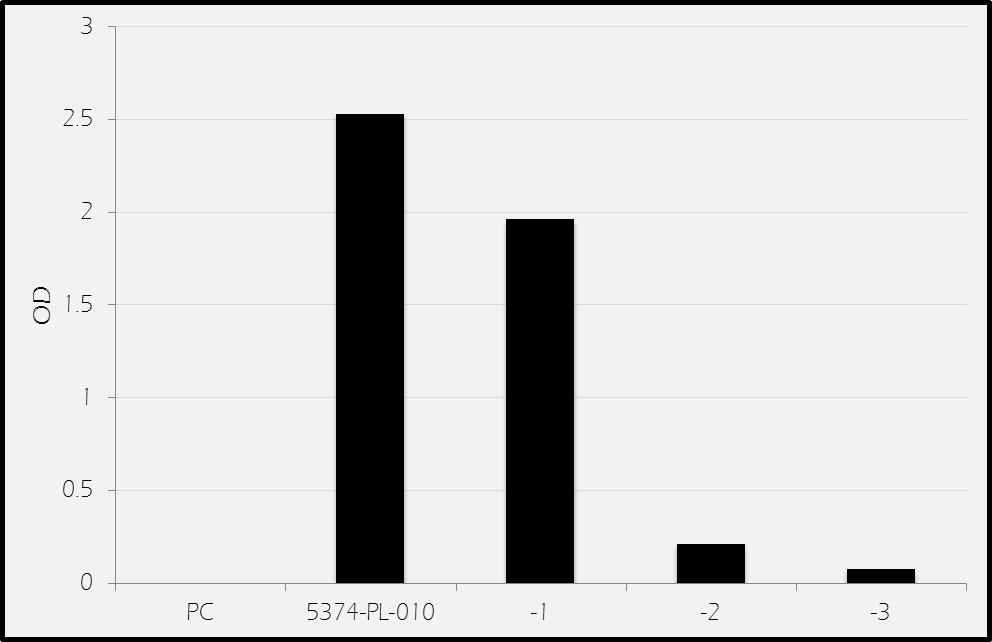
Application: Enzymatic activity in vitroVerified Customer | Posted 07/18/2016A titration of the enzyme showed (as expected) weaker activity

There are no reviews that match your criteria.
Protocols
View specific protocols for Recombinant Human PLA2G2A Protein, CF (5374-PL):
Materials
- Assay Buffer: 50 mM Tris, 0.1 M NaCl, 20 mM CaCl2, 2 mg/mL BSA, pH 8.5
- Enzyme Buffer: 50 mM Tris, 0.1 M NaCl, 2 mg/mL BSA, pH 8.5
- Recombinant Human Phospholipase A2 Group IIA/PLA2G2A (rhPLA2G2A) (Catalog # 5374-PL)
- Substrate: 1-Hexadecanoyl-2-(1-Pyrenedecanoyl)-sn-Glycero-3-Phosphoglycerol Ammonium salt, 2 mM stock in DMSO
- Black 96-well Plate
- Fluorescent Plate Reader
- Thaw Substrate at 37 °C for five minutes. Mix well.
- Dilute rhPLA2G2A to 20 ng/mL in Enzyme Buffer.
- Dilute Substrate to 40 µM in Assay Buffer.
- Load 50 µL of the 20 ng/mL rhPLA2G2A into a black well plate, and start the reaction by adding 50 µL of 40 µM Substrate. Include a Substrate Blank containing 50 µL Assay Buffer and 50 µL of 40 µM Substrate without any rhPLA2-G2A.
- Read at excitation and emission wavelengths of 345 nm and 395 nm (top read), respectively, in kinetic mode for 5 minutes. Mix between reads. Use the first three minutes for data analysis.
- Calculate specific activity:
|
Specific Activity (pmol/min/µg) = |
Adjusted Vmax* (RFU/min) x Conversion Factor** (pmol/RFU) |
| amount of enzyme (µg) |
*Adjusted for Substrate Blank
**Derived using calibration standard 1-pyrenedecanoic acid
- rhPLA2G2A: 0.001 µg
- Substrate: 20 µM
Loading...