
Recombinant Human PSGL-1/CD162 Fc Chimera Protein, CF
R&D Systems | Catalog # 3345-PS

Key Product Details
- R&D Systems CHO-derived Recombinant Human PSGL-1/CD162 Fc Chimera Protein (3345-PS)
- Quality control testing to verify active proteins with lot specific assays by in-house scientists
- All R&D Systems proteins are covered with a 100% guarantee
Source
Accession Number
Structure / Form
Applications
Why choose R&D Systems PSGL-1 Protein?
- Guaranteed Bioactivity and High Purity: Bioactivity tested by functional ELISA and purity determined by SDS-PAGE to be greater than 95%.
- Lot-to-Lot Consistency: Stringent QC testing performed on each lot to ensure consistent activity and purity.
- Bulk Quantities Available: Bulk up and save with large mass quantities to meet your research needs. Supply agreements available, partner with us. Please contact us.
- Most Respected, Most Cited Brand in Proteins: With over 35 years of providing the best recombinant proteins to the scientific community, R&D Systems continues to lead the industry in quality, activity, and purity.
Product Specifications
Source
| Human PSGL-1 (Gln42-Val295) Accession # AAC50061 |
IEGRMD | Human IgG1 (Pro100-Lys330) |
| N-terminus | C-terminus |
Purity
Endotoxin Level
N-terminal Sequence Analysis
Gln42
Predicted Molecular Mass
SDS-PAGE
Activity
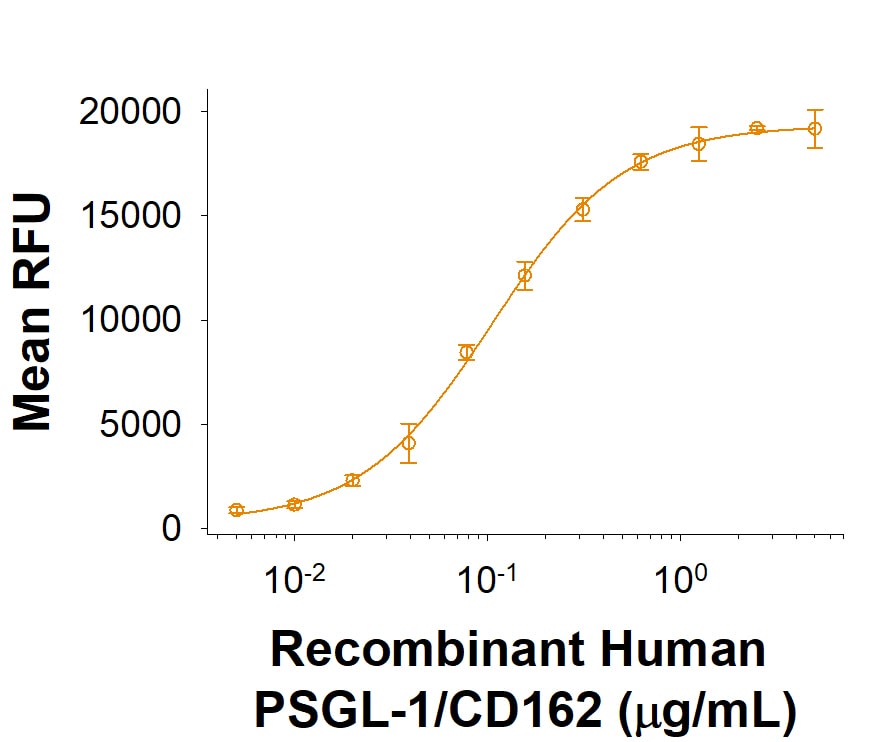
The ED50 for this effect is 0.04-0.32 µg/mL.
Reviewed Applications
Read 1 review rated 4 using 3345-PS in the following applications:
Scientific Data Images for Recombinant Human PSGL-1/CD162 Fc Chimera Protein, CF
Recombinant Human PSGL-1/CD162 Fc Chimera Protein Bioactivity
Recombinant Human PSGL-1/CD162 Fc Chimera (Catalog # 3345-PS) supports the adhesion of CHO Chinese hamster ovary cells transfected with P-Selectin. The ED50 for this effect is 0.04-0.32 μg/mL.Formulation, Preparation, and Storage
3345-PS
| Formulation | Lyophilized from a 0.2 μm filtered solution in Tris and NaCl. |
| Reconstitution | Reconstitute at 100 μg/mL in sterile PBS.
Loading...
|
| Shipping | The product is shipped at ambient temperature. Upon receipt, store it immediately at the temperature recommended below. |
| Stability & Storage | Use a manual defrost freezer and avoid repeated freeze-thaw cycles.
|
Calculators
Background: PSGL-1/CD162
References
- Yang, J. et al. (1999) Thromb. Haemost. 81:1.
- Sako, D. et al. (1993) Cell 75:1179.
- Carlow, D.A. et al. (2009) Immunol. Rev. 230:75.
- Zarbock, A. et al. (2011) Blood 278:37.
- Bernimoulin, M.P. et al. (2003) J. Biol. Chem. 278:37.
- Sako, D. et al. (1995) Cell 83:323.
- Xia, L. et al. (2003) Blood 101:552.
- Gardiner, E.E. et al. (2001) Blood 98:1440.
- Lozano, M.L. et al. (2001) Br. J. Haematol. 115:969.
- Veerman, K.M. et al. (2007) Nat. Immunol. 8:532.
- Hirata, T. et al. (2004) J. Biol. Chem. 279:51775.
- del Conde, I. et al. (2005) Blood 106:1604.
- Thomas, G.M. et al. (2009) J Exp. Med. 206:1913.
Long Name
Alternate Names
Gene Symbol
UniProt
Additional PSGL-1/CD162 Products
Product Documents for Recombinant Human PSGL-1/CD162 Fc Chimera Protein, CF
Certificate of Analysis
To download a Certificate of Analysis, please enter a lot or batch number in the search box below.
Note: Certificate of Analysis not available for kit components.
Product Specific Notices for Recombinant Human PSGL-1/CD162 Fc Chimera Protein, CF
For research use only
Citations for Recombinant Human PSGL-1/CD162 Fc Chimera Protein, CF
 Powered by Bioz
Customer Reviews for Recombinant Human PSGL-1/CD162 Fc Chimera Protein, CF (1)
Have you used Recombinant Human PSGL-1/CD162 Fc Chimera Protein, CF?
Submit a review and receive an Amazon gift card!
$25/€18/£15/$25CAN/¥2500 for a review with an image
$10/€7/£6/$10CAN/¥1110 for a review without an image
Submit a review
-
Application: Binding assay/Protein-protein interactionVerified Customer | Posted 08/07/2019
There are no reviews that match your criteria.
FAQs for Recombinant Human PSGL-1/CD162 Fc Chimera Protein, CF
-
Q: Does the CHO-derived rhPSGL-1/CD162, Catalog # 3345-PS, have O-glycosylation and the Sialyl-LewisX modification?
A: Yes. We use proprietary methods to produce a functional rhPSGL-1 protein with O-glycosylation and the Sialyl-Lewis X Modification.