
Recombinant Human Resistin Protein, CF
R&D Systems | Catalog # 1359-RN


Key Product Details
- R&D Systems E. coli-derived Recombinant Human Resistin Protein (1359-RN)
- Quality control testing to verify active proteins with lot specific assays by in-house scientists
- All R&D Systems proteins are covered with a 100% guarantee
Source
Accession Number
Applications
Product Specifications
Source
Ser17-Pro108
Purity
Endotoxin Level
N-terminal Sequence Analysis
Predicted Molecular Mass
SDS-PAGE
Activity
Reviewed Applications
Read 2 reviews rated 5 using 1359-RN in the following applications:
Formulation, Preparation, and Storage
1359-RN
| Formulation | Lyophilized from a 0.2 μm filtered solution in Acetic Acid. |
| Reconstitution | Reconstitute at 50 μg/mL in 2 mM acetic acid, pH 3.0.
Loading...
|
| Shipping | The product is shipped at ambient temperature. Upon receipt, store it immediately at the temperature recommended below. |
| Stability & Storage | Use a manual defrost freezer and avoid repeated freeze-thaw cycles.
|
Calculators
Background: Resistin
References
- Kottke, M.D. et al. (2006) J. Cell Sci. 119:797.
- Garrod, D.R. et al. (2002) Mol. Membrane Biol. 19:81.
- Leckband, D. and A. Prakasam (2006) Annu. Rev. Biomed. Eng. 8:259.
- King, I.A. et al. (1993) Genomics 18:185.
- Theis, D.G. et al. (1993) Int. J. Dev. Biol. 37:101.
- King, I.A. et al. (1996) J. Invest. Dermatol. 107:531.
- Nuber, U.A. et al. (1996) Eur. J. Cell Biol. 71:1.
- Chidgey, M. et al. (2001) J. Cell Biol. 155:821.
- Khan, K. et al. (2006) Br. J. Cancer 95:1367.
- Hashimoto, T. et al. (1997) J. Invest. Dermatol. 109:127.
- Caubet, C. et al. (2004) J. Invest. Dermatol. 122:1235.
- Descargues, P. et al. (2006) J. Invest. Dermatol. 126:1622.
Alternate Names
Gene Symbol
UniProt
Additional Resistin Products
Product Documents for Recombinant Human Resistin Protein, CF
Certificate of Analysis
To download a Certificate of Analysis, please enter a lot or batch number in the search box below.
Note: Certificate of Analysis not available for kit components.
Product Specific Notices for Recombinant Human Resistin Protein, CF
The purchase of this product conveys to the buyer the limited, non-exclusive, non-transferable right (without the right to resell, repackage, or further sublicense) to use these reagents for non-commercial research purposes only. No other license is granted to the buyer whether expressly, by implication, by estoppel or otherwise. In particular, the purchase of this product does not include nor carry any right or license to use, develop, or otherwise exploit this product commercially, which includes without limitation, provision of services to a third party, generation of commercial databases, clinical diagnostics or therapeutics, or drug development.
This product is manufactured under a license to U.S. Patent number 7,470,522. Any party desiring rights under this patent should contact Ryogen LLC, Montebello Park, 75 Montebello Road, Suffern, NY 10901.
For research use only
Related Research Areas
Citations for Recombinant Human Resistin Protein, CF
 Powered by Bioz
Customer Reviews for Recombinant Human Resistin Protein, CF (2)
Have you used Recombinant Human Resistin Protein, CF?
Submit a review and receive an Amazon gift card!
$25/€18/£15/$25CAN/¥2500 for a review with an image
$10/€7/£6/$10CAN/¥1110 for a review without an image
Submit a review
Customer Images
-
Application: Binding assay/Protein-protein interactionVerified Customer | Posted 12/01/2017
-
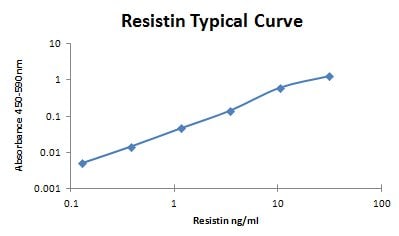
Application: Immunoassay StandardVerified Customer | Posted 11/17/2017MAB13591 was used as the capture antibody in a sandwich ELISA along with AF1359 as the detection. We also tested BAF1359 as the detection since in comes biotinylated. The standard for the ELISA was 1359-RN. The assay worked excellently! It was sensitive and specific and detected all human samples we tested at a 1:4 dilution.

There are no reviews that match your criteria.
Associated Pathways
