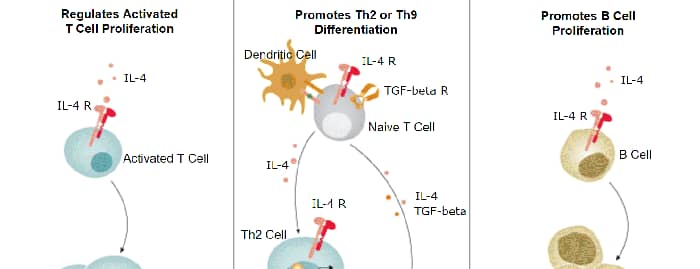
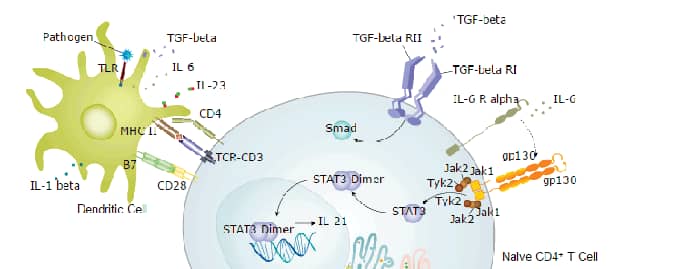
Interleukin-21 (IL-21) is an approximately 14 kDa four-helix-bundle cytokine in the family of cytokines that utilize the common gamma chain ( gamma c) as a receptor subunit. gamma c is also a subunit of the receptors for IL-2, IL-4, IL-7, IL-9, and IL-15 (1). IL-21 is produced by activated T follicular helper cells (Tfh), Th17 cells, and NKT cells (2-6). It exerts its biological effects through a heterodimeric receptor complex of gamma c and the IL-21-specific IL-21 R (2, 7). Tfh-derived IL-21 plays an important role in the development of humoral immunity through its autocrine effects on the Tfh cell and paracrine effects on immunoglobulin affinity maturation, plasma cell differentiation, and B cell memory responses (4, 8, 9). It is also required for the migration of dendritic cells to draining lymph nodes (10). IL-21 regulates several aspects of T cell function. It co‑stimulates the activation, proliferation, and survival of CD8+ T cells and NKT cells and promotes Th17 cell polarization (3, 5, 6, 11, 12). It blocks the generation of regulatory T cells and their suppressive effects on CD4+ T cells (13, 14). IL-21 R engagement enhances the cytolytic activity and IFN-gamma production of activated NK cells but limits the expansion of resting NK cells (15). In addition, IL-21 suppresses cutaneous hypersensitivity reactions by limiting allergen-specific IgE production and mast cell degranulation (16). Dysregulation of the IL‑21/IL‑21 R system contributes to the development of multiple immunological disorders (1, 17). The mouse IL‑21 precursor contains a predicted 17 amino acid (aa) signal sequence and a 129 aa mature chain. Mature mouse IL-21 shares 66%, 59%, 58%, and 88% aa sequence identity with mature canine, human, rabbit, and rat IL-21, respectively.

Key Product Details
- R&D Systems E. coli-derived Recombinant Mouse IL-21 Protein (594-ML)
- Quality control testing to verify active proteins with lot specific assays by in-house scientists
- All R&D Systems proteins are covered with a 100% guarantee
Source
Accession Number
Applications
Product Specifications
Source
Pro25-Ser146, with and without an N-terminal Met
Purity
Endotoxin Level
N-terminal Sequence Analysis
Predicted Molecular Mass
Activity
The ED50 for this effect is 3-30 ng/mL.
Reviewed Applications
Read 3 reviews rated 4.3 using 594-ML in the following applications:
Scientific Data Images for Recombinant Mouse IL-21 Protein
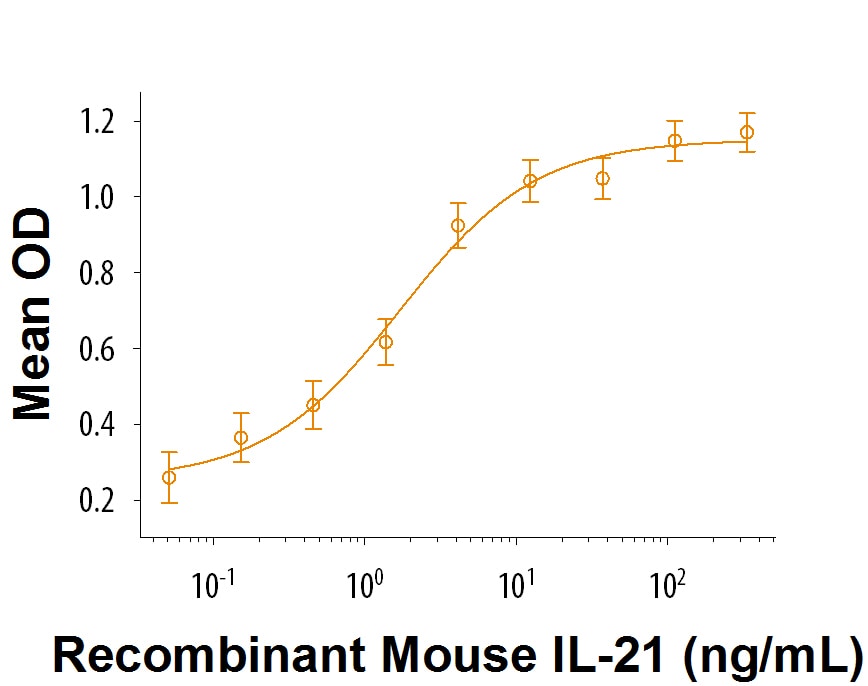
Recombinant Mouse IL-21 Protein Bioactivity
Recombinant Mouse IL-21 (Catalog # 594‑ML) enhances IFN-gamma secretion in NK-92 human natural killer lymphoma cells. The ED50 is 3-30 ng/mL.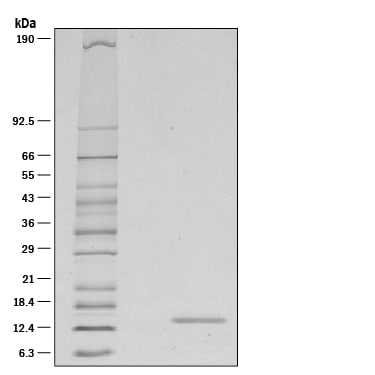
Recombinant Mouse IL-21 Protein SDS-PAGE
1 μg/lane of Recombinant Mouse IL-21 was resolved with SDS-PAGE under reducing (R) conditions and visualized by silver staining, showing a single band at 15 kDa.Formulation, Preparation, and Storage
Carrier Free
What does CF mean?CF stands for Carrier Free (CF). We typically add Bovine Serum Albumin (BSA) as a carrier protein to our recombinant proteins. Adding a carrier protein enhances protein stability, increases shelf-life, and allows the recombinant protein to be stored at a more dilute concentration. The carrier free version does not contain BSA.
What formulation is right for me?In general, we advise purchasing the recombinant protein with BSA for use in cell or tissue culture, or as an ELISA standard. In contrast, the carrier free protein is recommended for applications, in which the presence of BSA could interfere.
Carrier: 594-ML
| Formulation | Lyophilized from a 0.2 μm filtered solution in PBS with BSA as a carrier protein. |
| Reconstitution | Reconstitute at 100 μg/mL in sterile PBS containing at least 0.1% human or bovine serum albumin. |
| Shipping | The product is shipped at ambient temperature. Upon receipt, store it immediately at the temperature recommended below. |
| Stability & Storage | Use a manual defrost freezer and avoid repeated freeze-thaw cycles.
|
Carrier Free: 594-ML/CF
| Formulation | Lyophilized from a 0.2 μm filtered solution in PBS. |
| Reconstitution | Reconstitute at 100 μg/mL in sterile PBS. |
| Shipping | The product is shipped at ambient temperature. Upon receipt, store it immediately at the temperature recommended below. |
| Stability & Storage | Use a manual defrost freezer and avoid repeated freeze-thaw cycles.
|
Calculators
Background: IL-21
References
- Leonard, W.J. et al. (2008) J. Leukoc. Biol. 84:348.
- Parrish-Novak, et al. (2000) Nature 408:57.
- Coquet, J.M. et al. (2007) J. Immunol. 178:2827.
- Vogelzang, A. et al. (2008) Immunity 29:127.
- Korn, T. et al. (2007) Nature 448:484.
- Nurieva, R. et al. (2007) Nature 448:480.
- Asao, H. et al. (2001) J. Immunol. 167:1.
- Zotos, D. et al. (2010) J. Exp. Med. 207:365.
- Rankin, A.L. et al. (2011) J. Immunol. 186:667.
- Jin, H. et al. (2009) J. Clin. Invest. 119:47.
- Frohlich, A. et al. (2009) Science 324:1576.
- Yi, J.S., et al. (2009) Science 324:1572.
- Peluso, I. et al. (2007) J. Immunol. 178:732.
- Bucher, C. et al. (2009) Blood 114:5375.
- Kasaian, M.T. et al. (2002) Immunity 16:559.
- Tamagawa-Mineoka, R. et al. (2011) J. Invest. Dermatol. 131:1513.
- Ma, J. et al. (2011) Cytokine 56:133.
Long Name
Alternate Names
Gene Symbol
UniProt
Additional IL-21 Products
Product Documents for Recombinant Mouse IL-21 Protein
Certificate of Analysis
To download a Certificate of Analysis, please enter a lot or batch number in the search box below.
Note: Certificate of Analysis not available for kit components.
Product Specific Notices for Recombinant Mouse IL-21 Protein
For research use only
Citations for Recombinant Mouse IL-21 Protein
 Powered by Bioz
Customer Reviews for Recombinant Mouse IL-21 Protein (3)
Have you used Recombinant Mouse IL-21 Protein?
Submit a review and receive an Amazon gift card!
$25/€18/£15/$25CAN/¥2500 for a review with an image
$10/€7/£6/$10CAN/¥1110 for a review without an image
Submit a review
Customer Images
-
Application: Cell ProliferationVerified Customer | Posted 05/20/2021
-
Application: Cell ProliferationVerified Customer | Posted 10/22/2020
-
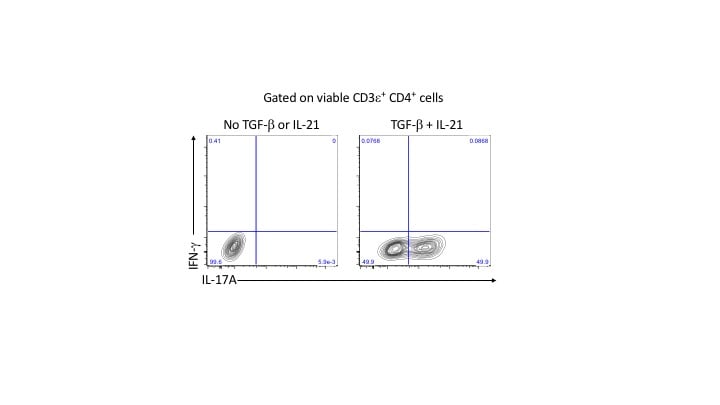
Application: Th cell differentiationVerified Customer | Posted 11/19/2017Naive CD4+ T cells (CD4+CD44lowCD62L+CD25-) were cultured with 3 ng/mL TGF-b, 100 ng/mL IL-21, 10 ug/mL each of anti-IL-4 and anti-IFN-g, 1 ug/mL anti-CD23 (plate-bound) and 1 ug/mL anti-CD28 for 4 days.

There are no reviews that match your criteria.