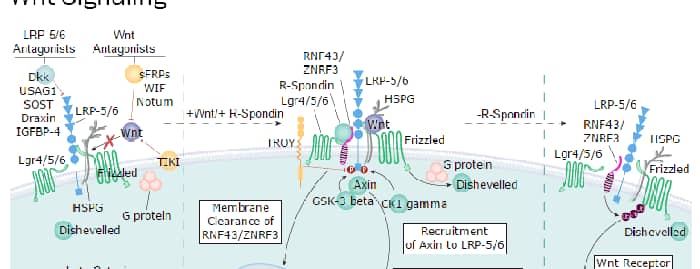
The low-density lipoprotein (LDL) receptor-related proteins LRP-5 and LRP-6 (LRP-5/6) constitute a distinct subgroup of the LDL receptor family (1). Both are widely expressed type I transmembrane proteins that function as Wnt co-receptors with Frizzled proteins in the beta -catenin (canonical) signaling pathway. Both also play critical roles in gastrulation and skeletal patterning during development (1-5). The 1614 amino acid (aa) mouse LRP5 contains a 30 aa signal sequence, a 1353 aa extracellular domain (ECD) with four beta -propeller structures, a 23 aa transmembrane domain and a 208 aa cytoplasmic domain (6). The beta -propellers are formed of five LDLR class B domains each, separated by EGF-like motifs, and followed by three cysteine-rich LDLR class A domains (6, 7). The ECD of mouse LRP-5 shares 95%, 99% and 71% aa sequence identity with the ECD of human LRP-5, rat LRP-5, and mouse LRP-6, respectively. LRP-5/6 associates with Wnt/Frizzled complexes, triggering phosphorylation of its intracellular PPPS motifs, binding of Axin, and propagation of beta -catenin signals (1, 7, 8). The LRP-5 ECD can also interact directly with inhibitors, such as Dickkopf (Dkk), Sclerostin, and USAG1/Wise, and the non-Wnt, activating complex of Norrin with Frizzled-4 (2, 7, 9-12). Formation of a ternary complex of LRP-5, Dkk-1, and Kremen triggers the internalization of the complex (1, 2). LRP-5/6 share many, but not all interactions (1, 2). However, deletion of LRP‑6 has a larger effect on embryonic developmental processes, while deletion and polymorphisms of LRP-5 mainly affect bone density (1, 4, 5, 9, 10). In humans, or mouse models, autosomal recessive osteoporosis-pseudoglioma syndrome and hereditary high bone mass (HBM) are caused by loss- and gain-of-function mutations LRP-5, respectively (4, 9, 10, 13). In mice, Wnt/LRP-5 may inhibit duodenal synthesis of the bone antagonist, serotonin, indirectly enhancing bone formation (14). Accordingly, serum serotonin is decreased in human HBM compared to controls (13).


Key Product Details
- R&D Systems HEK293-derived Recombinant Mouse LRP-5 Protein (7344-LR)
- Quality control testing to verify active proteins with lot specific assays by in-house scientists
- All R&D Systems proteins are covered with a 100% guarantee
Source
Accession Number
Applications
Product Specifications
Source
Ser31-Ser1383, with a C-terminal 6-His tag
Purity
Endotoxin Level
N-terminal Sequence Analysis
Predicted Molecular Mass
SDS-PAGE
Activity
Reviewed Applications
Read 2 reviews rated 4 using 7344-LR in the following applications:
Formulation, Preparation, and Storage
Carrier Free
What does CF mean?CF stands for Carrier Free (CF). We typically add Bovine Serum Albumin (BSA) as a carrier protein to our recombinant proteins. Adding a carrier protein enhances protein stability, increases shelf-life, and allows the recombinant protein to be stored at a more dilute concentration. The carrier free version does not contain BSA.
What formulation is right for me?In general, we advise purchasing the recombinant protein with BSA for use in cell or tissue culture, or as an ELISA standard. In contrast, the carrier free protein is recommended for applications, in which the presence of BSA could interfere.
Carrier: 7344-LR
| Formulation | Lyophilized from a 0.2 μm filtered solution in PBS with BSA as a carrier protein. |
| Reconstitution | Reconstitute at 100 μg/mL in PBS containing at least 0.1% human or bovine serum albumin. |
| Shipping | The product is shipped at ambient temperature. Upon receipt, store it immediately at the temperature recommended below. |
| Stability & Storage | Use a manual defrost freezer and avoid repeated freeze-thaw cycles.
|
Carrier Free: 7344-LR/CF
| Formulation | Lyophilized from a 0.2 μm filtered solution in PBS. |
| Reconstitution | Reconstitute at 100 μg/mL in PBS. |
| Shipping | The product is shipped at ambient temperature. Upon receipt, store it immediately at the temperature recommended below. |
| Stability & Storage | Use a manual defrost freezer and avoid repeated freeze-thaw cycles.
|
Calculators
Background: LRP-5
References
- MacDonald, B.T. et al. (2011) PLoS ONE 6:e23537.
- Kikuchi, A. et al. (2007) Cell. Signal. 19:659.
- Kelly, O.G. et al. (2004) Development 131:2803.
- Joeng, K.S. et al. (2011) Dev. Biol. 359:222.
- Holmen, S.L. et al. (2004) J. Bone Miner. Res. 19:2033.
- Hey, P.J. et al. (1998) Gene 216:103.
- Williams, B.O. and K.L. Insogna (2009) J. Bone Miner. Res. 24:171.
- Tamai, K. et al. (2004) Mol. Cell 13:149.
- Cui, Y. et al. (2011) Nat. Med. 17:684.
- Gong, Y. et al. (2001) Cell 107:513.
- Li, X. et al. (2005) J. Biol. Chem. 280:19883.
- Semenov, M. et al. (2005) J. Biol. Chem. 280:26770.
- Frost, M. et al. (2011) J. Bone Miner. Res. 26:1721.
- Yadav, V.K. et al. (2008) Cell 135:825.
Long Name
Alternate Names
Gene Symbol
UniProt
Additional LRP-5 Products
Product Documents for Recombinant Mouse LRP-5 Protein
Certificate of Analysis
To download a Certificate of Analysis, please enter a lot or batch number in the search box below.
Note: Certificate of Analysis not available for kit components.
Product Specific Notices for Recombinant Mouse LRP-5 Protein
For research use only
Related Research Areas
Citations for Recombinant Mouse LRP-5 Protein
 Powered by Bioz
Customer Reviews for Recombinant Mouse LRP-5 Protein (2)
Have you used Recombinant Mouse LRP-5 Protein?
Submit a review and receive an Amazon gift card!
$25/€18/£15/$25CAN/¥2500 for a review with an image
$10/€7/£6/$10CAN/¥1110 for a review without an image
Submit a review
Customer Images
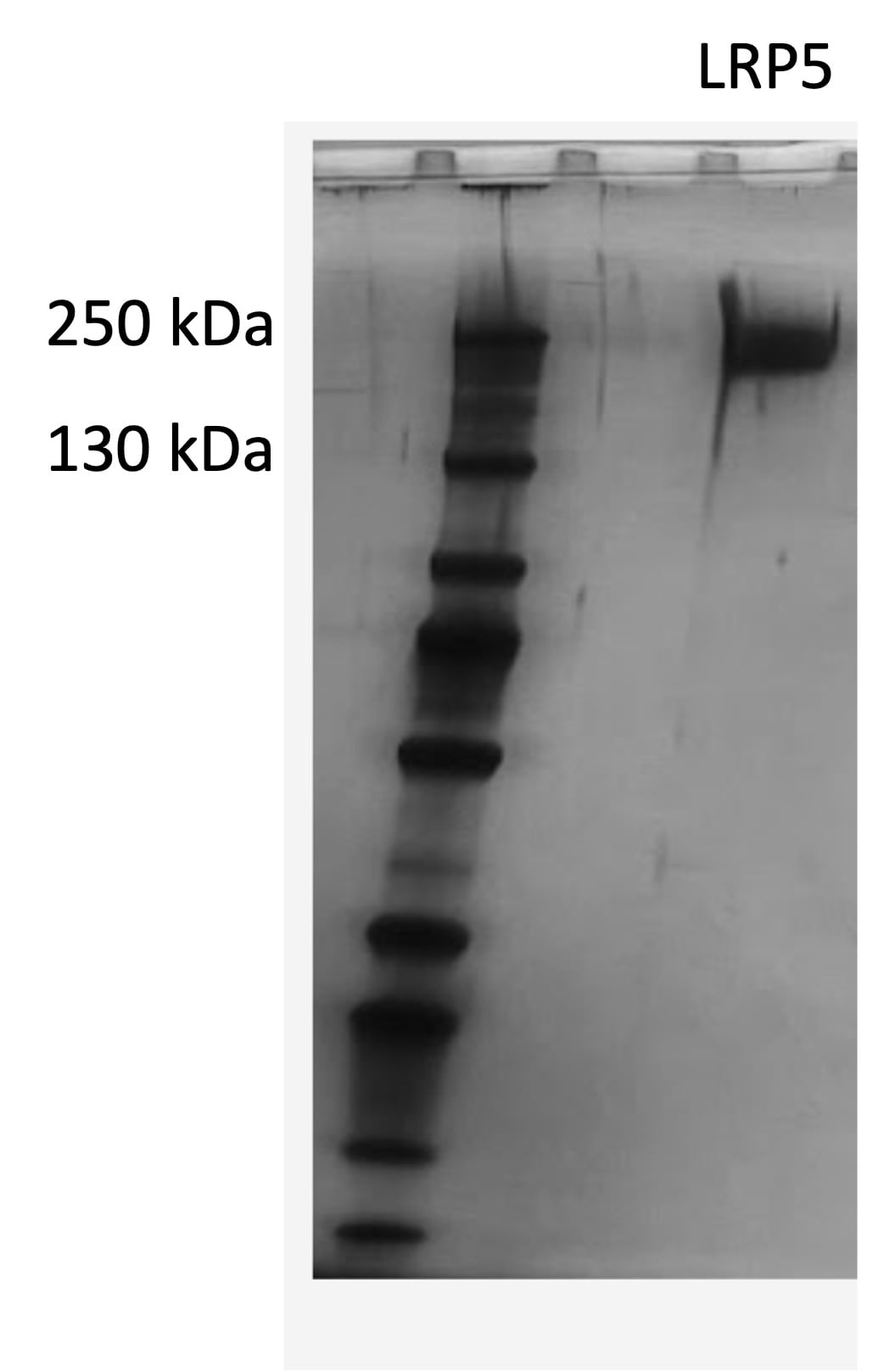
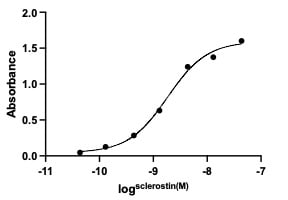
-
Application: SDS-PAGE ControlVerified Customer | Posted 08/19/2023

-
Application: Binding assay/Protein-protein interactionVerified Customer | Posted 08/19/2023
There are no reviews that match your criteria.
Associated Pathways