

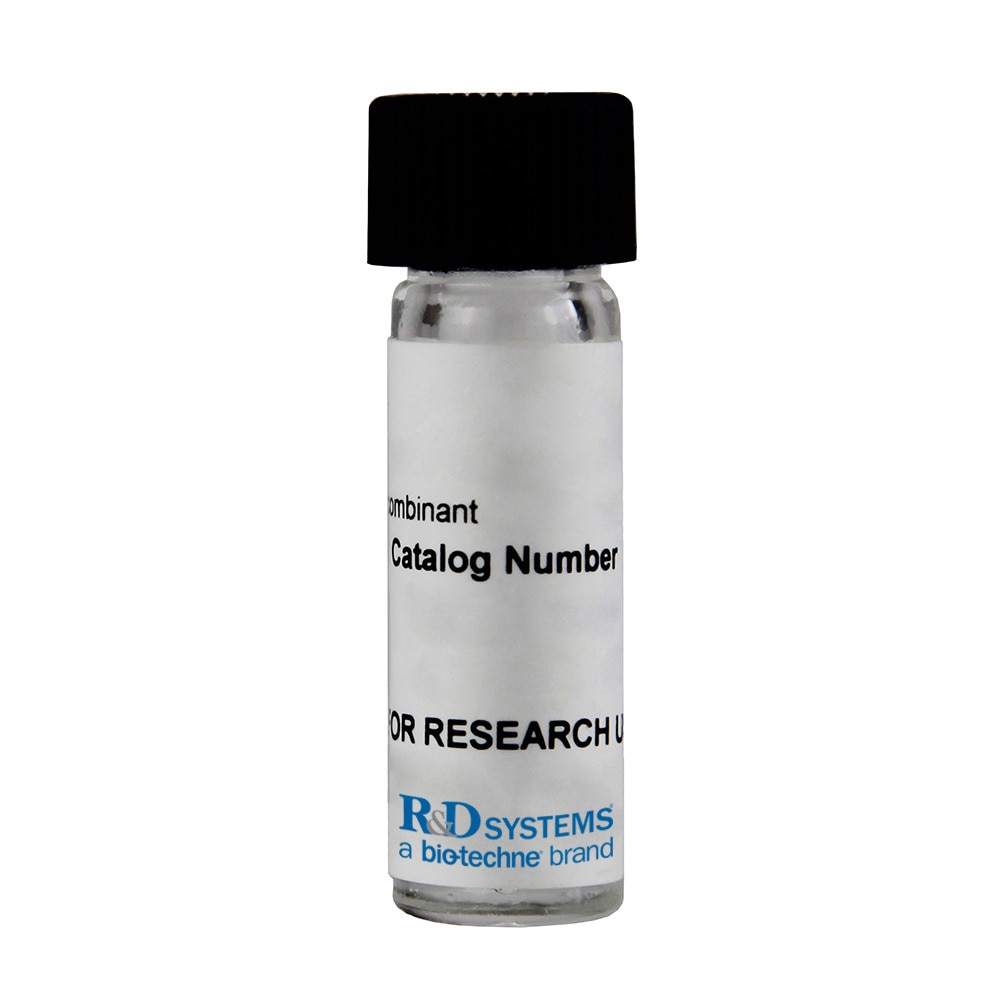
Recombinant Rat beta-NGF (CHO-expressed) Protein

R&D Systems | Catalog # 7815-NG

R&D Systems
Loading...

Key Product Details

  • R&D Systems CHO-derived Recombinant Rat beta-NGF (CHO-expressed) Protein (7815-NG)
  • Quality control testing to verify active proteins with lot specific assays by in-house scientists
  • All R&D Systems proteins are covered with a 100% guarantee

Source

CHO

Accession Number

Applications

Bioactivity
Loading...

Product Specifications

Source

Chinese Hamster Ovary cell line, CHO-derived rat beta-NGF protein
Ser122-Gly241

Purity

>95%, by SDS-PAGE under reducing conditions and visualized by silver stain.

Endotoxin Level

<0.10 EU per 1 μg of the protein by the LAL method.

N-terminal Sequence Analysis

Ser122

Predicted Molecular Mass

13.4 kDa

SDS-PAGE

11-12 kDa, reducing conditions

Activity

Measured in a cell proliferation assay using TF‑1 human erythroleukemic cells. Kitamura, T. et al. (1989) J. Cell Physiol. 140:323.
The ED50 for this effect is 0.3-1.8 ng/mL.

Formulation, Preparation, and Storage

Carrier Free
What does CF mean?

CF stands for Carrier Free (CF). We typically add Bovine Serum Albumin (BSA) as a carrier protein to our recombinant proteins. Adding a carrier protein enhances protein stability, increases shelf-life, and allows the recombinant protein to be stored at a more dilute concentration. The carrier free version does not contain BSA.

What formulation is right for me?

In general, we advise purchasing the recombinant protein with BSA for use in cell or tissue culture, or as an ELISA standard. In contrast, the carrier free protein is recommended for applications, in which the presence of BSA could interfere.

Carrier: 7815-NG
Formulation Lyophilized from a 0.2 μm filtered solution in PBS with BSA as a carrier protein.
Reconstitution Reconstitute at 100 μg/mL in PBS containing at least 0.1% human or bovine serum albumin.
Shipping The product is shipped at ambient temperature. Upon receipt, store it immediately at the temperature recommended below.
Stability & Storage Use a manual defrost freezer and avoid repeated freeze-thaw cycles.
  • 12 months from date of receipt, -20 to -70 °C as supplied.
  • 1 month, 2 to 8 °C under sterile conditions after reconstitution.
  • 3 months, -20 to -70 °C under sterile conditions after reconstitution.
Carrier Free: 7815-NG/CF
Formulation Lyophilized from a 0.2 μm filtered solution in PBS.
Reconstitution Reconstitute at 100 μg/mL in PBS.
Shipping The product is shipped at ambient temperature. Upon receipt, store it immediately at the temperature recommended below.
Stability & Storage Use a manual defrost freezer and avoid repeated freeze-thaw cycles.
  • 12 months from date of receipt, -20 to -70 °C as supplied.
  • 1 month, 2 to 8 °C under sterile conditions after reconstitution.
  • 3 months, -20 to -70 °C under sterile conditions after reconstitution.

Calculators

The reconstitution calculator allows you to quickly calculate the volume of a reagent to reconstitute your vial. Simply enter the mass of reagent and the target concentration and the calculator will determine the rest.

=
÷

Background: beta-NGF

NGF (Nerve growth factor; also known as beta ‑NGF and 2.5S NGF) is a 13‑14 kDa secreted member of the neurotrophin family, cysteine knot superfamily of molecules (1‑3). It is a noncovalent dimer expressed by a wide variety of cells including adipocytes (4), eosinophils (5), mast cells (DC) (6), neurons (7), CD4+ and CD8+ T cells (8), activated astrocytes (9), keratinocytes (10), rodent submandibular gland epithelium (11) and activated microglia plus Schwann cells (12). Rat beta ‑NGF is synthesized as a precursor that is 241 amino acids (aa) in length (13, 14). Based on mouse, it contains an 18 aa signal sequence, a 103 aa cleavable proregion, a 118 aa mature region (aa 122‑239) and a two aa C‑terminal propeptide (13‑16). Based on mouse, there is likely to be a 307 aa isoform that utilizes an upstream alternative start site (14, 16, 17).  Although proteolytic processing typically occurs intracellularly, proNGF is well recognized to be secreted, where it either undergoes extracellar proteolytic processing, or remains intact to act as a bioactive isoform of NGF (3, 7, 18, 19, 20). Mature rat NGF shares 92% and 96% aa sequence identity with human and mouse NGF, respectively. It should be noted that beta ‑NGF and NGF are synonymous. NGF was originally isolated from the mouse submaxillary/submandibular gland as part of a 7S/140 kDa complex that contained three subunits; an inactive kallikrein molecule ( alpha ‑subunit), a potentially active different kallikrein molecule ( gamma ‑subunit) and a beta ‑subunit (NGF). Other than in rodent, this complex does not exist, and the two kallikreins are not believed to contribute to NGF proteolytic processing. Their presence may simply reflect an incidental release of kallikrein molecules during NGF secretion (3, 20).

NGF has a number of functions, some of which seem at odds with each other. Although it has been reported to have direct neurotrophic activity in the CNS, this is likely due to the effects of proNGF rather than NGF (21). Outside the CNS and during development, NGF activity reportedly ensures that the proper number of heat‑sensitive C‑fibers form, and that they maintain their sensitivity to heat through TRPV1 expression (22). And in the immune system, NGF promotes mast cell survival at the expense of proliferation (23). During inflammation, NGF is also reportedly up‑regulated by Schwann cells. Here, it acts on local neurons, inducing neuronal TNF‑ alpha secretion, which feeds‑back on TNF type II receptors on neurons and promotes survival (12). By contrast, NGF action on select cell lines has been shown to induce apoptosis, and this has led to some confusion as to the mechanism of NGF action (24). To date, there are two receptors for NGF (at least three for proNGF) (2, 25‑27). They are p75NTR and TrkA. It would appear at this time that the p75:TrkA ratio drives the various outcomes associated with NGF exposure (21, 25).

References

  1. Skaper, S.D. (2012) Methods Mol. Biol. 846:1.
  2. Ichim G. et al. (2012) Exp. Cell Res. 318:1221.
  3. Shooter, E.M. (2001) Annu. Rev. Neurosci. 24:601.
  4. Wang, B. et al. (2005) Am. J. Physiol. Endocrinol. Metab. 288:E731.
  5. Kobayashi, H. et al. (2002) Blood 99:2214.
  6. Nilsson, G. et al. (1997) Eur. J. Immunol. 27:2295.
  7. Lim, K-C. et al. (2007) Biochem. Biophys. Res. Commun. 361:599.
  8. Santambrogio, L. et al. (1994) J. Immunol. 153:4488.
  9. Labie, C. et al. (1999) Br. J. Pharmacol. 127:139.
  10. Pincelli, C. et al. (1994) J. Invest. Dermatol. 103:13.
  11. Leick, M. et al. (2009) Immunology 129:536.
  12. Yoshimura, T. and J.J. Oppenheim (2011) Exp. Cell Res. 317:674.
  13. SwissProt Accession # P25427.
  14. Whittemore, S.R. et al. (1988) J. Neurosci. Res. 20:403
  15. Scott, J. et al. (1983) Nature 302:538.
  16. Ullrich, A. et al. (1983) Nature 303:821.
  17. Dicou, E. (1992) Mol. Brain Res. 14:136.
  18. Hempstead, B.L. (2009) Neurotox. Res. 16:225.
  19. Dicou, E. (2007) Arch. Physiol. Biochem. 113:228.
  20. Seidah, N.G. et al. (1996) Biochem J. 314:951.
  21. Masoudi, R. et al. (2009) J. Biol. Chem. 284:18424.
  22. Petruska, J.C. and L.M. Mendell (2004) Neurosci. Lett. 361:168.
  23. Horigome, K. et al. (1994) J. Biol. Chem. 269:2695.
  24. Bono, F. et al. (1999) FEBS Lett. 457:93.
  25. He, X-L. and K.C. Garcia (2004) Science 304:870.
  26. Clewes, O. et al. (2008) J. Neurochem. 107:1124.
  27. Boutilier, J. et al. (2008) J. Biol. Chem. 283:12709.

Long Name

beta Nerve Growth Factor

Alternate Names

betaNGF, NGFB

Entrez Gene IDs

4803 (Human); 18049 (Mouse); 310738 (Rat); 403402 (Canine); 103350089 (Rabbit)

Gene Symbol

NGF

UniProt

Additional beta-NGF Products

Product Documents for Recombinant Rat beta-NGF (CHO-expressed) Protein

Certificate of Analysis

To download a Certificate of Analysis, please enter a lot or batch number in the search box below.

Note: Certificate of Analysis not available for kit components.

Product Specific Notices for Recombinant Rat beta-NGF (CHO-expressed) Protein

For research use only

Related Research Areas

Citations for Recombinant Rat beta-NGF (CHO-expressed) Protein

Customer Reviews for Recombinant Rat beta-NGF (CHO-expressed) Protein

There are currently no reviews for this product. Be the first to review Recombinant Rat beta-NGF (CHO-expressed) Protein and earn rewards!

Have you used Recombinant Rat beta-NGF (CHO-expressed) Protein?

Submit a review and receive an Amazon gift card!

$25/€18/£15/$25CAN/¥2500 Yen for a review with an image

$10/€7/£6/$10CAN/¥1110 Yen for a review without an image

Submit a review
Amazon Gift Card

FAQs

No product specific FAQs exist for this product.

View all FAQs for Proteins and Enzymes
