
Recombinant S. cerevisiae SUMO Protease ULP1 His Protein, CF
R&D Systems | Catalog # 11697-SO
His-tag

Loading...
Key Product Details
- R&D Systems E. coli-derived Recombinant S. cerevisiae SUMO Protease ULP1 His Protein (11697-SO)
- Quality control testing to verify active proteins with lot specific assays by in-house scientists
- All R&D Systems proteins are covered with a 100% guarantee
Source
E. coli
Accession Number
Applications
Enzyme Activity
Loading...
Product Specifications
Source
E. coli-derived yeast SUMO Protease ULP1 protein
Leu403-Lys621, with an N-terminal Met and 6-His tag
Leu403-Lys621, with an N-terminal Met and 6-His tag
Purity
>95%, by SDS-PAGE visualized with Silver Staining and quantitative densitometry by Coomassie® Blue Staining.
Endotoxin Level
<0.10 EU per 1 μg of the protein by the LAL method.
N-terminal Sequence Analysis
Met
Predicted Molecular Mass
26 kDa
SDS-PAGE
27-33 kDa, under reducing conditions.
Activity
Measured by its ability to cleave SUMO-GFP Protease Substrate.
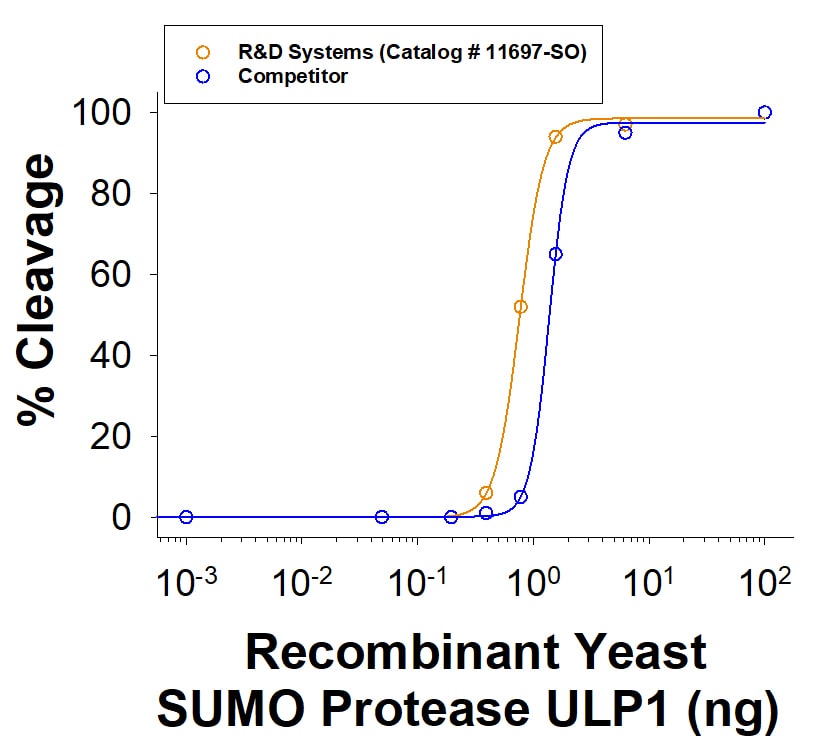
The DC50 is <0.8 ng, as measured under the described conditions.The DC50 is defined as the amount of enzyme required to cleave 50% of 1 μg SUMO-GFP in 2 hours at room temperature. Use of Recombinant Yeast SUMO Protease ULP1 in the cleavage of other protein substrates may require alternative conditions for optimal performance.
Scientific Data Images for Recombinant S. cerevisiae SUMO Protease ULP1 His Protein, CF
Recombinant Yeast SUMO Protease ULP1 His-tag Protein Enzyme Activity.
Recombinant Yeast SUMO Protease ULP1 His-tag activity is measured by its ability to cleave SUMO-GFP Protease Substrate (11698-SO). The R&D Systems protein has higher activity than competitor protein in direct comparison.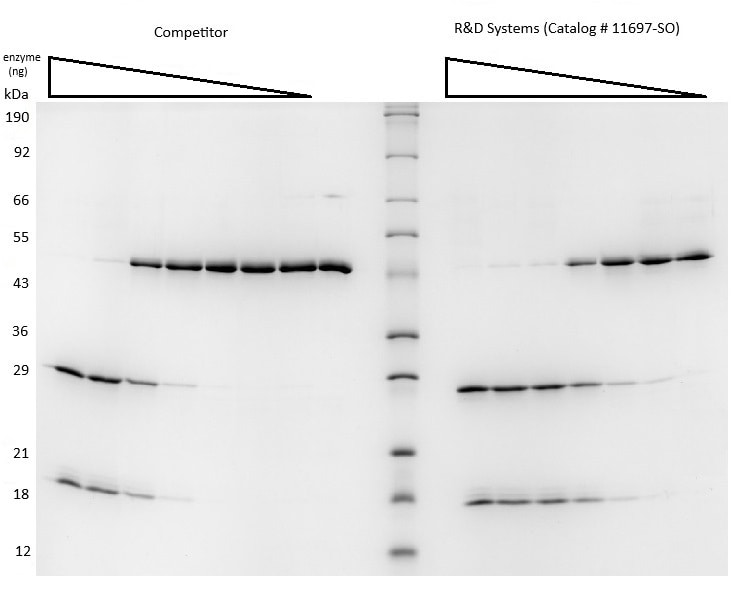
Recombinant Yeast SUMO Protease ULP1 His-tag Protein Enzyme Activity.
Recombinant Yeast SUMO Protease ULP1 His-tag Protein (Catalog # 11697-SO) from R&D Systems and a competitor product are able to cleave Recombinant SUMO-GFP Protease Substrate (~47 kDa, 11698-SO) per insert assay conditions. Cleavage is detected with SDS-PAGE under reducing (R) conditions and visualized by Coomassie® Blue staining. The enzyme from R&D Systems offers a better value than the competition.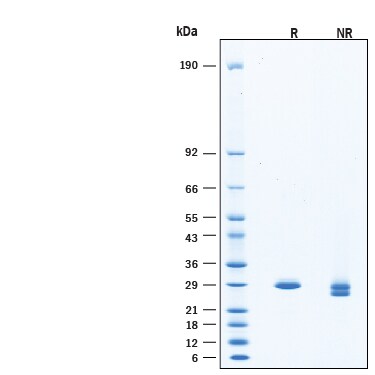
Recombinant Yeast SUMO Protease ULP1 His-tag Protein SDS-PAGE.
2 μg/lane of Recombinant Yeast SUMO Protease ULP1 His-tag Protein (Catalog # 11697-SO) was resolved with SDS-PAGE under reducing (R) and non-reducing (NR) conditions and visualized by Coomassie® Blue staining, showing bands at 27-33 kDa, under reducing conditions.Formulation, Preparation, and Storage
11697-SO
| Formulation | Supplied as a 0.2 μm filtered solution in Tris, NaCl, DTT and Glycerol. |
| Shipping | The product is shipped with dry ice or equivalent. Upon receipt, store it immediately at the temperature recommended below. |
| Stability & Storage | Use a manual defrost freezer and avoid repeated freeze-thaw cycles.
|
Background: SUMO Protease ULP1
References
- Li, S.J and M. Hochstrasser (1999) Nature 398:246.
- Li, S.J and M. Hochstrasser (2000) Mol Cell Biol. 20:2367.
- Mossessova, E. and C.D. Lima (2000) Mol. Cell 5:865.
- Malakhov, M.P. et al. (2004) J. Struct. Funct. Genomics 5:75.
- Marblestone, J.G. et al. (2006) Protein Sci. 15:182.
- Satakarni, M. and R. Curtis (2011) Protein Expr. Purif. 78:113.
- Baker, R.T. (1996) Curr. Opin. Biotechnol. 7:541.
- Jonasson, P. et al. (2002) Biotechnol. Appl. Biochem. 35:91.
- Butt, T.R. et al. (2005) Protein Expr. Purif. 43:1.
- Peroutka, R.J. et al. (2011) Methods Mol. Biol. 705:15.
- Wang, Z. et al. (2010) Protein Expr. Purif. 73:203.
Alternate Names
EC 3.4.22.68, NIB1
Entrez Gene IDs
856087 (Yeast)
Gene Symbol
ULP1
UniProt
Additional SUMO Protease ULP1 Products
Product Documents for Recombinant S. cerevisiae SUMO Protease ULP1 His Protein, CF
Certificate of Analysis
To download a Certificate of Analysis, please enter a lot or batch number in the search box below.
Note: Certificate of Analysis not available for kit components.
Product Specific Notices for Recombinant S. cerevisiae SUMO Protease ULP1 His Protein, CF
For research use only
Customer Reviews for Recombinant S. cerevisiae SUMO Protease ULP1 His Protein, CF
There are currently no reviews for this product. Be the first to review Recombinant S. cerevisiae SUMO Protease ULP1 His Protein, CF and earn rewards!
Have you used Recombinant S. cerevisiae SUMO Protease ULP1 His Protein, CF?
Submit a review and receive an Amazon gift card!
$25/€18/£15/$25CAN/¥2500 for a review with an image
$10/€7/£6/$10CAN/¥1110 for a review without an image
Submit a review
Protocols
View specific protocols for Recombinant S. cerevisiae SUMO Protease ULP1 His Protein, CF (11697-SO):
Materials
- Assay Buffer: 50 mM Tris, 5 mM DTT, pH 8.0
- Recombinant Yeast SUMO Protease ULP1 His-tag (SUMO Protease ULP1) (Catalog # 11697-SO)
- Recombinant SUMO-GFP Protease Substrate (rSUMO-GFP) (Catalog # 11698-SO)
- 15% SDS-PAGE gel
- Reducing Sample Buffer
- Gel Staining Reagent
- Prepare a curve of SUMO Protease ULP1 by diluting SUMO Protease ULP1 to 20, 1.25, 0.312, 0.156, 0.078, 0.039 and 0.00977 µg/mL in Assay Buffer.
- Dilute rSUMO-GFP to 200 µg/mL in Assay Buffer.
- Combine 20 µL of each SUMO Protease ULP1 curve dilution and 20 µL of 200 µg/mL rSUMO-GFP. Prepare a Control by combining 20 µL of 200 µg/mL rSUMO-GFP and 20 µL Assay Buffer.
- Incubate reaction mixtures and control at room temperature for 2 hours.
- Stop the reactions by combining equal volumes of reaction mixture (including control) and Reducing SDS-PAGE Sample Buffer. Heat all samples at 95 °C for 3 minutes.
- Load 20 µL of each stopped reaction per lane on a 15% SDS-PAGE gel and perform electrophoresis.
- Stain gel and analyze the % cleavage of rSUMO-GFP using densitometry for each SUMO Protease ULP1 curve dilution.
- Determine the DC50 by plotting % cleavage vs SUMO Protease ULP1 concentration (ng) using 4-PL fitting.
Per Lane:
- SUMO Protease ULP1: 100, 6.25, 1.56, 0.78, 0.39, 0.195, 0.0488, and 0 ng
- rSUMO-GFP: 1 µg
Loading...