
Recombinant SUMO-GFP Protease Substrate Protein, CF
R&D Systems | Catalog # 11698-SO

Loading...
Key Product Details
- R&D Systems E. coli-derived Recombinant SUMO-GFP Protease Substrate Protein (11698-SO)
- Quality control testing to verify active proteins with lot specific assays by in-house scientists
- All R&D Systems proteins are covered with a 100% guarantee
Source
E. coli
Accession Number
Applications
Enzyme Activity
Loading...
Product Specifications
Source
E. coli-derived crystal jellyfish SUMO-GFP Protease Substrate protein
Ser2-Lys238, with an N-terminal Met, 6-His tag, and Sumo tag
Ser2-Lys238, with an N-terminal Met, 6-His tag, and Sumo tag
Purity
>95%, by SDS-PAGE visualized with Silver Staining and quantitative densitometry by Coomassie® Blue Staining.
Endotoxin Level
<1.0 EU per 1 μg of the protein by the LAL method.
N-terminal Sequence Analysis
Met
Predicted Molecular Mass
39 kDa
SDS-PAGE
42-47 kDa, under reducing conditions.
Activity
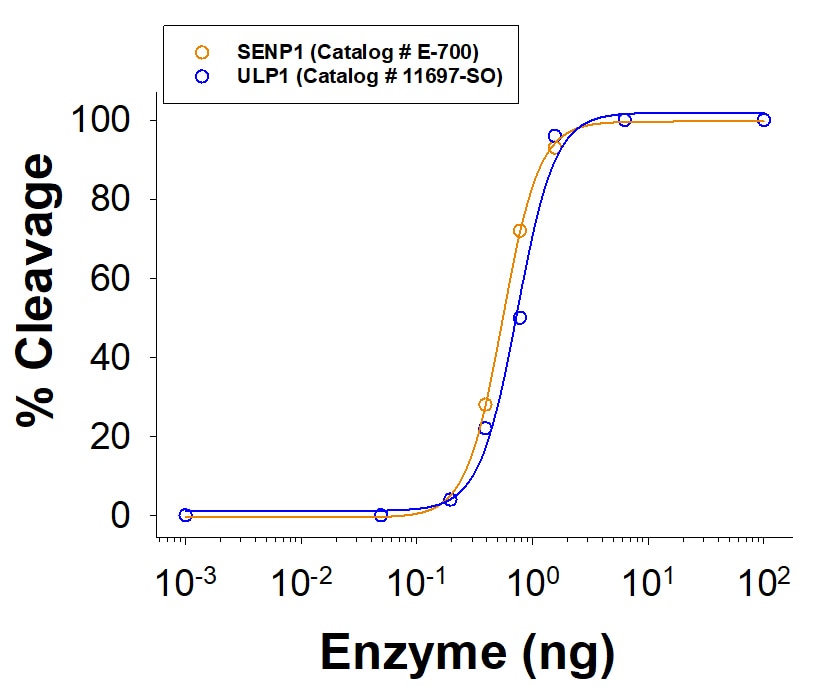
Measured by its cleavage by SUMO Protease ULP1.
>60% of 1 μg can be cleaved by 1 ng of SUMO Protease ULP1, as measured under the described conditions.
Scientific Data Images for Recombinant SUMO-GFP Protease Substrate Protein, CF
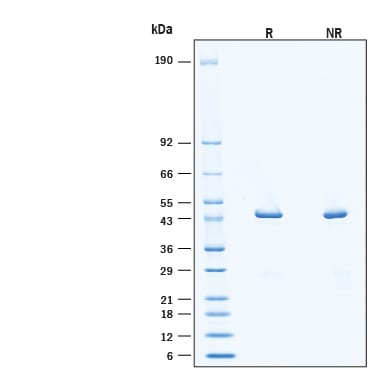
Recombinant SUMO-GFP Protease Substrate Protein SDS-PAGE.
2 μg/lane of Recombinant SUMO-GFP Protease Substrate Protein (Catalog # 11698-SO) was resolved with SDS-PAGE under reducing (R) and non-reducing (NR) conditions and visualized by Coomassie® Blue staining, showing bands at 42-47 kDa, under reducing conditions.Formulation, Preparation, and Storage
11698-SO
| Formulation | Supplied as a 0.2 μm filtered solution in Tris, NaCl and Glycerol. |
| Shipping | The product is shipped with polar packs. Upon receipt, store it immediately at the temperature recommended below. |
| Stability & Storage | Use a manual defrost freezer and avoid repeated freeze-thaw cycles.
|
Background: SUMO-GFP Protease Substrate
(Catalog # http://www.rndsystems.com/product_results.aspx?k=E-700">E-700). SUMO is a member of the small ubiquitin-like modifier (SUMO) family. In the cell, the SUMO protein is modified and covalently conjugated to other proteins in the cell via an isopeptide bond formed between its carboxyl-terminal glycine residues and the lysine of the protein substrate in a similar parallel mechanism of ubiquitination that regulates cellular processes such as DNA replication and repair, nuclear transport, signal transduction, and regulation of transcription (1-3). Use of SUMO fusions as a technology has been used to enhance protein expression, solubility, and purification in prokaryotes for a diverse population of protein targets and unlike other common fusion partners SUMO can serve as a chaperone for correct folding (4). SUMO is cleaved at its c-terminus to a mature form after a glycine-glycine pair by a family of sentrin/SUMO-specific proteases (SENPs) in humans and ubiquitin-like protein specific proteases (Ulps) in yeast to regulate the reversible process of sumoylation (3). In a fusion application, the cleavage of SUMO allows for successful recombinant protein production with a native N-terminal sequence providing a distinct advantage over other fusion cleavage models used in recombinant protein production in both academic research and industrial biotechnology (4‑10).
References
- Li, S.J and M. Hochstrasser (1999) Nature 398:246.
- Li, S.J and M. Hochstrasser (2000) Mol. Cell Biol. 20:2367.
- Mukhopadhyay, D. and M. Dasso. (2007) Trends Biochem. Sci. 32:286.
- Malakhov, M.P. et al. (2004) J. Struct. Funct. Genomics 5:75.
- Marblestone, J.G. et al. (2006) Protein Sci. 15:182.
- Baker, R.T. (1996) Curr. Opin. Biotechnol. 7:541.
- Jonasson, P. et al. (2002) Biotechnol. Appl. Biochem. 35:91.
- Butt, T.R. et al. (2005) Protein Expr. Purif. 43:1.
- Peroutka, R.J. et al. (2011) Methods Mol. Biol. 705:15.
- Wang, Z. et al. (2010) Protein Expr. Purif. 73:203.
Alternate Names
green fluorescent protein, small ubiquitin-related modifier, SUMO substrate
UniProt
Additional SUMO-GFP Protease Substrate Products
Product Documents for Recombinant SUMO-GFP Protease Substrate Protein, CF
Certificate of Analysis
To download a Certificate of Analysis, please enter a lot or batch number in the search box below.
Note: Certificate of Analysis not available for kit components.
Product Specific Notices for Recombinant SUMO-GFP Protease Substrate Protein, CF
For research use only
Customer Reviews for Recombinant SUMO-GFP Protease Substrate Protein, CF
There are currently no reviews for this product. Be the first to review Recombinant SUMO-GFP Protease Substrate Protein, CF and earn rewards!
Have you used Recombinant SUMO-GFP Protease Substrate Protein, CF?
Submit a review and receive an Amazon gift card!
$25/€18/£15/$25CAN/¥2500 for a review with an image
$10/€7/£6/$10CAN/¥1110 for a review without an image
Submit a review
Protocols
View specific protocols for Recombinant SUMO-GFP Protease Substrate Protein, CF (11698-SO):
Materials
- Assay Buffer: 50 mM Tris, 5 mM DTT, pH 8.0
- Recombinant SUMO-GFP Protease Substrate (rSUMO-GFP) (Catalog # 11698-SO)
- Recombinant Yeast SUMO Protease ULP1 His-tag (SUMO Protease ULP1) (Catalog # 11697-SO)
- 15% SDS-PAGE gel
- Reducing Sample Buffer
- Gel Staining Reagent
- Dilute rSUMO-GFP to 200 µg/mL in Assay Buffer.
- Dilute SUMO Protease ULP1 to 0.2 µg/mL in Assay buffer.
- Combine 20 µL of 0.2 µg/mL SUMO Protease ULP1and 20 µL of 200 µg/mL rSUMO-GFP. Prepare a Negative Control by combining 20 µL of 200 µg/mL rSUMO-GFP and 20 µL Assay Buffer.
- Incubate reaction mixtures and control at room temperature for 2 hours.
- Stop the reactions by combining equal volumes of reactions (including control) and Reducing SDS-PAGE Sample Buffer. Heat all samples at 95 °C for 3 minutes.
- Load 20 µL of each stopped reaction per lane on a 15% SDS-PAGE gel and perform electrophoresis.
- Stain gel and analyze the % cleavage of rSUMO-GFP using densitometry.
Per Well:
- rSUMO-GFP: 1.0 µg
- SUMO Protease ULP1: 1.0 ng
Loading...