
Recombinant S. pyogenes Endo S2 His-tag Protein, CF
R&D Systems | Catalog # 10976-GH

Loading...
Key Product Details
- R&D Systems E. coli-derived Recombinant S. pyogenes Endo S2 His-tag Protein (10976-GH)
- Quality control testing to verify active proteins with lot specific assays by in-house scientists
- All R&D Systems proteins are covered with a 100% guarantee
Source
E. coli
Accession Number
Applications
Enzyme Activity
Loading...
Learn more about Fluorescent Glycan Labeling and Detection
Product Specifications
Source
E. coli-derived s. pyogenes Endo-beta-N-acetylglucosaminidase S2/Endo S2 protein
Glu37-Asp843, with a N-terminal Met & 6-His tag
Glu37-Asp843, with a N-terminal Met & 6-His tag
Purity
>90%, by SDS-PAGE visualized with Silver Staining and quantitative densitometry by Coomassie® Blue Staining.
Endotoxin Level
<1.0 EU per 1 μg of the protein by the LAL method.
N-terminal Sequence Analysis
Met
Predicted Molecular Mass
92 kDa
SDS-PAGE
86-93 kDa, under reducing conditions.
Activity
Measured by its ability to digest Cy5-Labeled Glycan G2
>50% of Cy5-Labeled Glycan G2 (0.2 pmol) is digested by 0.2 μg of rSp. Endo-S2, as measured under the described conditions.
>50% of Cy5-Labeled Glycan G2 (0.2 pmol) is digested by 0.2 μg of rSp. Endo-S2, as measured under the described conditions.
Scientific Data Images for Recombinant S. pyogenes Endo S2 His-tag Protein, CF
Recombinant Sp. Endo S2 (Endo S2) Enzyme Activity Diagram
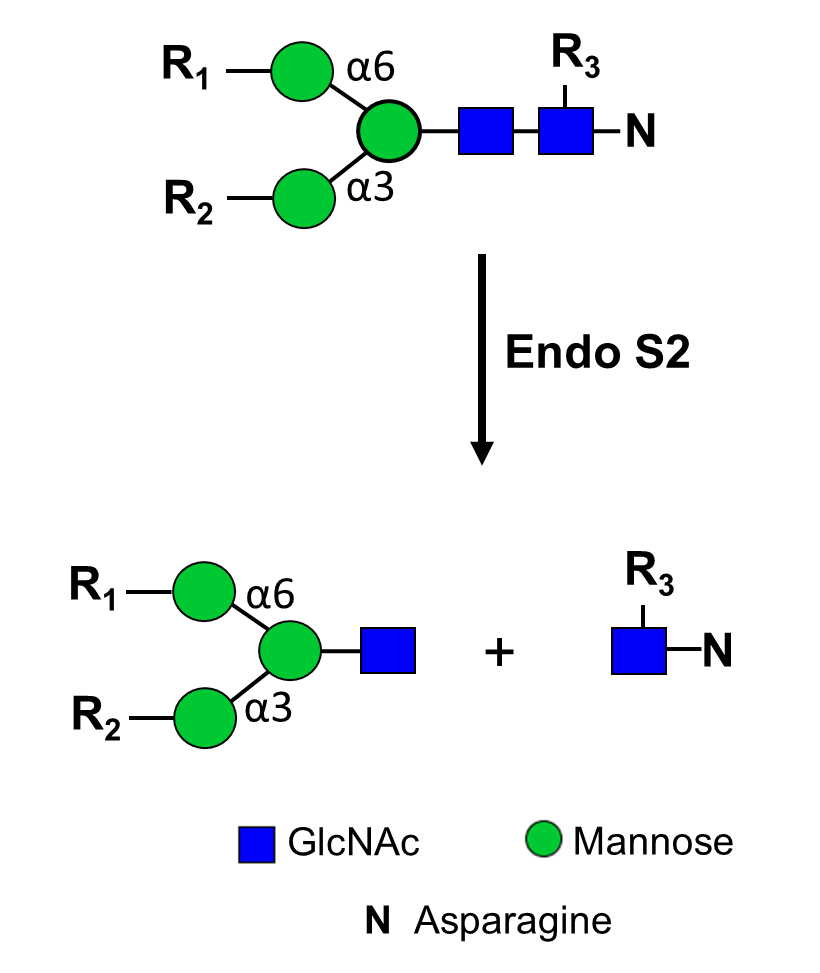
Endo S2 recognizes the conserved N-glycans on the Fc region of IgG by hydrolyzing the chitobiose core (at the beta -1,4 linkage between the two N-acetylglucosamines) of the N-glycans. Endo S2 leaves one GlcNAc residue attached the the asparagine of the peptide backbone. R1 and R2 can be oligosaccharide extensions containing Gal, GlcNAc, and Sialic Acid. R3 can be unmodified or Core-6 Fucose.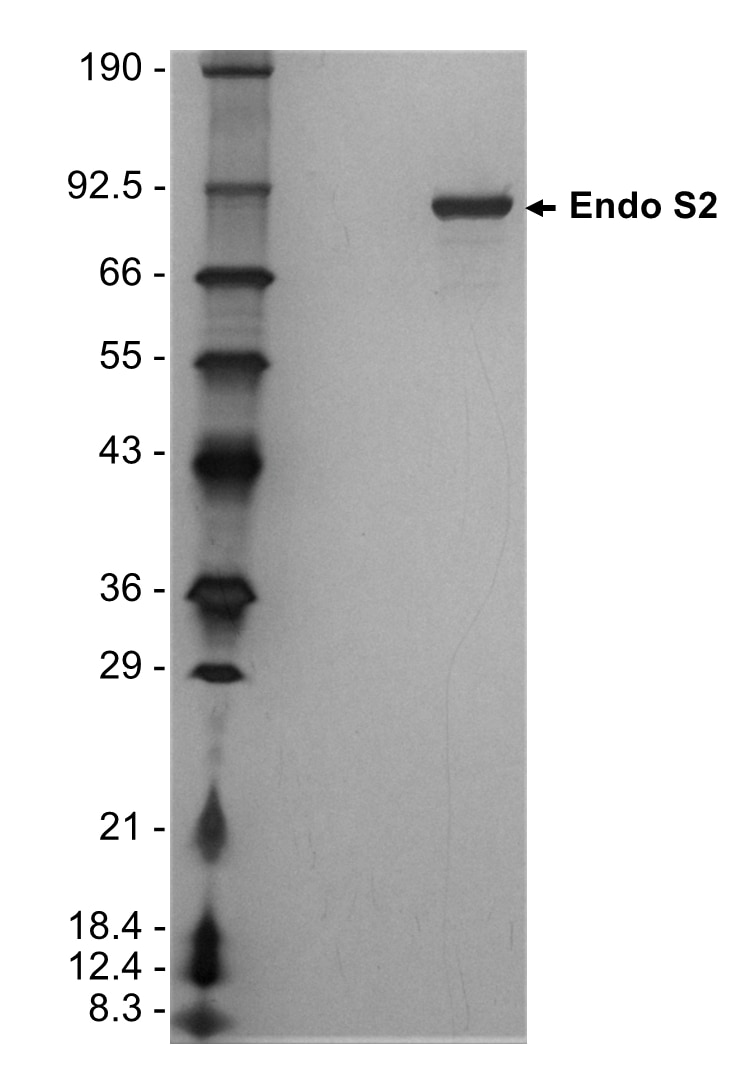
Recombinant S. pyogenes Endo S2 SDS-PAGE
1 μg/lane of rSp. Endo-S2 (Catalog # 10976-GH) was resolved with SDS-PAGE under reducing (R) conditions and visualized by silver staining, showing a band at 92 kDa.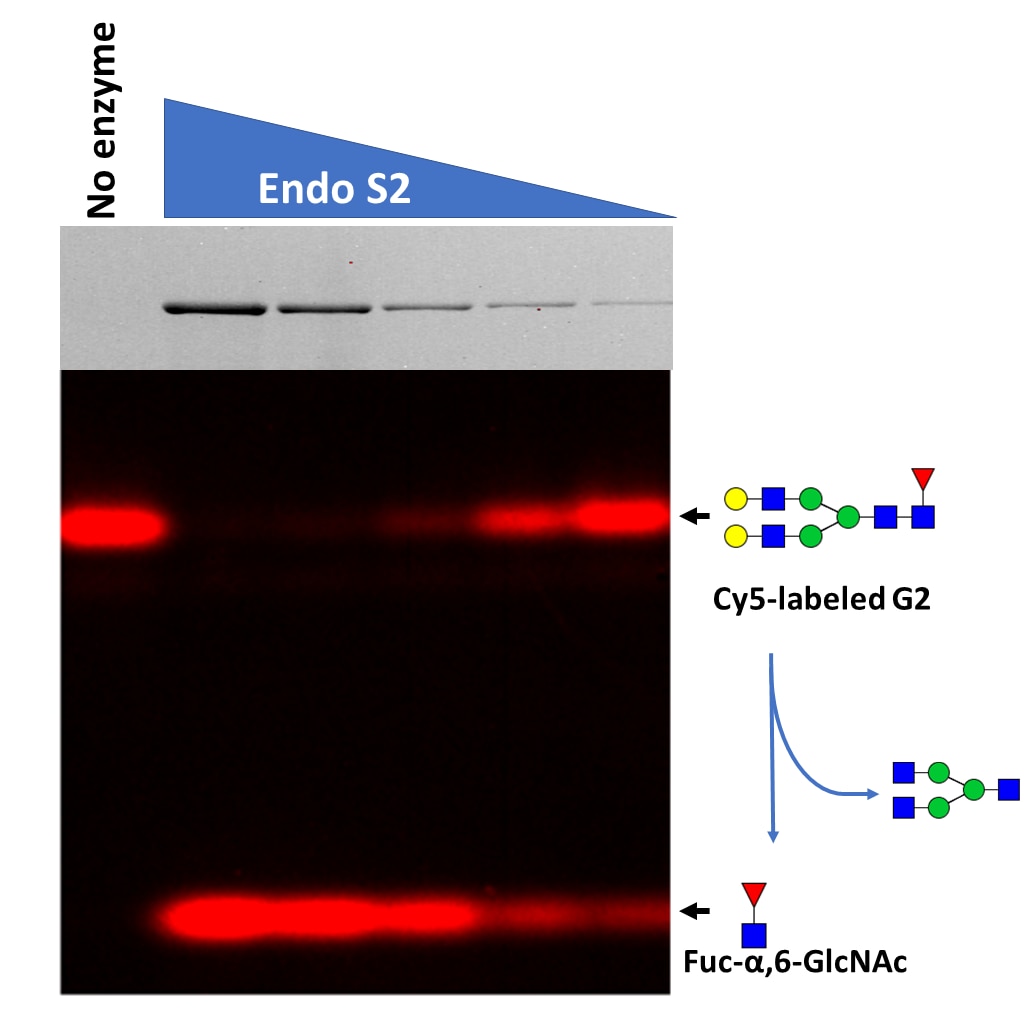
Fluorescent Gel Mobility Shift caused by rSp. Endo S2.
Lane 1 contained substrate Cy5-labeled G2 GL302. In the presence of Endo S2, the glycan was digested to products and the smaller product Fuc-alpha,6-GlcNAc is observed.Formulation, Preparation, and Storage
10976-GH
| Formulation | Supplied as a 0.2 μm filtered solution in Tris and NaCl. |
| Shipping | The product is shipped with polar packs. Upon receipt, store it immediately at the temperature recommended below. |
| Stability & Storage | Use a manual defrost freezer and avoid repeated freeze-thaw cycles.
|
Background: Endo-beta-N-acetylglucosaminidase S2/Endo S2
References
- Nizet, V. (2007) J. Allergy Clin. Immunol. 120:13.
- Collin, M. and Olsen, A. (2001) EMBO J. 20:3046.
- Sjogren, J. et al. (2013) Biochem. J. 455:107.
- Allhorn, M. et al. (2008) PLoS ONE. 3:e1413.
- Collin, M. et al. (2002) Infect Immun. 70:6646.
- Sjögren, J. et al. (2011) BMC Microbiol. 11:120.
Long Name
Endo-beta-N-acetylglucosaminidase S2
Alternate Names
EndoS2, NdoS2
Gene Symbol
NdoS2
UniProt
Additional Endo-beta-N-acetylglucosaminidase S2/Endo S2 Products
Product Documents for Recombinant S. pyogenes Endo S2 His-tag Protein, CF
Certificate of Analysis
To download a Certificate of Analysis, please enter a lot or batch number in the search box below.
Note: Certificate of Analysis not available for kit components.
Product Specific Notices for Recombinant S. pyogenes Endo S2 His-tag Protein, CF
For research use only
Related Research Areas
Customer Reviews for Recombinant S. pyogenes Endo S2 His-tag Protein, CF
There are currently no reviews for this product. Be the first to review Recombinant S. pyogenes Endo S2 His-tag Protein, CF and earn rewards!
Have you used Recombinant S. pyogenes Endo S2 His-tag Protein, CF?
Submit a review and receive an Amazon gift card!
$25/€18/£15/$25CAN/¥2500 for a review with an image
$10/€7/£6/$10CAN/¥1110 for a review without an image
Submit a review
Protocols
View specific protocols for Recombinant S. pyogenes Endo S2 His-tag Protein, CF (10976-GH):
Materials
- Assay Buffer: 50 mM MES, pH 6.0
- Recombinant Sp. Endo-S2 (rSpEndo-S2) (Catalog # 10976-GH)
- Cy5-Labeled Glycan G2 (Cy5-G2) (Catalog # GL302)
- 15% SDS-PAGE gel and SDS-PAGE Reagents
- Reducing SDS-PAGE Sample Buffer
- Fluorescent imager
- Dilute rSpEndo-S2 to 20 ng/µL in Assay Buffer.
- Dilute Cy5-G2 to 0.02 µM in Assay Buffer.
- Prepare reaction by combine 10 µL of diluted rSpEndo-S2 and 10 µL of diluted Cy5-G2.
- Prepare a negative control by combining 10 µL of diluted Cy5-G2 and 10 µL of Assay Buffer.
- Incubate reaction(s) and negative control at 37 °C for 60 minutes.
- Add 7 µL of reducing SDS-PAGE sample buffer to each reaction and negative control.
- Load 13.5 µL of each sample and control per well on a 15% SDS-PAGE gel and run SDS-PAGE until the dye front has migrated more than two thirds of the way down the gel.
- Acquire gel image with a fluorescent imager.
- Analyze the amount (%) of Cy5-G2 digested by rSpEndo-S2 in each reaction lane.
Per Reaction:
- rSpEndo-S2: 0.20 µg
- Cy5-G2: 0.2 pmol
Loading...