
SEC6 Antibody (9H5) - BSA Free
Novus Biologicals | Catalog # NBP1-97500

![Western Blot: SEC6 Antibody (9H5) [NBP1-97500]](https://resources.rndsystems.com/images/products/SEC6-Antibody-9H5-Western-Blot-NBP1-97500-img0005.jpg "Western Blot: SEC6 Antibody (9H5) [NBP1-97500]")
Loading...
Key Product Details
Species Reactivity
Validated:
Human, Mouse, Rat, Porcine, Bovine, Canine, Chicken, Hamster, Monkey, Rabbit, Sheep, Yeast
Cited:
Human, Rat, Canine, Yeast
Applications
Validated:
Immunohistochemistry, Immunohistochemistry-Paraffin, Western Blot, Immunoblotting, Immunocytochemistry/ Immunofluorescence
Cited:
Western Blot, Immunoblotting, Immunocytochemistry/ Immunofluorescence
Label
Unconjugated
Antibody Source
Monoclonal Mouse IgG2A Clone # 9H5
Format
BSA Free
Loading...
Product Specifications
Immunogen
Recombinant rat Sec6.
Reactivity Notes
Yeast reactivity reported in scientific literature (PMID: 30510181).
Clonality
Monoclonal
Host
Mouse
Isotype
IgG2A
Scientific Data Images for SEC6 Antibody (9H5) - BSA Free
Western Blot: SEC6 Antibody (9H5) [NBP1-97500]
SEC6-Antibody-9H5-Western-Blot-NBP1-97500-img0005.jpg![Immunohistochemistry-Paraffin: SEC6 Antibody (9H5) [NBP1-97500]](https://resources.rndsystems.com/images/products/SEC6-Antibody-9H5-Immunohistochemistry-Paraffin-NBP1-97500-img0003.jpg "Immunohistochemistry-Paraffin: SEC6 Antibody (9H5) [NBP1-97500]")
Immunohistochemistry-Paraffin: SEC6 Antibody (9H5) [NBP1-97500]
Immunohistochemistry-Paraffin: SEC6 Antibody (9H5) [NBP1-97500] - Analysis of human tonsil tissue stained with rSec6, mAb (9H5) at 10ug/ml.![Western Blot: SEC6 Antibody (9H5) [NBP1-97500]](https://resources.rndsystems.com/images/products/SEC6-Antibody-9H5-Western-Blot-NBP1-97500-img0004.jpg "Western Blot: SEC6 Antibody (9H5) [NBP1-97500]")
Western Blot: SEC6 Antibody (9H5) [NBP1-97500]
Western Blot: SEC6 Antibody (9H5) [NBP1-97500] - Analysis of pig ESK-4 cell lysate.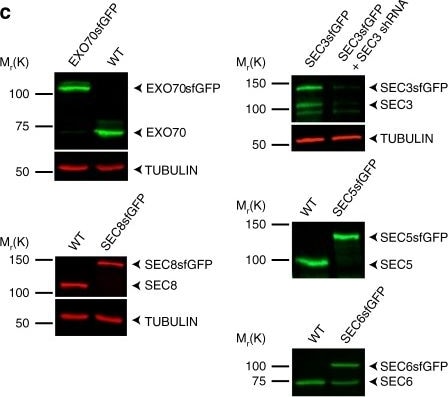
Western Blot: SEC6 Antibody (9H5) [NBP1-97500] -
Western Blot: SEC6 Antibody (9H5) [NBP1-97500] - Establishment & validation of tagged exocyst subunit cell lines. a Schematic showing a region of subunit gene targeted by sgRNA & tags to be inserted C-terminally, in-frame with the coding region. b Strategy to isolate CRISPR/Cas9-mediated sfGFP-tagged clones of exocyst subunits in NMuMG cells. c Western blots with subunit specific antibodies show successful incorporation of sfGFP in both alleles (EXO70, SEC5, & SEC8), or in one allele (SEC3 & SEC6). A shRNA specific to SEC3 was used to confirm the identity of multiple bands in the blot. d Confocal images of live wild-type NMuMG cells & endogenously tagged SEC3-GFP, SEC5-GFP, SEC6-GFP, SEC8-GFP, & EXO70-GFP cell lines. Scale bar = 10 μm. e Protein–protein interaction heat map for endogenous SEC3-GFP, SEC5-GFP, & EXO70-GFP pulldown using GFP-Trap nanobodies & MS. Yellow indicates baits, blue the protein identified with high confidence, & gray denotes preys that were not identified. The experiments were repeated three times for EXO70-GFP & twice for SEC3-GFP & SEC5-GFP. All experiments were also partially confirmed by IP–WB in at least three independent experiments, with similar results. f Western blot analysis to assess the relative abundance of exocyst subunits fused to sfGFP, using anti-GFP antibodies (SEC3 & SEC6 quantifications corrected for heterozygosity). GAPDH was the loading control. Y axis shows the ratio of GFP/GAPDH. Quantification shows pooled data from three experiments Image collected & cropped by CiteAb from the following publication (https://pubmed.ncbi.nlm.nih.gov/30510181), licensed under a CC-BY license. Not internally tested by Novus Biologicals.Applications for SEC6 Antibody (9H5) - BSA Free
Application
Recommended Usage
Immunocytochemistry/ Immunofluorescence
1:10-1:500
Immunohistochemistry
1:10-1:500
Immunohistochemistry-Paraffin
1:10-1:500
Western Blot
1:250
Application Notes
Detects a band of ~87kDa by Western blot. Use in Immunoblotting reported in scientific literature (PMID 28358000).
Formulation, Preparation, and Storage
Purification
Protein G purified
Formulation
PBS (pH 7.2) and 50% Glycerol
Format
BSA Free
Preservative
0.09% Sodium Azide
Concentration
Please see the vial label for concentration. If unlisted please contact technical services.
Shipping
The product is shipped with polar packs. Upon receipt, store it immediately at the temperature recommended below.
Stability & Storage
Store at -20C. Avoid freeze-thaw cycles.
Background: SEC6
Alternate Names
exocyst complex component 3, Exocyst complex component Sec6, Sec 6 homolog, SEC6, SEC6L1, SEC6-like 1, SEC6-like 1 (S. cerevisiae), Sec6p
Gene Symbol
EXOC3
Additional SEC6 Products
Product Documents for SEC6 Antibody (9H5) - BSA Free
Certificate of Analysis
To download a Certificate of Analysis, please enter a lot or batch number in the search box below.
Product Specific Notices for SEC6 Antibody (9H5) - BSA Free
This product is for research use only and is not approved for use in humans or in clinical diagnosis. Primary Antibodies are guaranteed for 1 year from date of receipt.
Citations for SEC6 Antibody (9H5) - BSA Free
 Powered by Bioz
Customer Reviews for SEC6 Antibody (9H5) - BSA Free
There are currently no reviews for this product. Be the first to review SEC6 Antibody (9H5) - BSA Free and earn rewards!
Have you used SEC6 Antibody (9H5) - BSA Free?
Submit a review and receive an Amazon gift card!
$25/€18/£15/$25CAN/¥2500 Yen for a review with an image
$10/€7/£6/$10CAN/¥1110 Yen for a review without an image
Submit a review
Protocols
Find general support by application which include: protocols, troubleshooting, illustrated assays, videos and webinars.
- Antigen Retrieval Protocol (PIER)
- Antigen Retrieval for Frozen Sections Protocol
- Appropriate Fixation of IHC/ICC Samples
- Cellular Response to Hypoxia Protocols
- Chromogenic IHC Staining of Formalin-Fixed Paraffin-Embedded (FFPE) Tissue Protocol
- Chromogenic Immunohistochemistry Staining of Frozen Tissue
- ClariTSA™ Fluorophore Kits
- Detection & Visualization of Antibody Binding
- Fluorescent IHC Staining of Frozen Tissue Protocol
- Graphic Protocol for Heat-induced Epitope Retrieval
- Graphic Protocol for the Preparation and Fluorescent IHC Staining of Frozen Tissue Sections
- Graphic Protocol for the Preparation and Fluorescent IHC Staining of Paraffin-embedded Tissue Sections
- Graphic Protocol for the Preparation of Gelatin-coated Slides for Histological Tissue Sections
- ICC Cell Smear Protocol for Suspension Cells
- ICC Immunocytochemistry Protocol Videos
- ICC for Adherent Cells
- IHC Sample Preparation (Frozen sections vs Paraffin)
- Immunocytochemistry (ICC) Protocol
- Immunocytochemistry Troubleshooting
- Immunofluorescence of Organoids Embedded in Cultrex Basement Membrane Extract
- Immunofluorescent IHC Staining of Formalin-Fixed Paraffin-Embedded (FFPE) Tissue Protocol
- Immunohistochemistry (IHC) and Immunocytochemistry (ICC) Protocols
- Immunohistochemistry Frozen Troubleshooting
- Immunohistochemistry Paraffin Troubleshooting
- Preparing Samples for IHC/ICC Experiments
- Preventing Non-Specific Staining (Non-Specific Binding)
- Primary Antibody Selection & Optimization
- Protocol for Heat-Induced Epitope Retrieval (HIER)
- Protocol for Making a 4% Formaldehyde Solution in PBS
- Protocol for VisUCyte™ HRP Polymer Detection Reagent
- Protocol for the Fluorescent ICC Staining of Cell Smears - Graphic
- Protocol for the Fluorescent ICC Staining of Cultured Cells on Coverslips - Graphic
- Protocol for the Preparation & Fixation of Cells on Coverslips
- Protocol for the Preparation and Chromogenic IHC Staining of Frozen Tissue Sections
- Protocol for the Preparation and Chromogenic IHC Staining of Frozen Tissue Sections - Graphic
- Protocol for the Preparation and Chromogenic IHC Staining of Paraffin-embedded Tissue Sections
- Protocol for the Preparation and Chromogenic IHC Staining of Paraffin-embedded Tissue Sections - Graphic
- Protocol for the Preparation and Fluorescent ICC Staining of Cells on Coverslips
- Protocol for the Preparation and Fluorescent ICC Staining of Non-adherent Cells
- Protocol for the Preparation and Fluorescent ICC Staining of Stem Cells on Coverslips
- Protocol for the Preparation and Fluorescent IHC Staining of Frozen Tissue Sections
- Protocol for the Preparation and Fluorescent IHC Staining of Paraffin-embedded Tissue Sections
- Protocol for the Preparation of Gelatin-coated Slides for Histological Tissue Sections
- Protocol for the Preparation of a Cell Smear for Non-adherent Cell ICC - Graphic
- R&D Systems Quality Control Western Blot Protocol
- TUNEL and Active Caspase-3 Detection by IHC/ICC Protocol
- The Importance of IHC/ICC Controls
- Troubleshooting Guide: Immunohistochemistry
- Troubleshooting Guide: Western Blot Figures
- Western Blot Conditions
- Western Blot Protocol
- Western Blot Protocol for Cell Lysates
- Western Blot Troubleshooting
- Western Blot Troubleshooting Guide
- View all Protocols, Troubleshooting, Illustrated assays and Webinars
Loading...