
SET Antibody - BSA Free
Novus Biologicals | Catalog # NBP1-33713

![Western Blot: SET Antibody [NBP1-33713]](https://resources.rndsystems.com/images/products/SET-Antibody-Western-Blot-NBP1-33713-img0008.jpg "Western Blot: SET Antibody [NBP1-33713]")
Scientific images may be resized, cropped, or adjusted for brightness or contrast for presentation purposes. These updates are limited to presentation and do not affect the underlying scientific interpretation of the data. Where available, additional source data may be provided upon request.
Key Product Details
Validated by
Species Reactivity
Validated:
Cited:
Applications
Validated:
Cited:
Label
Antibody Source
Format
Product Specifications
Immunogen
Localization
Specificity
Clonality
Host
Isotype
Theoretical MW
Disclaimer note: The observed molecular weight of the protein may vary from the listed predicted molecular weight due to post translational modifications, post translation cleavages, relative charges, and other experimental factors.
Scientific Data Images for SET Antibody - BSA Free
Western Blot: SET Antibody [NBP1-33713]
Western Blot: SET Antibody [NBP1-33713] - SET antibody detects SET protein by western blot analysis. A. 30 ug Neuro2A whole cell lysate/extract. B. 30 ug GL261 whole cell lysate/extract. C. 30 ug C8D30 whole cell lysate/extract. D. 30 ug NIH-3T3 whole cell lysate/extract. E. 30 ug BCL-1 whole cell lysate/extract. F. 30 ug Raw 264.7 whole cell lysate/extract. G. 30 ug C2Cl2 whole cell lysate/extract. 12 % SDS-PAGE. SET antibody dilution: 1:1000![Western Blot: SET Antibody [NBP1-33713]](https://resources.rndsystems.com/images/products/SET-Antibody-Western-Blot-NBP1-33713-img0004.jpg "Western Blot: SET Antibody [NBP1-33713]")
Western Blot: SET Antibody [NBP1-33713]
Western Blot: SET Antibody [NBP1-33713] - SET antibody detects SET protein by Western blot analysis. A. 30 ug A431 whole cell lysate/extract whole cell lysate/extract. B. 30 ug H1299 whole cell lysate/extract. C. 30 ug HeLa whole cell lysate/extract. D. 30 ug HepG2 whole cell lysate/extract. E. 30 ug Molt-4 whole cell lysate/extract. F. 30 ug Raji whole cell lysate/extract. 12 % SDS-PAGE. SET antibody dilution: 1:1000 SET antibody detects SET protein by Western blot analysis.Observed SET protein is larger than the predicted M.W., possibly due to post-translational![Western Blot: SET Antibody [NBP1-33713]](https://resources.rndsystems.com/images/products/SET-Antibody-Western-Blot-NBP1-33713-img0005.jpg "Western Blot: SET Antibody [NBP1-33713]")
Western Blot: SET Antibody [NBP1-33713]
Western Blot: SET Antibody [NBP1-33713] - SET antibody detects SET protein by western blot analysis. A. 30 ug PC-12 whole cell lysate/extract. B. 30 ug Rat2 whole cell lysate/extract. 12 % SDS-PAGE. SET antibody dilution: 1:1000.![Immunoprecipitation: SET Antibody [NBP1-33713]](https://resources.rndsystems.com/images/products/SET-Antibody-Immunoprecipitation-NBP1-33713-img0006.jpg "Immunoprecipitation: SET Antibody [NBP1-33713]")
Immunoprecipitation: SET Antibody [NBP1-33713]
Immunoprecipitation: SET Antibody [NBP1-33713] - SET antibody immunoprecipitates SET protein in IP experiments. IP samples: HeLa whole cell extract. A. Control with 4 ug of preimmune Rabbit IgG. B. Immunoprecipitation of SET protein by 4 ug SET antibody. 10 % SDS-PAGE. The immunoprecipitated SET protein was detected by SET antibody diluted at 1:500.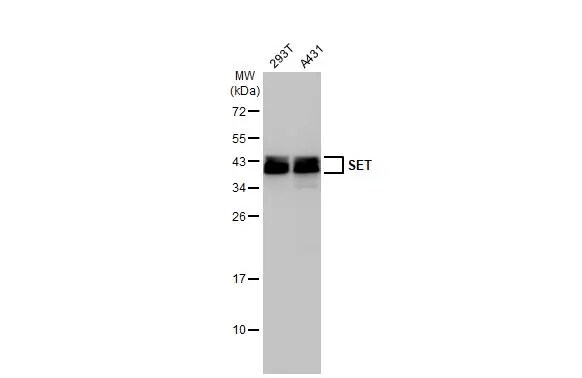
Western Blot: SET Antibody [NBP1-33713] -
Western Blot: SET Antibody [NBP1-33713] - Various whole cell extracts (30 ug) were separated by 12% SDS-PAGE, and the membrane was blotted with SET antibody (NBP1-33713) diluted at 1:1000. The HRP-conjugated anti-rabbit IgG antibody was used to detect the primary antibody.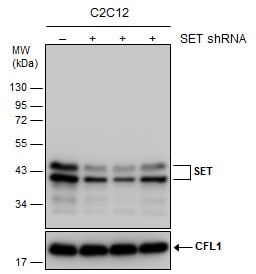
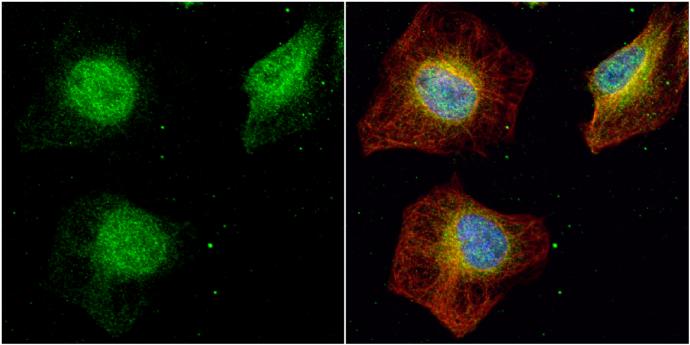
Immunocytochemistry/ Immunofluorescence: SET Antibody [NBP1-33713] -
SET antibody detects SET protein at cytoplasm and nucleus by immunofluorescent analysis.Sample: HeLa cells were fixed in 4% paraformaldehyde at RT for 15 min.
Green: SET protein stained by SET antibody (NBP1-33713) diluted at 1:500.
Red: alpha Tubulin, a cytoskeleton marker, stained by alpha Tubulin antibody [GT114] diluted at 1:1000.
Blue: Hoechst 33342 staining.
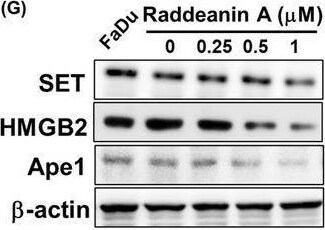
Western Blot: SET Antibody - BSA Free [NBP1-33713] -
Raddeanin A‐treated NK cells enhance apoptosis in FaDu cells. (A, B) Mitochondrial membrane potential assay and (C, D) annexin V/PI stain assay of FaDu cells were measured after Raddeanin A treatment by Muse Cell Analyser. Quantitative data were analysed by Muse Cell Software V1.4.0.0. (E) Fas protein levels of Raddeanin A‐induced apoptosis. FaDu cells were cocultured with KHYG‐1 cells at an effector: Target ratio of 6:1 And then treated with Raddeanin A for 24 h. (F) FaDu cells were treated with Raddeanin A for 24 h. Cell viability was assessed using WST‐8 assays. (G, H) Protein levels of Raddeanin A‐induced apoptosis. FaDu cells were cocultured with KHYG‐1 cells at an effector: Target ratio of 6:1 and then treated with Raddeanin A for 24 h. ImageJ was used for protein quantification; the levels of all proteins were normalized to that of beta ‐Actin. Data were presented as the mean +/- standard deviation (n = 3) of three independent experiments. *p < 0.05 compare with control; # p < 0.05 compare with cotreatment control. Image collected and cropped by CiteAb from the following open publication (https://pubmed.ncbi.nlm.nih.gov/39175122), licensed under a CC-BY license. Not internally tested by Novus Biologicals.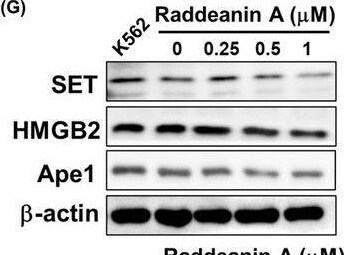
Western Blot: SET Antibody - BSA Free [NBP1-33713] -
Raddeanin A‐treated NK cells enhance apoptosis in K562 cells. Raddeanin A induced apoptosis in cocultured K562 cells. KHYG‐1 cells were pretreated with Raddeanin A for 24 h before being transferred to a co‐culture system. (A and B) Mitochondrial membrane potential assay and (C and D) annexin V/PI stain assay of K562 cells were measured after Raddeanin A treatment by Muse Cell Analyser. Quantitative data were analysed by Muse Cell Software V1.4.0.0. (E) Fas protein levels of Raddeanin A‐induced apoptosis. K562 cells were cocultured with KHYG‐1 cells at an effector: Target ratio of 6:1 And then treated with Raddeanin A for 24 h. (F) K562 cells were treated with Raddeanin A for 24 h. Cell viability was assessed using WST‐8 assays. (G, H) Protein levels of Raddeanin A‐induced apoptosis. K562 cells were cocultured with KHYG‐1 cells at an effector: Target ratio of 6:1 And then treated with Raddeanin A for 24 h. ImageJ was used for protein quantification; the levels of all proteins were normalized to that of beta ‐Actin. Data were presented as the mean +/- standard deviation (n = 3) of three independent experiments. *p < 0.05 compare with control; # p < 0.05 compare with cotreatment control. Image collected and cropped by CiteAb from the following open publication (https://pubmed.ncbi.nlm.nih.gov/39175122), licensed under a CC-BY license. Not internally tested by Novus Biologicals.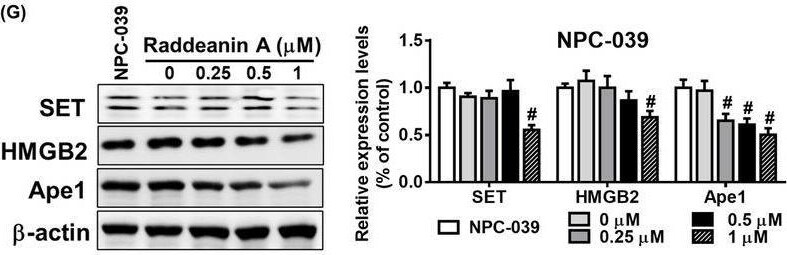
Western Blot: SET Antibody - BSA Free [NBP1-33713] -
Raddeanin A‐treated NK cells enhance apoptosis in NPC‐039 cells. (A, B) Mitochondrial membrane potential assay and (C, D) annexin V/PI stain assay of NPC‐039 cells were measured after Raddeanin A treatment by Muse Cell Analyser. Quantitative data were analysed by Muse Cell Software V1.4.0.0. (E) Fas protein levels of Raddeanin A‐induced apoptosis. NPC‐039 cells were cocultured with KHYG‐1 cells at an effector: Target ratio of 6:1 And then treated with Raddeanin A for 24 h. (F) NPC‐039 cells were treated with Raddeanin A for 24 h. Cell viability was assessed using WST‐8 assays. (G, H) Protein levels of Raddeanin A‐induced apoptosis. NPC‐039 cells were cocultured with KHYG‐1 cells at an effector: Target ratio of 6:1 And then treated with Raddeanin A for 24 h. ImageJ was used for protein quantification; the levels of all proteins were normalized to that of beta ‐Actin. Data were presented as the mean +/- standard deviation (n = 3) of three independent experiments. *p < 0.05 compare with control; # p < 0.05 compare with cotreatment control. Image collected and cropped by CiteAb from the following open publication (https://pubmed.ncbi.nlm.nih.gov/39175122), licensed under a CC-BY license. Not internally tested by Novus Biologicals.Applications for SET Antibody - BSA Free
Immunocytochemistry/ Immunofluorescence
Immunoprecipitation
Western Blot
Formulation, Preparation, and Storage
Purification
Formulation
Format
Preservative
Concentration
Shipping
Stability & Storage
Background: SET
Alternate Names
Entrez Gene IDs
Gene Symbol
UniProt
Additional SET Products
Product Documents for SET Antibody - BSA Free
Certificate of Analysis
To download a Certificate of Analysis, please enter a lot or batch number in the search box below.
Product Specific Notices for SET Antibody - BSA Free
This product is for research use only and is not approved for use in humans or in clinical diagnosis. Primary Antibodies are guaranteed for 1 year from date of receipt.
⚠ WARNING: This product can expose you to chemicals including mercury, which is known to the State of California to cause reproductive toxicity with developmental effects. For more information go to www.P65Warnings.ca.gov.Citations for SET Antibody - BSA Free
 Powered by Bioz
Customer Reviews for SET Antibody - BSA Free
There are currently no reviews for this product. Be the first to review SET Antibody - BSA Free and earn rewards!
Have you used SET Antibody - BSA Free?
Submit a review and receive an Amazon gift card!
$25/€18/£15/$25CAN/¥2500 for a review with an image
$10/€7/£6/$10CAN/¥1110 for a review without an image
Submit a review
Protocols
Find general support by application which include: protocols, troubleshooting, illustrated assays, videos and webinars.
- Appropriate Fixation of IHC/ICC Samples
- Cellular Response to Hypoxia Protocols
- ClariTSA™ Fluorophore Kits
- Detection & Visualization of Antibody Binding
- ICC Cell Smear Protocol for Suspension Cells
- ICC Immunocytochemistry Protocol Videos
- ICC for Adherent Cells
- Immunocytochemistry (ICC) Protocol
- Immunocytochemistry Troubleshooting
- Immunofluorescence of Organoids Embedded in Cultrex Basement Membrane Extract
- Immunohistochemistry (IHC) and Immunocytochemistry (ICC) Protocols
- Immunoprecipitation Protocol
- Preparing Samples for IHC/ICC Experiments
- Preventing Non-Specific Staining (Non-Specific Binding)
- Primary Antibody Selection & Optimization
- Protocol for VisUCyte™ HRP Polymer Detection Reagent
- Protocol for the Fluorescent ICC Staining of Cell Smears - Graphic
- Protocol for the Fluorescent ICC Staining of Cultured Cells on Coverslips - Graphic
- Protocol for the Preparation and Fluorescent ICC Staining of Cells on Coverslips
- Protocol for the Preparation and Fluorescent ICC Staining of Non-adherent Cells
- Protocol for the Preparation and Fluorescent ICC Staining of Stem Cells on Coverslips
- Protocol for the Preparation of a Cell Smear for Non-adherent Cell ICC - Graphic
- R&D Systems Quality Control Western Blot Protocol
- TUNEL and Active Caspase-3 Detection by IHC/ICC Protocol
- The Importance of IHC/ICC Controls
- Troubleshooting Guide: Western Blot Figures
- Western Blot Conditions
- Western Blot Protocol
- Western Blot Protocol for Cell Lysates
- Western Blot Troubleshooting
- Western Blot Troubleshooting Guide
- View all Protocols, Troubleshooting, Illustrated assays and Webinars