
Snail Antibody - BSA Free
Novus Biologicals | Catalog # NBP2-27293

![Western Blot: Snail AntibodyBSA Free [NBP2-27293]](https://resources.rndsystems.com/images/products/Snail-Antibody-Western-Blot-NBP2-27293-img0005.jpg "Western Blot: Snail AntibodyBSA Free [NBP2-27293]")
Scientific images may be resized, cropped, or adjusted for brightness or contrast for presentation purposes. These updates are limited to presentation and do not affect the underlying scientific interpretation of the data. Where available, additional source data may be provided upon request.
Key Product Details
Species Reactivity
Validated:
Human, Mouse
Cited:
Human
Predicted:
Rat (94%). Backed by our 100% Guarantee.
Applications
Validated:
Immunohistochemistry, Immunohistochemistry-Paraffin, Western Blot, Simple Western
Cited:
Immunohistochemistry-Paraffin, Western Blot, Immunocytochemistry/ Immunofluorescence, Simple Western, IF/IHC
Label
Unconjugated
Antibody Source
Polyclonal Rabbit IgG
Format
BSA Free
Loading...
Product Specifications
Immunogen
A portion of amino acids 1-60 of human SNAI1 was used as the immunogen.
Reactivity Notes
The amino acid sequence used as immunogen is 61% homologous with human SNAI2 protein.
Clonality
Polyclonal
Host
Rabbit
Isotype
IgG
Scientific Data Images for Snail Antibody - BSA Free
Western Blot: Snail AntibodyBSA Free [NBP2-27293]
Snail-Antibody-Western-Blot-NBP2-27293-img0005.jpg![Immunohistochemistry-Paraffin: Snail Antibody - BSA Free [NBP2-27293]](https://resources.rndsystems.com/images/products/Snail-Antibody-Immunohistochemistry-Paraffin-NBP2-27293-img0007.jpg "Immunohistochemistry-Paraffin: Snail Antibody - BSA Free [NBP2-27293]")
Immunohistochemistry-Paraffin: Snail Antibody - BSA Free [NBP2-27293]
Immunohistochemistry-Paraffin: Snail Antibody [NBP2-27293] - Analysis of a FFPE tissue section of mouse placenta using 1:200 dilution of SNAIL antibody. The staining was developed using HRP labeled anti-rabbit secondary antibody and DAB reagent, and nuclei of cells were counter-stained with hematoxylin.![Western Blot: Snail AntibodyBSA Free [NBP2-27293]](https://resources.rndsystems.com/images/products/Snail-Antibody-Western-Blot-NBP2-27293-img0006.jpg "Western Blot: Snail AntibodyBSA Free [NBP2-27293]")
Western Blot: Snail AntibodyBSA Free [NBP2-27293]
Snail-Antibody-Western-Blot-NBP2-27293-img0006.jpg![Immunohistochemistry-Paraffin: Snail Antibody - BSA Free [NBP2-27293]](https://resources.rndsystems.com/images/products/Snail-Antibody-Immunohistochemistry-Paraffin-NBP2-27293-img0004.jpg "Immunohistochemistry-Paraffin: Snail Antibody - BSA Free [NBP2-27293]")
Immunohistochemistry-Paraffin: Snail Antibody - BSA Free [NBP2-27293]
Immunohistochemistry-Paraffin: Snail Antibody [NBP2-27293] - Analysis of in FFPE human kidney tissue using this antibody at 5 ug/mL.![Simple Western: Snail AntibodyBSA Free [NBP2-27293]](https://resources.rndsystems.com/images/products/Snail-Antibody-Simple-Western-NBP2-27293-img0002.jpg "Simple Western: Snail AntibodyBSA Free [NBP2-27293]")
Simple Western: Snail AntibodyBSA Free [NBP2-27293]
Simple Western: Snail Antibody [NBP2-27293] - Image shows a specific band for SNAIL in 0.5 mg/mL of MCF-7 lysate. This experiment was performed under reducing conditions using the 12-230 kDa separation system.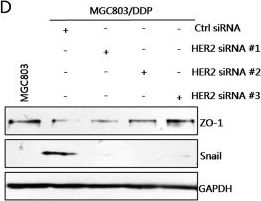
Western Blot: Snail Antibody - BSA Free [NBP2-27293] -
Western Blot: Snail Antibody - BSA Free [NBP2-27293] - SiRNAs against HER2 could abrogate the EMT phenotype & cell invasiveness in cisplatin-resistant gastric cancer cells.(A) Validation of silencing efficiency of HER2. Cells were transiently transfected with 50 nM HER2-specific siRNAs #1-#3 or a control siRNA for 48 h. (B) Knock-down of HER2 abrogated EMT morphology. Cells were transiently transfected with 50 nM specific siRNAs targeting HER2 for 48 h, Representative images of cellular morphology were shown. (C) Knock-down of HER2 abolished EMT phenotype. Cells were treated as in Fig. 4B. FITC-phalloidin staining of F-actin were performed & representative images were shown. (D) Effects of HER2 knock-down on the levels of ZO1 & Snail. (E) Effects of HER2 knock-down on cell migration. Representative images of transwell cell migration assay were shown. (F) Summary of Fig. 4E. Values represented the mean ± SD from three independent experiments with triplicate samples. *P < 0.01. Image collected & cropped by CiteAb from the following publication (https://pubmed.ncbi.nlm.nih.gov/26846307), licensed under a CC-BY license. Not internally tested by Novus Biologicals.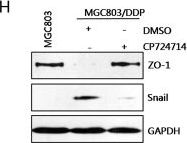
Western Blot: Snail Antibody - BSA Free [NBP2-27293] -
Western Blot: Snail Antibody - BSA Free [NBP2-27293] - HER2 is overexpressed & both Herceptin incubation & siRNAs against HER2 reversed the EMT in cisplatin-resistant gastric cancer cells.(A) Western blot of HER2 in MGC803/DDP & AGS/DDP cell lines, & parental MGC803 & AGS cells. GAPDH was used as loading control. (B) Relative amplification of HER2 in parental & cisplatin-resistant cells. Results were presented as the mean ± SD of two independent experiments, *P < 0.05 compared with parental cells. (C) Herceptin incubation abrogated EMT morphology in MGC803/DDP cells. Representative images of cellular morphology of MGC803/DDP cells, plus parental MGC803 cells treated with Herceptin for 24 h were shown. Hercep represents Herceptin. (D) Herceptin incubation reversed EMT morphology in MGC803/DDP cells. Representative images of FITC-phalloidin staining of F-actin after 100 μg/ml Herceptin treatment for 24 h were shown. (E) Effects of Herceptin on levels of ZO1 & Snail. (F) CP724714 treatment abolished EMT-like cell morphology. Cells were incubated with 10 μM CP724714 for 24 h. Representative images of cellular morphology of were captured. (G) CP724714 treatment abrogated EMT-like cell morphology. Cells were treated as in Fig. 4F, FITC-phalloidin staining of F-actin was performed & typical images were shown. (H) Effects of CP724714 on ZO1 & Snail. (I) CP724714 inhibited the increased cell migration in cisplatin-resistant gastric cancer cells. Representative images were presented here. (J) CP724714 inhibited the increased cell migration in cisplatin-resistant gastric cancer cells. Values represented the mean ± SD from three independent experiments with triplicate samples. *P < 0.01. Image collected & cropped by CiteAb from the following publication (https://pubmed.ncbi.nlm.nih.gov/26846307), licensed under a CC-BY license. Not internally tested by Novus Biologicals.Applications for Snail Antibody - BSA Free
Application
Recommended Usage
Immunohistochemistry
1:200. Use reported in scientific literature (PMID 30488343)
Immunohistochemistry-Paraffin
1:200
Simple Western
1:500
Western Blot
1 - 2 ug/ml. Use reported in scientific literature (PMID 28260923)
Application Notes
In Simple Western only 10 - 15 uL of the recommended dilution is used per data point.
See Simple Western Antibody Database for Simple Western validation: Tested in 12Z, Ovaries; separated by Size; antibody dilution of 1:25
See Simple Western Antibody Database for Simple Western validation: Tested in 12Z, Ovaries; separated by Size; antibody dilution of 1:25
Formulation, Preparation, and Storage
Purification
Immunogen affinity purified
Formulation
PBS
Format
BSA Free
Preservative
0.05% Sodium Azide
Concentration
1.0 mg/ml
Shipping
The product is shipped with polar packs. Upon receipt, store it immediately at the temperature recommended below.
Stability & Storage
Store at 4C short term. Aliquot and store at -20C long term. Avoid freeze-thaw cycles.
Background: Snail
In addition to its role in embryonic development, Snail-induced EMT is also associated with cancer metastasis (1-5). Snail is expressed in a variety of cancer lines including breast cancer, cervical carcinoma, and colorectal carcinoma, and typically results in increased migration, invasion, and metastasis (1). Accordingly, Snail expression is also correlated with drug resistance and tumor recurrence (1-5). Chemical inhibitors that target Snail have shown some promise in reducing or eliminating Snail-induced EMT, increasing E-cadherin expression, and increasing tumor regression (1).
1. Kaufhold, S., & Bonavida, B. (2014). Central role of Snail1 in the regulation of EMT and resistance in cancer: a target for therapeutic intervention. Journal of Experimental & Clinical Cancer Research. https://doi.org/10.1186/s13046-014-0062-0
2. Wang, Y., Shi, J., Chai, K., Ying, X., & Zhou, B. P. (2013). The Role of Snail in EMT and Tumorigenesis. Current Cancer Drug Targets. https://doi.org/10.2174/15680096113136660102
3. Kang, E., Seo, J., Yoon, H., & Cho, S. (2021). The Post-Translational Regulation of Epithelial-Mesenchymal Transition-Inducing Transcription Factors in Cancer Metastasis. International Journal of Molecular Sciences. https://doi.org/10.3390/ijms22073591
4. Seo, J., Ha, J., Kang, E., & Cho, S. (2021). The role of epithelial-mesenchymal transition-regulating transcription factors in anti-cancer drug resistance. Archives of Pharmacal Research. https://doi.org/10.1007/s12272-021-01321-x
5. Baulida, J., Diaz, V. M., & Herreros, A. G. (2019). Snail1: A Transcriptional Factor Controlled at Multiple Levels. Journal of Clinical Medicine. https://doi.org/10.3390/jcm8060757
Additional Snail Products
Product Documents for Snail Antibody - BSA Free
Certificate of Analysis
To download a Certificate of Analysis, please enter a lot or batch number in the search box below.
Product Specific Notices for Snail Antibody - BSA Free
This product is for research use only and is not approved for use in humans or in clinical diagnosis. Primary Antibodies are guaranteed for 1 year from date of receipt.
Citations for Snail Antibody - BSA Free
 Powered by Bioz
Customer Reviews for Snail Antibody - BSA Free
There are currently no reviews for this product. Be the first to review Snail Antibody - BSA Free and earn rewards!
Have you used Snail Antibody - BSA Free?
Submit a review and receive an Amazon gift card!
$25/€18/£15/$25CAN/¥2500 for a review with an image
$10/€7/£6/$10CAN/¥1110 for a review without an image
Submit a review
Protocols
Find general support by application which include: protocols, troubleshooting, illustrated assays, videos and webinars.
- Antigen Retrieval Protocol (PIER)
- Antigen Retrieval for Frozen Sections Protocol
- Appropriate Fixation of IHC/ICC Samples
- Cellular Response to Hypoxia Protocols
- Chromogenic IHC Staining of Formalin-Fixed Paraffin-Embedded (FFPE) Tissue Protocol
- Chromogenic Immunohistochemistry Staining of Frozen Tissue
- ClariTSA™ Fluorophore Kits
- Detection & Visualization of Antibody Binding
- Fluorescent IHC Staining of Frozen Tissue Protocol
- Graphic Protocol for Heat-induced Epitope Retrieval
- Graphic Protocol for the Preparation and Fluorescent IHC Staining of Frozen Tissue Sections
- Graphic Protocol for the Preparation and Fluorescent IHC Staining of Paraffin-embedded Tissue Sections
- Graphic Protocol for the Preparation of Gelatin-coated Slides for Histological Tissue Sections
- IHC Sample Preparation (Frozen sections vs Paraffin)
- Immunofluorescent IHC Staining of Formalin-Fixed Paraffin-Embedded (FFPE) Tissue Protocol
- Immunohistochemistry (IHC) and Immunocytochemistry (ICC) Protocols
- Immunohistochemistry Frozen Troubleshooting
- Immunohistochemistry Paraffin Troubleshooting
- Preparing Samples for IHC/ICC Experiments
- Preventing Non-Specific Staining (Non-Specific Binding)
- Primary Antibody Selection & Optimization
- Protocol for Heat-Induced Epitope Retrieval (HIER)
- Protocol for Making a 4% Formaldehyde Solution in PBS
- Protocol for VisUCyte™ HRP Polymer Detection Reagent
- Protocol for the Preparation & Fixation of Cells on Coverslips
- Protocol for the Preparation and Chromogenic IHC Staining of Frozen Tissue Sections
- Protocol for the Preparation and Chromogenic IHC Staining of Frozen Tissue Sections - Graphic
- Protocol for the Preparation and Chromogenic IHC Staining of Paraffin-embedded Tissue Sections
- Protocol for the Preparation and Chromogenic IHC Staining of Paraffin-embedded Tissue Sections - Graphic
- Protocol for the Preparation and Fluorescent IHC Staining of Frozen Tissue Sections
- Protocol for the Preparation and Fluorescent IHC Staining of Paraffin-embedded Tissue Sections
- Protocol for the Preparation of Gelatin-coated Slides for Histological Tissue Sections
- R&D Systems Quality Control Western Blot Protocol
- TUNEL and Active Caspase-3 Detection by IHC/ICC Protocol
- The Importance of IHC/ICC Controls
- Troubleshooting Guide: Immunohistochemistry
- Troubleshooting Guide: Western Blot Figures
- Western Blot Conditions
- Western Blot Protocol
- Western Blot Protocol for Cell Lysates
- Western Blot Troubleshooting
- Western Blot Troubleshooting Guide
- View all Protocols, Troubleshooting, Illustrated assays and Webinars
FAQs for Snail Antibody - BSA Free
Showing
1
-
2 of
2 FAQs
Showing All
-
Q: Could you please let me know the secondary antibody recommended for this particular primary antibody (Catalog NumberNBP2-27293) so that I could order both primary & secondary antibodies.
A: Our SNAIL antibody with catalogue number NBP2-27293 is a rabbit polyclonal, and as such you would require an anti-rabbit secondary to detect it. You can see our full range of anti-rabbit secondary antibodies at the following link, and by using the search filters at the left hand side of the webpage you can select a suitably conjugated product for your research: View Secondary Antibodies
-
Q: There are many kinds of antibodies you supply against SNAIL. Could you give me your recommendation? Which is the best for the IHC-P experiments the species of my samples to be tested is human.
A:
Our SNAIL antibody with catalog # NBP1-19529 has been successfully validated for IHC-P in paraffin-embedded human lung carcinoma tissue and I would highly recommend you to use the same for your samples too. The working dilutions of this antibody for IHC-P ranges from 1:50 - 1:200 and beside IHC, you can use this antibody for Western Blot and Immunofluorescence also.
-
Q: Could you please let me know the secondary antibody recommended for this particular primary antibody (Catalog NumberNBP2-27293) so that I could order both primary & secondary antibodies.
A: Our SNAIL antibody with catalogue number NBP2-27293 is a rabbit polyclonal, and as such you would require an anti-rabbit secondary to detect it. You can see our full range of anti-rabbit secondary antibodies at the following link, and by using the search filters at the left hand side of the webpage you can select a suitably conjugated product for your research: View Secondary Antibodies
-
Q: There are many kinds of antibodies you supply against SNAIL. Could you give me your recommendation? Which is the best for the IHC-P experiments the species of my samples to be tested is human.
A:
Our SNAIL antibody with catalog # NBP1-19529 has been successfully validated for IHC-P in paraffin-embedded human lung carcinoma tissue and I would highly recommend you to use the same for your samples too. The working dilutions of this antibody for IHC-P ranges from 1:50 - 1:200 and beside IHC, you can use this antibody for Western Blot and Immunofluorescence also.
Loading...
Associated Pathways
