
TDO2 Antibody - Azide and BSA Free
Novus Biologicals | Catalog # H00006999-B01P

![Knockout Validated: TDO2 Antibody [H00006999-B01P]](https://resources.rndsystems.com/images/products/TDO2-Antibody-Western-Blot-H00006999-B01P-img0006.jpg "Western Blot: TDO2 Antibody [H00006999-B01P]")
Scientific images may be resized, cropped, or adjusted for brightness or contrast for presentation purposes. These updates are limited to presentation and do not affect the underlying scientific interpretation of the data. Where available, additional source data may be provided upon request.
Key Product Details
Validated by
Species Reactivity
Validated:
Cited:
Applications
Validated:
Cited:
Label
Antibody Source
Format
Product Specifications
Immunogen
Reactivity Notes
Specificity
Clonality
Host
Isotype
Description
Scientific Data Images for TDO2 Antibody - Azide and BSA Free
![Western Blot: TDO2 Antibody [H00006999-B01P]](https://resources.rndsystems.com/images/products/TDO2-Antibody-Western-Blot-H00006999-B01P-img0005.jpg "Western Blot: TDO2 Antibody [H00006999-B01P]")
Western Blot: TDO2 Antibody [H00006999-B01P]
Western Blot: TDO2 Antibody [H00006999-B01P] - Analysis of TDO2 expression in transfected 293T cell line by TDO2 polyclonal antibody. Lane 1: TDO2 transfected lysate(44.66 KDa). Lane 2: Non-transfected lysate.![Immunohistochemistry: TDO2 Antibody [H00006999-B01P]](https://resources.rndsystems.com/images/products/TDO2-Antibody-Immunocytochemistry-Immunofluorescence-H00006999-B01P-img0009.jpg "Immunohistochemistry: TDO2 Antibody [H00006999-B01P]")
Immunohistochemistry: TDO2 Antibody [H00006999-B01P]
TDO2-Antibody-Immunocytochemistry-Immunofluorescence-H00006999-B01P-img0009.jpg![Western Blot: TDO2 Antibody [H00006999-B01P]](https://resources.rndsystems.com/images/products/TDO2-Antibody-Western-Blot-H00006999-B01P-img0004.jpg "Western Blot: TDO2 Antibody [H00006999-B01P]")
Western Blot: TDO2 Antibody [H00006999-B01P]
Western Blot: TDO2 Antibody [H00006999-B01P] - Analysis of TDO2 expression in human liver.![Immunohistochemistry: TDO2 Antibody [H00006999-B01P]](https://resources.rndsystems.com/images/products/TDO2-Antibody-Immunocytochemistry-Immunofluorescence-H00006999-B01P-img0007.jpg "Immunohistochemistry: TDO2 Antibody [H00006999-B01P]")
Immunohistochemistry: TDO2 Antibody [H00006999-B01P]
TDO2-Antibody-Immunocytochemistry-Immunofluorescence-H00006999-B01P-img0007.jpg![Immunohistochemistry: TDO2 Antibody [H00006999-B01P]](https://resources.rndsystems.com/images/products/TDO2-Antibody-Immunocytochemistry-Immunofluorescence-H00006999-B01P-img0008.jpg "Immunohistochemistry: TDO2 Antibody [H00006999-B01P]")
Immunohistochemistry: TDO2 Antibody [H00006999-B01P]
TDO2-Antibody-Immunocytochemistry-Immunofluorescence-H00006999-B01P-img0008.jpg![Immunohistochemistry: TDO2 Antibody [H00006999-B01P]](https://resources.rndsystems.com/images/products/TDO2-Antibody-Immunohistochemistry-H00006999-B01P-img0010.jpg "Immunohistochemistry: TDO2 Antibody [H00006999-B01P]")
Immunohistochemistry: TDO2 Antibody [H00006999-B01P]
TDO2-Antibody-Immunohistochemistry-H00006999-B01P-img0010.jpg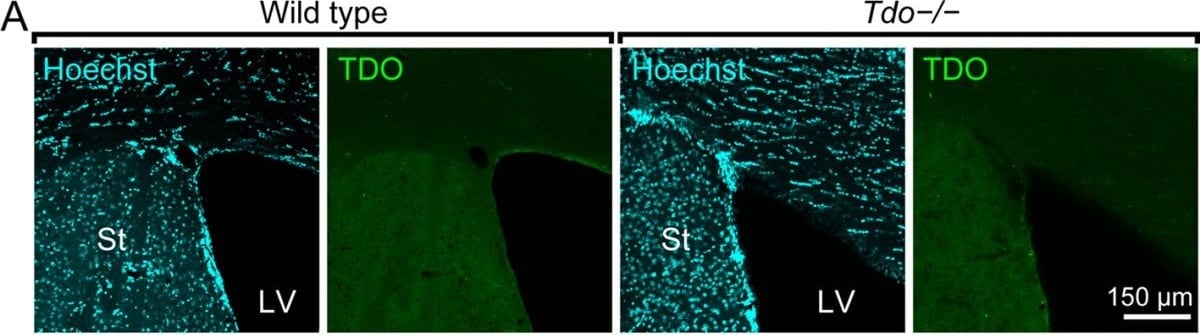
Immunocytochemistry/ Immunofluorescence: TDO2 Antibody [H00006999-B01P] -
Immunocytochemistry/ Immunofluorescence: TDO2 Antibody [H00006999-B01P] - Immunoreactivity of TDO in the SVZ, the olfactory bulb, & the cerebellum. A & B: TDO was not stained in the SVZ (A) & the olfactory bulb (OB) (B). The immunoreactivities for TDO in wild type & Tdo-/- mice were background level. C: In the cerebellum, the immunoreactivity for TDO was observed in granule cells & Purkinje cells of wild type mice, but these positive structures disappeared in Tdo-/- mice. The cytoarchitectural organization of Tdo-/- mice was the same as that of wild type mice. E, external plexiform layer; G, granule cell layer; Gm, glomerular layer; I, internal plexiform layer; LV, lateral ventricle; Mi, mitral cell layer; Mo, molecular layer; P, Purkinje cell layer; St, striatum; Su, subependymal zone. Image collected & cropped by CiteAb from the following publication (https://pubmed.ncbi.nlm.nih.gov/20815922), licensed under a CC-BY license. Not internally tested by Novus Biologicals.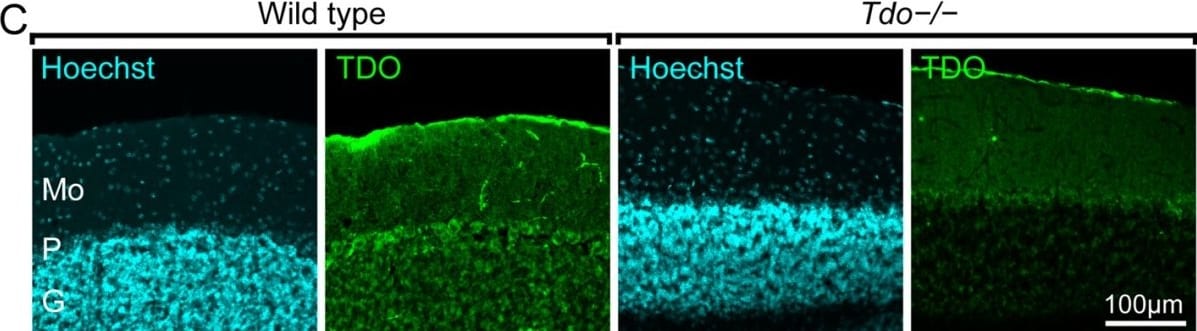
Immunocytochemistry/ Immunofluorescence: TDO2 Antibody [H00006999-B01P] -
Immunocytochemistry/ Immunofluorescence: TDO2 Antibody [H00006999-B01P] - Immunoreactivity of TDO in the SVZ, the olfactory bulb, & the cerebellum. A & B: TDO was not stained in the SVZ (A) & the olfactory bulb (OB) (B). The immunoreactivities for TDO in wild type & Tdo-/- mice were background level. C: In the cerebellum, the immunoreactivity for TDO was observed in granule cells & Purkinje cells of wild type mice, but these positive structures disappeared in Tdo-/- mice. The cytoarchitectural organization of Tdo-/- mice was the same as that of wild type mice. E, external plexiform layer; G, granule cell layer; Gm, glomerular layer; I, internal plexiform layer; LV, lateral ventricle; Mi, mitral cell layer; Mo, molecular layer; P, Purkinje cell layer; St, striatum; Su, subependymal zone. Image collected & cropped by CiteAb from the following publication (https://pubmed.ncbi.nlm.nih.gov/20815922), licensed under a CC-BY license. Not internally tested by Novus Biologicals.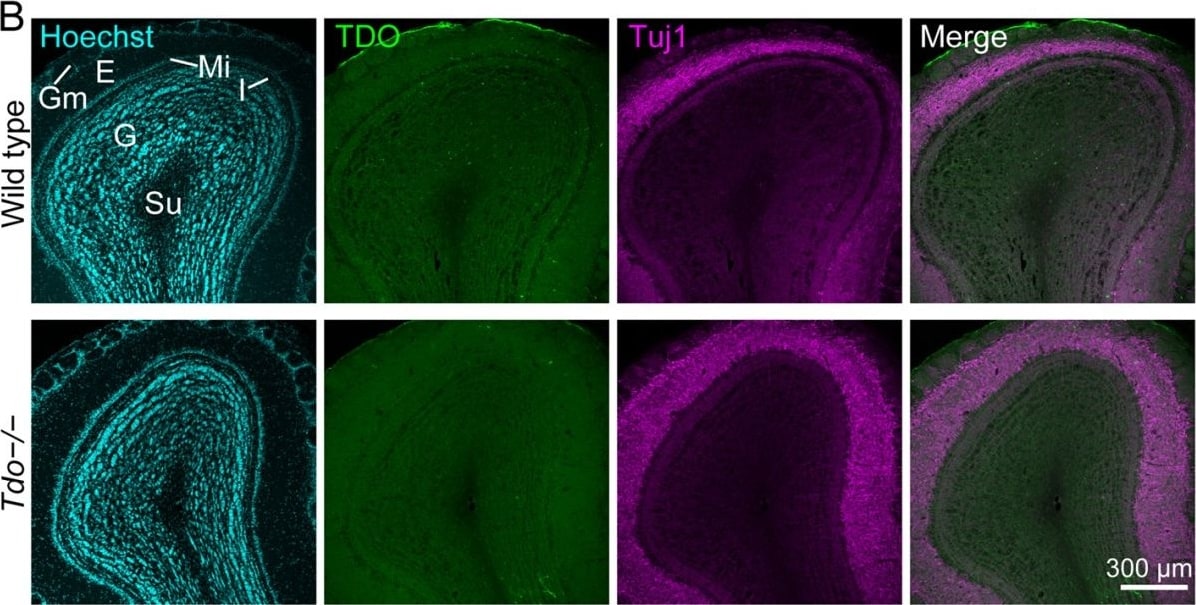
Immunocytochemistry/ Immunofluorescence: TDO2 Antibody [H00006999-B01P] -
Immunocytochemistry/ Immunofluorescence: TDO2 Antibody [H00006999-B01P] - Immunoreactivity of TDO in the SVZ, the olfactory bulb, & the cerebellum. A & B: TDO was not stained in the SVZ (A) & the olfactory bulb (OB) (B). The immunoreactivities for TDO in wild type & Tdo-/- mice were background level. C: In the cerebellum, the immunoreactivity for TDO was observed in granule cells & Purkinje cells of wild type mice, but these positive structures disappeared in Tdo-/- mice. The cytoarchitectural organization of Tdo-/- mice was the same as that of wild type mice. E, external plexiform layer; G, granule cell layer; Gm, glomerular layer; I, internal plexiform layer; LV, lateral ventricle; Mi, mitral cell layer; Mo, molecular layer; P, Purkinje cell layer; St, striatum; Su, subependymal zone. Image collected & cropped by CiteAb from the following publication (https://pubmed.ncbi.nlm.nih.gov/20815922), licensed under a CC-BY license. Not internally tested by Novus Biologicals.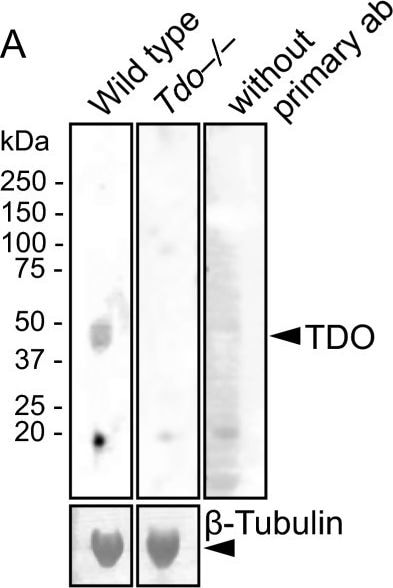
Western Blot: TDO2 Antibody [H00006999-B01P] -
Western Blot: TDO2 Antibody [H00006999-B01P] - Specificity of antibodies for tryptophan 2,3-dioxygenase (TDO) by Western blot (A) & immunofluorescent staining (B). A: The total protein (20 μg) of the dentate gyrus, extracted from the wild-type (lanes 1 & 3) & Tdo-/- mice (lane 2), was subjected to 4% to 12% gradient sodium dodecyl sulfate polyacrylamide gel electrophoresis, & transferred to polyvinylidene difluoride membranes. TDO was detected as described in the Methods section. Note that a 45-kDa band was detected with the anti-TDO antibody. The positions of molecular weight markers are shown on the left. Lane 3: negative control without the primary antibody. beta -Tubulin is a positive control for the Western blot. B: The hippocampal sections of wild-type & Tdo-/- mice were stained with anti-TDO antibody. In sections of Tdo-/- mice, immunofluorescence signals were not detected in granule cells, interneurons (arrowhead), CA1, or CA3 cells, suggesting that the secondary antibody used in this study bound specifically to the primary antibody (mouse IgG). g, granule cell layer; h, hilus. Image collected & cropped by CiteAb from the following publication (https://pubmed.ncbi.nlm.nih.gov/20815922), licensed under a CC-BY license. Not internally tested by Novus Biologicals.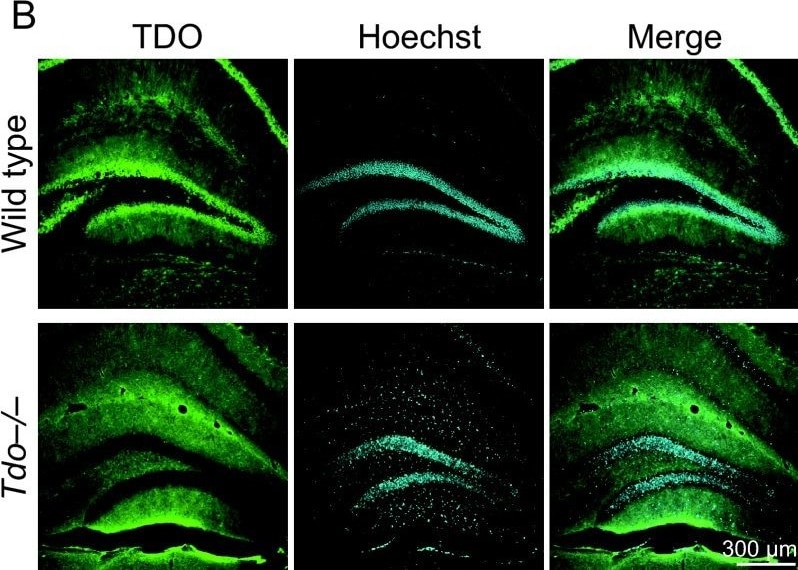
Immunohistochemistry: TDO2 Antibody [H00006999-B01P] -
Immunohistochemistry: TDO2 Antibody [H00006999-B01P] - Specificity of antibodies for tryptophan 2,3-dioxygenase (TDO) by Western blot (A) & immunofluorescent staining (B). A: The total protein (20 μg) of the dentate gyrus, extracted from the wild-type (lanes 1 & 3) & Tdo-/- mice (lane 2), was subjected to 4% to 12% gradient sodium dodecyl sulfate polyacrylamide gel electrophoresis, & transferred to polyvinylidene difluoride membranes. TDO was detected as described in the Methods section. Note that a 45-kDa band was detected with the anti-TDO antibody. The positions of molecular weight markers are shown on the left. Lane 3: negative control without the primary antibody. beta -Tubulin is a positive control for the Western blot. B: The hippocampal sections of wild-type & Tdo-/- mice were stained with anti-TDO antibody. In sections of Tdo-/- mice, immunofluorescence signals were not detected in granule cells, interneurons (arrowhead), CA1, or CA3 cells, suggesting that the secondary antibody used in this study bound specifically to the primary antibody (mouse IgG). g, granule cell layer; h, hilus. Image collected & cropped by CiteAb from the following publication (https://pubmed.ncbi.nlm.nih.gov/20815922), licensed under a CC-BY license. Not internally tested by Novus Biologicals.Applications for TDO2 Antibody - Azide and BSA Free
Western Blot
Formulation, Preparation, and Storage
Purification
Formulation
Format
Preservative
Concentration
Shipping
Stability & Storage
Background: TDO2
Long Name
Alternate Names
Entrez Gene IDs
Gene Symbol
UniProt
Additional TDO2 Products
Product Documents for TDO2 Antibody - Azide and BSA Free
Certificate of Analysis
To download a Certificate of Analysis, please enter a lot or batch number in the search box below.
Product Specific Notices for TDO2 Antibody - Azide and BSA Free
This product is produced by and distributed for Abnova, a company based in Taiwan.
This product is for research use only and is not approved for use in humans or in clinical diagnosis. Primary Antibodies are guaranteed for 1 year from date of receipt.
Related Research Areas
Citations for TDO2 Antibody - Azide and BSA Free
 Powered by Bioz
Customer Reviews for TDO2 Antibody - Azide and BSA Free
There are currently no reviews for this product. Be the first to review TDO2 Antibody - Azide and BSA Free and earn rewards!
Have you used TDO2 Antibody - Azide and BSA Free?
Submit a review and receive an Amazon gift card!
$25/€18/£15/$25CAN/¥2500 for a review with an image
$10/€7/£6/$10CAN/¥1110 for a review without an image
Submit a review
Protocols
Find general support by application which include: protocols, troubleshooting, illustrated assays, videos and webinars.
- Antigen Retrieval Protocol (PIER)
- Antigen Retrieval for Frozen Sections Protocol
- Appropriate Fixation of IHC/ICC Samples
- Cellular Response to Hypoxia Protocols
- Chromogenic IHC Staining of Formalin-Fixed Paraffin-Embedded (FFPE) Tissue Protocol
- Chromogenic Immunohistochemistry Staining of Frozen Tissue
- ClariTSA™ Fluorophore Kits
- Detection & Visualization of Antibody Binding
- Fluorescent IHC Staining of Frozen Tissue Protocol
- Graphic Protocol for Heat-induced Epitope Retrieval
- Graphic Protocol for the Preparation and Fluorescent IHC Staining of Frozen Tissue Sections
- Graphic Protocol for the Preparation and Fluorescent IHC Staining of Paraffin-embedded Tissue Sections
- Graphic Protocol for the Preparation of Gelatin-coated Slides for Histological Tissue Sections
- IHC Sample Preparation (Frozen sections vs Paraffin)
- Immunofluorescent IHC Staining of Formalin-Fixed Paraffin-Embedded (FFPE) Tissue Protocol
- Immunohistochemistry (IHC) and Immunocytochemistry (ICC) Protocols
- Immunohistochemistry Frozen Troubleshooting
- Immunohistochemistry Paraffin Troubleshooting
- Preparing Samples for IHC/ICC Experiments
- Preventing Non-Specific Staining (Non-Specific Binding)
- Primary Antibody Selection & Optimization
- Protocol for Heat-Induced Epitope Retrieval (HIER)
- Protocol for Making a 4% Formaldehyde Solution in PBS
- Protocol for VisUCyte™ HRP Polymer Detection Reagent
- Protocol for the Preparation & Fixation of Cells on Coverslips
- Protocol for the Preparation and Chromogenic IHC Staining of Frozen Tissue Sections
- Protocol for the Preparation and Chromogenic IHC Staining of Frozen Tissue Sections - Graphic
- Protocol for the Preparation and Chromogenic IHC Staining of Paraffin-embedded Tissue Sections
- Protocol for the Preparation and Chromogenic IHC Staining of Paraffin-embedded Tissue Sections - Graphic
- Protocol for the Preparation and Fluorescent IHC Staining of Frozen Tissue Sections
- Protocol for the Preparation and Fluorescent IHC Staining of Paraffin-embedded Tissue Sections
- Protocol for the Preparation of Gelatin-coated Slides for Histological Tissue Sections
- R&D Systems Quality Control Western Blot Protocol
- TUNEL and Active Caspase-3 Detection by IHC/ICC Protocol
- The Importance of IHC/ICC Controls
- Troubleshooting Guide: Immunohistochemistry
- Troubleshooting Guide: Western Blot Figures
- Western Blot Conditions
- Western Blot Protocol
- Western Blot Protocol for Cell Lysates
- Western Blot Troubleshooting
- Western Blot Troubleshooting Guide
- View all Protocols, Troubleshooting, Illustrated assays and Webinars
FAQs for TDO2 Antibody - Azide and BSA Free
-
Q: Why do you guys see two different molecular weight bands, one around 46 kDa in HEK cell lysates and the other around 50 kDa in liver lysates?
A: From the data I have available, the reason you see the molecular weight running slightly lower in the HEK lysate is because these cells were transfected with a partial length protein (a few aa short of the full length). The liver lysate will show you the correct sizing of the endogenous expression. The theoretical molecular weight of this protein is ~48kDa. However the observed weight can vary slightly due to your experimental conditions.