
TiterTACS In Situ Detection Kit - Colorimetric
R&D Systems | Catalog # 4822-96-K
Identification and quantitation of apoptosis in cultured cells in a 96 well assay.

Discontinued Product
4822-96-K has been discontinued.
View all TUNEL Assays products.
Key Product Details
Features
TUNEL based assay for high throughput quantitative detection of apoptosis.
Key Benefits
- Convenient, 96 well microplate format.
- Quantitative colorimetric detection.
- Includes both Proteinase K and exclusive Cytonin non-enzymatic permeabilization reagents.
- Includes TACS-Nuclease solution for preparing sample-dependent positive controls.
Species
Multi-Species
Product Summary for TiterTACS In Situ Detection Kit - Colorimetric
Why Use the TiterRACS In Situ Apoptosis Detection Kit?
During the process of apoptosis, DNA fragmentation occurs following the activation of endonucleases. The labeling of the 3’ ends of DNA fragments provides an easy measure of cells undergoing apoptosis. Modified nucleotides are incorporated at the 3’ ends by the activity of terminal deoxynucleotidyl transferase (TdT).
The TiterTACS Colorimetric Apoptosis Detection Kit is a TUNEL based assay utilizing specific in situ labeling technology that enables a 96 well microplate format for high throughput quantitative detection of apoptosis. TiterTACS can be used with suspension or monolayer cells. The kit is designed to use fixed samples, allowing you to work safely with samples that are infected with biohazardous agents. Fixed samples may be stored conveniently during time-course experiments. The TiterTACS Kit also provides TACS-Nuclease solution to generate positive controls from your own samples giving you a maximal value for the assay.
Detection using TACS-Sapphire, a non-toxic colorimetric substrate, allows both kinetic and endpoint readings. The reaction generates a blue product that can be measured at 630 nm, and will turn yellow after the reaction is stopped with acid allowing endpoint reading at 450 nm.
The TiterTACS Colorimetric Apoptosis Detection Kit is a TUNEL based assay utilizing specific in situ labeling technology that enables a 96 well microplate format for high throughput quantitative detection of apoptosis. TiterTACS can be used with suspension or monolayer cells. The kit is designed to use fixed samples, allowing you to work safely with samples that are infected with biohazardous agents. Fixed samples may be stored conveniently during time-course experiments. The TiterTACS Kit also provides TACS-Nuclease solution to generate positive controls from your own samples giving you a maximal value for the assay.
Detection using TACS-Sapphire, a non-toxic colorimetric substrate, allows both kinetic and endpoint readings. The reaction generates a blue product that can be measured at 630 nm, and will turn yellow after the reaction is stopped with acid allowing endpoint reading at 450 nm.
Loading...
Scientific Data Images for TiterTACS In Situ Detection Kit - Colorimetric
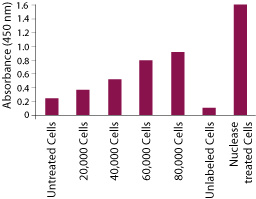
Detection of Apoptosis in Staurosporine-treated ML-1 Cells.
Human ML-1 myeloblastic leukemia cells were treated with 1 µM staurosporine and then harvested, fixed, and labeled according to the protocol in the TiterTACS In Situ Detection Kit (Catalog # 4822-96-K) prior to colorimetric analysis.Kit Contents for TiterTACS In Situ Detection Kit - Colorimetric
- Proteinase K
- Streptavidin-HRP
- Blue Strep-HRP Diluent
- TACS-Nuclease
- TACS-Nuclease Buffer
- TACS 2 TdT dNTP
- 50x Manganese Cation
- 10X TdT Labeling Buffer
- 10X TdT Stop Buffer
- TdT Enzyme
- TACS-Sapphire
- Cytonin
Formulation, Preparation, and Storage
Shipping
The components for this kit may require different storage/shipping temperatures and may arrive in separate packaging. Upon receipt, store products immediately at the temperature recommended on the product labels.
Storage
Store the unopened product at -20 to -70 °C. Use a manual defrost freezer and avoid repeated freeze-thaw cycles. Do not use past expiration date.
Product Documents for TiterTACS In Situ Detection Kit - Colorimetric
Certificate of Analysis
To download a Certificate of Analysis, please enter a lot or batch number in the search box below.
Note: Certificate of Analysis not available for kit components.
Citations for TiterTACS In Situ Detection Kit - Colorimetric
 Powered by Bioz
Customer Reviews for TiterTACS In Situ Detection Kit - Colorimetric (1)
3 out of 5
1 Customer Rating
Have you used TiterTACS In Situ Detection Kit - Colorimetric?
Submit a review and receive an Amazon gift card!
$25/€18/£15/$25CAN/¥2500 for a review with an image
$10/€7/£6/$10CAN/¥1110 for a review without an image
Submit a review
Showing
1
-
1 of
1 review
Showing All
Filter By:
-
Verified Customer | Posted 09/12/2016
There are no reviews that match your criteria.
Loading...