
UCH-L1/PGP9.5 Antibody
Novus Biologicals | Catalog # NB110-58872

![Western Blot: UCH-L1/PGP9.5 Antibody [NB110-58872]](https://resources.rndsystems.com/images/products/UCH-L1-PGP9.5-Antibody-Western-Blot-NB110-58872-img0002.jpg "Western Blot: UCH-L1/PGP9.5 Antibody [NB110-58872]")
Scientific images may be resized, cropped, or adjusted for brightness or contrast for presentation purposes. These updates are limited to presentation and do not affect the underlying scientific interpretation of the data. Where available, additional source data may be provided upon request.
Key Product Details
Species Reactivity
Validated:
Cited:
Applications
Validated:
Cited:
Label
Antibody Source
Product Specifications
Immunogen
Marker
Clonality
Host
Isotype
Theoretical MW
Disclaimer note: The observed molecular weight of the protein may vary from the listed predicted molecular weight due to post translational modifications, post translation cleavages, relative charges, and other experimental factors.
Scientific Data Images for UCH-L1/PGP9.5 Antibody
Western Blot: UCH-L1/PGP9.5 Antibody [NB110-58872]
Western Blot: UCH-L1/PGP9.5 Antibody [NB110-58872] - Analysis of equal amounts of different tissue and cell lysates using chicken pAb to UCHL1, NB110-58872, dilution 1:2,000 in green, and mouse mAb to Actin, dilution 1:1,000, in red: [1] protein standard, [2] rat brain, [3] mouse brain, [4] NIH-3T3, [5] HEK293, [6] HeLa and [7] SH-SY5Y cells. The single band at 24 kDa mark corresponds to UCHL1 protein which is detectable in CNS extracts and lysates of cells with neuronal properties but not in lysates of HeLa, NIH-3T3 and other non-neuronal cells. Actin is detected with apparent molecular weight of 42 kDa and provides an excellent loading control.![Immunocytochemistry/ Immunofluorescence: UCH-L1/PGP9.5 Antibody [NB110-58872]](https://resources.rndsystems.com/images/products/UCH-L1-PGP9.5-Antibody-Immunocytochemistry-Immunofluorescence-NB110-58872-img0003.jpg "Immunocytochemistry/ Immunofluorescence: UCH-L1/PGP9.5 Antibody [NB110-58872]")
Immunocytochemistry/ Immunofluorescence: UCH-L1/PGP9.5 Antibody [NB110-58872]
UCH-L1-PGP9.5-Antibody-Immunocytochemistry-Immunofluorescence-NB110-58872-img0003.jpg![Immunocytochemistry/ Immunofluorescence: UCH-L1/PGP9.5 Antibody [NB110-58872]](https://resources.rndsystems.com/images/products/UCH-L1-PGP9.5-Antibody-Immunocytochemistry-Immunofluorescence-NB110-58872-img0001.jpg "Immunocytochemistry/ Immunofluorescence: UCH-L1/PGP9.5 Antibody [NB110-58872]")
Immunocytochemistry/ Immunofluorescence: UCH-L1/PGP9.5 Antibody [NB110-58872]
Immunocytochemistry/Immunofluorescence: UCH-L1/PGP9.5 Antibody [NB110-58872] - Analysis of cortical neuron-glial cell culture from E20 rat stained with chicken pAb to UCHL1, NB110-58872, dilution 1:500 in red, and costained with mouse mAb to vimentin, dilution 1:2,000, in green. The blue is DAPI staining of nuclear DNA. The UCHL1 antibody produces strong staining of the cell body and dendrites in neurons. The vimentin antibody stains intermediate filaments in fibroblastic and developing glial cells.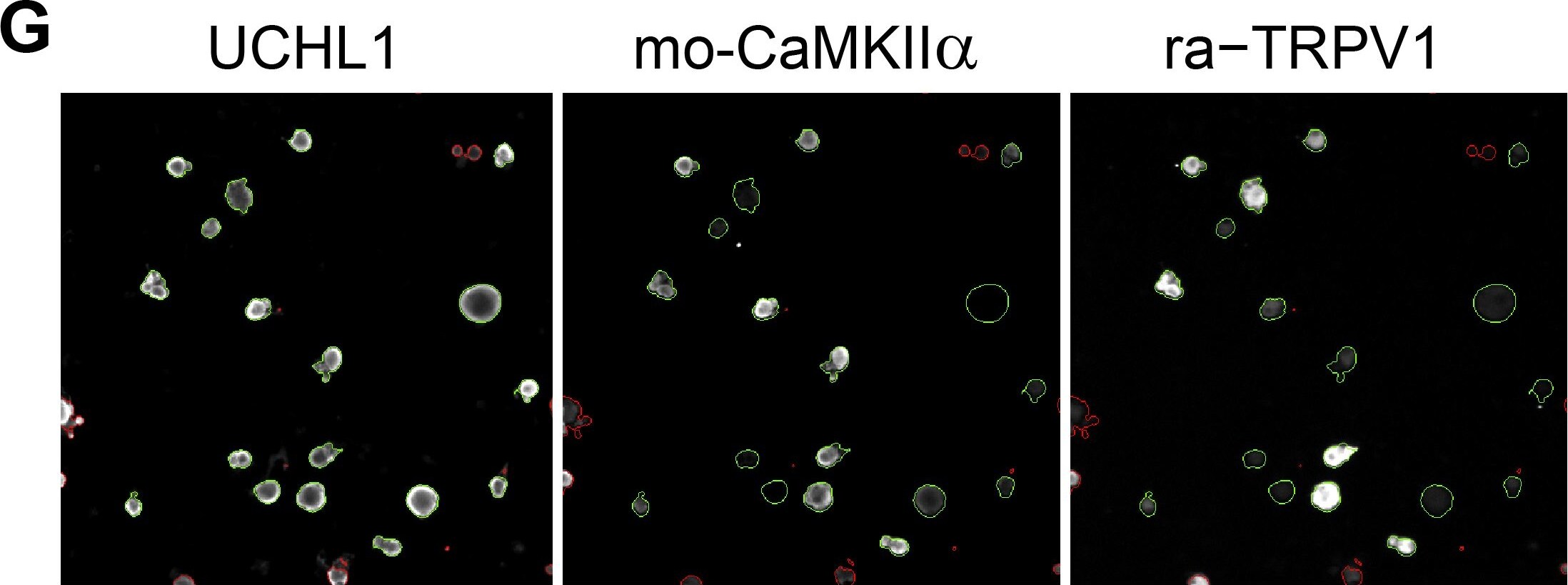
Immunocytochemistry/ Immunofluorescence: UCH-L1/PGP9.5 Antibody [NB110-58872] -
Immunocytochemistry/ Immunofluorescence: UCH-L1/PGP9.5 Antibody [NB110-58872] - Validation of the transcriptome data by single cell based quantitative High Content Screening (HCS) microscopy focusing on selected signaling-relevant proteins.(A) Triple staining of the neuronal marker UCHL1 & two different TRPV1 antibodies derived from rabbit & goat, respectively, to facilitate the analysis of various targets. The staining intensities obtained with both TRPV1 antibodies correlated significantly (Spearmans ρ = 0.96, p<2.2e-16). (B-E, G) Co-labeling of TRPV1 & CART (B), Nos1 (C), KChIP1 (D), KChIP2 (E), & CaMKII alpha (G). Plots of respective controls are shown in S1 Fig. (F) Average fluorescence intensities of TRPV1 & the indicated targets in TRPV1-negative (grey) & -positive (black) neurons. Signal intensities of all analyzed targets were significantly higher within the TRPV1(+) population (n = 3 with>3000 analyzed neurons per experiment, paired two-tailed t-tests). Image collected & cropped by CiteAb from the following publication (https://dx.plos.org/10.1371/journal.pone.0115731), licensed under a CC-BY license. Not internally tested by Novus Biologicals.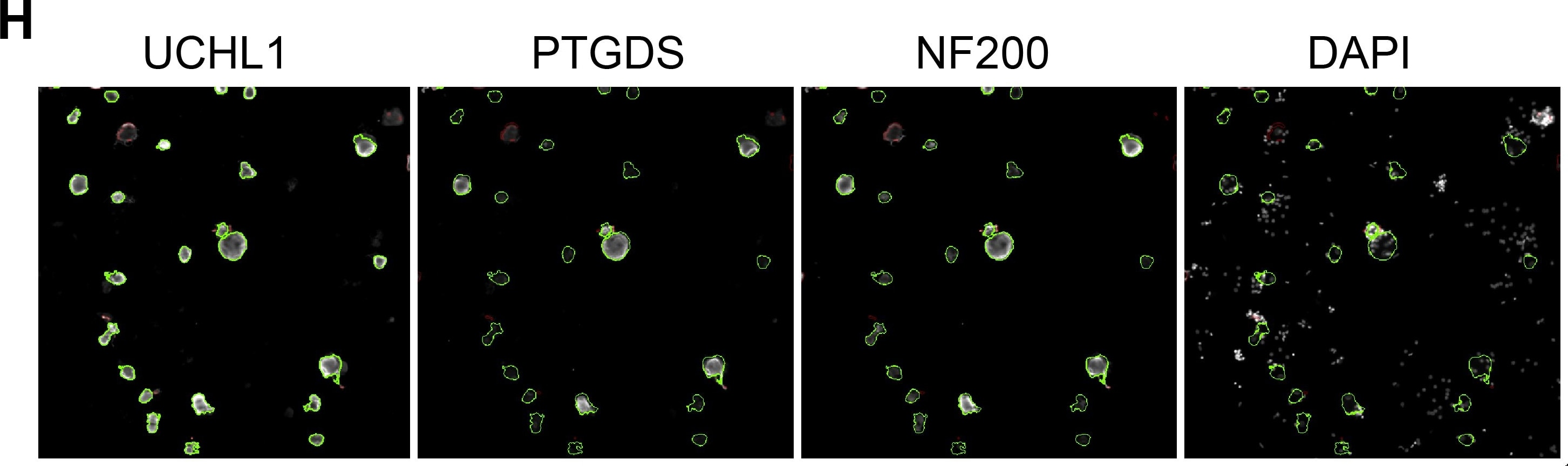
Immunocytochemistry/ Immunofluorescence: UCH-L1/PGP9.5 Antibody [NB110-58872] -
Immunocytochemistry/ Immunofluorescence: UCH-L1/PGP9.5 Antibody [NB110-58872] - PGD2 is a paracrine mediator synthesized in myelinated large-diameter neurons acts on TRPV1(+) neurons.(A) Dose-dependent induction of RII phosphorylation in sensory neurons after 1 min stimulation w/ PGD2 (EC50 = 377 nM, n = 3,>2000 neurons/condition; one-way ANOVA w/ Bonferroni's multiple comparisons test). (B) PGD2 did not induce pRII in non-neuronal cells of same cultures shown in A. (C) Time course of RII phosphorylation indicating long-lasting effects of PGD2 (10 µM) on sensory neurons. (D) Stimulation w/ PGD2 also results in phosphorylation of ERK1/2 measured in same cultures shown in D. (E) Representative experiment demonstrating induction of RII phosphorylation is enhanced in TRPV1(+) neurons (total of 3664 neurons). Plots of respective controls are shown in S2 Fig. (F) Fold changes of pRII intensities in TRPV1(−) (grey bars) & TRPV1(+) (black bars) neurons after 1 min stimulation w/ 10 µM PGD2 (n = 3,>2000 neurons/condition, one-way ANOVA w/ Bonferroni's multiple comparisons test). (G) Co-labeling of TRPV1 & PTGDS revealing PTGDS is expressed in neurons lacking TRPV1 (total of 9951 neurons, also refer to S2 Fig. for control plots). (H) Co-labeling of NF200 & PTGDS showing PTGDS(+) neurons express NF200 (total of 12966 neurons, also refer to S2 Fig. for control plots).(I) Size distribution of PTGDS(+) (green), NF200(+) (red), & all sensory neurons (black) indicating PTGDS(+) neurons are larger than other neurons. (J) Suggested pathway of interneuronal communication between subgroups of sensory neurons. Large-diameter mechanosensitive neurons express PTGDS resulting in production of PGD2, which activates DP1 receptors present on nociceptive neurons expressing TRPV1. Image collected & cropped by CiteAb from following publication (https://dx.plos.org/10.1371/journal.pone.0115731), licensed under a CC-BY license. Not internally tested by Novus Biologicals.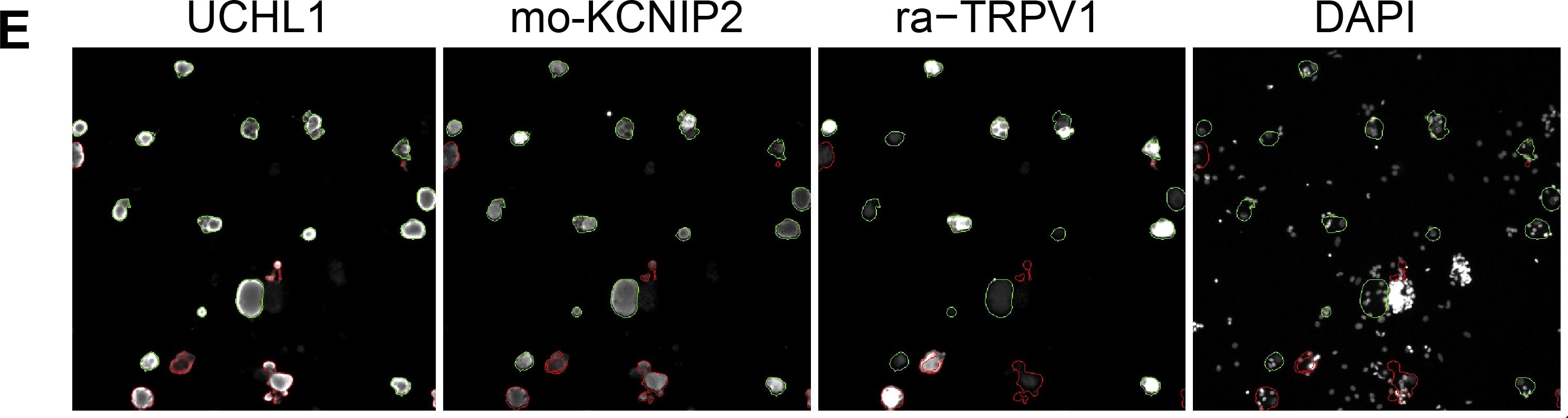
Immunocytochemistry/ Immunofluorescence: UCH-L1/PGP9.5 Antibody [NB110-58872] -
Immunocytochemistry/ Immunofluorescence: UCH-L1/PGP9.5 Antibody [NB110-58872] - Validation of the transcriptome data by single cell based quantitative High Content Screening (HCS) microscopy focusing on selected signaling-relevant proteins.(A) Triple staining of the neuronal marker UCHL1 & two different TRPV1 antibodies derived from rabbit & goat, respectively, to facilitate the analysis of various targets. The staining intensities obtained with both TRPV1 antibodies correlated significantly (Spearmans ρ = 0.96, p<2.2e-16). (B-E, G) Co-labeling of TRPV1 & CART (B), Nos1 (C), KChIP1 (D), KChIP2 (E), & CaMKII alpha (G). Plots of respective controls are shown in S1 Fig. (F) Average fluorescence intensities of TRPV1 & the indicated targets in TRPV1-negative (grey) & -positive (black) neurons. Signal intensities of all analyzed targets were significantly higher within the TRPV1(+) population (n = 3 with>3000 analyzed neurons per experiment, paired two-tailed t-tests). Image collected & cropped by CiteAb from the following publication (https://dx.plos.org/10.1371/journal.pone.0115731), licensed under a CC-BY license. Not internally tested by Novus Biologicals.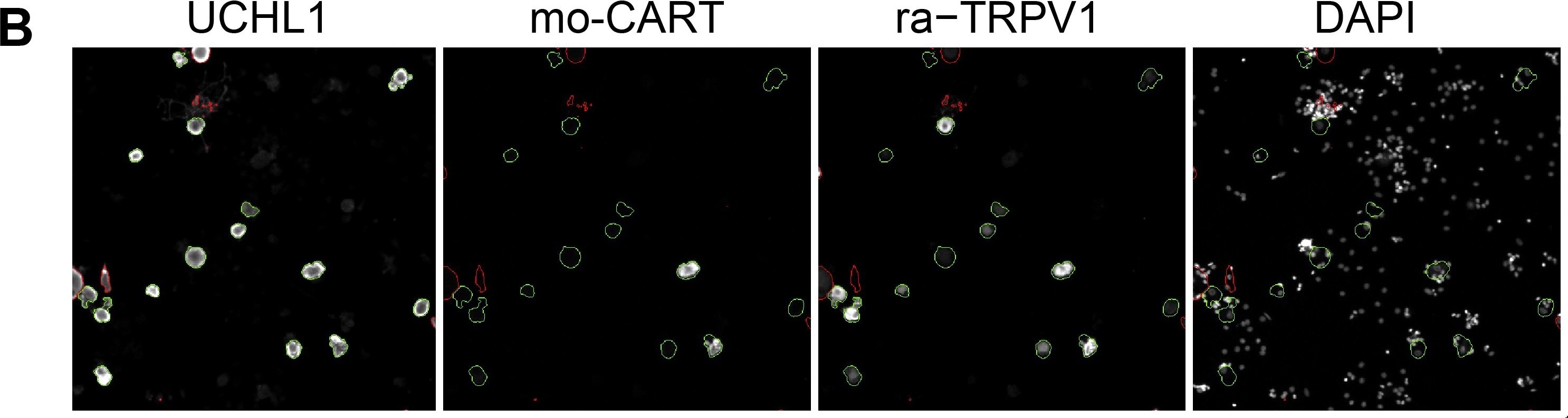
Immunocytochemistry/ Immunofluorescence: UCH-L1/PGP9.5 Antibody [NB110-58872] -
Immunocytochemistry/ Immunofluorescence: UCH-L1/PGP9.5 Antibody [NB110-58872] - Validation of the transcriptome data by single cell based quantitative High Content Screening (HCS) microscopy focusing on selected signaling-relevant proteins.(A) Triple staining of the neuronal marker UCHL1 & two different TRPV1 antibodies derived from rabbit & goat, respectively, to facilitate the analysis of various targets. The staining intensities obtained with both TRPV1 antibodies correlated significantly (Spearmans ρ = 0.96, p<2.2e-16). (B-E, G) Co-labeling of TRPV1 & CART (B), Nos1 (C), KChIP1 (D), KChIP2 (E), & CaMKII alpha (G). Plots of respective controls are shown in S1 Fig. (F) Average fluorescence intensities of TRPV1 & the indicated targets in TRPV1-negative (grey) & -positive (black) neurons. Signal intensities of all analyzed targets were significantly higher within the TRPV1(+) population (n = 3 with>3000 analyzed neurons per experiment, paired two-tailed t-tests). Image collected & cropped by CiteAb from the following publication (https://dx.plos.org/10.1371/journal.pone.0115731), licensed under a CC-BY license. Not internally tested by Novus Biologicals.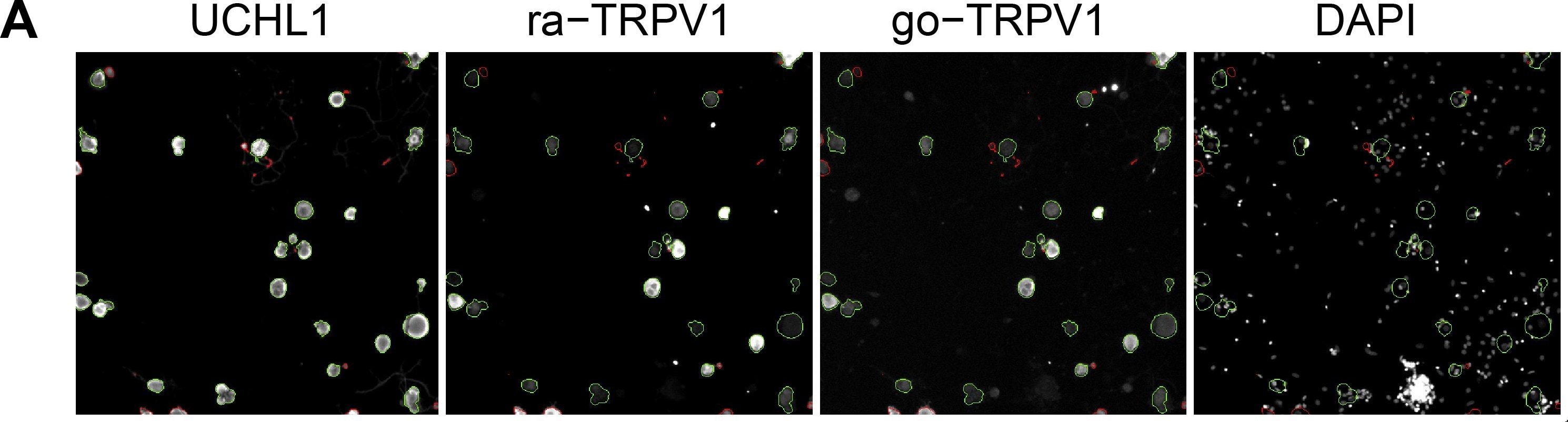
Immunocytochemistry/ Immunofluorescence: UCH-L1/PGP9.5 Antibody [NB110-58872] -
Immunocytochemistry/ Immunofluorescence: UCH-L1/PGP9.5 Antibody [NB110-58872] - Validation of the transcriptome data by single cell based quantitative High Content Screening (HCS) microscopy focusing on selected signaling-relevant proteins.(A) Triple staining of the neuronal marker UCHL1 & two different TRPV1 antibodies derived from rabbit & goat, respectively, to facilitate the analysis of various targets. The staining intensities obtained with both TRPV1 antibodies correlated significantly (Spearmans ρ = 0.96, p<2.2e-16). (B-E, G) Co-labeling of TRPV1 & CART (B), Nos1 (C), KChIP1 (D), KChIP2 (E), & CaMKII alpha (G). Plots of respective controls are shown in S1 Fig. (F) Average fluorescence intensities of TRPV1 & the indicated targets in TRPV1-negative (grey) & -positive (black) neurons. Signal intensities of all analyzed targets were significantly higher within the TRPV1(+) population (n = 3 with>3000 analyzed neurons per experiment, paired two-tailed t-tests). Image collected & cropped by CiteAb from the following publication (https://dx.plos.org/10.1371/journal.pone.0115731), licensed under a CC-BY license. Not internally tested by Novus Biologicals.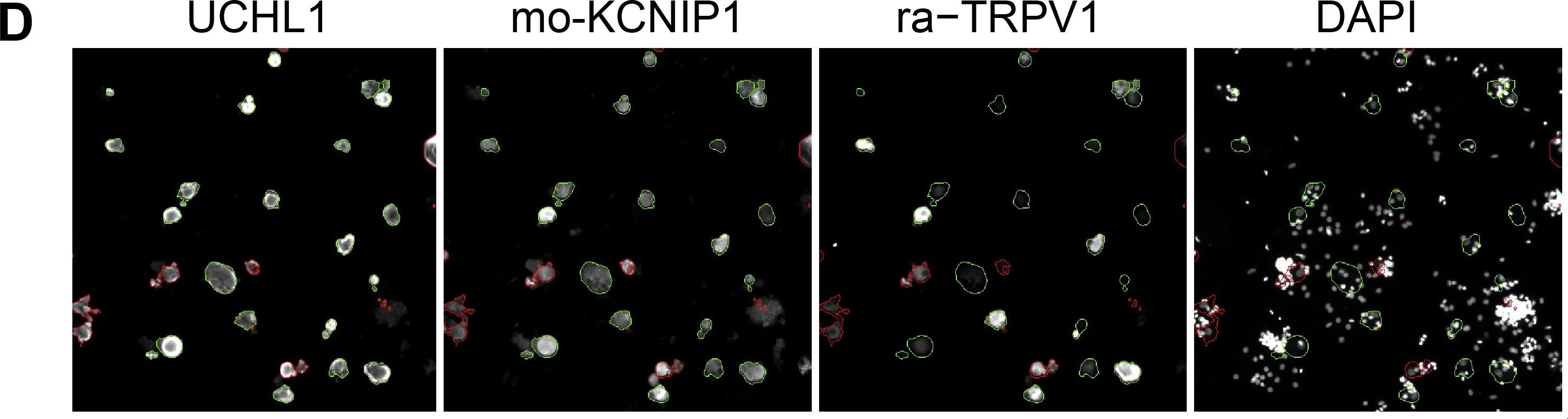
Immunocytochemistry/ Immunofluorescence: UCH-L1/PGP9.5 Antibody [NB110-58872] -
Immunocytochemistry/ Immunofluorescence: UCH-L1/PGP9.5 Antibody [NB110-58872] - Validation of the transcriptome data by single cell based quantitative High Content Screening (HCS) microscopy focusing on selected signaling-relevant proteins.(A) Triple staining of the neuronal marker UCHL1 & two different TRPV1 antibodies derived from rabbit & goat, respectively, to facilitate the analysis of various targets. The staining intensities obtained with both TRPV1 antibodies correlated significantly (Spearmans ρ = 0.96, p<2.2e-16). (B-E, G) Co-labeling of TRPV1 & CART (B), Nos1 (C), KChIP1 (D), KChIP2 (E), & CaMKII alpha (G). Plots of respective controls are shown in S1 Fig. (F) Average fluorescence intensities of TRPV1 & the indicated targets in TRPV1-negative (grey) & -positive (black) neurons. Signal intensities of all analyzed targets were significantly higher within the TRPV1(+) population (n = 3 with>3000 analyzed neurons per experiment, paired two-tailed t-tests). Image collected & cropped by CiteAb from the following publication (https://dx.plos.org/10.1371/journal.pone.0115731), licensed under a CC-BY license. Not internally tested by Novus Biologicals.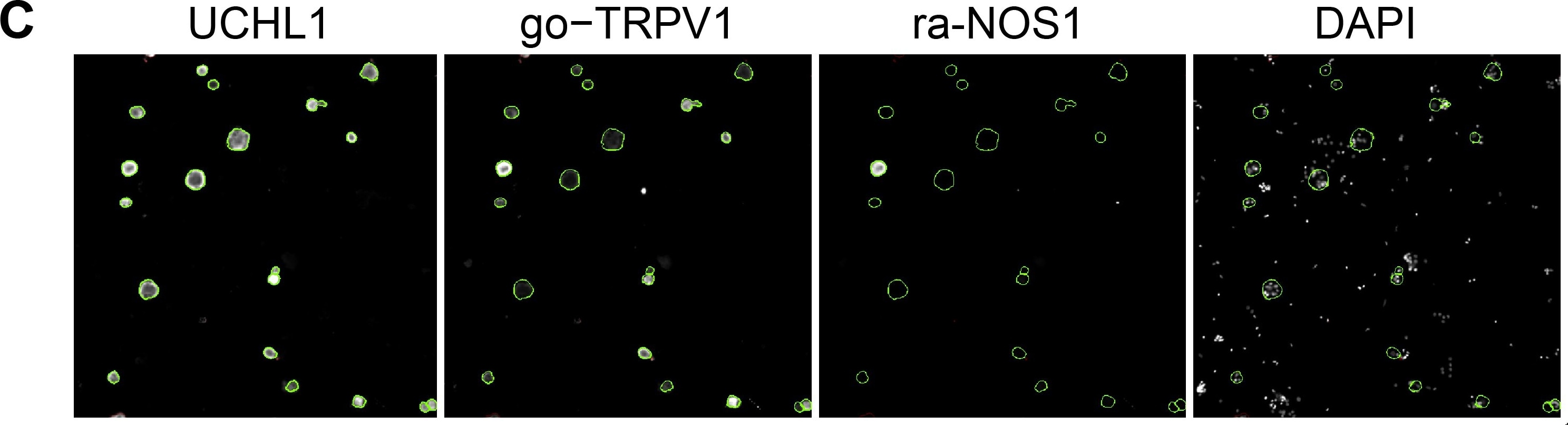
Immunocytochemistry/ Immunofluorescence: UCH-L1/PGP9.5 Antibody [NB110-58872] -
Immunocytochemistry/ Immunofluorescence: UCH-L1/PGP9.5 Antibody [NB110-58872] - Validation of the transcriptome data by single cell based quantitative High Content Screening (HCS) microscopy focusing on selected signaling-relevant proteins.(A) Triple staining of the neuronal marker UCHL1 & two different TRPV1 antibodies derived from rabbit & goat, respectively, to facilitate the analysis of various targets. The staining intensities obtained with both TRPV1 antibodies correlated significantly (Spearmans ρ = 0.96, p<2.2e-16). (B-E, G) Co-labeling of TRPV1 & CART (B), Nos1 (C), KChIP1 (D), KChIP2 (E), & CaMKII alpha (G). Plots of respective controls are shown in S1 Fig. (F) Average fluorescence intensities of TRPV1 & the indicated targets in TRPV1-negative (grey) & -positive (black) neurons. Signal intensities of all analyzed targets were significantly higher within the TRPV1(+) population (n = 3 with>3000 analyzed neurons per experiment, paired two-tailed t-tests). Image collected & cropped by CiteAb from the following publication (https://dx.plos.org/10.1371/journal.pone.0115731), licensed under a CC-BY license. Not internally tested by Novus Biologicals.Applications for UCH-L1/PGP9.5 Antibody
Immunocytochemistry/ Immunofluorescence
Immunohistochemistry
Western Blot
Formulation, Preparation, and Storage
Purification
Formulation
Preservative
Concentration
Shipping
Stability & Storage
Background: UCH-L1/PGP9.5
Long Name
Alternate Names
Gene Symbol
UniProt
Additional UCH-L1/PGP9.5 Products
Product Documents for UCH-L1/PGP9.5 Antibody
Certificate of Analysis
To download a Certificate of Analysis, please enter a lot or batch number in the search box below.
Product Specific Notices for UCH-L1/PGP9.5 Antibody
Chicken products cannot be exported to Canada.
This product is for research use only and is not approved for use in humans or in clinical diagnosis. Primary Antibodies are guaranteed for 1 year from date of receipt.
Related Research Areas
Citations for UCH-L1/PGP9.5 Antibody
 Powered by Bioz
Customer Reviews for UCH-L1/PGP9.5 Antibody
There are currently no reviews for this product. Be the first to review UCH-L1/PGP9.5 Antibody and earn rewards!
Have you used UCH-L1/PGP9.5 Antibody?
Submit a review and receive an Amazon gift card!
$25/€18/£15/$25CAN/¥2500 for a review with an image
$10/€7/£6/$10CAN/¥1110 for a review without an image
Submit a review
Protocols
Find general support by application which include: protocols, troubleshooting, illustrated assays, videos and webinars.
- Antigen Retrieval Protocol (PIER)
- Antigen Retrieval for Frozen Sections Protocol
- Appropriate Fixation of IHC/ICC Samples
- Cellular Response to Hypoxia Protocols
- Chromogenic IHC Staining of Formalin-Fixed Paraffin-Embedded (FFPE) Tissue Protocol
- Chromogenic Immunohistochemistry Staining of Frozen Tissue
- ClariTSA™ Fluorophore Kits
- Detection & Visualization of Antibody Binding
- Fluorescent IHC Staining of Frozen Tissue Protocol
- Graphic Protocol for Heat-induced Epitope Retrieval
- Graphic Protocol for the Preparation and Fluorescent IHC Staining of Frozen Tissue Sections
- Graphic Protocol for the Preparation and Fluorescent IHC Staining of Paraffin-embedded Tissue Sections
- Graphic Protocol for the Preparation of Gelatin-coated Slides for Histological Tissue Sections
- ICC Cell Smear Protocol for Suspension Cells
- ICC Immunocytochemistry Protocol Videos
- ICC for Adherent Cells
- IHC Sample Preparation (Frozen sections vs Paraffin)
- Immunocytochemistry (ICC) Protocol
- Immunocytochemistry Troubleshooting
- Immunofluorescence of Organoids Embedded in Cultrex Basement Membrane Extract
- Immunofluorescent IHC Staining of Formalin-Fixed Paraffin-Embedded (FFPE) Tissue Protocol
- Immunohistochemistry (IHC) and Immunocytochemistry (ICC) Protocols
- Immunohistochemistry Frozen Troubleshooting
- Immunohistochemistry Paraffin Troubleshooting
- Preparing Samples for IHC/ICC Experiments
- Preventing Non-Specific Staining (Non-Specific Binding)
- Primary Antibody Selection & Optimization
- Protocol for Heat-Induced Epitope Retrieval (HIER)
- Protocol for Making a 4% Formaldehyde Solution in PBS
- Protocol for VisUCyte™ HRP Polymer Detection Reagent
- Protocol for the Fluorescent ICC Staining of Cell Smears - Graphic
- Protocol for the Fluorescent ICC Staining of Cultured Cells on Coverslips - Graphic
- Protocol for the Preparation & Fixation of Cells on Coverslips
- Protocol for the Preparation and Chromogenic IHC Staining of Frozen Tissue Sections
- Protocol for the Preparation and Chromogenic IHC Staining of Frozen Tissue Sections - Graphic
- Protocol for the Preparation and Chromogenic IHC Staining of Paraffin-embedded Tissue Sections
- Protocol for the Preparation and Chromogenic IHC Staining of Paraffin-embedded Tissue Sections - Graphic
- Protocol for the Preparation and Fluorescent ICC Staining of Cells on Coverslips
- Protocol for the Preparation and Fluorescent ICC Staining of Non-adherent Cells
- Protocol for the Preparation and Fluorescent ICC Staining of Stem Cells on Coverslips
- Protocol for the Preparation and Fluorescent IHC Staining of Frozen Tissue Sections
- Protocol for the Preparation and Fluorescent IHC Staining of Paraffin-embedded Tissue Sections
- Protocol for the Preparation of Gelatin-coated Slides for Histological Tissue Sections
- Protocol for the Preparation of a Cell Smear for Non-adherent Cell ICC - Graphic
- R&D Systems Quality Control Western Blot Protocol
- TUNEL and Active Caspase-3 Detection by IHC/ICC Protocol
- The Importance of IHC/ICC Controls
- Troubleshooting Guide: Immunohistochemistry
- Troubleshooting Guide: Western Blot Figures
- Western Blot Conditions
- Western Blot Protocol
- Western Blot Protocol for Cell Lysates
- Western Blot Troubleshooting
- Western Blot Troubleshooting Guide
- View all Protocols, Troubleshooting, Illustrated assays and Webinars