VE-Cadherin Antibody (BV14) - BSA Free
Novus Biologicals | Catalog # NBP1-43347

![Western Blot: VE-Cadherin Antibody (BV14)BSA Free [NBP1-43347]](https://resources.rndsystems.com/images/products/VE-Cadherin-Antibody-BV14-Western-Blot-NBP1-43347-img0003.jpg "Western Blot: VE-Cadherin Antibody (BV14)BSA Free [NBP1-43347]")
Scientific images may be resized, cropped, or adjusted for brightness or contrast for presentation purposes. These updates are limited to presentation and do not affect the underlying scientific interpretation of the data. Where available, additional source data may be provided upon request.
Key Product Details
Species Reactivity
Validated:
Cited:
Applications
Validated:
Cited:
Label
Antibody Source
Format
Product Specifications
Immunogen
Reactivity Notes
Marker
Clonality
Host
Isotype
Scientific Data Images for VE-Cadherin Antibody (BV14) - BSA Free
Western Blot: VE-Cadherin Antibody (BV14)BSA Free [NBP1-43347]
Western Blot: VE-Cadherin Antibody (BV14) [NBP1-43347] - Non-reduced (left) and reduced (right) bEnd.3 cell line lysates were loaded at 1x10^5 cells/lane, probed with 2 ug/mL of Anti-Mouse CD144 (VE-Cadherin) Purified and revealed with Anti-Rat IgG HRP.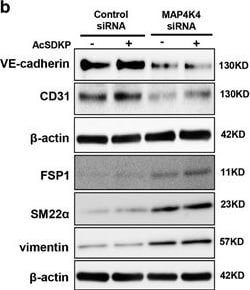
Western Blot: VE-Cadherin Antibody (BV14) - BSA Free [NBP1-43347] -
MAP4K4 deficiency induces TGF beta /smad signaling and EndMT via activation of integrin beta 1. (a) HMVECs were transfected with MAP4K4 siRNA (100 nM) for 48 h. Next, the cells were treated with or without AcSDKP for 2 h. The p-smad3/smad3 pathway was analyzed by western blot. Densitometric analysis of the p-smad3/smad3 levels was performed, with n=3 for each group. (b) HMVECs were treated with MAP4K4 siRNA for 48 h with or without AcSDKP treatment. The VE-cadherin, CD31, FSP1, SM22 alpha and vimentin protein levels were analyzed by western blot. (c) HMVECs were transfected with MAP4K4 siRNA for 48 h in the presence or absence of TGF beta 2 with or without AcSDKP. The integrin beta 1 level was analyzed by western blot Image collected and cropped by CiteAb from the following open publication (https://pubmed.ncbi.nlm.nih.gov/28771231), licensed under a CC-BY license. Not internally tested by Novus Biologicals.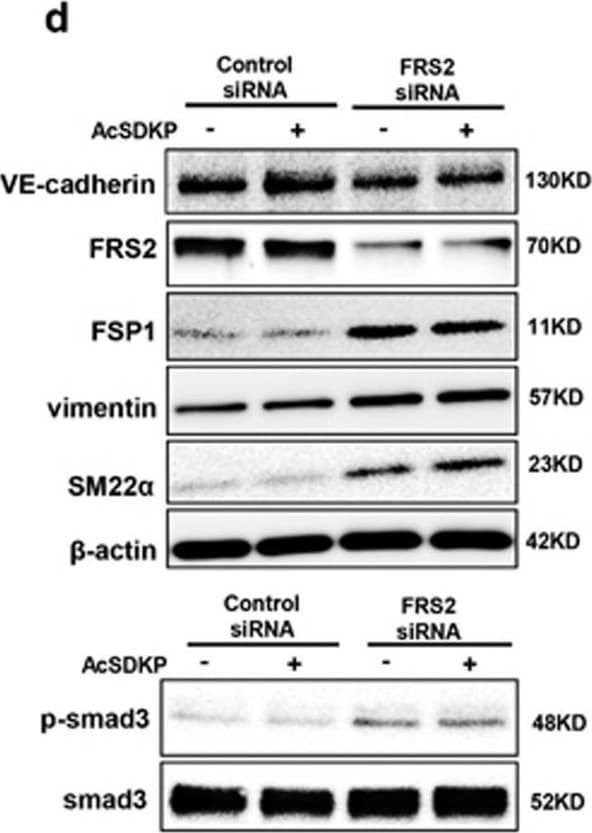
Western Blot: VE-Cadherin Antibody (BV14) - BSA Free [NBP1-43347] -
AcSDKP suppresses TGF beta /smad signaling and EndMT through the FGFR1/FRS2 pathway. (a) HMVECs were treated with N-FGFR1 for 48 h, and the FGFR1, TGF beta R1 and TGF beta R2 protein levels were analyzed by western blot. (b) HMVECs were treated with TGF beta 2 in the presence or absence of N-FGFR1 for 15 min with or without AcSDKP preincubation. The p-smad3 and TGF beta R1 protein levels were analyzed by western blot. Densitometric analysis of the p-smad3/smad3 and TGF beta R1/ beta -actin levels (n=3) in each group was performed. (c) HMVECs were incubated with either N-FGFR1 in the presence or absence of TGF beta 2 for 48 h with or without preincubation with AcSDKP for 2 h or with N-FGFR1 in the presence or absence of TGF beta 2 for 48 h with or without 24 h of incubation with FGF2 (50 ng/ml). The CD31, SM22 alpha, FSP1 and alpha -SMA protein levels were analyzed by western blot. (d) HMVECs were transfected with FRS2 siRNA (100 nM) for 48 h with or without AcSDKP preincubation. The VE-cadherin, FSP1, vimentin, SM22 alpha and p-smad3 levels were analyzed by western blot. (e) HMVECs were treated with N-FGFR1 for 48 h or 15 min in the presence or absence of N-TGF beta (1, 2, 3) (1.0 μg/ml). The CD31, VE-cadherin, SM22 alpha, FSP1, TGF beta R1, TGF beta R2 and p-smad3 levels were analyzed by western blot Image collected and cropped by CiteAb from the following open publication (https://pubmed.ncbi.nlm.nih.gov/28771231), licensed under a CC-BY license. Not internally tested by Novus Biologicals.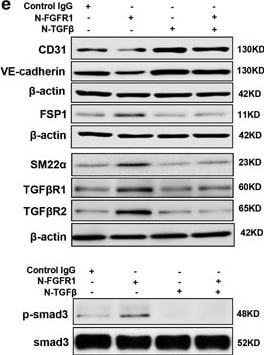
Western Blot: VE-Cadherin Antibody (BV14) - BSA Free [NBP1-43347] -
AcSDKP suppresses TGF beta /smad signaling and EndMT through the FGFR1/FRS2 pathway. (a) HMVECs were treated with N-FGFR1 for 48 h, and the FGFR1, TGF beta R1 and TGF beta R2 protein levels were analyzed by western blot. (b) HMVECs were treated with TGF beta 2 in the presence or absence of N-FGFR1 for 15 min with or without AcSDKP preincubation. The p-smad3 and TGF beta R1 protein levels were analyzed by western blot. Densitometric analysis of the p-smad3/smad3 and TGF beta R1/ beta -actin levels (n=3) in each group was performed. (c) HMVECs were incubated with either N-FGFR1 in the presence or absence of TGF beta 2 for 48 h with or without preincubation with AcSDKP for 2 h or with N-FGFR1 in the presence or absence of TGF beta 2 for 48 h with or without 24 h of incubation with FGF2 (50 ng/ml). The CD31, SM22 alpha, FSP1 and alpha -SMA protein levels were analyzed by western blot. (d) HMVECs were transfected with FRS2 siRNA (100 nM) for 48 h with or without AcSDKP preincubation. The VE-cadherin, FSP1, vimentin, SM22 alpha and p-smad3 levels were analyzed by western blot. (e) HMVECs were treated with N-FGFR1 for 48 h or 15 min in the presence or absence of N-TGF beta (1, 2, 3) (1.0 μg/ml). The CD31, VE-cadherin, SM22 alpha, FSP1, TGF beta R1, TGF beta R2 and p-smad3 levels were analyzed by western blot Image collected and cropped by CiteAb from the following open publication (https://pubmed.ncbi.nlm.nih.gov/28771231), licensed under a CC-BY license. Not internally tested by Novus Biologicals.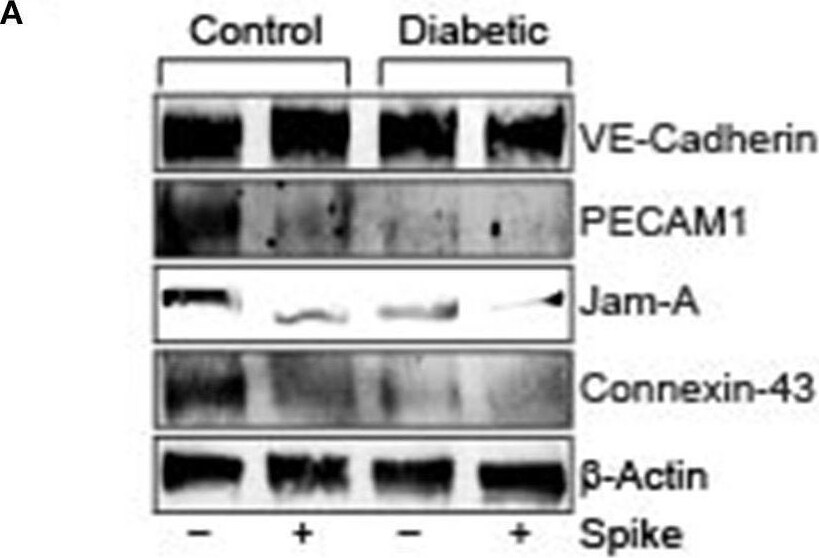
Western Blot: VE-Cadherin Antibody (BV14) - BSA Free [NBP1-43347] -
Spike-induced degradation of endothelial junctional proteins is greater in arteries of diabetic mice. (A) Representative Western blot indicating expression of endothelial junctional proteins in arteries isolated from control or diabetic mice. (B) Mean data indicating fold change in protein expression. n = 4 for each, *P < 0.05 vs. untreated control, delta P < 0.05 vs. untreated diabetic, #P < 0.05 vs. Spike-treated control. Image collected and cropped by CiteAb from the following open publication (https://pubmed.ncbi.nlm.nih.gov/34179146), licensed under a CC-BY license. Not internally tested by Novus Biologicals.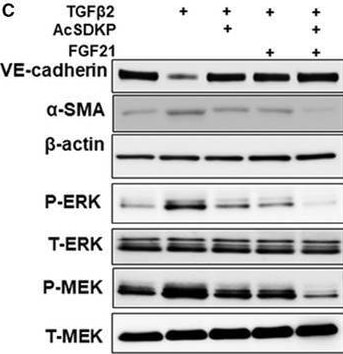
Western Blot: VE-Cadherin Antibody (BV14) - BSA Free [NBP1-43347] -
Either FGF19 or FGF21 enhanced the inhibitory effect of AcSDKP on EndMT and MEK/ERK pathway. In the presence of AcSDKP, HMVECs were stimulated by TGF beta 2 with or without FGF19 (100 ng·mL−1) or FGF21 (100 ng·mL−1) treatment. The levels of VE‐cadherin/ beta ‐Actin, alpha ‐SMA/ beta ‐Actin, P‐ERK/T‐ERK, and P‐MEK/T‐MEK were examined by western blot analysis (A, C) and quantified (B, D). The data represent mean +/- SD. Three independent experiments were performed for each result. ANOVA with Tukey's multiple comparisons test was applied. Image collected and cropped by CiteAb from the following open publication (https://pubmed.ncbi.nlm.nih.gov/30972974), licensed under a CC-BY license. Not internally tested by Novus Biologicals.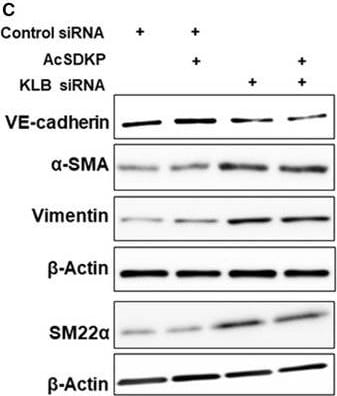
Western Blot: VE-Cadherin Antibody (BV14) - BSA Free [NBP1-43347] -
KLB deficiency led to EndMT in HMVECs. (A) Subconfluent HMVECs were transfected with KLB siRNA or control siRNA. Six hours later, the medium was replaced with an experimental medium, followed by N‐FGFR1 (1.5 mg·mL−1) treatment. At 48 h, the cells were harvested for western blot analysis. The results are from three repeated experiments. (B) The same treated HMVECs (as in A) cultured on 8‐well culture slides were subjected to immunofluorescence staining with an anti‐ alpha ‐SMA antibody and DAPI (scale bar, 100 μm). Six different fields were observed for each slide. (C) HMVECs with or without preincubation with AcSDKP (100 nm) for 2 h were transfected with KLB siRNA or control siRNA for 48 h. The expression of EndMT markers, including VE‐cadherin, alpha ‐SMA, vimentin, and SM22 alpha, was assessed by western blotting and quantified (D) by imagej software (GE Healthcare Life Sciences, Uppsala, Sweden). The data represent mean +/- SD and are representative of three independent experiments. One‐way ANOVA with Tukey's multiple comparisons test was used for statistical analysis. Image collected and cropped by CiteAb from the following open publication (https://pubmed.ncbi.nlm.nih.gov/30972974), licensed under a CC-BY license. Not internally tested by Novus Biologicals.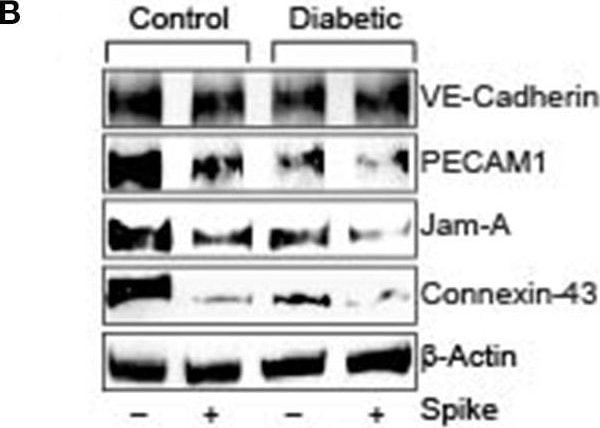
Western Blot: VE-Cadherin Antibody (BV14) - BSA Free [NBP1-43347] -
SARS-CoV-2 spike protein (Spike) increases endothelial permeability by downregulation of junctional proteins in diabetic endothelial cells. (A) Endothelial transwell permeability assay, mean data expressed as fold change. n = 6 for each, *P < 0.05 vs. untreated control, delta P < 0.05 vs. untreated diabetic, #P < 0.05 vs. Spike-treated control. (B) Representative Western blot indicating expression of endothelial junctional proteins in endothelial cell culture with or without Spike treatment. (C) Mean data indicating fold change in protein expression. n = 6 for each, *P < 0.05 vs. untreated control, delta P < 0.05 vs. untreated diabetic, #P < 0.05 vs. Spike-treated control. Image collected and cropped by CiteAb from the following open publication (https://pubmed.ncbi.nlm.nih.gov/34179146), licensed under a CC-BY license. Not internally tested by Novus Biologicals.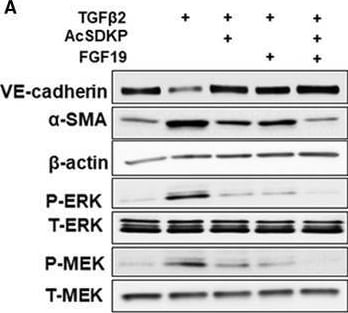
Western Blot: VE-Cadherin Antibody (BV14) - BSA Free [NBP1-43347] -
Either FGF19 or FGF21 enhanced the inhibitory effect of AcSDKP on EndMT and MEK/ERK pathway. In the presence of AcSDKP, HMVECs were stimulated by TGF beta 2 with or without FGF19 (100 ng·mL−1) or FGF21 (100 ng·mL−1) treatment. The levels of VE‐cadherin/ beta ‐Actin, alpha ‐SMA/ beta ‐Actin, P‐ERK/T‐ERK, and P‐MEK/T‐MEK were examined by western blot analysis (A, C) and quantified (B, D). The data represent mean +/- SD. Three independent experiments were performed for each result. ANOVA with Tukey's multiple comparisons test was applied. Image collected and cropped by CiteAb from the following open publication (https://pubmed.ncbi.nlm.nih.gov/30972974), licensed under a CC-BY license. Not internally tested by Novus Biologicals.Applications for VE-Cadherin Antibody (BV14) - BSA Free
Immunohistochemistry
Immunohistochemistry-Frozen
Immunoprecipitation
Western Blot
Formulation, Preparation, and Storage
Purification
Formulation
Format
Preservative
Concentration
Shipping
Stability & Storage
Background: VE-Cadherin
Long Name
Alternate Names
Entrez Gene IDs
Gene Symbol
UniProt
Additional VE-Cadherin Products
Product Documents for VE-Cadherin Antibody (BV14) - BSA Free
Certificate of Analysis
To download a Certificate of Analysis, please enter a lot or batch number in the search box below.
Product Specific Notices for VE-Cadherin Antibody (BV14) - BSA Free
This product is for research use only and is not approved for use in humans or in clinical diagnosis. Primary Antibodies are guaranteed for 1 year from date of receipt.
Citations for VE-Cadherin Antibody (BV14) - BSA Free
 Powered by Bioz
Customer Reviews for VE-Cadherin Antibody (BV14) - BSA Free
There are currently no reviews for this product. Be the first to review VE-Cadherin Antibody (BV14) - BSA Free and earn rewards!
Have you used VE-Cadherin Antibody (BV14) - BSA Free?
Submit a review and receive an Amazon gift card!
$25/€18/£15/$25CAN/¥2500 for a review with an image
$10/€7/£6/$10CAN/¥1110 for a review without an image
Submit a review
Protocols
Find general support by application which include: protocols, troubleshooting, illustrated assays, videos and webinars.
- Antigen Retrieval Protocol (PIER)
- Antigen Retrieval for Frozen Sections Protocol
- Appropriate Fixation of IHC/ICC Samples
- Cellular Response to Hypoxia Protocols
- Chromogenic IHC Staining of Formalin-Fixed Paraffin-Embedded (FFPE) Tissue Protocol
- Chromogenic Immunohistochemistry Staining of Frozen Tissue
- ClariTSA™ Fluorophore Kits
- Detection & Visualization of Antibody Binding
- Fluorescent IHC Staining of Frozen Tissue Protocol
- Graphic Protocol for Heat-induced Epitope Retrieval
- Graphic Protocol for the Preparation and Fluorescent IHC Staining of Frozen Tissue Sections
- Graphic Protocol for the Preparation and Fluorescent IHC Staining of Paraffin-embedded Tissue Sections
- Graphic Protocol for the Preparation of Gelatin-coated Slides for Histological Tissue Sections
- ICC Cell Smear Protocol for Suspension Cells
- ICC Immunocytochemistry Protocol Videos
- ICC for Adherent Cells
- IHC Sample Preparation (Frozen sections vs Paraffin)
- Immunocytochemistry (ICC) Protocol
- Immunocytochemistry Troubleshooting
- Immunofluorescence of Organoids Embedded in Cultrex Basement Membrane Extract
- Immunofluorescent IHC Staining of Formalin-Fixed Paraffin-Embedded (FFPE) Tissue Protocol
- Immunohistochemistry (IHC) and Immunocytochemistry (ICC) Protocols
- Immunohistochemistry Frozen Troubleshooting
- Immunohistochemistry Paraffin Troubleshooting
- Immunoprecipitation Protocol
- Preparing Samples for IHC/ICC Experiments
- Preventing Non-Specific Staining (Non-Specific Binding)
- Primary Antibody Selection & Optimization
- Protocol for Heat-Induced Epitope Retrieval (HIER)
- Protocol for Making a 4% Formaldehyde Solution in PBS
- Protocol for VisUCyte™ HRP Polymer Detection Reagent
- Protocol for the Fluorescent ICC Staining of Cell Smears - Graphic
- Protocol for the Fluorescent ICC Staining of Cultured Cells on Coverslips - Graphic
- Protocol for the Preparation & Fixation of Cells on Coverslips
- Protocol for the Preparation and Chromogenic IHC Staining of Frozen Tissue Sections
- Protocol for the Preparation and Chromogenic IHC Staining of Frozen Tissue Sections - Graphic
- Protocol for the Preparation and Chromogenic IHC Staining of Paraffin-embedded Tissue Sections
- Protocol for the Preparation and Chromogenic IHC Staining of Paraffin-embedded Tissue Sections - Graphic
- Protocol for the Preparation and Fluorescent ICC Staining of Cells on Coverslips
- Protocol for the Preparation and Fluorescent ICC Staining of Non-adherent Cells
- Protocol for the Preparation and Fluorescent ICC Staining of Stem Cells on Coverslips
- Protocol for the Preparation and Fluorescent IHC Staining of Frozen Tissue Sections
- Protocol for the Preparation and Fluorescent IHC Staining of Paraffin-embedded Tissue Sections
- Protocol for the Preparation of Gelatin-coated Slides for Histological Tissue Sections
- Protocol for the Preparation of a Cell Smear for Non-adherent Cell ICC - Graphic
- R&D Systems Quality Control Western Blot Protocol
- TUNEL and Active Caspase-3 Detection by IHC/ICC Protocol
- The Importance of IHC/ICC Controls
- Troubleshooting Guide: Immunohistochemistry
- Troubleshooting Guide: Western Blot Figures
- Western Blot Conditions
- Western Blot Protocol
- Western Blot Protocol for Cell Lysates
- Western Blot Troubleshooting
- Western Blot Troubleshooting Guide
- View all Protocols, Troubleshooting, Illustrated assays and Webinars
Associated Pathways