
Protein A ELISA Kits

Use Protein a ELISA Kits in a Therapeutic Antibody Manufacturing Workflow
Protein A affinity chromatography is commonly used in monoclonal antibody (mAb) manufacturing workflows because of its high binding affinity and the purity of the product obtained with it (1). There are occasions where Protein A or its fragments leach from a purification column and remain bound to the Fc region of a therapeutic antibody. This must be avoided, particularly in instances where antibodies are manufactured for clinical uses in order to preclude any adverse effects of residual protein A on the patient.
R&D Systems has developed two ELISA kits for reliable supply and accurate detection of Protein A residuals in the manufacturing of therapeutic monoclonal antibodies, one for natural and recombinant protein A and the other for Protein A engineered variants. These kits have been designed with a simplified procedure, accurate quantification, and allow for easy transfer to automated platforms.
R&D Systems Protein A ELISA Advantages

Calibrated to Natural or Engineered Protein A
Prevent over or under-reporting Protein A levels with an ELISAcalibrated to the Protein A construct used in your workflow.

Ready-to-use Components Including Buffers
Eliminate the hassle of preparing reagents. Our components are optimized and ready to use immediately.

Single-step Sample Pretreatment
Simple and easy pretreatment allows for faster sample preparation. Just mix your sample with our pretreatment buffer to begin your assay.

Minimal Assay Incubations
3 incubation steps total 3 hours or less ensuring quick turn-around for assay results.

Consistent Supply and Technical Support
Unrivaled customer service and shipped immediately upon order.
Fully Validated for Accurate Protein A Detection
Multiple Protein A variants are used in the manufacturing workflow. To accurately quantify Protein A, a kit calibrated to a closely related variant must be used. Both Protein A ELISA kits have been validated and qualified based on the following parameters:
| Protein A ELISA Kit | Protein A Engineered Variant ELISA Kit |
|---|---|
| Specificity | Natural Recombinant Protein A |
| Calibration | E. coli expressed recombinant Protein A |
| Intra-Assay Precision (CV) | 2.7-3.1% |
| Inter-Assay Precision (CV) | 6.0-8.3% |
| Recovery | 88-113% |
| Linearity | 104-112% |
| Limit of Detection | 16.1 pg/mL |
| Limit of Quantification | 23.4 pg/mL |
Protein A ELISA Kit Spiked Recovery

Protein A Spiked Recovery. Protein A constructs were spiked into in-house Trastuzumab, Cetuximab, and Rituximab biosimilar antibody samples. Spiked sample matrix Protein A recovery ranged from 80% to 101%, which was in the acceptable range.
Protein A ELISA Kit Linearity of Dilution

Protein A ELISA Linearity of Dilution. Protein A constructs were spiked at a high concentration into in-house biosimilar antibody samples and diluted to produce samples with values within the dynamic range of the assay. The linearity is between 97%-112%.
Protein A ELISA Protocol
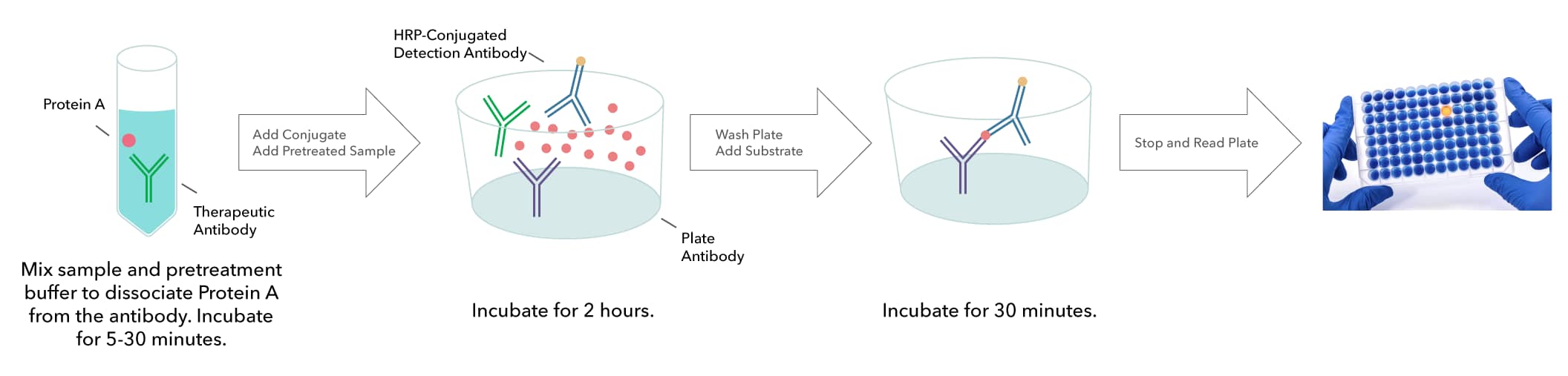
Pretreatment releases Protein A from the therapeutic antibody sample followed by Protein A quantification via sandwich ELISA. Click on image to view larger.
What is Protein A?
Protein A, also known as staphylococcus aureus protein A (SpA) is a 40-60 kDa surface protein originally found in the cell wall of the bacterium Staphylococcus aureus (2). The carboxyl terminal end of Protein A is anchored to the staphylococcus cell wall by the transpeptidase enzyme sortase. It is encoded by the spa gene and consists of five homologous 6.7 kDA immunoglobulin domains (E, D, A, B, and C) joined by conserved linkers of six to nine residues (3). Protein A has been shown to stimulate inflammatory responses by interacting with several proteins including tumor necrosis factor alpha receptors, Willebrand factor and C1qR.
Protein A is most known for interacting with the Fc region of the antibody heavy chain. Although it binds all mouse immunoglobulin (IgG) subtypes (IgG1, IgG2a, IgG2b and IgG3), in humans, it binds to IgG1, IgG2 and IgG4 but not IgG3 (3). Protein A fails to bind IgG3 because of a single histidine to arginine change at amino acid 435 (3). Protein A reacts with Ig from a variety of other species including rhesus monkey, guinea pig, pig, cow, and goat.
Featured Content
The ELISA Guide
A clear and easy guide to ELISAs
Custom Assay Services
Need your own assay? Unique targets? We can help.
Avoid False Positive ELISA Data
This app note will help you generate data you can trust.
Resources
- Bioprocessing
- Simple Plex Assays for Bioprocess Testing
- Biosimilar antibodies
- Anti-Idiotype antibodies
- View All ELISA Kits
- Cell Culture Essentials
References
- Ramos-de-la-Pena, A.M. et al. (2019) Journal of Separation Science. 42: 1816
- Rigi, G. et al (2019) Biotechnology and Applied Biochemistry. 66:454
- Mazigi, O. et al (2019) Protein Engineering and Selection. 32: 359
MabSelect SuRe™ is a trademark of GE Healthcare.