
ABCA1 Antibody (3A1.891.3) - BSA Free
Novus Biologicals | Catalog # NB400-164

![Western Blot: ABCA1 Antibody (3A1.891.3) [NB400-164]](https://resources.rndsystems.com/images/products/ABCA1-Antibody-3A1-891-3-Western-Blot-NB400-164-img0008.jpg "Western Blot: ABCA1 Antibody (3A1.891.3) [NB400-164]")
Scientific images may be resized, cropped, or adjusted for brightness or contrast for presentation purposes. These updates are limited to presentation and do not affect the underlying scientific interpretation of the data. Where available, additional source data may be provided upon request.
Loading...
Key Product Details
Validated by
Biological Validation
Species Reactivity
Validated:
Mouse, Human (Negative)
Cited:
Mouse
Applications
Validated:
Immunohistochemistry, Immunohistochemistry-Paraffin, Western Blot
Cited:
Immunohistochemistry-Paraffin, Western Blot
Label
Unconjugated
Antibody Source
Monoclonal Rat IgG1 kappa Clone # 3A1.891.3
Format
BSA Free
Loading...
Product Specifications
Immunogen
A1-N3 peptide (within residues 200-250) of mouse ABCA1 Antibody (3A1.891.3) covalently linked to chicken egg albumin by means of glutaraldehyde. [Uniprot: P41233]
Localization
Cell Membrane
Clonality
Monoclonal
Host
Rat
Isotype
IgG1 kappa
Theoretical MW
250 kDa.
Disclaimer note: The observed molecular weight of the protein may vary from the listed predicted molecular weight due to post translational modifications, post translation cleavages, relative charges, and other experimental factors.
Disclaimer note: The observed molecular weight of the protein may vary from the listed predicted molecular weight due to post translational modifications, post translation cleavages, relative charges, and other experimental factors.
Scientific Data Images for ABCA1 Antibody (3A1.891.3) - BSA Free
![Immunohistochemistry-Paraffin: ABCA1 Antibody (3A1.891.3) [NB400-164]](https://resources.rndsystems.com/images/products/ABCA1-Antibody-3A1-891-3-Immunohistochemistry-Paraffin-NB400-164-img0007.jpg "Immunohistochemistry-Paraffin: ABCA1 Antibody (3A1.891.3) [NB400-164]")
Immunohistochemistry-Paraffin: ABCA1 Antibody (3A1.891.3) [NB400-164]
Immunohistochemistry-Paraffin: ABCA1 Antibody (3A1.891.3) [NB400-164] - Analysis of FFPE mouse liver using ABCA1 antibody at 1:500 on a Bond Rx autostainer (Leica Biosystems). The assay involved 20 minutes of heat induced antigen retrieval (HIER) using 10mM sodium citrate buffer (pH 6.0) and endogenous peroxidase quenching with peroxide block. The sections were incubated with primary antibody for 30 minutes and Bond Polymer Refine Detection (Leica Biosystems) with DAB was used for signal development followed by counterstaining with hematoxylin. Whole slide scanning and capturing of representative images was performed using Aperio AT2 (Leica Biosystems). Plasma membrane staining was observed. Staining was performed by Histowiz.![Western Blot: ABCA1 Antibody (3A1.891.3) [NB400-164]](https://resources.rndsystems.com/images/products/ABCA1-Antibody-3A1-891-3-Western-Blot-NB400-164-img0004.jpg "Western Blot: ABCA1 Antibody (3A1.891.3) [NB400-164]")
Western Blot: ABCA1 Antibody (3A1.891.3) [NB400-164]
Western Blot: ABCA1 Antibody (3A1.891.3) [NB400-164] - Detection of ABCA1 using NB400-164 at various dilutions in ABCA1 transfected HeLa lysates.![Western Blot: ABCA1 Antibody (3A1.891.3) [NB400-164]](https://resources.rndsystems.com/images/products/ABCA1-Antibody-3A1-891-3-Western-Blot-NB400-164-img0006.jpg "Western Blot: ABCA1 Antibody (3A1.891.3) [NB400-164]")
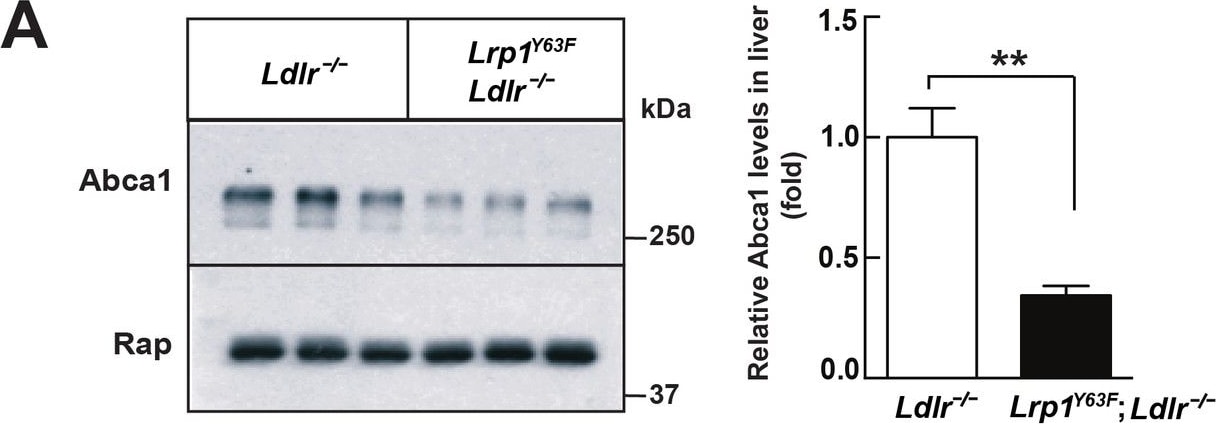
Western Blot: ABCA1 Antibody (3A1.891.3) [NB400-164] -
Western Blot: ABCA1 Antibody (3A1.891.3) [NB400-164] - Lrp1Y63F mutation downregulates hepatic Abca1 levels.(A) Western blot analysis of Abca1 expression in the liver from Lrp1Y63F;Ldlr−/− & Ldlr−/− mice fed with HCHF diet for 16 weeks (n = 5, each group). (B) Western blot analysis of Abca1 expression in the liver from 16 week HCHF-fed Lrp1Y63F;Ldlr−/− & Ldlr−/− mice after BMT (n = 5, each group). All data are mean ±SEM. **p<0.01. Image collected & cropped by CiteAb from the following publication (https://elifesciences.org/articles/29292), licensed under a CC-BY license. Not internally tested by Novus Biologicals.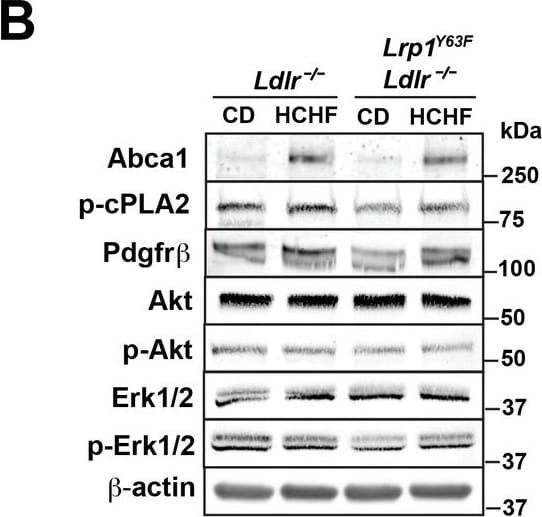
Western Blot: ABCA1 Antibody (3A1.891.3) [NB400-164] -
Western Blot: ABCA1 Antibody (3A1.891.3) [NB400-164] - Lrp1Y63F mutation has no effect on atherogenic signaling pathways & morphological phenotype in SMCs.(A) Left: representative images of H&E stained descending thoracic aortas (scale bar = 50 μm). Right: aortic wall thickness & cell number were quantified for the indicated genotypes. Data are expressed mean ±SEM; n = 3 per group & genotype. (B) HCHF diet in Lrp1Y63F;Ldlr−/− mice has no effect on PDGF & TGF beta -mediated signaling in the aorta. Proteins were extracted from whole aorta in Lrp1Y63F;Ldlr−/− & Ldlr−/− mice fed with indicated diets. Expression of proteins involved in PDGF signaling pathways was determined by Western blot analysis. (C) Lrp1Y63F mutation did not affect atherogenic signaling pathways mediated by PDGF in vitro. Primary SMCs from WT & Lrp1Y63F mice were incubated with or without 10 ng/ml PDGF-BB for 10 min. Expression of proteins involved in PDGF signaling were determined by Western blot analysis. (D) Lrp1Y63F mutation did not alter SMC functions in vitro. Primary cultured SMCs from WT & Lrp1Y63F mice were incubated with or without 10 ng/ml PDGF-BB under indicated conditions, then cell migration (left) & proliferation (right) were determined. Values from three independent experiments are expressed as mean ±SEM. *p<0.05. Image collected & cropped by CiteAb from the following publication (https://elifesciences.org/articles/29292), licensed under a CC-BY license. Not internally tested by Novus Biologicals.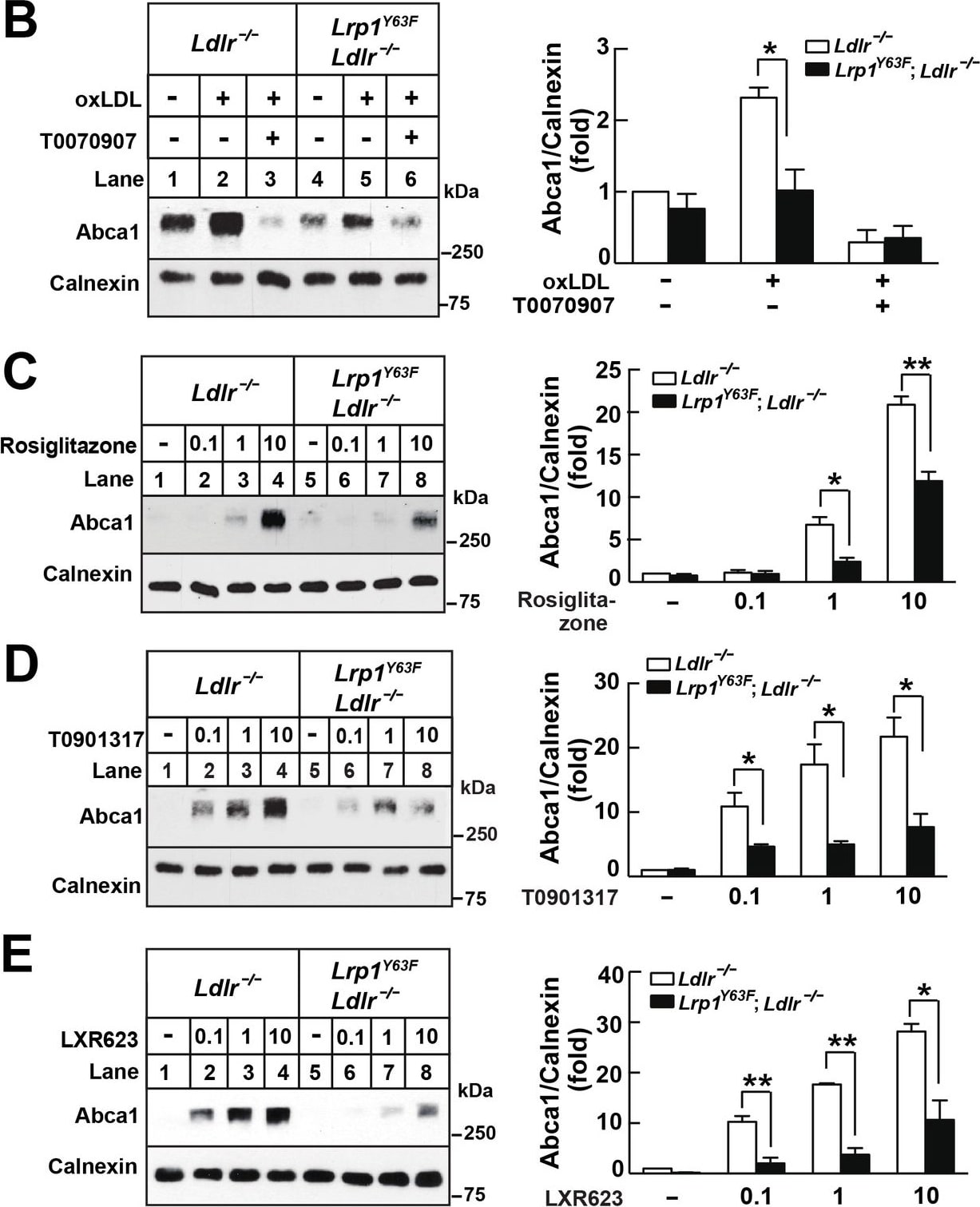
Western Blot: ABCA1 Antibody (3A1.891.3) [NB400-164] -
Western Blot: ABCA1 Antibody (3A1.891.3) [NB400-164] - Lrp1Y63F impairs Abca1 induction through inhibiting the PPAR gamma /LXR pathway.(A) Real-time PCR analysis of Abca1, Abca7, Pparg, Nr1h3 & Nr2h2 expression in macrophages treated with or without ox-LDL. (B–E) Isolated peritoneal macrophages from Lrp1Y63F;Ldlr−/− & Ldlr−/− were pre-incubated for 1 hr with (B) T0070907 (PPAR gamma antagonist, 10 μM), (C) Rosiglitizone (PPAR gamma agonist) at indicated concentrations in μM, (D) T0901317 (nonspecific LXR agonist) at indicated concentrations in μM, (E) LXR623 (LXR beta full agonist & LXR alpha partial agonist) at indicated concentrations in μM, followed by the treatment with or without oxLDL for an additional 24 hr. Abca1 expression was assessed by immunoblot analysis (left). Protein expression was quantified & analyzed (right). Data are mean ±SEM from three independent experiments. *p<0.05; **p<0.01. Image collected & cropped by CiteAb from the following publication (https://elifesciences.org/articles/29292), licensed under a CC-BY license. Not internally tested by Novus Biologicals.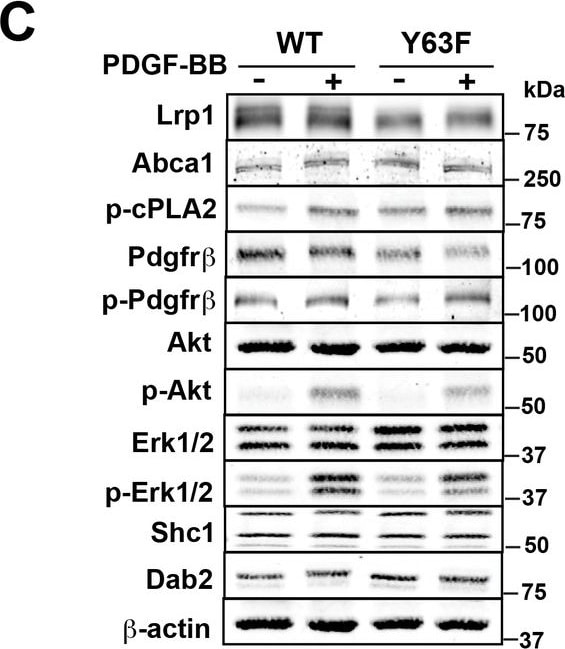
Western Blot: ABCA1 Antibody (3A1.891.3) [NB400-164] -
Western Blot: ABCA1 Antibody (3A1.891.3) [NB400-164] - Lrp1Y63F mutation has no effect on atherogenic signaling pathways & morphological phenotype in SMCs.(A) Left: representative images of H&E stained descending thoracic aortas (scale bar = 50 μm). Right: aortic wall thickness & cell number were quantified for the indicated genotypes. Data are expressed mean ±SEM; n = 3 per group & genotype. (B) HCHF diet in Lrp1Y63F;Ldlr−/− mice has no effect on PDGF & TGF beta -mediated signaling in the aorta. Proteins were extracted from whole aorta in Lrp1Y63F;Ldlr−/− & Ldlr−/− mice fed with indicated diets. Expression of proteins involved in PDGF signaling pathways was determined by Western blot analysis. (C) Lrp1Y63F mutation did not affect atherogenic signaling pathways mediated by PDGF in vitro. Primary SMCs from WT & Lrp1Y63F mice were incubated with or without 10 ng/ml PDGF-BB for 10 min. Expression of proteins involved in PDGF signaling were determined by Western blot analysis. (D) Lrp1Y63F mutation did not alter SMC functions in vitro. Primary cultured SMCs from WT & Lrp1Y63F mice were incubated with or without 10 ng/ml PDGF-BB under indicated conditions, then cell migration (left) & proliferation (right) were determined. Values from three independent experiments are expressed as mean ±SEM. *p<0.05. Image collected & cropped by CiteAb from the following publication (https://elifesciences.org/articles/29292), licensed under a CC-BY license. Not internally tested by Novus Biologicals.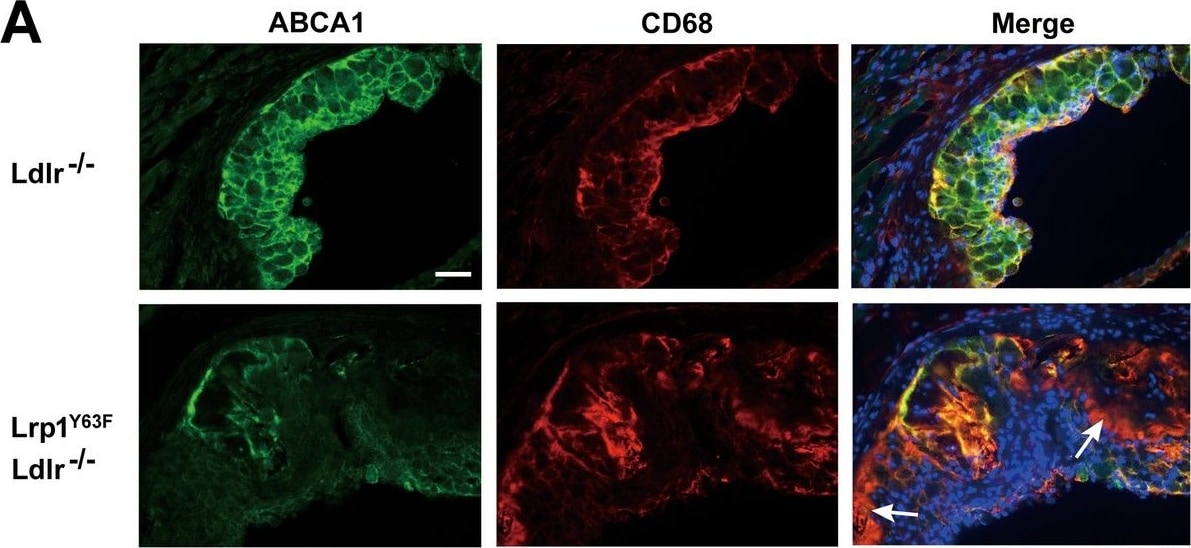
Immunocytochemistry/ Immunofluorescence: ABCA1 Antibody (3A1.891.3) - BSA Free [NB400-164] -
Abca1 expression is reduced in atherosclerotic lesions in Lrp1Y63F;Ldlr−/− mice.(A) Cryo-sections of aortic roots from HCD-fed Ldlr−/− and Lrp1Y63F;Ldlr−/− mice were double-stained with Abca1 (green) and Cd68 (red) antibodies. Nuclei were stained with DAPI (blue). (B) Abca1 immunoreactivity was determined by color and normalized to lesion size. Scale bar = 200 μM. White arrows indicate the areas of macrophages without Abca1 expression. Data are mean +/-SEM from five mice for each genotype. **p<0.01. Image collected and cropped by CiteAb from the following open publication (https://pubmed.ncbi.nlm.nih.gov/29144234), licensed under a CC-BY license. Not internally tested by Novus Biologicals.Applications for ABCA1 Antibody (3A1.891.3) - BSA Free
Application
Recommended Usage
Immunohistochemistry
1:500
Immunohistochemistry-Paraffin
1:500. Use reported in scientific literature (PMID 19718435)
Western Blot
1:1000-1:3000
Application Notes
In Western blot, a band is observed at ~250 kDa. ABCA1 is known to aggregate. Do not boil samples and use a reducing buffer.
Reviewed Applications
Read 1 review rated 5 using NB400-164 in the following applications:
Formulation, Preparation, and Storage
Purification
Unpurified
Formulation
Ascites
Format
BSA Free
Preservative
0.1% Sodium Azide
Concentration
This product is unpurified. The exact concentration of antibody is not quantifiable.
Shipping
The product is shipped with polar packs. Upon receipt, store it immediately at the temperature recommended below.
Stability & Storage
Aliquot and store at -20C or -80C. Avoid freeze-thaw cycles.
Background: ABCA1
ABCA1 is comprised of 2,261 amino acids with a theoretical molecular weight of 254 kDa and human ABCA1 shares 97% amino acid identity with mouse ABCA1. The general structure of ABCA consists of two transmembrane domains (TMDs) and two nucleotide binding domains (NBDs). ABCA1 is a widely distributed cell-membrane protein with the highest expression found in macrophages. DHHC8 mediated palmitoylation of ABCA1 is essential for its localization to the plasma membrane and expression of mouse ABCA1 (not human) is induced by cAMP analogs (2). ABCA1 is phosphorylated at Ser1042 and Ser2054 by PKA, with Ser2054 being key for regulating phospholipid efflux. Mutations in ABCA1 have been linked to atherosclerosis and the progression of metabolic syndrome phenotypes: high density lipoprotein deficiency type 1 (HDLD1); also known as Tangier disease (TGD), and high density lipoprotein deficiency type 2 (HDLD2); also known as familial hypoalphalipoproteinemia (FHA) (3).
References
1.Oram JF, Lawn RM. (2001) ABCA1. The gatekeeper for eliminating excess tissue cholesterol. J Lipid Res. 42(8):1173-9. PMID: 11483617
2.Singaraja RR, Kang MH, Vaid K, Sanders SS, Vilas GL, Arstikaitis P, Coutinho J, Drisdel RC, El-Husseini Ael D, Green WN, Berthiaume L, Hayden MR. (2009) Palmitoylation of ATP-binding cassette transporter A1 is essential for its trafficking and function. Circ Res. 105(2):138-47. PMID: 19556522
3.Attie AD. (2007) ABCA1: at the nexus of cholesterol, HDL and atherosclerosis. Trends in Biochemical Sciences 32(4):172-9. PMID: 17324574
Long Name
ATP-binding Cassette, Sub-family A (ABC1), Member 1
Alternate Names
ABC1, CERP, HDLDT1, TGD
Gene Symbol
ABCA1
Additional ABCA1 Products
Product Documents for ABCA1 Antibody (3A1.891.3) - BSA Free
Certificate of Analysis
To download a Certificate of Analysis, please enter a lot or batch number in the search box below.
Product Specific Notices for ABCA1 Antibody (3A1.891.3) - BSA Free
This product is for research use only and is not approved for use in humans or in clinical diagnosis. Primary Antibodies are guaranteed for 1 year from date of receipt.
Related Research Areas
Citations for ABCA1 Antibody (3A1.891.3) - BSA Free
 Powered by Bioz
Customer Reviews for ABCA1 Antibody (3A1.891.3) - BSA Free (1)
5 out of 5
1 Customer Rating
Have you used ABCA1 Antibody (3A1.891.3) - BSA Free?
Submit a review and receive an Amazon gift card!
$25/€18/£15/$25CAN/¥2500 for a review with an image
$10/€7/£6/$10CAN/¥1110 for a review without an image
Submit a review
Showing
1
-
1 of
1 review
Showing All
Filter By:
-
Application: Western BlotSample Tested: Brain microvessels total proteins, Sample Amount: 20 microgramsSpecies: MouseVerified Customer | Posted 10/25/2011
There are no reviews that match your criteria.
Protocols
Find general support by application which include: protocols, troubleshooting, illustrated assays, videos and webinars.
- Antigen Retrieval Protocol (PIER)
- Antigen Retrieval for Frozen Sections Protocol
- Appropriate Fixation of IHC/ICC Samples
- Cellular Response to Hypoxia Protocols
- Chromogenic IHC Staining of Formalin-Fixed Paraffin-Embedded (FFPE) Tissue Protocol
- Chromogenic Immunohistochemistry Staining of Frozen Tissue
- ClariTSA™ Fluorophore Kits
- Detection & Visualization of Antibody Binding
- Fluorescent IHC Staining of Frozen Tissue Protocol
- Graphic Protocol for Heat-induced Epitope Retrieval
- Graphic Protocol for the Preparation and Fluorescent IHC Staining of Frozen Tissue Sections
- Graphic Protocol for the Preparation and Fluorescent IHC Staining of Paraffin-embedded Tissue Sections
- Graphic Protocol for the Preparation of Gelatin-coated Slides for Histological Tissue Sections
- IHC Sample Preparation (Frozen sections vs Paraffin)
- Immunofluorescent IHC Staining of Formalin-Fixed Paraffin-Embedded (FFPE) Tissue Protocol
- Immunohistochemistry (IHC) and Immunocytochemistry (ICC) Protocols
- Immunohistochemistry Frozen Troubleshooting
- Immunohistochemistry Paraffin Troubleshooting
- Preparing Samples for IHC/ICC Experiments
- Preventing Non-Specific Staining (Non-Specific Binding)
- Primary Antibody Selection & Optimization
- Protocol for Heat-Induced Epitope Retrieval (HIER)
- Protocol for Making a 4% Formaldehyde Solution in PBS
- Protocol for VisUCyte™ HRP Polymer Detection Reagent
- Protocol for the Preparation & Fixation of Cells on Coverslips
- Protocol for the Preparation and Chromogenic IHC Staining of Frozen Tissue Sections
- Protocol for the Preparation and Chromogenic IHC Staining of Frozen Tissue Sections - Graphic
- Protocol for the Preparation and Chromogenic IHC Staining of Paraffin-embedded Tissue Sections
- Protocol for the Preparation and Chromogenic IHC Staining of Paraffin-embedded Tissue Sections - Graphic
- Protocol for the Preparation and Fluorescent IHC Staining of Frozen Tissue Sections
- Protocol for the Preparation and Fluorescent IHC Staining of Paraffin-embedded Tissue Sections
- Protocol for the Preparation of Gelatin-coated Slides for Histological Tissue Sections
- R&D Systems Quality Control Western Blot Protocol
- TUNEL and Active Caspase-3 Detection by IHC/ICC Protocol
- The Importance of IHC/ICC Controls
- Troubleshooting Guide: Immunohistochemistry
- Troubleshooting Guide: Western Blot Figures
- Western Blot Conditions
- Western Blot Protocol
- Western Blot Protocol for Cell Lysates
- Western Blot Troubleshooting
- Western Blot Troubleshooting Guide
- View all Protocols, Troubleshooting, Illustrated assays and Webinars
FAQs for ABCA1 Antibody (3A1.891.3) - BSA Free
Showing
1
-
2 of
2 FAQs
Showing All
-
Q: For Western blot protocol for ABCA1 antibody NB400-105, why does it suggest treating with beta-ME while not heating?
A: For some membrane proteins it is not recommended to boil the samples. You may incubate them at room temperature or at 37C in SDS sample buffer with BME. However, from personal experience, if you boil the samples you will not see the protein on the blot. I do not think the exact reason is known.
-
Q: Our customer would like to consult something about the ABCA1 antibody with the Cat No. NB400-105. In the datasheet, it showed this protein expressed very low in most cell types. The customer may test the mouse liver tissues, and he doesn’t know the expression level of ABCA1 in this tissue. Is it necessary to induce the expression via LXR treatment to get enough protein expressed? If he doesn’t induce the expression, how much protein loaded was suitable as recommended?
A:
Our own Western blot data for NB400-105 was generated by treating RAW cells with 9-cis-retinoic acid and 22R-hydroxycholesterol, which are both known to induce expression of ABCA1 in macrophages. 40ug of protein was loaded on to the gel in this instance. Unfortunately we do not have any testing data from mouse liver tissues using this particular antibody, however the data for another of our ABCA1 antibodies may be of interest to your customer: NB100-2068. The Western blot data for this product was generated using mouse liver tissue, and a clear band can be seen at the expected molecular weight in wild type tissue. We loaded 30ug of protein when running this Western blot, however, your customer may need to optimise the staining procedure for their sample type.
-
Q: For Western blot protocol for ABCA1 antibody NB400-105, why does it suggest treating with beta-ME while not heating?
A: For some membrane proteins it is not recommended to boil the samples. You may incubate them at room temperature or at 37C in SDS sample buffer with BME. However, from personal experience, if you boil the samples you will not see the protein on the blot. I do not think the exact reason is known.
-
Q: Our customer would like to consult something about the ABCA1 antibody with the Cat No. NB400-105. In the datasheet, it showed this protein expressed very low in most cell types. The customer may test the mouse liver tissues, and he doesn’t know the expression level of ABCA1 in this tissue. Is it necessary to induce the expression via LXR treatment to get enough protein expressed? If he doesn’t induce the expression, how much protein loaded was suitable as recommended?
A:
Our own Western blot data for NB400-105 was generated by treating RAW cells with 9-cis-retinoic acid and 22R-hydroxycholesterol, which are both known to induce expression of ABCA1 in macrophages. 40ug of protein was loaded on to the gel in this instance. Unfortunately we do not have any testing data from mouse liver tissues using this particular antibody, however the data for another of our ABCA1 antibodies may be of interest to your customer: NB100-2068. The Western blot data for this product was generated using mouse liver tissue, and a clear band can be seen at the expected molecular weight in wild type tissue. We loaded 30ug of protein when running this Western blot, however, your customer may need to optimise the staining procedure for their sample type.
Loading...