
Abhd5 Antibody (1F3) - Azide and BSA Free
Novus Biologicals | Catalog # H00051099-M01

![Immunohistochemistry-Paraffin: Abhd5 Antibody (1F3) [H00051099-M01]](https://resources.rndsystems.com/images/products/Abhd5-Antibody-1F3-Immunohistochemistry-Paraffin-H00051099-M01-img0012.jpg "Immunohistochemistry-Paraffin: Abhd5 Antibody (1F3) [H00051099-M01]")
Scientific images may be resized, cropped, or adjusted for brightness or contrast for presentation purposes. These updates are limited to presentation and do not affect the underlying scientific interpretation of the data. Where available, additional source data may be provided upon request.
Key Product Details
Species Reactivity
Validated:
Cited:
Applications
Validated:
Cited:
Label
Antibody Source
Format
Product Specifications
Immunogen
Reactivity Notes
Specificity
Clonality
Host
Isotype
Scientific Data Images for Abhd5 Antibody (1F3) - Azide and BSA Free
Immunohistochemistry-Paraffin: Abhd5 Antibody (1F3) [H00051099-M01]
Immunohistochemistry-Paraffin: Abhd5 Antibody (1F3) [H00051099-M01] - Analysis of monoclonal antibody to ABHD5 on formalin-fixed paraffin-embedded human small Intestine. Antibody concentration 3 ug/ml.![Western Blot: Abhd5 Antibody (1F3) [H00051099-M01]](https://resources.rndsystems.com/images/products/Abhd5-Antibody-1F3-Western-Blot-H00051099-M01-img0018.jpg "Western Blot: Abhd5 Antibody (1F3) [H00051099-M01]")
Western Blot: Abhd5 Antibody (1F3) [H00051099-M01]
Western Blot: Abhd5 Antibody (1F3) [H00051099-M01] - ABHD5 expression in HeLa, mouse and bovine tissues. Primary: 1:500 dilution. This image was submitted via customer Review.![Western Blot: Abhd5 Antibody (1F3) [H00051099-M01]](https://resources.rndsystems.com/images/products/Abhd5-Antibody-1F3-Western-Blot-H00051099-M01-img0004.jpg "Western Blot: Abhd5 Antibody (1F3) [H00051099-M01]")
Western Blot: Abhd5 Antibody (1F3) [H00051099-M01]
Western Blot: Abhd5 Antibody (1F3) [H00051099-M01] - Western Blot analysis of ABHD5 expression in Jurkat(Cat # L017V1 ).![Western Blot: Abhd5 Antibody (1F3) [H00051099-M01]](https://resources.rndsystems.com/images/products/Abhd5-Antibody-1F3-Western-Blot-H00051099-M01-img0005.jpg "Western Blot: Abhd5 Antibody (1F3) [H00051099-M01]")
Western Blot: Abhd5 Antibody (1F3) [H00051099-M01]
Western Blot: Abhd5 Antibody (1F3) [H00051099-M01] - Western Blot analysis of ABHD5 expression in human liver.![Western Blot: Abhd5 Antibody (1F3) [H00051099-M01]](https://resources.rndsystems.com/images/products/Abhd5-Antibody-1F3-Western-Blot-H00051099-M01-img0014.jpg "Western Blot: Abhd5 Antibody (1F3) [H00051099-M01]")
Western Blot: Abhd5 Antibody (1F3) [H00051099-M01]
Western Blot: Abhd5 Antibody (1F3) [H00051099-M01] - ABHD5 monoclonal antibody (M01), clone 1F3. Analysis of ABHD5 expression in HeLa.![Western Blot: Abhd5 Antibody (1F3) [H00051099-M01]](https://resources.rndsystems.com/images/products/Abhd5-Antibody-1F3-Western-Blot-H00051099-M01-img0015.jpg "Western Blot: Abhd5 Antibody (1F3) [H00051099-M01]")
Western Blot: Abhd5 Antibody (1F3) [H00051099-M01]
Western Blot: Abhd5 Antibody (1F3) [H00051099-M01] - ABHD5 monoclonal antibody (M01), clone 1F3. Analysis of ABHD5 expression in rat testis.![Western Blot: Abhd5 Antibody (1F3) [H00051099-M01]](https://resources.rndsystems.com/images/products/Abhd5-Antibody-1F3-Western-Blot-H00051099-M01-img0016.jpg "Western Blot: Abhd5 Antibody (1F3) [H00051099-M01]")
Western Blot: Abhd5 Antibody (1F3) [H00051099-M01]
Western Blot: Abhd5 Antibody (1F3) [H00051099-M01] - Analysis of ABHD5 expression in transfected 293T cell line by ABHD5 monoclonal antibody (M01), clone 1F3.Lane 1: ABHD5 transfected lysate(39 KDa).Lane 2: Non-transfected lysate.![ELISA: Abhd5 Antibody (1F3) [H00051099-M01]](https://resources.rndsystems.com/images/products/Abhd5-Antibody-1F3-ELISA-H00051099-M01-img0017.jpg "ELISA: Abhd5 Antibody (1F3) [H00051099-M01]")
ELISA: Abhd5 Antibody (1F3) [H00051099-M01]
ELISA: Abhd5 Antibody (1F3) [H00051099-M01] - Detection limit for recombinant GST tagged ABHD5 is approximately 1ng/ml as a capture antibody.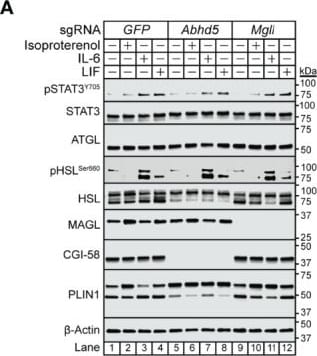
Western Blot: Abhd5 Antibody (1F3) - Azide and BSA Free [H00051099-M01] -
The Role of MAGL and CGI-58 in IL-6 and beta -adrenergic Adipocyte Signaling and Lipolysis. (A-D) Pre-adipocytes in a 12-well format were infected with lentivirus containing Cas9 and sgGFP (black), sgAbhd5 (red), or sgMgll (blue) followed by differentiation as described in Methods. On day 8, differentiated adipocytes were treated in a final volume of 1 ml of medium D with 3 ul DMSO and 3 ul PBS containing the indicated concentration of isoproterenol (A, B), IL-6 (A, C), or LIF (A, D). After incubation for 24 hours, medium was collected and processed to measure concentrations of glycerol (left panel) or NEFA (right panel) and adipocytes were harvested and processed for immunoblot analysis (A) with the indicated antibodies as described in Methods. Glycerol levels are shown relative to the average 300 nM isoproterenol condition (B, 653 uM), 3 nM IL-6 condition (C, 109 uM), or 0.3 nM LIF condition (D, 55 uM) of the sgGFP-treated adipocytes. NEFA levels are shown relative to the average 300 nM isoproterenol condition (B, 282 uM), 3 nM IL-6 condition (C, 70 uM), or 1 nM LIF condition (D, 21 uM) of the sgGFP-treated adipocytes. Data is shown as mean +/- SEM of three wells. P value calculated by using a two-way repeated measures ANOVA between sgGFP and the indicated sgRNA conditions. These results were confirmed in at least three independent experiments. Not significant (n.s.). Image collected and cropped by CiteAb from the following open publication (https://pubmed.ncbi.nlm.nih.gov/35785158), licensed under a CC-BY license. Not internally tested by Novus Biologicals.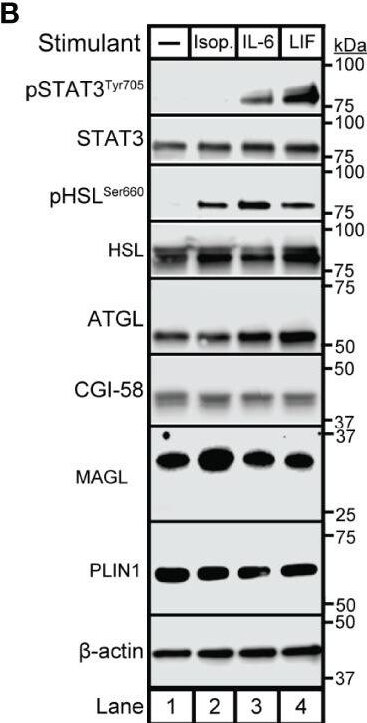
Western Blot: Abhd5 Antibody (1F3) - Azide and BSA Free [H00051099-M01] -
Comparison of IL-6 Family Cytokine and beta -adrenergic Adipocyte Signaling and Lipolysis. (A–D) Differentiated adipocytes in a 12-well format were treated in a final volume of 1 ml of medium D with 3 ul DMSO and 3 ul PBS in the absence or presence of 300 nM isoproterenol (black, Isop.), 3 nM IL-6 (red), or 0.3 nM LIF (blue). After incubation (37C, 10% CO2) for either 24 hours (A, B) or the indicated time (C, D), medium was collected and processed to measure concentrations of NEFA (A, C; top panels) or glycerol (A,C; bottom panels), and adipocytes were harvested and processed for immunoblot analysis (B, D) with the indicated antibody as described in Methods. Data is shown as mean +/- SEM of three wells. *p < 0.05, **p < 0.01, or ****p < 0.0001 based on one-way ANOVA followed by Dunnett’s multiple comparison test to compare each condition to the vehicle condition (A) or two-way ANOVA followed by Šidak’s multiple comparison test to compare isoproterenol to IL-6 conditions at matched time points (B). These results were confirmed in at least three independent experiments. Image collected and cropped by CiteAb from the following open publication (https://pubmed.ncbi.nlm.nih.gov/35785158), licensed under a CC-BY license. Not internally tested by Novus Biologicals.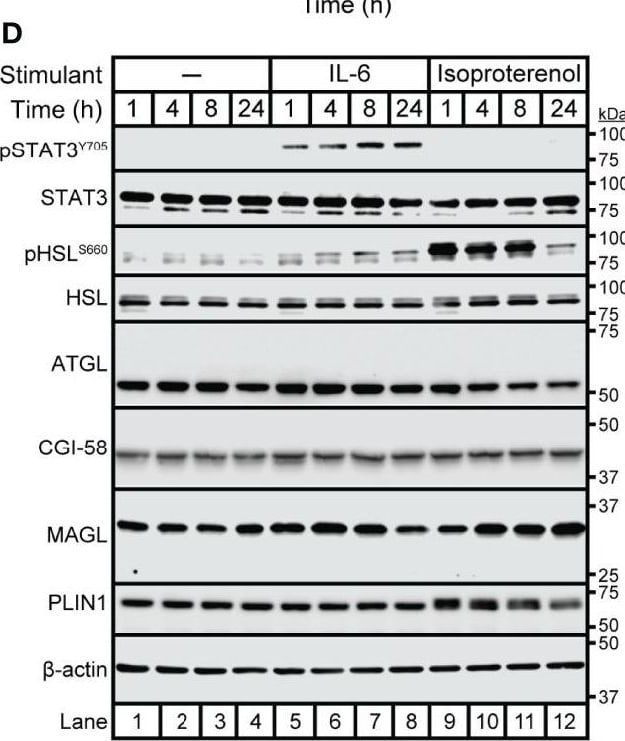
Western Blot: Abhd5 Antibody (1F3) - Azide and BSA Free [H00051099-M01] -
Comparison of IL-6 Family Cytokine and beta -adrenergic Adipocyte Signaling and Lipolysis. (A–D) Differentiated adipocytes in a 12-well format were treated in a final volume of 1 ml of medium D with 3 ul DMSO and 3 ul PBS in the absence or presence of 300 nM isoproterenol (black, Isop.), 3 nM IL-6 (red), or 0.3 nM LIF (blue). After incubation (37C, 10% CO2) for either 24 hours (A, B) or the indicated time (C, D), medium was collected and processed to measure concentrations of NEFA (A, C; top panels) or glycerol (A,C; bottom panels), and adipocytes were harvested and processed for immunoblot analysis (B, D) with the indicated antibody as described in Methods. Data is shown as mean +/- SEM of three wells. *p < 0.05, **p < 0.01, or ****p < 0.0001 based on one-way ANOVA followed by Dunnett’s multiple comparison test to compare each condition to the vehicle condition (A) or two-way ANOVA followed by Šidak’s multiple comparison test to compare isoproterenol to IL-6 conditions at matched time points (B). These results were confirmed in at least three independent experiments. Image collected and cropped by CiteAb from the following open publication (https://pubmed.ncbi.nlm.nih.gov/35785158), licensed under a CC-BY license. Not internally tested by Novus Biologicals.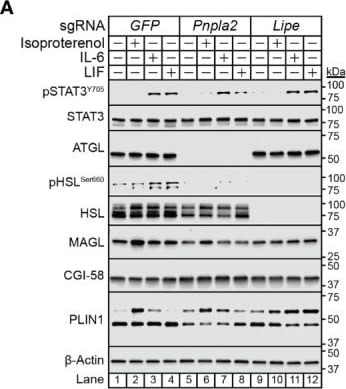
Western Blot: Abhd5 Antibody (1F3) - Azide and BSA Free [H00051099-M01] -
The Role of ATGL and HSL in IL-6 and beta -adrenergic Adipocyte Signaling and Lipolysis. (A–D) Pre-adipocytes in a 12-well format were infected with lentivirus containing Cas9 and sgGFP (black), sgPnpla2 (red), or sgLipe (blue) followed by differentiation as described in Methods. On day 8, differentiated adipocytes were treated in a final volume of 1 ml of medium D with 3 ul DMSO and 3 ul PBS containing the indicated concentration of isoproterenol (A, B), IL-6 (A, C), or LIF (A, D). After incubation for 24 hours, medium was collected and processed to measure concentrations of glycerol (left panel) or NEFA (right panel) and adipocytes were harvested and processed for immunoblot analysis (A) with the indicated antibodies as described in Methods. Glycerol levels are shown relative to the average 300 nM isoproterenol condition (B, 578 uM), 3 nM IL-6 condition (C, 140 uM), or 1 nM LIF condition (D, 86 uM) of the sgGFP-treated adipocytes. NEFA levels are shown relative to the average 300 nM isoproterenol condition (B, 123 uM), 3 nM IL-6 condition (C, 57 uM), or 1 nM LIF condition (D, 27 uM) of the sgGFP-treated adipocytes. Data is shown as mean +/- SEM of three wells. P value calculated by using a two-way repeated measures ANOVA between sgGFP and the indicated sgRNA conditions. These results were confirmed in at least three independent experiments. Not significant (n.s.). Image collected and cropped by CiteAb from the following open publication (https://pubmed.ncbi.nlm.nih.gov/35785158), licensed under a CC-BY license. Not internally tested by Novus Biologicals.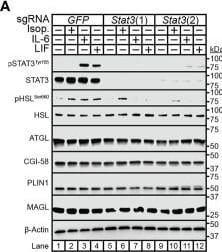
Western Blot: Abhd5 Antibody (1F3) - Azide and BSA Free [H00051099-M01] -
The Role of STAT3 in IL-6 and beta -adrenergic Adipocyte Signaling and Lipolysis. (A–C) Pre-adipocytes in a 12-well format were infected with lentivirus containing Cas9 and the indicated sgRNA as described in Methods. On day 8, differentiated adipocytes were treated in a final volume of 1 ml of medium D with 3 ul DMSO and 3 ul PBS containing 300 nM isoproterenol, 3 nM IL-6, or 0.3nM LIF. After incubation for 24 hours, medium was collected and processed to measure concentrations of glycerol (B) or NEFA (C) and adipocytes were harvested and processed for immunoblot analysis (A) with the indicated antibodies as described in Methods. Glycerol release is shown relative to the respective stimulant in the sgGFP condition which were 366 μM, 70 μM, and 33 μM for isoproterenol, IL-6, and LIF, respectively. NEFA release is shown relative to the respective stimulant in the sgGFP condition which were 273 μM, 137 μM, and 34 μM for isoproterenol, IL-6, and LIF, respectively. Data is shown as mean +/- SEM of three wells. *p < 0.5, ***p < 0.001, or ****p < 0.0001 based on two-way ANOVA with Tukey’s multiple comparison test for differences in relative glycerol or NEFA release between sgRNA treatments with the same stimulant. These results were confirmed in at least three independent experiments. Image collected and cropped by CiteAb from the following open publication (https://pubmed.ncbi.nlm.nih.gov/35785158), licensed under a CC-BY license. Not internally tested by Novus Biologicals.Applications for Abhd5 Antibody (1F3) - Azide and BSA Free
ELISA
Immunohistochemistry
Immunohistochemistry-Paraffin
Western Blot
Reviewed Applications
Read 1 review rated 3 using H00051099-M01 in the following applications:
Formulation, Preparation, and Storage
Purification
Formulation
Format
Preservative
Concentration
Shipping
Stability & Storage
Background: Abhd5
Alternate Names
Entrez Gene IDs
Gene Symbol
OMIM
UniProt
Additional Abhd5 Products
Product Documents for Abhd5 Antibody (1F3) - Azide and BSA Free
Certificate of Analysis
To download a Certificate of Analysis, please enter a lot or batch number in the search box below.
Product Specific Notices for Abhd5 Antibody (1F3) - Azide and BSA Free
This product is produced by and distributed for Abnova, a company based in Taiwan.
This product is for research use only and is not approved for use in humans or in clinical diagnosis. Primary Antibodies are guaranteed for 1 year from date of receipt.
Citations for Abhd5 Antibody (1F3) - Azide and BSA Free
 Powered by Bioz
Customer Reviews for Abhd5 Antibody (1F3) - Azide and BSA Free (1)
Have you used Abhd5 Antibody (1F3) - Azide and BSA Free?
Submit a review and receive an Amazon gift card!
$25/€18/£15/$25CAN/¥2500 for a review with an image
$10/€7/£6/$10CAN/¥1110 for a review without an image
Submit a review
Customer Images

-
Application: Western BlotSample Tested: Hela whole cell lysate, Mouse adipose tissue, mouse liver lysate, bovine adipose tissue lysate, bovine liver tissue lysate and HeLa CytosolSpecies: Bovine, Mouse and HumanVerified Customer | Posted 09/12/2017Western Blot analysis of ABHD5 expression in HeLa, mouse and bovine tissues.4-20% gradient gel 15 ug/well PVDF and Nitocellulose Block: 5% NFDM in TBS 0.1% Tween-20 Primary: 1:500 dilution, 1% NFDM in TBS 0.1% Tween-20, overnight at 4 C Secondary: 1:10,000 anti-mouse - HRP (Jackson ImmunoResearch 115-035-205); 1:5000 anti-biotin - HRP (Cell Signaling 7075P5), 1% NFDM in TBS 0.1% Tween-20, 1 hr at RT ECL: SuperSignal West Femto (ThermoFisher Scientific 34096), UVP Image Station

There are no reviews that match your criteria.
Protocols
Find general support by application which include: protocols, troubleshooting, illustrated assays, videos and webinars.
- Antigen Retrieval Protocol (PIER)
- Antigen Retrieval for Frozen Sections Protocol
- Appropriate Fixation of IHC/ICC Samples
- Cellular Response to Hypoxia Protocols
- Chromogenic IHC Staining of Formalin-Fixed Paraffin-Embedded (FFPE) Tissue Protocol
- Chromogenic Immunohistochemistry Staining of Frozen Tissue
- ClariTSA™ Fluorophore Kits
- Detection & Visualization of Antibody Binding
- ELISA Sample Preparation & Collection Guide
- ELISA Troubleshooting Guide
- Fluorescent IHC Staining of Frozen Tissue Protocol
- Graphic Protocol for Heat-induced Epitope Retrieval
- Graphic Protocol for the Preparation and Fluorescent IHC Staining of Frozen Tissue Sections
- Graphic Protocol for the Preparation and Fluorescent IHC Staining of Paraffin-embedded Tissue Sections
- Graphic Protocol for the Preparation of Gelatin-coated Slides for Histological Tissue Sections
- How to Run an R&D Systems DuoSet ELISA
- How to Run an R&D Systems Quantikine ELISA
- How to Run an R&D Systems Quantikine™ QuicKit™ ELISA
- ICC Cell Smear Protocol for Suspension Cells
- ICC Immunocytochemistry Protocol Videos
- ICC for Adherent Cells
- IHC Sample Preparation (Frozen sections vs Paraffin)
- Immunocytochemistry (ICC) Protocol
- Immunocytochemistry Troubleshooting
- Immunofluorescence of Organoids Embedded in Cultrex Basement Membrane Extract
- Immunofluorescent IHC Staining of Formalin-Fixed Paraffin-Embedded (FFPE) Tissue Protocol
- Immunohistochemistry (IHC) and Immunocytochemistry (ICC) Protocols
- Immunohistochemistry Frozen Troubleshooting
- Immunohistochemistry Paraffin Troubleshooting
- Preparing Samples for IHC/ICC Experiments
- Preventing Non-Specific Staining (Non-Specific Binding)
- Primary Antibody Selection & Optimization
- Protocol for Heat-Induced Epitope Retrieval (HIER)
- Protocol for Making a 4% Formaldehyde Solution in PBS
- Protocol for VisUCyte™ HRP Polymer Detection Reagent
- Protocol for the Fluorescent ICC Staining of Cell Smears - Graphic
- Protocol for the Fluorescent ICC Staining of Cultured Cells on Coverslips - Graphic
- Protocol for the Preparation & Fixation of Cells on Coverslips
- Protocol for the Preparation and Chromogenic IHC Staining of Frozen Tissue Sections
- Protocol for the Preparation and Chromogenic IHC Staining of Frozen Tissue Sections - Graphic
- Protocol for the Preparation and Chromogenic IHC Staining of Paraffin-embedded Tissue Sections
- Protocol for the Preparation and Chromogenic IHC Staining of Paraffin-embedded Tissue Sections - Graphic
- Protocol for the Preparation and Fluorescent ICC Staining of Cells on Coverslips
- Protocol for the Preparation and Fluorescent ICC Staining of Non-adherent Cells
- Protocol for the Preparation and Fluorescent ICC Staining of Stem Cells on Coverslips
- Protocol for the Preparation and Fluorescent IHC Staining of Frozen Tissue Sections
- Protocol for the Preparation and Fluorescent IHC Staining of Paraffin-embedded Tissue Sections
- Protocol for the Preparation of Gelatin-coated Slides for Histological Tissue Sections
- Protocol for the Preparation of a Cell Smear for Non-adherent Cell ICC - Graphic
- Quantikine HS ELISA Kit Assay Principle, Alkaline Phosphatase
- Quantikine HS ELISA Kit Principle, Streptavidin-HRP Polymer
- R&D Systems Quality Control Western Blot Protocol
- Sandwich ELISA (Colorimetric) – Biotin/Streptavidin Detection Protocol
- Sandwich ELISA (Colorimetric) – Direct Detection Protocol
- TUNEL and Active Caspase-3 Detection by IHC/ICC Protocol
- The Importance of IHC/ICC Controls
- Troubleshooting Guide: ELISA
- Troubleshooting Guide: Immunohistochemistry
- Troubleshooting Guide: Western Blot Figures
- Western Blot Conditions
- Western Blot Protocol
- Western Blot Protocol for Cell Lysates
- Western Blot Troubleshooting
- Western Blot Troubleshooting Guide
- View all Protocols, Troubleshooting, Illustrated assays and Webinars