
Aflatoxin B1 Antibody (6A10) - BSA Free
Novus Biologicals | Catalog # NB600-443

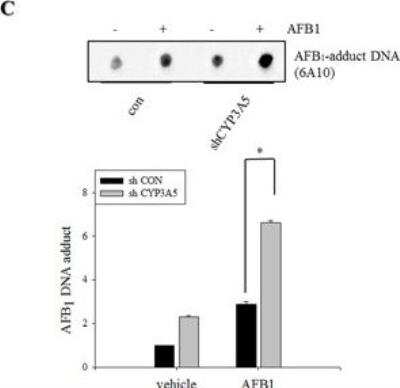
Key Product Details
Validated by
Species Reactivity
Validated:
Cited:
Applications
Validated:
Cited:
Label
Antibody Source
Format
Product Specifications
Immunogen
Localization
Specificity
Clonality
Host
Isotype
Scientific Data Images for Aflatoxin B1 Antibody (6A10) - BSA Free
![Immunohistochemistry: Aflatoxin B1 Antibody (6A10) - BSA Free [NB600-443]](https://resources.rndsystems.com/images/products/Aflatoxin-B1-Antibody-6A10-Immunohistochemistry-NB600-443-img0003.jpg "Immunohistochemistry: Aflatoxin B1 Antibody (6A10) - BSA Free [NB600-443]")
Immunohistochemistry: Aflatoxin B1 Antibody (6A10) - BSA Free [NB600-443]
Immunohistochemistry: Aflatoxin B1 Antibody (6A10) [NB600-443] - Staining of positive (A) and negative (B) tumor tissues for AFB, -DNA adducts. Photos courtesy of Dr. Regina Santella.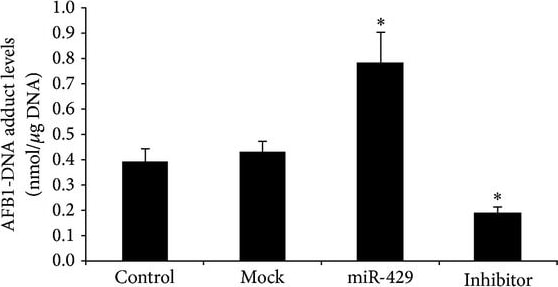
ELISA: Aflatoxin B1 Antibody (6A10) - BSA Free [NB600-443] -
AFB1-DNA adducts formation in AFB1-treated SMMC-7721 cells with overexpression of miR-429 (see Section 2). Levels of AFB1-DNA adducts were tested using comparative ELISA. Data were analyzed from three independent tests using one-way ANOVA with Bonferroni corrections. *P < 0.05.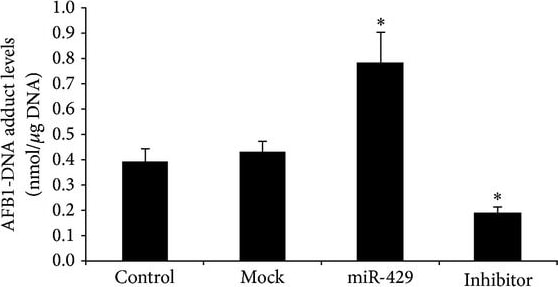
ELISA: Aflatoxin B1 Antibody (6A10) - BSA Free [NB600-443] -
ELISA: Aflatoxin B1 Antibody (6A10) - BSA Free [NB600-443] - AFB1-DNA adducts formation in AFB1-treated SMMC-7721 cells with overexpression of miR-429 (see Section 2). Levels of AFB1-DNA adducts were tested using comparative ELISA. Data were analyzed from three independent tests using one-way ANOVA with Bonferroni corrections. *P < 0.05. Image collected & cropped by CiteAb from the following publication (https://pubmed.ncbi.nlm.nih.gov/24204382), licensed under a CC-BY license. Not internally tested by Novus Biologicals.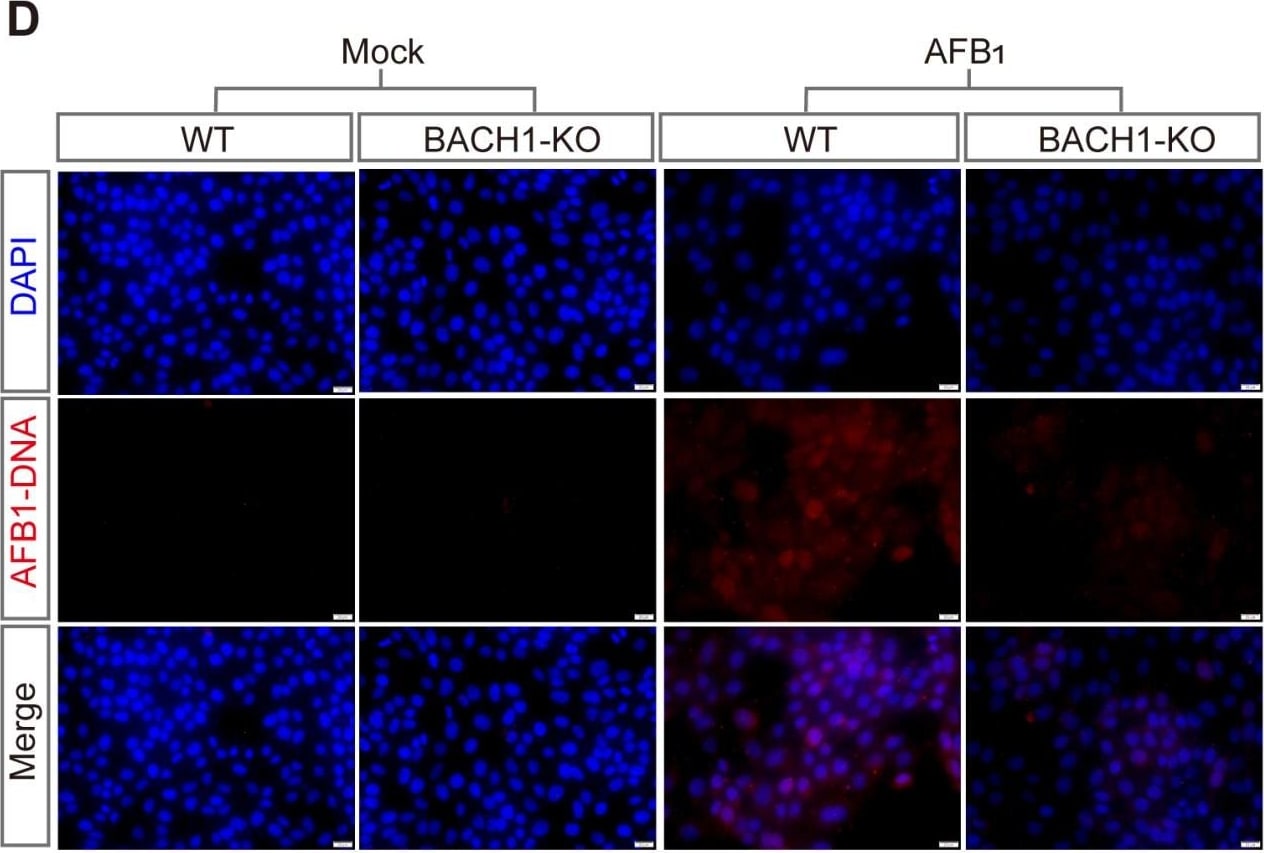
Immunocytochemistry/ Immunofluorescence: Aflatoxin B1 Antibody (6A10) - BSA Free [NB600-443] -
BACH1 knockout cells exhibit higher resistance to aflatoxin B1. (A) Western blot analysis of BACH1 expression in WT and KO cells. (B) Representative images of WT and BACH1-KO PK-15 cells challenged with 2 μg/mL AFB1 for 48 h. Scale bar, 100 μM. (C) The IC50 values for AFB1 in WT and BACH1-KO cells determined by CCK-8 assays. (D,E) Immunofluorescence staining of AFB1-induced DNA adduct formation in WT and BACH1-KO cells; relative fluorescence intensity calculated using ImageJ software. Scale bar, 20 μM. (F) Enhanced resistance to AFM1, AFG1, and F-2 in BACH1-KO cells. WT and BACH1-KO cells were treated with AFM1 (at 0.5 μg/mL and 1 μg/mL), AFG1 (at 8 μg/mL and 10 μg/mL), and F-2 (at 20 μg/mL and 30 μg/mL) for 36 h. Cell viability was measured with CCK-8 assays. * p < 0.05, ** p < 0.01, *** p < 0.001, **** p < 0.0001. p values were determined with two-tailed Student’s t-tests. AFB1, aflatoxin B1; AFG1, aflatoxin G1; F2, zearalenone; WT, wild-type; KO, knockout. Image collected and cropped by CiteAb from the following open publication (https://pubmed.ncbi.nlm.nih.gov/36139865), licensed under a CC-BY license. Not internally tested by Novus Biologicals.Applications for Aflatoxin B1 Antibody (6A10) - BSA Free
Dot Blot
ELISA
Immunocytochemistry/ Immunofluorescence
Immunohistochemistry
Immunohistochemistry-Paraffin
Western Blot
Reviewed Applications
Read 2 reviews rated 4.5 using NB600-443 in the following applications:
Formulation, Preparation, and Storage
Purification
Formulation
Format
Preservative
Concentration
Shipping
Stability & Storage
Background: Aflatoxin B1
Alternate Names
Additional Aflatoxin B1 Products
Product Documents for Aflatoxin B1 Antibody (6A10) - BSA Free
Certificate of Analysis
To download a Certificate of Analysis, please enter a lot or batch number in the search box below.
Product Specific Notices for Aflatoxin B1 Antibody (6A10) - BSA Free
This product is for research use only and is not approved for use in humans or in clinical diagnosis. Primary Antibodies are guaranteed for 1 year from date of receipt.
Citations for Aflatoxin B1 Antibody (6A10) - BSA Free
 Powered by Bioz
Customer Reviews for Aflatoxin B1 Antibody (6A10) - BSA Free (2)
Have you used Aflatoxin B1 Antibody (6A10) - BSA Free?
Submit a review and receive an Amazon gift card!
$25/€18/£15/$25CAN/¥2500 for a review with an image
$10/€7/£6/$10CAN/¥1110 for a review without an image
Submit a review
-
Application: ImmunohistochemistrySample Tested: Zebra FishSpecies: OtherVerified Customer | Posted 12/09/2011
-
Application: ELISASample Tested: mouse lung tissueSpecies: MouseVerified Customer | Posted 09/08/2010
There are no reviews that match your criteria.
Protocols
View specific protocols for Aflatoxin B1 Antibody (6A10) - BSA Free (NB600-443):
Competitive ELISA
Coating of Plates
DNA coating: DNA is dissolved in PBS at appropriate concentration. 0.1 ml is added/well and plates put in 37 degrees Celsius incubator to evaporate overnight. Alternatively, plates can be coated with a 2-fold higher concentration of DNA for 2 hrs at 37 degrees Celsius then used. Column 1 is not coated. These well will not be used for the assay (no blocking, no antibody and no secondary antibody) but will have substrate added for blanking the reader. Plates are stored in the refrigerator.
Protein coating: Proteins are dissolved in PBS at the appropriate concentration. 0.1 ml is added/well and plates put in 37 degrees Celsius incubator to evaporate overnight. Column 1 is again not coated. Plates are stored in the refrigerator.
An alternate protein coating condition is to dissolve the protein in 0.1 M sodium carbonate buffer pH 9.6. 0.1 ml is added/well and the plates are refrigerated for several hours or overnight. They cannot be used after 3 days.
1 M solution 1.59 g Na2CO3 + 2.93 g NaHCO3/100ml
Assay
1. Label assay sheet and determine which rows are to be used. Row 1 (A-H) is not used; it will be used to blank the spectrophotometer. Avoid using the outer rows if possible (i.e.12A-H, H 1-12 and A 1-12.
2. Wash plate with wash buffer containing PBS-Tween and NaN3 3 x on each side (right side up and upside down). Shake out onto paper towel.
3. Add 0.2 ml/well of 1% FCS in wash buffer to block non specific binding. Solution of FCS should be made fresh.
4. Incubate 1 hr.
5. Preparation of inhibitor series (during incubation of plate with FCS). Calculate appropriate concentrations to give desired fmol/well=fmol/0.05 ml. Make serial dilutions by adding PBS or CT DNA to tubes followed by competitor.
6. Prepare antibody in 1% FCS washing buffer.
7. At end of incubation period, shake out solution from plate and tap onto paper towel to dry.
8. Add 0.05 ml of competitor to each well followed by 0.05 ml of diluted antibody. Be sure to run all controls including zero (no competitor), minus Ab ( no antigen specific antibody but secondary antisera) and positive and negative controls.
9. Incubate for 90 min at 37 degrees Celsius.
10. Wash the plate with washing buffer 3 times on each side. Tap onto paper towels.
11. Secondary antisera - Use goat anti-mouse IgG-alkaline phosphatase for monoclonals and anti rabbit for polyclonals. Dilute as appropriate and add 0.1 ml/well.
12. Incubate for 90 min at 37 degrees Celsius.
13. Wash with wash buffer 3 x each side. Tap onto paper towel.
14. Wash plate 2 times with 0.01 M diethanolamine using the was bottle and covering the well completely each time. Tap onto paper towel. This step removes phosphate buffer which inhibits alkaline phosphatase activity.
15. Prepare the substrate - 2 tablets 95 mg/tablet) Sigma 104 in 10 ml 1 M diethanolamine, pH 8.6. Final concentration 1 mg/ml. Avoid physical contact of skin with the tablets since skin contains alkaline phosphatase. Add 0.1 ml/well
16. Incubate at 37 degrees Celsius and read absorbance at 405 nm. The absorbance of the 0 fmol standard should be between 0.5 and 1. Values above 2 are not usable since the reader may not be linear in this range.
Rinse water - One liter of H2O + 2 ml 10% NaN3
Wash buffer - One liter of 1 x PBS + 500 ul Tween 20 + 2 ml 10% NaN3
Blocking buffer - Wash buffer + 1% FCS
Find general support by application which include: protocols, troubleshooting, illustrated assays, videos and webinars.
- Antigen Retrieval Protocol (PIER)
- Antigen Retrieval for Frozen Sections Protocol
- Appropriate Fixation of IHC/ICC Samples
- Cellular Response to Hypoxia Protocols
- Chromogenic IHC Staining of Formalin-Fixed Paraffin-Embedded (FFPE) Tissue Protocol
- Chromogenic Immunohistochemistry Staining of Frozen Tissue
- ClariTSA™ Fluorophore Kits
- Detection & Visualization of Antibody Binding
- ELISA Sample Preparation & Collection Guide
- ELISA Troubleshooting Guide
- Fluorescent IHC Staining of Frozen Tissue Protocol
- Graphic Protocol for Heat-induced Epitope Retrieval
- Graphic Protocol for the Preparation and Fluorescent IHC Staining of Frozen Tissue Sections
- Graphic Protocol for the Preparation and Fluorescent IHC Staining of Paraffin-embedded Tissue Sections
- Graphic Protocol for the Preparation of Gelatin-coated Slides for Histological Tissue Sections
- How to Run an R&D Systems DuoSet ELISA
- How to Run an R&D Systems Quantikine ELISA
- How to Run an R&D Systems Quantikine™ QuicKit™ ELISA
- ICC Cell Smear Protocol for Suspension Cells
- ICC Immunocytochemistry Protocol Videos
- ICC for Adherent Cells
- IHC Sample Preparation (Frozen sections vs Paraffin)
- Immunocytochemistry (ICC) Protocol
- Immunocytochemistry Troubleshooting
- Immunofluorescence of Organoids Embedded in Cultrex Basement Membrane Extract
- Immunofluorescent IHC Staining of Formalin-Fixed Paraffin-Embedded (FFPE) Tissue Protocol
- Immunohistochemistry (IHC) and Immunocytochemistry (ICC) Protocols
- Immunohistochemistry Frozen Troubleshooting
- Immunohistochemistry Paraffin Troubleshooting
- Preparing Samples for IHC/ICC Experiments
- Preventing Non-Specific Staining (Non-Specific Binding)
- Primary Antibody Selection & Optimization
- Protocol for Heat-Induced Epitope Retrieval (HIER)
- Protocol for Making a 4% Formaldehyde Solution in PBS
- Protocol for VisUCyte™ HRP Polymer Detection Reagent
- Protocol for the Fluorescent ICC Staining of Cell Smears - Graphic
- Protocol for the Fluorescent ICC Staining of Cultured Cells on Coverslips - Graphic
- Protocol for the Preparation & Fixation of Cells on Coverslips
- Protocol for the Preparation and Chromogenic IHC Staining of Frozen Tissue Sections
- Protocol for the Preparation and Chromogenic IHC Staining of Frozen Tissue Sections - Graphic
- Protocol for the Preparation and Chromogenic IHC Staining of Paraffin-embedded Tissue Sections
- Protocol for the Preparation and Chromogenic IHC Staining of Paraffin-embedded Tissue Sections - Graphic
- Protocol for the Preparation and Fluorescent ICC Staining of Cells on Coverslips
- Protocol for the Preparation and Fluorescent ICC Staining of Non-adherent Cells
- Protocol for the Preparation and Fluorescent ICC Staining of Stem Cells on Coverslips
- Protocol for the Preparation and Fluorescent IHC Staining of Frozen Tissue Sections
- Protocol for the Preparation and Fluorescent IHC Staining of Paraffin-embedded Tissue Sections
- Protocol for the Preparation of Gelatin-coated Slides for Histological Tissue Sections
- Protocol for the Preparation of a Cell Smear for Non-adherent Cell ICC - Graphic
- Quantikine HS ELISA Kit Assay Principle, Alkaline Phosphatase
- Quantikine HS ELISA Kit Principle, Streptavidin-HRP Polymer
- R&D Systems Quality Control Western Blot Protocol
- Sandwich ELISA (Colorimetric) – Biotin/Streptavidin Detection Protocol
- Sandwich ELISA (Colorimetric) – Direct Detection Protocol
- TUNEL and Active Caspase-3 Detection by IHC/ICC Protocol
- The Importance of IHC/ICC Controls
- Troubleshooting Guide: ELISA
- Troubleshooting Guide: Immunohistochemistry
- Troubleshooting Guide: Western Blot Figures
- Western Blot Conditions
- Western Blot Protocol
- Western Blot Protocol for Cell Lysates
- Western Blot Troubleshooting
- Western Blot Troubleshooting Guide
- View all Protocols, Troubleshooting, Illustrated assays and Webinars
FAQs for Aflatoxin B1 Antibody (6A10) - BSA Free
-
Q: I have an inquiry about NB600-443. The product name on your homepage states, that this antibody is against Aflatoxin B1, but the Immunogen states to be Aflatoxin B1 DNA - could you please clarify if this antibody recognizes the aflatoxin B1 toxin or the DNA of Aflatoxin B1? In case this antibody recognizes the toxin itself - are you aware of another antibody in your portfolio that has successfully been used with NB600-443 in a Sandwich ELISA?
A: I can inform you that Aflatoxin B1 Antibody (6A10) (NB600-443) is specific for aflatoxin B1 DNA adducts (DNA modified with the toxin; particularly the imidazole ring-opened form), and is not suitable for detecting free aflatoxin B1. Please see this paper for a detailed description of the clone 6A10: Cancer Research.
-
Q: The immunogen for this antibody is noted as “Aflatoxin B1 DNA (against the midazole ring-opened persistent form of the major N-7 guanine adduct of AFB1)”. Does this mean that the antibody only recognizes Aflatoxin B1 when it is bound to DNA?
A: In terms of the immunogen, it does seem like that this antibody will have a higher affinity to an AFB1-d-DNA other than just the AFB1 alone. For your reference, I have attached the literature paper that this antibody was originally characterized: http://cancerres.aacrjournals.org/content/canres/48/22/6328.full.pdf. Please see attachment and esepecially refer to Table 1.
-
Q: I have an inquiry about NB600-443. The product name on your homepage states, that this antibody is against Aflatoxin B1, but the Immunogen states to be Aflatoxin B1 DNA - could you please clarify if this antibody recognizes the aflatoxin B1 toxin or the DNA of Aflatoxin B1? In case this antibody recognizes the toxin itself - are you aware of another antibody in your portfolio that has successfully been used with NB600-443 in a Sandwich ELISA?
A: I can inform you that Aflatoxin B1 Antibody (6A10) (NB600-443) is specific for aflatoxin B1 DNA adducts (DNA modified with the toxin; particularly the imidazole ring-opened form), and is not suitable for detecting free aflatoxin B1. Please see this paper for a detailed description of the clone 6A10: Cancer Research.
-
Q: The immunogen for this antibody is noted as “Aflatoxin B1 DNA (against the midazole ring-opened persistent form of the major N-7 guanine adduct of AFB1)”. Does this mean that the antibody only recognizes Aflatoxin B1 when it is bound to DNA?
A: In terms of the immunogen, it does seem like that this antibody will have a higher affinity to an AFB1-d-DNA other than just the AFB1 alone. For your reference, I have attached the literature paper that this antibody was originally characterized: http://cancerres.aacrjournals.org/content/canres/48/22/6328.full.pdf. Please see attachment and esepecially refer to Table 1.