
AG-2/AGR2 Antibody - BSA Free
Novus Biologicals | Catalog # NBP2-27393

![Simple Western: AG-2/AGR2 Antibody [NBP2-27393]](https://resources.rndsystems.com/images/products/AG-2-AGR2-Antibody-Simple-Western-NBP2-27393-img0008.jpg "Simple Western: AG-2/AGR2 Antibody [NBP2-27393]")
Scientific images may be resized, cropped, or adjusted for brightness or contrast for presentation purposes. These updates are limited to presentation and do not affect the underlying scientific interpretation of the data. Where available, additional source data may be provided upon request.
Key Product Details
Validated by
Species Reactivity
Validated:
Cited:
Applications
Validated:
Cited:
Label
Antibody Source
Format
Product Specifications
Immunogen
Specificity
Clonality
Host
Isotype
Scientific Data Images for AG-2/AGR2 Antibody - BSA Free
Simple Western: AG-2/AGR2 Antibody [NBP2-27393]
Simple Western: AG-2/AGR2 Antibody [NBP2-27393] - Analysis using the Azide Free version of NBP2-27393. Simple Western lane view shows a specific band for AGR2 in 0.5 mg/ml of MCF-7 lysate. This experiment was performed under reducing conditions using the 12-230 kDa separation system.![Knockdown Validated: AG-2/AGR2 Antibody [NBP2-27393]](https://resources.rndsystems.com/images/products/AG-2-AGR2-Antibody-Knockdown-Validated-NBP2-27393-img0013.jpg "Western Blot: AG-2/AGR2 Antibody [NBP2-27393]")
![Immunohistochemistry-Paraffin: AG-2/AGR2 Antibody [NBP2-27393]](https://resources.rndsystems.com/images/products/AG-2-AGR2-Antibody-Immunohistochemistry-Paraffin-NBP2-27393-img0004.jpg "Immunohistochemistry-Paraffin: AG-2/AGR2 Antibody [NBP2-27393]")
Immunohistochemistry-Paraffin: AG-2/AGR2 Antibody [NBP2-27393]
Immunohistochemistry-Paraffin: AG-2/AGR2 Antibody [NBP2-27393] - Analysis using the Azide Free version of NBP2-27393. Staining of human adenocarcinoma of the colon stained with AGR2 antibody (2-5 ug/ml), peroxidase-conjugate and DAB chromogen. Staining of formalin-fixed tissues is enhanced by boiling tissue sections in 10 mM sodium citrate buffer, pH 6.0 for 10-20 min followed by cooling at RT for 20 min.![Western Blot: AG-2/AGR2 Antibody [NBP2-27393]](https://resources.rndsystems.com/images/products/AG-2-AGR2-Antibody-Western-Blot-NBP2-27393-img0014.jpg "Western Blot: AG-2/AGR2 Antibody [NBP2-27393]")
![Western Blot: AG-2/AGR2 Antibody [NBP2-27393]](https://resources.rndsystems.com/images/products/AG-2-AGR2-Antibody-Western-Blot-NBP2-27393-img0009.jpg "Western Blot: AG-2/AGR2 Antibody [NBP2-27393]")
Western Blot: AG-2/AGR2 Antibody [NBP2-27393]
Western Blot: AG-2/AGR2 Antibody [NBP2-27393] - Analysis using the Azide Free version of NBP2-27393. Detection of AGR2 using AGR2 antibody. MCF7 (A), Caco-2 (B) and human stomach lysate (C) probed with AGR2 antibody at 1:100. were used for this test. The higher molecular weight band of variable intensity at ~30 kDa is uncharacterized and may represent a form of AGR2.![Immunohistochemistry-Paraffin: AG-2/AGR2 Antibody [NBP2-27393]](https://resources.rndsystems.com/images/products/AG-2-AGR2-Antibody-Immunohistochemistry-Paraffin-NBP2-27393-img0003.jpg "Immunohistochemistry-Paraffin: AG-2/AGR2 Antibody [NBP2-27393]")
Immunohistochemistry-Paraffin: AG-2/AGR2 Antibody [NBP2-27393]
Immunohistochemistry-Paraffin: AG-2/AGR2 Antibody [NBP2-27393] - Analysis using the Azide Free version of NBP2-27393. Staining of human adenocarcinoma of the breast stained with AGR2 antibody (2 ug/ml), peroxidase-conjugate and DAB chromogen. Staining of formalin-fixed tissues is enhanced by boiling tissue sections in 10 mM sodium citrate buffer, pH 6.0 for 10-20 min followed by cooling at RT for 20 min.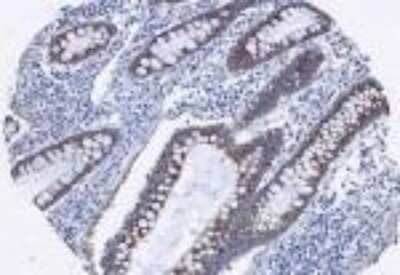
Immunohistochemistry-Paraffin: AG-2/AGR2 Antibody [NBP2-27393] -
Immunohistochemistry-Paraffin: AG-2/AGR2 Antibody [NBP2-27393] - Staining of AGR2 using AGR2 antibody. Formalin-fixed, paraffin-embedded normal colon tissue probed with AGR2 antibody at 1:100 dilution.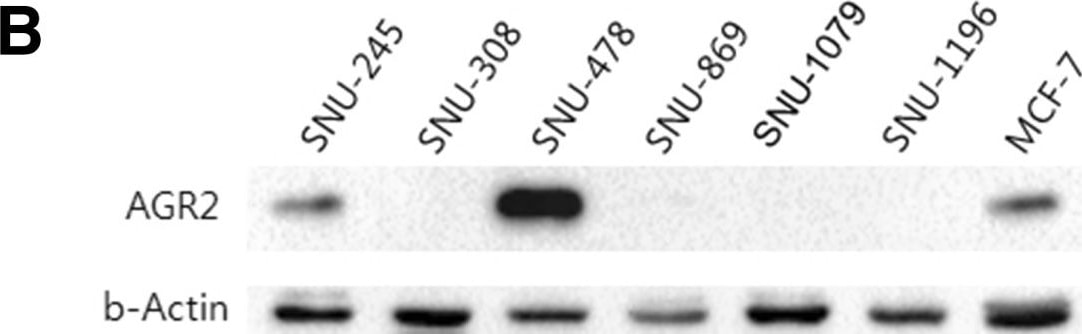
Western Blot: AG-2/AGR2 Antibody [NBP2-27393] -
Western Blot: AG-2/AGR2 Antibody [NBP2-27393] - AGR2 expression in cancer cell lines of the biliary tract. A. AGR2 mRNA levels in six biliary tract cancer cell lines were measured by real-time RT-PCR. The AGR2 transcript levels were normalized against those of the GAPDH. Results shown are means ± standard deviations of (1/2)CT of target - CT of GAPDH of three experiments. B. AGR2 protein expression was detected by western blot analysis with beta -actin as a loading control. The result shown is a representative of three experiments. Abbreviations: CBD, common bile duct; GB, gall bladder; AoV, ampulla of Vater; IHD, intrahepatic duct; HDB, hepatic duct bifurcation; WD, well differentiated; MD, moderately differentiated; PD, poorly differentiated [24]. Image collected & cropped by CiteAb from the following publication (http://bmccancer.biomedcentral.com/articles/10.1186/1471-2407-14-804), licensed under a CC-BY license. Not internally tested by Novus Biologicals.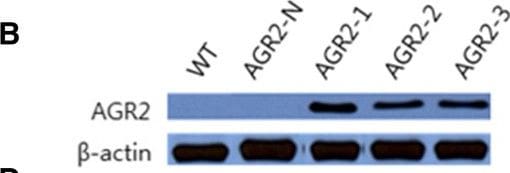
Western Blot: AG-2/AGR2 Antibody [NBP2-27393] -
Western Blot: AG-2/AGR2 Antibody [NBP2-27393] - Alterations of tumor-associated phenotypes by overexpression of AGR2 in SNU-869 cells. A. AGR2 expression in the SNU-869 stable transfectants was verified by real-time RT-PCR. The AGR2 transcript level was normalized against that of GAPDH. Results shown are means ± standard deviations of (1/2)CT of target - CT of GAPDH of three experiments. B. AGR2 protein expression in the SNU-869 stable transfectants was detected by western blot analysis with beta -actin as a loading control. The result shown is a representative of three experiments. C. Viability of the SNU-869 stable transfectants was measured by the MTT assay. Results shown are means ± standard deviations of three experiments (ANOVA P = 0.008; post hoc analysis by Bonferroni testing: AGR2-2 vs. AGR2-N, P = 0.013). D. The effect of AGR2 overexpression on cell proliferation. Pulsed BrdU incorporation into the SNU-869 stable transfectants was measured by flow cytometry. Percentage of BrdU-positive cells was shown in mean ± standard deviation of four experiments (ANOVA P = 0.053; post hoc analysis by Bonferroni testing: AGR2-2 vs. AGR2-N, P = 0.027). Results shown are representatives of four experiments. E. The effect of AGR2 overexpression on tumor cell invasion of SNU-869 cells. The numbers of invading cells in the transwell invasion assay were determined for SNU-869 stable transfectants. Results shown are means ± standard deviations of three experiments (ANOVA P = 0.003; post hoc analysis by Bonferroni testing: AGR2-2 vs. AGR2-N, P = 0.026). Image collected & cropped by CiteAb from the following publication (http://bmccancer.biomedcentral.com/articles/10.1186/1471-2407-14-804), licensed under a CC-BY license. Not internally tested by Novus Biologicals.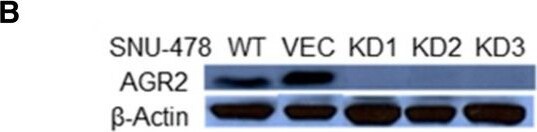
Knockdown Validated: AG-2/AGR2 Antibody - BSA Free [NBP2-27393] -
Alterations of tumor-associated phenotypes in AGR2-silenced SNU-478 cells. A. Expression of AGR2 mRNA in SNU-478:KD (AGR2 knockdown) clones was compared with that in SNU-478:VEC (vector control) by real-time RT-PCR. The AGR2 transcript level was normalized against that of GAPDH. Results shown are means +/- standard deviations of (1/2)CT of target - CT of GAPDH of three experiments. B. AGR2 protein expression in SNU-478:VEC and SNU-478:KDs was detected by western blot analysis with beta -actin as a loading control. The result shown is a representative of three experiments. C. Viability of SNU-478:VEC and SNU-478:KDs was measured by the MTT assay. Results shown are means +/- standard deviations of three experiments (ANOVA P = 0.010; post hoc analysis by Bonferroni testing: KD2 vs. VEC, P = 0.016). D. Anchorage-independent growth was examined by colony formation assay in soft agar. The number of colonies formed in the soft agar assay with SNU-478:VEC and SNU-478:KDs. Results shown are means +/- standard deviations of three experiments (ANOVA P = 0.000; post hoc analysis by Bonferroni testing: KD1-3 vs. VEC, P = 0.000). E. The number of invading cells in the transwell invasion assay with SNU-478:VEC and SNU-478:KDs. Results shown are means +/- standard deviations of three experiments (ANOVA P = 0.042). F. Drug sensitivity of SNU-478:VEC and SNU-478:KDs was measured by the MTT assay. Cells plated in a 96-well plate were treated with gemcitabine (20 μg/mL), cisplatin (0.5 μg/mL), or 5-FU (50 μg/mL), and the MTT assay was carried out on day three of the treatments. (ANOVA P = 0.000 for gemcitabine; ANOVA P = 0.048 for cisplatin; ANOVA P = 0.001 for 5-FU). Image collected and cropped by CiteAb from the following open publication (https://pubmed.ncbi.nlm.nih.gov/25367337), licensed under a CC-BY license. Not internally tested by Novus Biologicals.Applications for AG-2/AGR2 Antibody - BSA Free
Immunocytochemistry/ Immunofluorescence
Immunohistochemistry
Immunohistochemistry-Frozen
Immunohistochemistry-Paraffin
Immunoprecipitation
Simple Western
Western Blot
See Simple Western Antibody Database for Simple Western validation: Tested in MCF-7 lysate 0.5 mg/mL, separated by Size, antibody dilution of 1:50, apparent MW was 22 kDa.
Formulation, Preparation, and Storage
Purification
Formulation
Format
Preservative
Concentration
Shipping
Stability & Storage
Background: AG-2/AGR2
Long Name
Alternate Names
Gene Symbol
Additional AG-2/AGR2 Products
Product Documents for AG-2/AGR2 Antibody - BSA Free
Certificate of Analysis
To download a Certificate of Analysis, please enter a lot or batch number in the search box below.
Product Specific Notices for AG-2/AGR2 Antibody - BSA Free
This product is for research use only and is not approved for use in humans or in clinical diagnosis. Primary Antibodies are guaranteed for 1 year from date of receipt.
Related Research Areas
Citations for AG-2/AGR2 Antibody - BSA Free
 Powered by Bioz
Customer Reviews for AG-2/AGR2 Antibody - BSA Free
There are currently no reviews for this product. Be the first to review AG-2/AGR2 Antibody - BSA Free and earn rewards!
Have you used AG-2/AGR2 Antibody - BSA Free?
Submit a review and receive an Amazon gift card!
$25/€18/£15/$25CAN/¥2500 for a review with an image
$10/€7/£6/$10CAN/¥1110 for a review without an image
Submit a review
Protocols
Find general support by application which include: protocols, troubleshooting, illustrated assays, videos and webinars.
- Antigen Retrieval Protocol (PIER)
- Antigen Retrieval for Frozen Sections Protocol
- Appropriate Fixation of IHC/ICC Samples
- Cellular Response to Hypoxia Protocols
- Chromogenic IHC Staining of Formalin-Fixed Paraffin-Embedded (FFPE) Tissue Protocol
- Chromogenic Immunohistochemistry Staining of Frozen Tissue
- ClariTSA™ Fluorophore Kits
- Detection & Visualization of Antibody Binding
- Fluorescent IHC Staining of Frozen Tissue Protocol
- Graphic Protocol for Heat-induced Epitope Retrieval
- Graphic Protocol for the Preparation and Fluorescent IHC Staining of Frozen Tissue Sections
- Graphic Protocol for the Preparation and Fluorescent IHC Staining of Paraffin-embedded Tissue Sections
- Graphic Protocol for the Preparation of Gelatin-coated Slides for Histological Tissue Sections
- ICC Cell Smear Protocol for Suspension Cells
- ICC Immunocytochemistry Protocol Videos
- ICC for Adherent Cells
- IHC Sample Preparation (Frozen sections vs Paraffin)
- Immunocytochemistry (ICC) Protocol
- Immunocytochemistry Troubleshooting
- Immunofluorescence of Organoids Embedded in Cultrex Basement Membrane Extract
- Immunofluorescent IHC Staining of Formalin-Fixed Paraffin-Embedded (FFPE) Tissue Protocol
- Immunohistochemistry (IHC) and Immunocytochemistry (ICC) Protocols
- Immunohistochemistry Frozen Troubleshooting
- Immunohistochemistry Paraffin Troubleshooting
- Immunoprecipitation Protocol
- Preparing Samples for IHC/ICC Experiments
- Preventing Non-Specific Staining (Non-Specific Binding)
- Primary Antibody Selection & Optimization
- Protocol for Heat-Induced Epitope Retrieval (HIER)
- Protocol for Making a 4% Formaldehyde Solution in PBS
- Protocol for VisUCyte™ HRP Polymer Detection Reagent
- Protocol for the Fluorescent ICC Staining of Cell Smears - Graphic
- Protocol for the Fluorescent ICC Staining of Cultured Cells on Coverslips - Graphic
- Protocol for the Preparation & Fixation of Cells on Coverslips
- Protocol for the Preparation and Chromogenic IHC Staining of Frozen Tissue Sections
- Protocol for the Preparation and Chromogenic IHC Staining of Frozen Tissue Sections - Graphic
- Protocol for the Preparation and Chromogenic IHC Staining of Paraffin-embedded Tissue Sections
- Protocol for the Preparation and Chromogenic IHC Staining of Paraffin-embedded Tissue Sections - Graphic
- Protocol for the Preparation and Fluorescent ICC Staining of Cells on Coverslips
- Protocol for the Preparation and Fluorescent ICC Staining of Non-adherent Cells
- Protocol for the Preparation and Fluorescent ICC Staining of Stem Cells on Coverslips
- Protocol for the Preparation and Fluorescent IHC Staining of Frozen Tissue Sections
- Protocol for the Preparation and Fluorescent IHC Staining of Paraffin-embedded Tissue Sections
- Protocol for the Preparation of Gelatin-coated Slides for Histological Tissue Sections
- Protocol for the Preparation of a Cell Smear for Non-adherent Cell ICC - Graphic
- R&D Systems Quality Control Western Blot Protocol
- TUNEL and Active Caspase-3 Detection by IHC/ICC Protocol
- The Importance of IHC/ICC Controls
- Troubleshooting Guide: Immunohistochemistry
- Troubleshooting Guide: Western Blot Figures
- Western Blot Conditions
- Western Blot Protocol
- Western Blot Protocol for Cell Lysates
- Western Blot Troubleshooting
- Western Blot Troubleshooting Guide
- View all Protocols, Troubleshooting, Illustrated assays and Webinars