
BLAME, also known as Signaling Lymphocyte Activation Molecule Family Member 8 (SLAMF8), is an Ig superfamily protein that is a member of the SLAM/CD150/CD2 family of receptors. It is expressed on macrophages and dendritic cells. BLAME modulates signaling through the B cell receptor and may also function during B lineage commitment.
BLAME/SLAMF8 Antibody
Novus Biologicals | Catalog # NBP2-26110

![Western Blot: BLAME/SLAMF8 Antibody [NBP2-26110]](https://resources.rndsystems.com/images/products/BLAME-SLAMF8-Antibody-Western-Blot-NBP2-26110-img0001.jpg "Western Blot: BLAME/SLAMF8 Antibody [NBP2-26110]")
Scientific images may be resized, cropped, or adjusted for brightness or contrast for presentation purposes. These updates are limited to presentation and do not affect the underlying scientific interpretation of the data. Where available, additional source data may be provided upon request.
Loading...
Key Product Details
Species Reactivity
Human
Applications
Immunohistochemistry, Immunohistochemistry-Paraffin, Western Blot, Peptide ELISA
Label
Unconjugated
Antibody Source
Polyclonal Goat IgG
Loading...
Product Specifications
Immunogen
Peptide with sequence C-TLYHSRFLGRAQ corresponding to internal region according to NP_064510.1.
Reactivity Notes
Expected from sequence similarity: Mouse, Rat, Bovine
Clonality
Polyclonal
Host
Goat
Isotype
IgG
Scientific Data Images for BLAME/SLAMF8 Antibody
Western Blot: BLAME/SLAMF8 Antibody [NBP2-26110]
Western Blot: BLAME/SLAMF8 Antibody [NBP2-26110] - HEK293 lysate (10 ug protein in RIPA buffer) overexpressing Human SLAMF8 with C-terminal MYC tag probed with NBP2-26110 (1 ug/ml) in Lane A and probed with anti-MYC Tag (1/1000) in lane C. Mock-transfected HEK293 probed with NBP2-26110 (1 ug/ml) in Lane B. Primary incubations were for 1 hour. Detected by chemiluminescence.![Immunohistochemistry-Paraffin: BLAME/SLAMF8 Antibody [NBP2-26110]](https://resources.rndsystems.com/images/products/BLAME-SLAMF8-Antibody-Immunohistochemistry-Paraffin-NBP2-26110-img0002.jpg "Immunohistochemistry-Paraffin: BLAME/SLAMF8 Antibody [NBP2-26110]")
Immunohistochemistry-Paraffin: BLAME/SLAMF8 Antibody [NBP2-26110]
Immunohistochemistry-Paraffin: BLAME/SLAMF8 Antibody [NBP2-26110] - 5ug/ml staining of paraffin embedded Human Small Intestine. Steamed antigen retrieval with citrate buffer pH 6, AP-staining.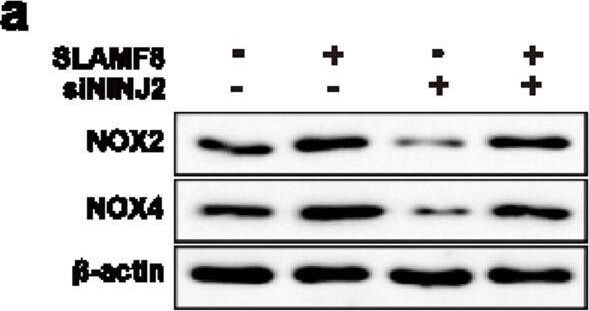
Western Blot: BLAME/SLAMF8 Antibody [NBP2-26110] -
(a,b) Knockdown of NINJ2 significantly abolished SLAMF8-induced oxidative stress, reduced ROS levels (DCF and MitoSOX Red), and decreased NOX2 and NOX4 expression in A beta 1-42-treated SH-SY5Y cells. (c) Similarly, knockdown of NINJ2 significantly reduced the SLAMF8-treated neuroinflammation in LPS-treated HMC3 cells. (d) In SLAMF8-stably overexpressing AD cell models, transient knockdown of NINJ2 with siNINJ2 for 48 h significantly abolished SLAMF8-induced p65 phosphorylation in the TLR4/NF-kappa B signaling pathway. Data are presented as mean +/- standard deviation. One-way ANOVA with Tukey’s post hoc test was used for multiple group comparisons, and a paired t-test was used for comparisons between two groups. “*" indicates p ≤ 0.05, and “**" indicates p ≤ 0.01.. Image collected and cropped by CiteAb from the following open publication (https://pubmed.ncbi.nlm.nih.gov/40394132), licensed under a CC-BY license. Not internally tested by Novus Biologicals.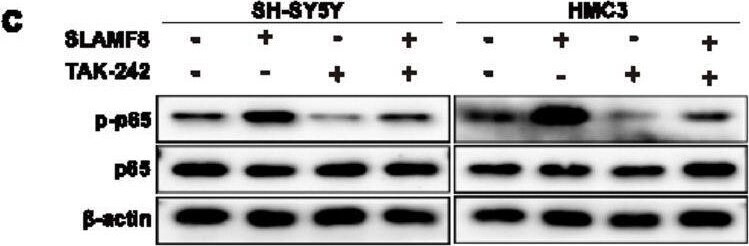
Western Blot: BLAME/SLAMF8 Antibody [NBP2-26110] -
(a) The overexpression of SLAMF8 in AD cell models increased the levels of TLR4/NF-kappa B signaling-related markers (TLR4, p-I kappa B alpha /I kappa B alpha ratio) and the phospho-p65/p65 ratio, as confirmed by Western blot. Quantification of the Western blot results was performed and normalized against beta -actin (n = 3) (a1). (b) Conversely, knockdown of SLAMF8 produced the opposite effect and the data were quantified and normalized to beta -actin (n = 3). (b1) The TLR4/NF-kappa B signaling inhibitor TAK-242 suppressed TLR4 expression (c,c1) and mitigated the increase in ROS (d,e) and neuroinflammation (f) caused by SLAMF8 overexpression in AD cell models. Data are presented as mean +/- standard deviation. One-way ANOVA with Tukey’s post hoc test was used for multiple group comparisons, and a paired t-test was used for comparisons between two groups. “*" indicates p ≤ 0.05, and “**" indicates p ≤ 0.01. Image collected and cropped by CiteAb from the following open publication (https://pubmed.ncbi.nlm.nih.gov/40394132), licensed under a CC-BY license. Not internally tested by Novus Biologicals.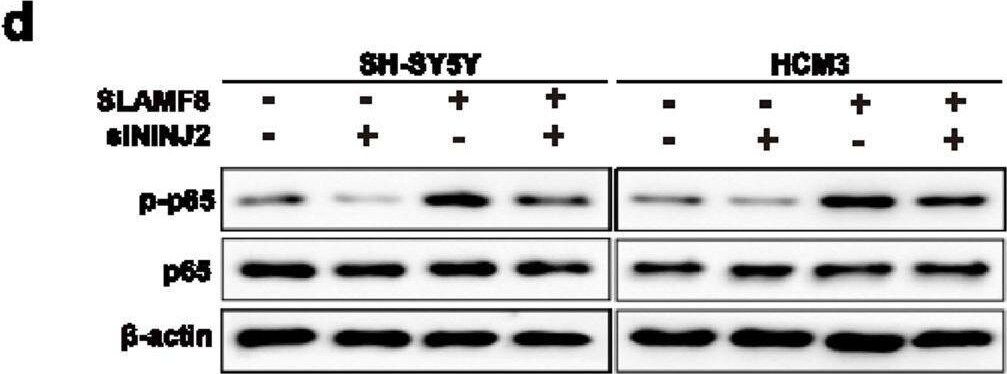
Western Blot: BLAME/SLAMF8 Antibody [NBP2-26110] -
(a,b) Knockdown of NINJ2 significantly abolished SLAMF8-induced oxidative stress, reduced ROS levels (DCF and MitoSOX Red), and decreased NOX2 and NOX4 expression in A beta 1-42-treated SH-SY5Y cells. (c) Similarly, knockdown of NINJ2 significantly reduced the SLAMF8-treated neuroinflammation in LPS-treated HMC3 cells. (d) In SLAMF8-stably overexpressing AD cell models, transient knockdown of NINJ2 with siNINJ2 for 48 h significantly abolished SLAMF8-induced p65 phosphorylation in the TLR4/NF-kappa B signaling pathway. Data are presented as mean +/- standard deviation. One-way ANOVA with Tukey’s post hoc test was used for multiple group comparisons, and a paired t-test was used for comparisons between two groups. “*" indicates p ≤ 0.05, and “**" indicates p ≤ 0.01.. Image collected and cropped by CiteAb from the following open publication (https://pubmed.ncbi.nlm.nih.gov/40394132), licensed under a CC-BY license. Not internally tested by Novus Biologicals.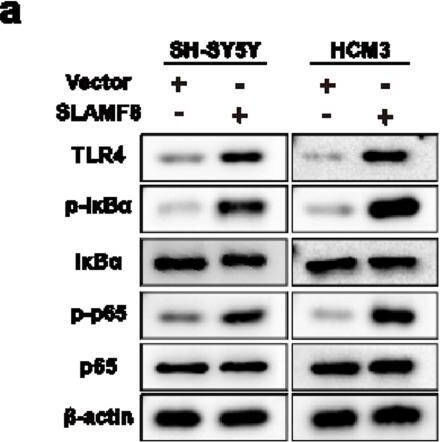
Western Blot: BLAME/SLAMF8 Antibody [NBP2-26110] -
(a) The overexpression of SLAMF8 in AD cell models increased the levels of TLR4/NF-kappa B signaling-related markers (TLR4, p-I kappa B alpha /I kappa B alpha ratio) and the phospho-p65/p65 ratio, as confirmed by Western blot. Quantification of the Western blot results was performed and normalized against beta -actin (n = 3) (a1). (b) Conversely, knockdown of SLAMF8 produced the opposite effect and the data were quantified and normalized to beta -actin (n = 3). (b1) The TLR4/NF-kappa B signaling inhibitor TAK-242 suppressed TLR4 expression (c,c1) and mitigated the increase in ROS (d,e) and neuroinflammation (f) caused by SLAMF8 overexpression in AD cell models. Data are presented as mean +/- standard deviation. One-way ANOVA with Tukey’s post hoc test was used for multiple group comparisons, and a paired t-test was used for comparisons between two groups. “*" indicates p ≤ 0.05, and “**" indicates p ≤ 0.01. Image collected and cropped by CiteAb from the following open publication (https://pubmed.ncbi.nlm.nih.gov/40394132), licensed under a CC-BY license. Not internally tested by Novus Biologicals.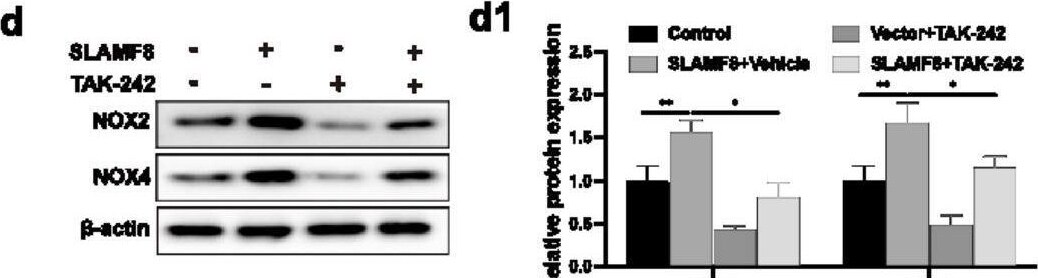
Western Blot: BLAME/SLAMF8 Antibody [NBP2-26110] -
(a) The overexpression of SLAMF8 in AD cell models increased the levels of TLR4/NF-kappa B signaling-related markers (TLR4, p-I kappa B alpha /I kappa B alpha ratio) and the phospho-p65/p65 ratio, as confirmed by Western blot. Quantification of the Western blot results was performed and normalized against beta -actin (n = 3) (a1). (b) Conversely, knockdown of SLAMF8 produced the opposite effect and the data were quantified and normalized to beta -actin (n = 3). (b1) The TLR4/NF-kappa B signaling inhibitor TAK-242 suppressed TLR4 expression (c,c1) and mitigated the increase in ROS (d,e) and neuroinflammation (f) caused by SLAMF8 overexpression in AD cell models. Data are presented as mean +/- standard deviation. One-way ANOVA with Tukey’s post hoc test was used for multiple group comparisons, and a paired t-test was used for comparisons between two groups. “*" indicates p ≤ 0.05, and “**" indicates p ≤ 0.01. Image collected and cropped by CiteAb from the following open publication (https://pubmed.ncbi.nlm.nih.gov/40394132), licensed under a CC-BY license. Not internally tested by Novus Biologicals.Applications for BLAME/SLAMF8 Antibody
Application
Recommended Usage
Immunohistochemistry
0.5-1ug/ml
Peptide ELISA
Detection limit 1:8000
Western Blot
1:100 - 1:2000
Application Notes
Western blot: In transfected HEK293 transiently expressing Human SLAMF8 (myc and DYKDDDDK tagged), a band of approx. 45kDa is observed. No bands are observed in mock-transfected HEK293 and the same band is observed using anti-myc antibody.
IHC: Paraffin embedded Human Small Intestine.
IHC: Paraffin embedded Human Small Intestine.
Formulation, Preparation, and Storage
Purification
Immunogen affinity purified
Formulation
Tris saline (20 mM Tris pH 7.3, 150 mM NaCl), 0.5% BSA
Preservative
0.02% Sodium Azide
Concentration
0.5 mg/ml
Shipping
The product is shipped with polar packs. Upon receipt, store it immediately at the temperature recommended below.
Stability & Storage
Store at -20C. Avoid freeze-thaw cycles.
Background: BLAME/SLAMF8
Long Name
SLAM Family Member 8
Alternate Names
CD353, SBBI42, SLAMF8
Gene Symbol
SLAMF8
Additional BLAME/SLAMF8 Products
Product Documents for BLAME/SLAMF8 Antibody
Certificate of Analysis
To download a Certificate of Analysis, please enter a lot or batch number in the search box below.
Product Specific Notices for BLAME/SLAMF8 Antibody
This product is for research use only and is not approved for use in humans or in clinical diagnosis. Primary Antibodies are guaranteed for 1 year from date of receipt.
Citations for BLAME/SLAMF8 Antibody
 Powered by Bioz
Customer Reviews for BLAME/SLAMF8 Antibody
There are currently no reviews for this product. Be the first to review BLAME/SLAMF8 Antibody and earn rewards!
Have you used BLAME/SLAMF8 Antibody?
Submit a review and receive an Amazon gift card!
$25/€18/£15/$25CAN/¥2500 for a review with an image
$10/€7/£6/$10CAN/¥1110 for a review without an image
Submit a review
Protocols
Find general support by application which include: protocols, troubleshooting, illustrated assays, videos and webinars.
- Antigen Retrieval Protocol (PIER)
- Antigen Retrieval for Frozen Sections Protocol
- Appropriate Fixation of IHC/ICC Samples
- Cellular Response to Hypoxia Protocols
- Chromogenic IHC Staining of Formalin-Fixed Paraffin-Embedded (FFPE) Tissue Protocol
- Chromogenic Immunohistochemistry Staining of Frozen Tissue
- ClariTSA™ Fluorophore Kits
- Detection & Visualization of Antibody Binding
- ELISA Sample Preparation & Collection Guide
- ELISA Troubleshooting Guide
- Fluorescent IHC Staining of Frozen Tissue Protocol
- Graphic Protocol for Heat-induced Epitope Retrieval
- Graphic Protocol for the Preparation and Fluorescent IHC Staining of Frozen Tissue Sections
- Graphic Protocol for the Preparation and Fluorescent IHC Staining of Paraffin-embedded Tissue Sections
- Graphic Protocol for the Preparation of Gelatin-coated Slides for Histological Tissue Sections
- How to Run an R&D Systems DuoSet ELISA
- How to Run an R&D Systems Quantikine ELISA
- How to Run an R&D Systems Quantikine™ QuicKit™ ELISA
- IHC Sample Preparation (Frozen sections vs Paraffin)
- Immunofluorescent IHC Staining of Formalin-Fixed Paraffin-Embedded (FFPE) Tissue Protocol
- Immunohistochemistry (IHC) and Immunocytochemistry (ICC) Protocols
- Immunohistochemistry Frozen Troubleshooting
- Immunohistochemistry Paraffin Troubleshooting
- Preparing Samples for IHC/ICC Experiments
- Preventing Non-Specific Staining (Non-Specific Binding)
- Primary Antibody Selection & Optimization
- Protocol for Heat-Induced Epitope Retrieval (HIER)
- Protocol for Making a 4% Formaldehyde Solution in PBS
- Protocol for VisUCyte™ HRP Polymer Detection Reagent
- Protocol for the Preparation & Fixation of Cells on Coverslips
- Protocol for the Preparation and Chromogenic IHC Staining of Frozen Tissue Sections
- Protocol for the Preparation and Chromogenic IHC Staining of Frozen Tissue Sections - Graphic
- Protocol for the Preparation and Chromogenic IHC Staining of Paraffin-embedded Tissue Sections
- Protocol for the Preparation and Chromogenic IHC Staining of Paraffin-embedded Tissue Sections - Graphic
- Protocol for the Preparation and Fluorescent IHC Staining of Frozen Tissue Sections
- Protocol for the Preparation and Fluorescent IHC Staining of Paraffin-embedded Tissue Sections
- Protocol for the Preparation of Gelatin-coated Slides for Histological Tissue Sections
- Quantikine HS ELISA Kit Assay Principle, Alkaline Phosphatase
- Quantikine HS ELISA Kit Principle, Streptavidin-HRP Polymer
- R&D Systems Quality Control Western Blot Protocol
- Sandwich ELISA (Colorimetric) – Biotin/Streptavidin Detection Protocol
- Sandwich ELISA (Colorimetric) – Direct Detection Protocol
- TUNEL and Active Caspase-3 Detection by IHC/ICC Protocol
- The Importance of IHC/ICC Controls
- Troubleshooting Guide: ELISA
- Troubleshooting Guide: Immunohistochemistry
- Troubleshooting Guide: Western Blot Figures
- Western Blot Conditions
- Western Blot Protocol
- Western Blot Protocol for Cell Lysates
- Western Blot Troubleshooting
- Western Blot Troubleshooting Guide
- View all Protocols, Troubleshooting, Illustrated assays and Webinars
Loading...