
Calmodulin Antibody (10W3Y7)
Novus Biologicals | Catalog # NBP3-16500

![Western Blot: Calmodulin Antibody (10W3Y7) [NBP3-16500]](https://resources.rndsystems.com/images/products/Calmodulin-Antibody-10W3Y7-Western-Blot-NBP3-16500-img0002.jpg "Western Blot: Calmodulin Antibody (10W3Y7) [NBP3-16500]")
Scientific images may be resized, cropped, or adjusted for brightness or contrast for presentation purposes. These updates are limited to presentation and do not affect the underlying scientific interpretation of the data. Where available, additional source data may be provided upon request.
Key Product Details
Species Reactivity
Applications
Label
Antibody Source
Product Specifications
Immunogen
Clonality
Host
Isotype
Theoretical MW
Disclaimer note: The observed molecular weight of the protein may vary from the listed predicted molecular weight due to post translational modifications, post translation cleavages, relative charges, and other experimental factors.
Scientific Data Images for Calmodulin Antibody (10W3Y7)
Western Blot: Calmodulin Antibody (10W3Y7) [NBP3-16500]
Western Blot: Calmodulin Antibody (10W3Y7) [NBP3-16500] - Western blot analysis of extracts of various cell lines, using Calmodulin Rabbit mAb (NBP3-16500) at 1:1000 dilution. Secondary antibody: HRP Goat Anti-Rabbit IgG (H+L) at 1:10000 dilution. Lysates/proteins: 25ug per lane. Blocking buffer: 3% nonfat dry milk in TBST. Detection: ECL Basic Kit. Exposure time: 3min.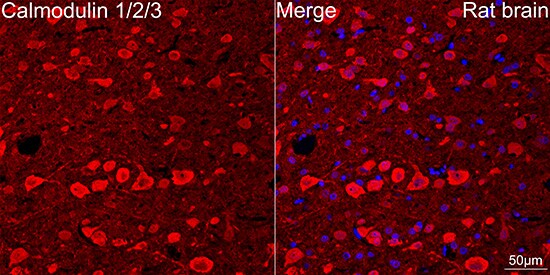
Immunocytochemistry/ Immunofluorescence: Calmodulin Antibody (10W3Y7) [NBP3-16500] -
Immunocytochemistry/ Immunofluorescence: Calmodulin Antibody (10W3Y7) [NBP3-16500] - Confocal imaging of paraffin-embedded Rat brain using Calmodulin Rabbit mAb followed by a further incubation with Cy3 Goat Anti-Rabbit IgG (H+L). DAPI was used for nuclear staining (Blue). Objective: 40x. Perform microwave antigen retrieval with 0.01 M citrate buffer (pH 6.0) prior to IF staining.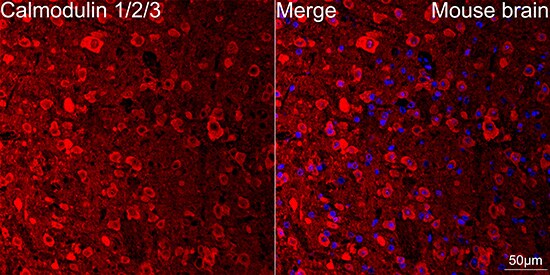
Immunocytochemistry/ Immunofluorescence: Calmodulin Antibody (10W3Y7) [Calmodulin] -
Immunocytochemistry/ Immunofluorescence: Calmodulin Antibody (10W3Y7) [Calmodulin] - Confocal imaging of paraffin-embedded Mouse brain using Calmodulin Rabbit mAb followed by a further incubation with Cy3 Goat Anti-Rabbit IgG (H+L). DAPI was used for nuclear staining (Blue). Objective: 40x. Perform microwave antigen retrieval with 0.01 M citrate buffer (pH 6.0) prior to IF staining.Applications for Calmodulin Antibody (10W3Y7)
ELISA
Immunocytochemistry/ Immunofluorescence
Western Blot
Formulation, Preparation, and Storage
Purification
Formulation
Preservative
Concentration
Shipping
Stability & Storage
Background: Calmodulin 1
Alternate Names
Gene Symbol
Additional Calmodulin 1 Products
Product Documents for Calmodulin Antibody (10W3Y7)
Certificate of Analysis
To download a Certificate of Analysis, please enter a lot or batch number in the search box below.
Product Specific Notices for Calmodulin Antibody (10W3Y7)
This product is for research use only and is not approved for use in humans or in clinical diagnosis. Primary Antibodies are guaranteed for 1 year from date of receipt.
Related Research Areas
Customer Reviews for Calmodulin Antibody (10W3Y7)
There are currently no reviews for this product. Be the first to review Calmodulin Antibody (10W3Y7) and earn rewards!
Have you used Calmodulin Antibody (10W3Y7)?
Submit a review and receive an Amazon gift card!
$25/€18/£15/$25CAN/¥2500 for a review with an image
$10/€7/£6/$10CAN/¥1110 for a review without an image
Submit a review
Protocols
Find general support by application which include: protocols, troubleshooting, illustrated assays, videos and webinars.
- Antigen Retrieval Protocol (PIER)
- Antigen Retrieval for Frozen Sections Protocol
- Appropriate Fixation of IHC/ICC Samples
- Cellular Response to Hypoxia Protocols
- Chromogenic IHC Staining of Formalin-Fixed Paraffin-Embedded (FFPE) Tissue Protocol
- Chromogenic Immunohistochemistry Staining of Frozen Tissue
- ClariTSA™ Fluorophore Kits
- Detection & Visualization of Antibody Binding
- ELISA Sample Preparation & Collection Guide
- ELISA Troubleshooting Guide
- Fluorescent IHC Staining of Frozen Tissue Protocol
- Graphic Protocol for Heat-induced Epitope Retrieval
- Graphic Protocol for the Preparation and Fluorescent IHC Staining of Frozen Tissue Sections
- Graphic Protocol for the Preparation and Fluorescent IHC Staining of Paraffin-embedded Tissue Sections
- Graphic Protocol for the Preparation of Gelatin-coated Slides for Histological Tissue Sections
- How to Run an R&D Systems DuoSet ELISA
- How to Run an R&D Systems Quantikine ELISA
- How to Run an R&D Systems Quantikine™ QuicKit™ ELISA
- ICC Cell Smear Protocol for Suspension Cells
- ICC Immunocytochemistry Protocol Videos
- ICC for Adherent Cells
- IHC Sample Preparation (Frozen sections vs Paraffin)
- Immunocytochemistry (ICC) Protocol
- Immunocytochemistry Troubleshooting
- Immunofluorescence of Organoids Embedded in Cultrex Basement Membrane Extract
- Immunofluorescent IHC Staining of Formalin-Fixed Paraffin-Embedded (FFPE) Tissue Protocol
- Immunohistochemistry (IHC) and Immunocytochemistry (ICC) Protocols
- Immunohistochemistry Frozen Troubleshooting
- Immunohistochemistry Paraffin Troubleshooting
- Preparing Samples for IHC/ICC Experiments
- Preventing Non-Specific Staining (Non-Specific Binding)
- Primary Antibody Selection & Optimization
- Protocol for Heat-Induced Epitope Retrieval (HIER)
- Protocol for Making a 4% Formaldehyde Solution in PBS
- Protocol for VisUCyte™ HRP Polymer Detection Reagent
- Protocol for the Fluorescent ICC Staining of Cell Smears - Graphic
- Protocol for the Fluorescent ICC Staining of Cultured Cells on Coverslips - Graphic
- Protocol for the Preparation & Fixation of Cells on Coverslips
- Protocol for the Preparation and Chromogenic IHC Staining of Frozen Tissue Sections
- Protocol for the Preparation and Chromogenic IHC Staining of Frozen Tissue Sections - Graphic
- Protocol for the Preparation and Chromogenic IHC Staining of Paraffin-embedded Tissue Sections
- Protocol for the Preparation and Chromogenic IHC Staining of Paraffin-embedded Tissue Sections - Graphic
- Protocol for the Preparation and Fluorescent ICC Staining of Cells on Coverslips
- Protocol for the Preparation and Fluorescent ICC Staining of Non-adherent Cells
- Protocol for the Preparation and Fluorescent ICC Staining of Stem Cells on Coverslips
- Protocol for the Preparation and Fluorescent IHC Staining of Frozen Tissue Sections
- Protocol for the Preparation and Fluorescent IHC Staining of Paraffin-embedded Tissue Sections
- Protocol for the Preparation of Gelatin-coated Slides for Histological Tissue Sections
- Protocol for the Preparation of a Cell Smear for Non-adherent Cell ICC - Graphic
- Quantikine HS ELISA Kit Assay Principle, Alkaline Phosphatase
- Quantikine HS ELISA Kit Principle, Streptavidin-HRP Polymer
- R&D Systems Quality Control Western Blot Protocol
- Sandwich ELISA (Colorimetric) – Biotin/Streptavidin Detection Protocol
- Sandwich ELISA (Colorimetric) – Direct Detection Protocol
- TUNEL and Active Caspase-3 Detection by IHC/ICC Protocol
- The Importance of IHC/ICC Controls
- Troubleshooting Guide: ELISA
- Troubleshooting Guide: Immunohistochemistry
- Troubleshooting Guide: Western Blot Figures
- Western Blot Conditions
- Western Blot Protocol
- Western Blot Protocol for Cell Lysates
- Western Blot Troubleshooting
- Western Blot Troubleshooting Guide
- View all Protocols, Troubleshooting, Illustrated assays and Webinars
FAQs for Calmodulin Antibody (10W3Y7)
-
Q: I am looking for an antibody that can bind an engineered calmodulin domain of a fluorescent biosensor. Can you provide me the amino acid sequence that your calmodulin antibodies were raised against so that I can compare them to the sequence I am working with? Can you please provide your sequence identity for this fragment: D Q L T E E Q I A E F K E A F S L F D K D G D G T I T T K E L G T V M R S L G Q N P T E A E L Q D M I N E V D A D G D G T I D F P E F L T M M A R K M W G T D S E E E I R E A F R V F D K D G N G Y I G A A E L R H V M A N L G E R L T D E E V D E M I R V A D I N G D G Q V S Y E E F V Q M M T A K
A:
Please see this link to our available calmodulin antibodies. This sequences shares 94% similarity with human calmodulin and does not share 100% similarity with any known calmodulin sequence. Any of our calmodulin antibodies will be predicted to react with this sequence. Any of our polyclonal antibodies will be a good choice and chances are most of the monoclonal antibodies will cross-react as well although, unfortunately, there is no way to predict this with the monoclonals. NBP1-61548 would be my best recommendation for your assay and sequence.


