
Caspase-3 Antibody - (active/cleaved) - BSA Free
Novus Biologicals | Catalog # NB100-56113

![Immunohistochemistry: Caspase-3 Antibody - (active/cleaved) [NB100-56113]](https://resources.rndsystems.com/images/products/Caspase-3-Antibody-active-cleaved-Immunohistochemistry-NB100-56113-img0005.jpg "Immunohistochemistry: Caspase-3 Antibody - (active/cleaved) [NB100-56113]")
Scientific images may be resized, cropped, or adjusted for brightness or contrast for presentation purposes. These updates are limited to presentation and do not affect the underlying scientific interpretation of the data. Where available, additional source data may be provided upon request.
Loading...
Key Product Details
Validated by
Biological Validation
Species Reactivity
Validated:
Human, Mouse, Rat, Gerbil
Cited:
Human, Mouse, Rat, Gerbil
Applications
Validated:
Immunohistochemistry, Immunohistochemistry-Paraffin, Immunohistochemistry-Frozen, Western Blot, Immunoblotting, Flow Cytometry, Flow (Intracellular), Immunocytochemistry/ Immunofluorescence, Immunoprecipitation
Cited:
Immunohistochemistry-Paraffin, Immunohistochemistry-Frozen, Western Blot, Flow Cytometry, Immunocytochemistry/ Immunofluorescence, Flow Cytometry Control, IF/IHC
Label
Unconjugated
Antibody Source
Polyclonal Rabbit IgG
Format
BSA Free
Loading...
Product Specifications
Immunogen
This Caspase-3 Antibody - (active/cleaved) was developed against catalytically active human caspase-3 protein.
Reactivity Notes
Use in Rat reported in scientific literature (PMID:34597692). Rat reactivity reported in scientific literature (PMID:32818590).
Clonality
Polyclonal
Host
Rabbit
Isotype
IgG
Theoretical MW
31.7 kDa.
Disclaimer note: The observed molecular weight of the protein may vary from the listed predicted molecular weight due to post translational modifications, post translation cleavages, relative charges, and other experimental factors.
Disclaimer note: The observed molecular weight of the protein may vary from the listed predicted molecular weight due to post translational modifications, post translation cleavages, relative charges, and other experimental factors.
Scientific Data Images for Caspase-3 Antibody - (active/cleaved) - BSA Free
![Western Blot: Caspase-3 Antibody(active/cleaved) [NB100-56113]](https://resources.rndsystems.com/images/products/Caspase-3-Antibody-active-cleaved-Western-Blot-NB100-56113-img0006.jpg "Western Blot: Caspase-3 Antibody(active/cleaved) [NB100-56113]")
![Western Blot: Caspase-3 Antibody(active/cleaved) [NB100-56113]](https://resources.rndsystems.com/images/products/Caspase-3-Antibody-active-cleaved-Western-Blot-NB100-56113-img0007.jpg "Western Blot: Caspase-3 Antibody(active/cleaved) [NB100-56113]")
![Immunohistochemistry-Paraffin: Caspase-3 Antibody - (active/cleaved) [NB100-56113]](https://resources.rndsystems.com/images/products/Caspase-3-Antibody-active-cleaved-Immunohistochemistry-Paraffin-NB100-56113-img0003.jpg "Immunohistochemistry-Paraffin: Caspase-3 Antibody - (active/cleaved) [NB100-56113]")
Immunohistochemistry-Paraffin: Caspase-3 Antibody - (active/cleaved) [NB100-56113]
Immunohistochemistry-Paraffin: Caspase-3 Antibody - (active/cleaved) [NB100-56113] - Dog ischemic brain stained for Active/Cleaved Caspase-3 expression using Caspase-3 Antibody - (active/cleaved)( NB100-56113) at 1:2000. Staining is seen in the nuclei of dying neurons (black arrow) but not in the morphologically normal nuclei (open arrows). Caspase-3 expression in the nucleus is considered to be a marker of active/caspase-3 expression and apoptosis. Hematoxylin-eosin counterstain.![Immunohistochemistry-Paraffin: Caspase-3 Antibody - (active/cleaved) [NB100-56113]](https://resources.rndsystems.com/images/products/Caspase-3-Antibody-active-cleaved-Immunohistochemistry-Paraffin-NB100-56113-img0004.jpg "Immunohistochemistry-Paraffin: Caspase-3 Antibody - (active/cleaved) [NB100-56113]")
Immunohistochemistry-Paraffin: Caspase-3 Antibody - (active/cleaved) [NB100-56113]
Immunohistochemistry-Paraffin: Caspase-3 Antibody - (active/cleaved) [NB100-56113] - Irradiated mouse spleen stained for Active/Cleaved Caspase-3 expression using Caspase-3 Antibody - (active/cleaved) (NB100-56113) at 1:2000. Staining is seen in the nuclei of a subset of the cell population. Caspase-3 expression in the nucleus is considered to be a marker of active/caspase-3 expression and apoptosis. Hematoxylin-eosin counterstain.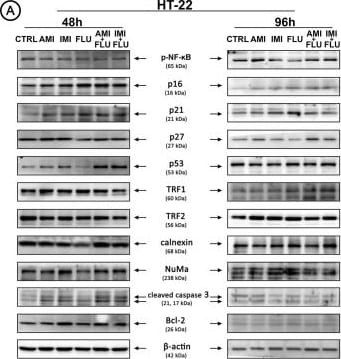
Western Blot: Caspase-3 Antibody - (active/cleaved) [NB100-56113] -
Antidepressants-mediated effect on cellular protein content. HT-22 cells were treated with antidepressants for 48 and 96 h and densitometry analysis of NF-kappa B (b), p16 (c), p21 (d), p27 (e), p53 (f), TRF1 (g), TRF2 (h), calnexin (i), NuMa (j), cleaved caspase 3 (k), Bcl-2 (l) was evaluated. Representative Western Blots are presented (a). Bars indicate SD, n = 3, ***/^^^p < 0.001, **/^^p < 0.01, */^p < 0.05, no indication—no statistical significance (one-way ANOVA and Dunnett’s a posteriori test)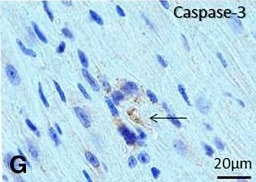
Immunohistochemistry: Caspase-3 Antibody - (active/cleaved) [NB100-56113] -
Immunohistochemistry: Caspase-3 Antibody - (active/cleaved) [NB100-56113] - Pathology in DOX treated acute & recovery phase mice. Regions of myofiber loss & frank replacement fibrosis were noted, most commonly in atria (A, acute phase), & rarely in ventricles (D, recovery phase). These areas were accompanied by macrophage infiltration (B, E) & myofibroblast proliferation (C) consistent with fibroplasia. Rare myofibers were matrix metalloproteinase 2 (F, recovery phase animal) or caspase-3 positive (G, acute phase animal). Reticulin staining (A, D); Immunohistochemistry: Iba 1(B, E; macrophages), alpha SMA (C), MMP-2 (F) & cleaved caspase -3 (G) Bar = 100µm (A-C); 50µm (D-F); 20µm (G). Image collected & cropped by CiteAb from the following publication (https://pubmed.ncbi.nlm.nih.gov/31263061), licensed under a CC-BY license. Not internally tested by Novus Biologicals.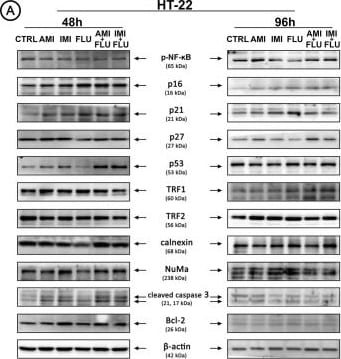
Western Blot: Caspase-3 Antibody - (active/cleaved) [NB100-56113] -
Western Blot: Caspase-3 Antibody - (active/cleaved) [NB100-56113] - Antidepressants-mediated effect on cellular protein content. HT-22 cells were treated with antidepressants for 48 & 96 h & densitometry analysis of NF-kappa B (b), p16 (c), p21 (d), p27 (e), p53 (f), TRF1 (g), TRF2 (h), calnexin (i), NuMa (j), cleaved caspase 3 (k), Bcl-2 (l) was evaluated. Representative Western Blots are presented (a). Bars indicate SD, n = 3, ***/^^^p < 0.001, **/^^p < 0.01, */^p < 0.05, no indication—no statistical significance (one-way ANOVA & Dunnett’s a posteriori test) Image collected & cropped by CiteAb from the following publication (https://pubmed.ncbi.nlm.nih.gov/31278507), licensed under a CC-BY license. Not internally tested by Novus Biologicals.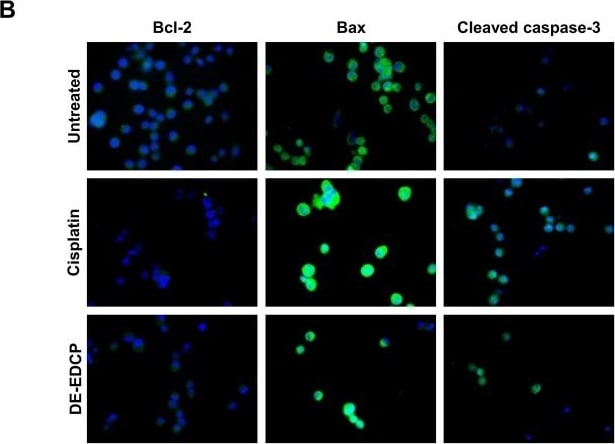
Immunocytochemistry/ Immunofluorescence: Caspase-3 Antibody - (active/cleaved) [NB100-56113] -
Immunocytochemistry/ Immunofluorescence: Caspase-3 Antibody - (active/cleaved) [NB100-56113] - Morphological changes & expression of key apoptosis-related molecules in 4T1 cells after DE-EDCP treatment(A) Morphological changes of 4T1 cells exposed to various concentrations of DE-EDCP for 24h. (B) Immunofluorescence staining for Bcl-2 (green), Bax (green) & cleaved caspase-3 (green) together with DNA staining with DAPI (blue) in 4T1 cells incubated with DE-EDCP or cisplatin (31.25 μM) for 24h, as well as in untreated cells (magnification at x200). (C) mRNA expression of Bcl-2, Bax & caspase-3 quantified by RT-PCR in 4T1 cells after DE-EDCP 24h treatment. DE-EDCP treatment markedly increased the expression of Bax & caspase-3 mRNA & decreased the expression of Bcl-2 mRNA in 4T1 cells. beta -actin mRNA was used as an internal control. Data points are represented by the expression ratio & mean±SD fold of control in 4T1 cells. (* Bcl-2-: DE-EDCP vs. untreated p=0.03; DE-EDCP vs. cisplatin p=0.006; cislatin vs. untreated p=0.001; Bax-: DE-EDCP vs. untreated p=0.011; cislatin vs. untreated p=0.009; caspase-3-: DE-EDCP vs. untreated p=0.015; DE-EDCP vs. cisplatin p=0.021) Image collected & cropped by CiteAb from the following publication (https://www.oncotarget.com/lookup/doi/10.18632/oncotarget.25610), licensed under a CC-BY license. Not internally tested by Novus Biologicals.Applications for Caspase-3 Antibody - (active/cleaved) - BSA Free
Application
Recommended Usage
Flow (Intracellular)
reported in scientific literature (PMID 24804954)
Flow Cytometry
reported in scientific literature (PMID 28287161)
Immunoblotting
reported in scientific literature (PMID 27912032)
Immunocytochemistry/ Immunofluorescence
reported in scientific literature (PMID 29963272)
Immunohistochemistry-Frozen
reported in scientific literature (PMID 29864441)
Immunohistochemistry-Paraffin
1:1000-1:5000
Immunoprecipitation
1:50-1:200
Western Blot
1:1000-1:2000
Application Notes
Preferentially detects active caspase-3 (large subunit: ~14-21 kDa, and small subunit: ~10 kDa). However, it may also detect pro-caspase-3 (~32 kDa) in some cell or tissue systems. Nuclear immunostaining of caspase-3 is considered be an indication of active/cleaved caspase-3.
Flow Cytometry Panel Builder
Bio-Techne Knows Flow Cytometry
Save time and reduce costly mistakes by quickly finding compatible reagents using the Panel Builder Tool.
Advanced Features
- Spectra Viewer - Custom analysis of spectra from multiple fluorochromes
- Spillover Popups - Visualize the spectra of individual fluorochromes
- Antigen Density Selector - Match fluorochrome brightness with antigen density

Formulation, Preparation, and Storage
Purification
Unpurified
Formulation
Whole antisera
Format
BSA Free
Preservative
0.05% Sodium Azide
Concentration
This product is unpurified. The exact concentration of antibody is not quantifiable.
Shipping
The product is shipped with polar packs. Upon receipt, store it immediately at the temperature recommended below.
Stability & Storage
Store at -20C. Avoid freeze-thaw cycles.
Background: Caspase-3
References
1.Mu, N., Lei, Y., Wang, Y., Wang, Y., Duan, Q., Ma, G.,... Su, L. (2019). Inhibition of SIRT1/2 upregulates HSPA5 acetylation and induces pro-survival autophagy via ATF4-DDIT4-mTORC1 axis in human lung cancer cells. Apoptosis, 24(9-10), 798-811. doi:10.1007/s10495-019-01559-3
2.Sun, C. M., Enkhjargal, B., Reis, C., Zhou, K. R., Xie, Z. Y., Wu, L. Y.,... Zhang, J. H. (2019). Osteopontin attenuates early brain injury through regulating autophagy-apoptosis interaction after subarachnoid hemorrhage in rats. CNS Neurosci Ther, 25(10), 1162-1172. doi:10.1111/cns.13199
3.Louneva, N., Cohen, J. W., Han, L. Y., Talbot, K., Wilson, R. S., Bennett, D. A.,... Arnold, S. E. (2008). Caspase-3 is enriched in postsynaptic densities and increased in Alzheimer's disease. Am J Pathol, 173(5), 1488-1495. doi:10.2353/ajpath.2008.080434
Alternate Names
Apopain, CASP3, Caspase3, CPP32, LICE-1, YAMA
Gene Symbol
CASP3
Additional Caspase-3 Products
Product Documents for Caspase-3 Antibody - (active/cleaved) - BSA Free
Certificate of Analysis
To download a Certificate of Analysis, please enter a lot or batch number in the search box below.
Product Specific Notices for Caspase-3 Antibody - (active/cleaved) - BSA Free
This product is for research use only and is not approved for use in humans or in clinical diagnosis. Primary Antibodies are guaranteed for 1 year from date of receipt.
Related Research Areas
Citations for Caspase-3 Antibody - (active/cleaved) - BSA Free
 Powered by Bioz
Customer Reviews for Caspase-3 Antibody - (active/cleaved) - BSA Free
There are currently no reviews for this product. Be the first to review Caspase-3 Antibody - (active/cleaved) - BSA Free and earn rewards!
Have you used Caspase-3 Antibody - (active/cleaved) - BSA Free?
Submit a review and receive an Amazon gift card!
$25/€18/£15/$25CAN/¥2500 for a review with an image
$10/€7/£6/$10CAN/¥1110 for a review without an image
Submit a review
Protocols
Find general support by application which include: protocols, troubleshooting, illustrated assays, videos and webinars.
- 7-Amino Actinomycin D (7-AAD) Cell Viability Flow Cytometry Protocol
- Antigen Retrieval Protocol (PIER)
- Antigen Retrieval for Frozen Sections Protocol
- Appropriate Fixation of IHC/ICC Samples
- Cellular Response to Hypoxia Protocols
- Chromogenic IHC Staining of Formalin-Fixed Paraffin-Embedded (FFPE) Tissue Protocol
- Chromogenic Immunohistochemistry Staining of Frozen Tissue
- ClariTSA™ Fluorophore Kits
- Detection & Visualization of Antibody Binding
- Extracellular Membrane Flow Cytometry Protocol
- Flow Cytometry Protocol for Cell Surface Markers
- Flow Cytometry Protocol for Staining Membrane Associated Proteins
- Flow Cytometry Staining Protocols
- Flow Cytometry Troubleshooting Guide
- Fluorescent IHC Staining of Frozen Tissue Protocol
- Graphic Protocol for Heat-induced Epitope Retrieval
- Graphic Protocol for the Preparation and Fluorescent IHC Staining of Frozen Tissue Sections
- Graphic Protocol for the Preparation and Fluorescent IHC Staining of Paraffin-embedded Tissue Sections
- Graphic Protocol for the Preparation of Gelatin-coated Slides for Histological Tissue Sections
- ICC Cell Smear Protocol for Suspension Cells
- ICC Immunocytochemistry Protocol Videos
- ICC for Adherent Cells
- IHC Sample Preparation (Frozen sections vs Paraffin)
- Immunocytochemistry (ICC) Protocol
- Immunocytochemistry Troubleshooting
- Immunofluorescence of Organoids Embedded in Cultrex Basement Membrane Extract
- Immunofluorescent IHC Staining of Formalin-Fixed Paraffin-Embedded (FFPE) Tissue Protocol
- Immunohistochemistry (IHC) and Immunocytochemistry (ICC) Protocols
- Immunohistochemistry Frozen Troubleshooting
- Immunohistochemistry Paraffin Troubleshooting
- Immunoprecipitation Protocol
- Intracellular Flow Cytometry Protocol Using Alcohol (Methanol)
- Intracellular Flow Cytometry Protocol Using Detergents
- Intracellular Nuclear Staining Flow Cytometry Protocol Using Detergents
- Intracellular Staining Flow Cytometry Protocol Using Alcohol Permeabilization
- Intracellular Staining Flow Cytometry Protocol Using Detergents to Permeabilize Cells
- Preparing Samples for IHC/ICC Experiments
- Preventing Non-Specific Staining (Non-Specific Binding)
- Primary Antibody Selection & Optimization
- Propidium Iodide Cell Viability Flow Cytometry Protocol
- Protocol for Heat-Induced Epitope Retrieval (HIER)
- Protocol for Liperfluo
- Protocol for Making a 4% Formaldehyde Solution in PBS
- Protocol for VisUCyte™ HRP Polymer Detection Reagent
- Protocol for the Characterization of Human Th22 Cells
- Protocol for the Characterization of Human Th9 Cells
- Protocol for the Fluorescent ICC Staining of Cell Smears - Graphic
- Protocol for the Fluorescent ICC Staining of Cultured Cells on Coverslips - Graphic
- Protocol for the Preparation & Fixation of Cells on Coverslips
- Protocol for the Preparation and Chromogenic IHC Staining of Frozen Tissue Sections
- Protocol for the Preparation and Chromogenic IHC Staining of Frozen Tissue Sections - Graphic
- Protocol for the Preparation and Chromogenic IHC Staining of Paraffin-embedded Tissue Sections
- Protocol for the Preparation and Chromogenic IHC Staining of Paraffin-embedded Tissue Sections - Graphic
- Protocol for the Preparation and Fluorescent ICC Staining of Cells on Coverslips
- Protocol for the Preparation and Fluorescent ICC Staining of Non-adherent Cells
- Protocol for the Preparation and Fluorescent ICC Staining of Stem Cells on Coverslips
- Protocol for the Preparation and Fluorescent IHC Staining of Frozen Tissue Sections
- Protocol for the Preparation and Fluorescent IHC Staining of Paraffin-embedded Tissue Sections
- Protocol for the Preparation of Gelatin-coated Slides for Histological Tissue Sections
- Protocol for the Preparation of a Cell Smear for Non-adherent Cell ICC - Graphic
- Protocol: Annexin V and PI Staining by Flow Cytometry
- Protocol: Annexin V and PI Staining for Apoptosis by Flow Cytometry
- R&D Systems Quality Control Western Blot Protocol
- TUNEL and Active Caspase-3 Detection by IHC/ICC Protocol
- The Importance of IHC/ICC Controls
- Troubleshooting Guide: Fluorokine Flow Cytometry Kits
- Troubleshooting Guide: Immunohistochemistry
- Troubleshooting Guide: Western Blot Figures
- Western Blot Conditions
- Western Blot Protocol
- Western Blot Protocol for Cell Lysates
- Western Blot Troubleshooting
- Western Blot Troubleshooting Guide
- View all Protocols, Troubleshooting, Illustrated assays and Webinars
FAQs for Caspase-3 Antibody - (active/cleaved) - BSA Free
Showing
1
-
1 of
1 FAQ
Showing All
-
Q: I used your NB100-56113 and I was wondering if the positive signal could show up in the cytoplasm
A: The caspase 3 protein is a cytoplasmic protein that can be transported from the cytoplasm to the nucleus during apoptosis, so it is possible that the antibody can be found in both locations.
Loading...
Associated Pathways

