
Ubiquitin carboxyl-terminal hydrolase CYLD (CYLD) is a 956 amino acid (aa) member of the peptidase C67 protein family with a predicted molecular weight of 107 kDa. The mouse and rat CYLD orthologs share 95% and 94% aa sequence identity with the human protein, respectively. Two isoforms of CYLD have been identified, a full-length isoform and a second isoform that lacks aa 305-307 due to alternative splicing. Expression of CYLD has been reported in fetal brain as well as adult brain, heart, leukocytes, skeletal muscle, spleen, and testis. CYLD acts as a deubiquitinase and removes K63-linked Ubiquitin chains from multiple substrates including IkB, c-Jun, and c-Fos, resulting in the inhibition of NFkB and JNK signaling. In some contexts, CYLD enhances mitosis entry, and it has also been shown to delay G 1 /S phase entry suggesting that CYLD regulates multiple phases of the cell cycle. CYLD is recognized as a tumor suppressor and mutations in CYLD result in skin appendage syndromes including Brooke-Spiegle Syndrome, familial cylindromatosis, and familial trichoepitheliomas type 1.
CYLD Antibody (HL1260) - Azide and BSA Free
Novus Biologicals | Catalog # NBP3-25425

Scientific images may be resized, cropped, or adjusted for brightness or contrast for presentation purposes. These updates are limited to presentation and do not affect the underlying scientific interpretation of the data. Where available, additional source data may be provided upon request.
Key Product Details
Validated by
Species Reactivity
Validated:
Predicted:
Applications
Label
Antibody Source
Format
Product Specifications
Immunogen
Clonality
Host
Isotype
Scientific Data Images for CYLD Antibody (HL1260) - Azide and BSA Free
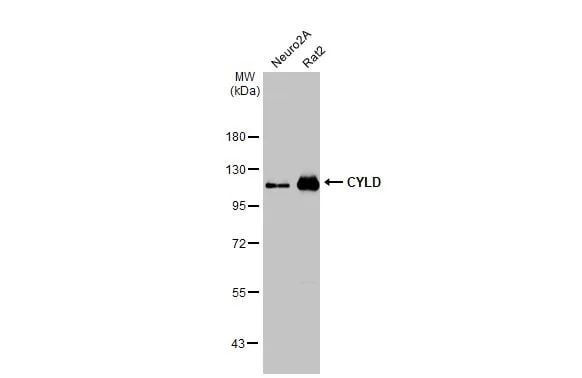
Western Blot: CYLD Antibody (HL1260) - Azide and BSA Free [NBP3-25425] -
Western Blot: CYLD Antibody (HL1260) - Azide and BSA Free [NBP3-25425] - Various whole cell extracts (30 ug) were separated by 7.5% SDS-PAGE, and the membrane was blotted with CYLD antibody [HL1260] (NBP3-25425) diluted at 1:1000. The HRP-conjugated anti-rabbit IgG antibody was used to detect the primary antibody.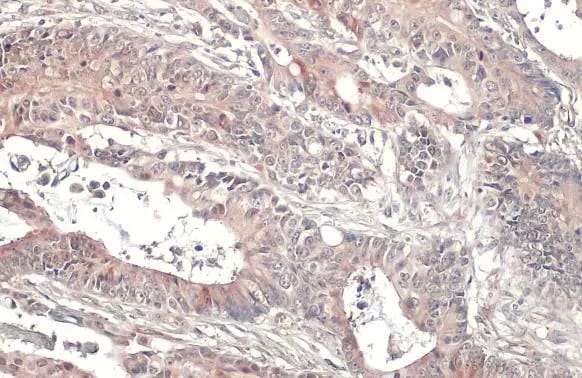
Immunohistochemistry-Paraffin: CYLD Antibody (HL1260) - Azide and BSA Free [NBP3-25425] -
Immunohistochemistry-Paraffin: CYLD Antibody (HL1260) - Azide and BSA Free [NBP3-25425] - CYLD antibody [HL1260] detects CYLD protein at cytoplasm by immunohistochemical analysis. Sample: Paraffin-embedded human colon cancer. CYLD stained by CYLD antibody [HL1260] (NBP3-25425) diluted at 1:100. Antigen Retrieval: Tris-EDTA buffer, pH 8.0, 15 min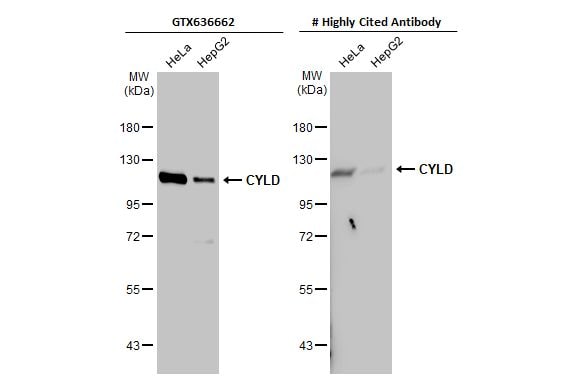
Western Blot: CYLD Antibody (HL1260) - Azide and BSA Free [NBP3-25425] -
Western Blot: CYLD Antibody (HL1260) - Azide and BSA Free [NBP3-25425] - Various whole cell extracts (30 ug) were separated by 7.5% SDS-PAGE, and the membranes were blotted with CYLD antibody [HL1260] (NBP3-25425) diluted at 1:1000 and competitor's antibody (# Highly Cited Antibody) diluted at 1:1000. The HRP-conjugated anti-rabbit IgG antibody was used to detect the primary antibody, and the signal was developed with Trident ECL plus-Enhanced.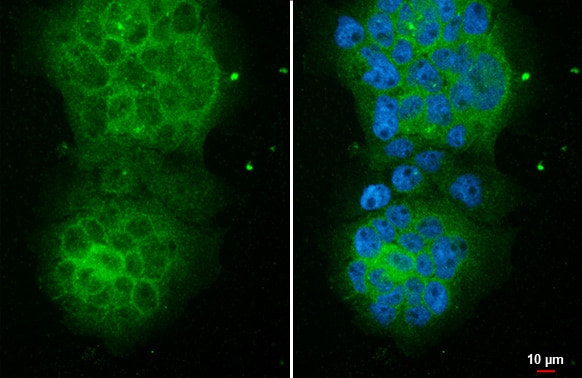
Immunocytochemistry/Immunofluorescence: CYLD Antibody (HL1260) - Azide and BSA Free [NBP3-25425] -
Immunocytochemistry/Immunofluorescence: CYLD Antibody (HL1260) - Azide and BSA Free [NBP3-25425] - CYLD antibody [HL1260] detects CYLD protein at cytoplasm by immunofluorescent analysis. Sample: A431 cells were fixed in 4% paraformaldehyde at RT for 15 min. Green: CYLD stained by CYLD antibody [HL1260] (NBP3-25425) diluted at 1:685. Blue: Fluoroshield with DAPI.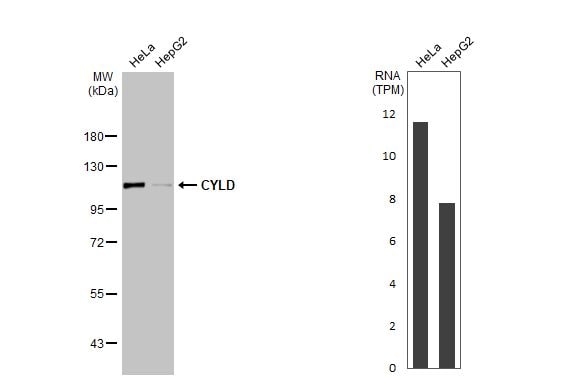
Western Blot: CYLD Antibody (HL1260) [NBP3-25425] -
Various whole cell extracts (30 ug) were separated by 7.5% SDS-PAGE, and the membrane was blotted with CYLD antibody [HL1260] (NBP3-25425) diluted at 1:1000. The HRP-conjugated anti-rabbit IgG antibody was used to detect the primary antibody. Corresponding RNA expression data for the same cell lines are based on Human Protein Atlas program.Applications for CYLD Antibody (HL1260) - Azide and BSA Free
Western Blot
Formulation, Preparation, and Storage
Purification
Formulation
Format
Preservative
Concentration
Shipping
Stability & Storage
Background: CYLD
Long Name
Alternate Names
Gene Symbol
Additional CYLD Products
Product Documents for CYLD Antibody (HL1260) - Azide and BSA Free
Certificate of Analysis
To download a Certificate of Analysis, please enter a lot or batch number in the search box below.
Product Specific Notices for CYLD Antibody (HL1260) - Azide and BSA Free
This product is for research use only and is not approved for use in humans or in clinical diagnosis. Primary Antibodies are guaranteed for 1 year from date of receipt.
Related Research Areas
Customer Reviews for CYLD Antibody (HL1260) - Azide and BSA Free
There are currently no reviews for this product. Be the first to review CYLD Antibody (HL1260) - Azide and BSA Free and earn rewards!
Have you used CYLD Antibody (HL1260) - Azide and BSA Free?
Submit a review and receive an Amazon gift card!
$25/€18/£15/$25CAN/¥2500 for a review with an image
$10/€7/£6/$10CAN/¥1110 for a review without an image
Submit a review
Protocols
Find general support by application which include: protocols, troubleshooting, illustrated assays, videos and webinars.
- Antigen Retrieval Protocol (PIER)
- Antigen Retrieval for Frozen Sections Protocol
- Appropriate Fixation of IHC/ICC Samples
- Cellular Response to Hypoxia Protocols
- Chromogenic IHC Staining of Formalin-Fixed Paraffin-Embedded (FFPE) Tissue Protocol
- Chromogenic Immunohistochemistry Staining of Frozen Tissue
- ClariTSA™ Fluorophore Kits
- Detection & Visualization of Antibody Binding
- Fluorescent IHC Staining of Frozen Tissue Protocol
- Graphic Protocol for Heat-induced Epitope Retrieval
- Graphic Protocol for the Preparation and Fluorescent IHC Staining of Frozen Tissue Sections
- Graphic Protocol for the Preparation and Fluorescent IHC Staining of Paraffin-embedded Tissue Sections
- Graphic Protocol for the Preparation of Gelatin-coated Slides for Histological Tissue Sections
- ICC Cell Smear Protocol for Suspension Cells
- ICC Immunocytochemistry Protocol Videos
- ICC for Adherent Cells
- IHC Sample Preparation (Frozen sections vs Paraffin)
- Immunocytochemistry (ICC) Protocol
- Immunocytochemistry Troubleshooting
- Immunofluorescence of Organoids Embedded in Cultrex Basement Membrane Extract
- Immunofluorescent IHC Staining of Formalin-Fixed Paraffin-Embedded (FFPE) Tissue Protocol
- Immunohistochemistry (IHC) and Immunocytochemistry (ICC) Protocols
- Immunohistochemistry Frozen Troubleshooting
- Immunohistochemistry Paraffin Troubleshooting
- Preparing Samples for IHC/ICC Experiments
- Preventing Non-Specific Staining (Non-Specific Binding)
- Primary Antibody Selection & Optimization
- Protocol for Heat-Induced Epitope Retrieval (HIER)
- Protocol for Making a 4% Formaldehyde Solution in PBS
- Protocol for VisUCyte™ HRP Polymer Detection Reagent
- Protocol for the Fluorescent ICC Staining of Cell Smears - Graphic
- Protocol for the Fluorescent ICC Staining of Cultured Cells on Coverslips - Graphic
- Protocol for the Preparation & Fixation of Cells on Coverslips
- Protocol for the Preparation and Chromogenic IHC Staining of Frozen Tissue Sections
- Protocol for the Preparation and Chromogenic IHC Staining of Frozen Tissue Sections - Graphic
- Protocol for the Preparation and Chromogenic IHC Staining of Paraffin-embedded Tissue Sections
- Protocol for the Preparation and Chromogenic IHC Staining of Paraffin-embedded Tissue Sections - Graphic
- Protocol for the Preparation and Fluorescent ICC Staining of Cells on Coverslips
- Protocol for the Preparation and Fluorescent ICC Staining of Non-adherent Cells
- Protocol for the Preparation and Fluorescent ICC Staining of Stem Cells on Coverslips
- Protocol for the Preparation and Fluorescent IHC Staining of Frozen Tissue Sections
- Protocol for the Preparation and Fluorescent IHC Staining of Paraffin-embedded Tissue Sections
- Protocol for the Preparation of Gelatin-coated Slides for Histological Tissue Sections
- Protocol for the Preparation of a Cell Smear for Non-adherent Cell ICC - Graphic
- R&D Systems Quality Control Western Blot Protocol
- TUNEL and Active Caspase-3 Detection by IHC/ICC Protocol
- The Importance of IHC/ICC Controls
- Troubleshooting Guide: Immunohistochemistry
- Troubleshooting Guide: Western Blot Figures
- Western Blot Conditions
- Western Blot Protocol
- Western Blot Protocol for Cell Lysates
- Western Blot Troubleshooting
- Western Blot Troubleshooting Guide
- View all Protocols, Troubleshooting, Illustrated assays and Webinars
Associated Pathways
