
ELF3/ESE-1 Antibody - BSA Free
Novus Biologicals | Catalog # NBP1-30873

![Western Blot: ELF3/ESE-1 Antibody [NBP1-30873]](https://resources.rndsystems.com/images/products/ELF3-ESE-1-Antibody-Western-Blot-NBP1-30873-img0010.jpg "Western Blot: ELF3/ESE-1 Antibody [NBP1-30873]")
Scientific images may be resized, cropped, or adjusted for brightness or contrast for presentation purposes. These updates are limited to presentation and do not affect the underlying scientific interpretation of the data. Where available, additional source data may be provided upon request.
Key Product Details
Validated by
Species Reactivity
Validated:
Cited:
Applications
Validated:
Cited:
Label
Antibody Source
Format
Product Specifications
Immunogen
Reactivity Notes
Localization
Clonality
Host
Isotype
Theoretical MW
Disclaimer note: The observed molecular weight of the protein may vary from the listed predicted molecular weight due to post translational modifications, post translation cleavages, relative charges, and other experimental factors.
Scientific Data Images for ELF3/ESE-1 Antibody - BSA Free
Western Blot: ELF3/ESE-1 Antibody [NBP1-30873]
ELF3-ESE-1-Antibody-Western-Blot-NBP1-30873-img0010.jpg![Immunocytochemistry/ Immunofluorescence: ELF3/ESE-1 Antibody [NBP1-30873]](https://resources.rndsystems.com/images/products/ELF3-ESE-1-Antibody-Immunocytochemistry-Immunofluorescence-NBP1-30873-img0006.jpg "Immunocytochemistry/ Immunofluorescence: ELF3/ESE-1 Antibody [NBP1-30873]")
Immunocytochemistry/ Immunofluorescence: ELF3/ESE-1 Antibody [NBP1-30873]
Immunocytochemistry/Immunofluorescence: ELF3/ESE-1 Antibody [NBP1-30873] - Methanol-fixed HeLa, using antibody at 1:500 dilution.![Immunohistochemistry-Paraffin: ELF3/ESE-1 Antibody [NBP1-30873]](https://resources.rndsystems.com/images/products/ELF3-ESE-1-Antibody-Immunohistochemistry-Paraffin-NBP1-30873-img0009.jpg "Immunohistochemistry-Paraffin: ELF3/ESE-1 Antibody [NBP1-30873]")
Immunohistochemistry-Paraffin: ELF3/ESE-1 Antibody [NBP1-30873]
Immunohistochemistry-Paraffin: ELF3/ESE-1 Antibody [NBP1-30873] - Human lung carcinoma. ESE1 antibody [C2C3], C-term diluted at 1:500. Antigen Retrieval: Trilogy™ (EDTA based, pH 8.0) buffer, 15min.![Immunohistochemistry-Paraffin: ELF3/ESE-1 Antibody [NBP1-30873]](https://resources.rndsystems.com/images/products/ELF3-ESE-1-Antibody-Immunohistochemistry-Paraffin-NBP1-30873-img0007.jpg "Immunohistochemistry-Paraffin: ELF3/ESE-1 Antibody [NBP1-30873]")
Immunohistochemistry-Paraffin: ELF3/ESE-1 Antibody [NBP1-30873]
Immunohistochemistry-Paraffin: ELF3/ESE-1 Antibody [NBP1-30873] - NCI-N87 xenograft, using ESE1 antibody at 1:100 dilution. Antigen Retrieval: Trilogy™ (EDTA based, pH 8.0) buffer, 15min.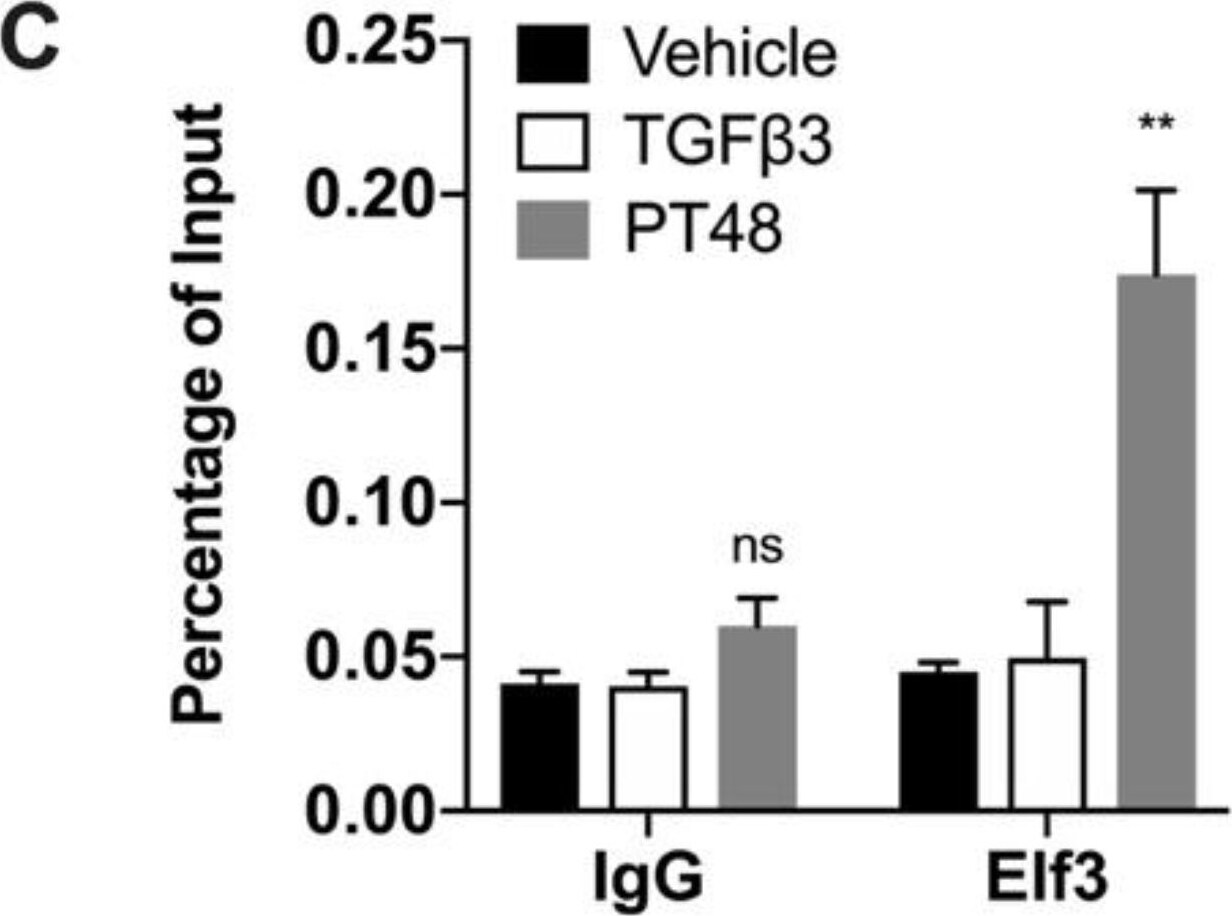
Chromatin Immunoprecipitation: ELF3/ESE-1 Antibody [NBP1-30873] -
Chromatin Immunoprecipitation: ELF3/ESE-1 Antibody [NBP1-30873] - The transcription factor ELF3 regulates the Grhl3 promoter. (A) The sequence of the Grhl3 promoter (1000 bp) showing the location of the predicted TATA box, SP1 sequence, & the transcription start site. Sequences in red represent the conserved regions, & green bases represent putative ELF3 binding sites. (B) Luciferase reporter assay showing the activation of the Grhl3 promoter by ELF3. Relative luciferase activity is calculated as fold induction relative to vector. Drawings on the left side show a schematic representation of the Grhl3 promoter region (top) & the structure of each reporter plasmid (below). The conserved regions are shown as horizontal boxes labeled 1,2 & 3, the restriction enzymes used to generate the reporter deletions of the promoter are labeled. (C) ELF3 binding at the promoter of Grhl3. NMuMG cells were treated with either vehicle or TGF beta 3 for 72 h, TGF beta 3 treated cells were then washed with PBS & continued incubation for an additional 48 h to initiate MET (post-treatment: PT48). Cells were cross-linked, & chromatin immunoprecipitation was performed. ChIP DNA was used in qPCR to measure the occupancy of ELF3 compared to control antibodies. (D) Sequence alignment of one putative ELF3 binding site in the Grhl3 promoter showing conservation among different species. In B & C, data represent the averages of at least three independent experiments. The paired Student’s t-test was used to calculate statistical significance. ** p-value < 0.01; **** p-value < 0.0001. Image collected & cropped by CiteAb from the following publication (https://pubmed.ncbi.nlm.nih.gov/31404945), licensed under a CC-BY license. Not internally tested by Novus Biologicals.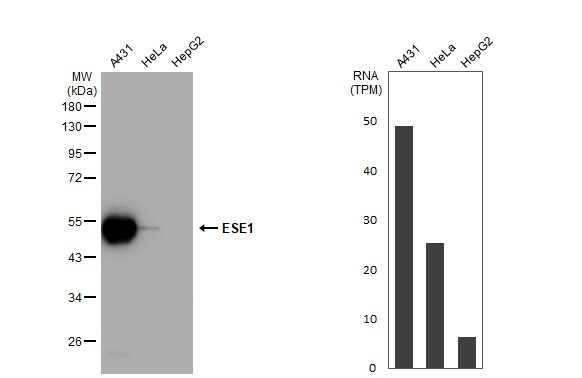
Western Blot: ELF3/ESE-1 Antibody [NBP1-30873] -
Western Blot: ELF3/ESE-1 Antibody [NBP1-30873] - Various whole cell extracts (30 ug) were separated by 10% SDS-PAGE, and the membrane was blotted with ESE1 antibody [C2C3], C-term diluted at 1:1000. The HRP-conjugated anti-rabbit IgG antibody was used to detect the primary antibody. Corresponding RNA expression data for the same cell lines are based on Human Protein Atlas program.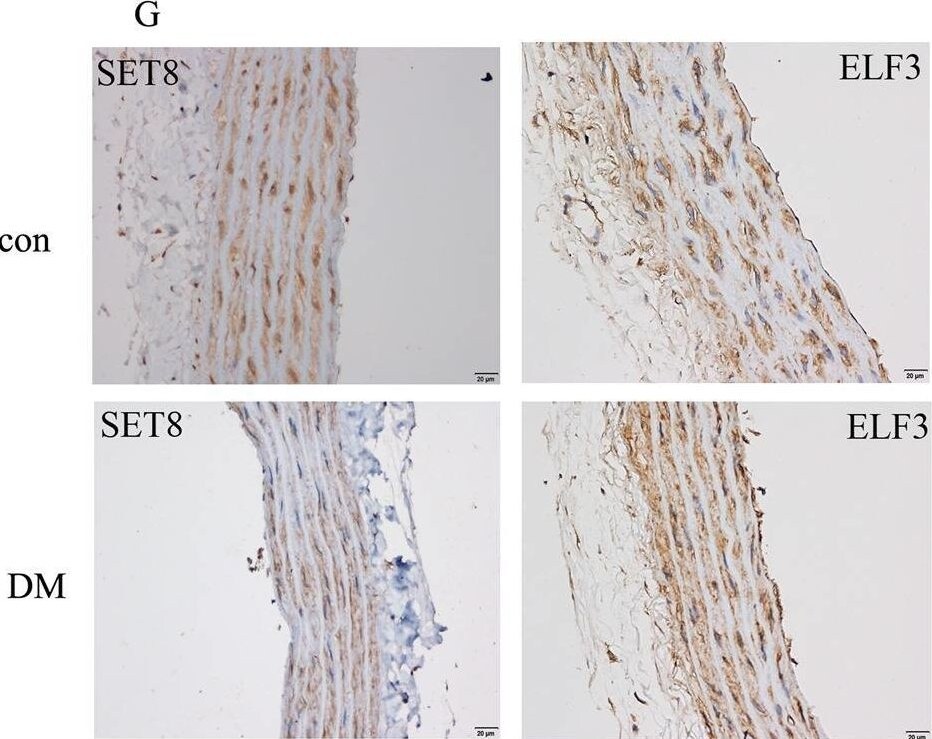
Immunohistochemistry: ELF3/ESE-1 Antibody - BSA Free [NBP1-30873] -
SET8 decrease and ELF3 increase were confirmed in diabetic patients and rats.a The mRNA expression of SET8 was examined by qPCR in PBMCs from diabetic patients and healthy controls (con: n = 30, DM: n = 50). b The mRNA expression of ELF3 was examined by qPCR in PBMCs from diabetic patients and healthy controls (con: n = 30, DM: n = 50). c Results from western blot analysis of ELF3 and SET8 expression in PBMCs from diabetic patients and heathy controls (con: n = 30, DM: n = 50). d The mRNA expression of SET8 was examined by qPCR in aorta tissues from the control group and diabetic group in rats (n = 5/group). e The mRNA expression of ELF3 was examined by qPCR in aorta tissues from the control group and diabetic group in rats (n = 5/group). f Results from western blot analysis of ELF3 and SET8 expression in aorta tissues from the control group and diabetic group in rats (n = 5/group). g Immunostaining of SET8 and ELF3 in aorta tissues from the control group and diabetic group (n = 5/group). Scale bar, 50 μm. h Schematic representation of the working model. High glucose mediated NLRP3 inflammasome activation via upregulation of MARK4 expression in vascular endothelial cells. Moreover, high glucose increased ELF3 expression while inhibiting SET8 expression. Furthermore, ELF3 interacted with SET8 to modulate MARK4 expression, which was involved in the high glucose-mediated endothelial inflammasome activation in hyperglycaemic HUVECs. (*P ≤ 0.001, **P ≤ 0.0001, compared with the control group). Image collected and cropped by CiteAb from the following open publication (https://pubmed.ncbi.nlm.nih.gov/32439949), licensed under a CC-BY license. Not internally tested by Novus Biologicals.Applications for ELF3/ESE-1 Antibody - BSA Free
Chromatin Immunoprecipitation (ChIP)
Immunocytochemistry/ Immunofluorescence
Immunohistochemistry
Immunohistochemistry-Paraffin
Western Blot
Formulation, Preparation, and Storage
Purification
Formulation
Format
Preservative
Concentration
Shipping
Stability & Storage
Background: ELF3
Long Name
Alternate Names
Gene Symbol
Additional ELF3 Products
Product Documents for ELF3/ESE-1 Antibody - BSA Free
Certificate of Analysis
To download a Certificate of Analysis, please enter a lot or batch number in the search box below.
Product Specific Notices for ELF3/ESE-1 Antibody - BSA Free
This product is for research use only and is not approved for use in humans or in clinical diagnosis. Primary Antibodies are guaranteed for 1 year from date of receipt.
⚠ WARNING: This product can expose you to chemicals including mercury, which is known to the State of California to cause reproductive toxicity with developmental effects. For more information go to www.P65Warnings.ca.gov.Related Research Areas
Citations for ELF3/ESE-1 Antibody - BSA Free
 Powered by Bioz
Customer Reviews for ELF3/ESE-1 Antibody - BSA Free
There are currently no reviews for this product. Be the first to review ELF3/ESE-1 Antibody - BSA Free and earn rewards!
Have you used ELF3/ESE-1 Antibody - BSA Free?
Submit a review and receive an Amazon gift card!
$25/€18/£15/$25CAN/¥2500 for a review with an image
$10/€7/£6/$10CAN/¥1110 for a review without an image
Submit a review
Protocols
Find general support by application which include: protocols, troubleshooting, illustrated assays, videos and webinars.
- Antigen Retrieval Protocol (PIER)
- Antigen Retrieval for Frozen Sections Protocol
- Appropriate Fixation of IHC/ICC Samples
- Cellular Response to Hypoxia Protocols
- ChIP Protocol Video
- Chromatin Immunoprecipitation (ChIP) Protocol
- Chromatin Immunoprecipitation Protocol
- Chromogenic IHC Staining of Formalin-Fixed Paraffin-Embedded (FFPE) Tissue Protocol
- Chromogenic Immunohistochemistry Staining of Frozen Tissue
- ClariTSA™ Fluorophore Kits
- Detection & Visualization of Antibody Binding
- Fluorescent IHC Staining of Frozen Tissue Protocol
- Graphic Protocol for Heat-induced Epitope Retrieval
- Graphic Protocol for the Preparation and Fluorescent IHC Staining of Frozen Tissue Sections
- Graphic Protocol for the Preparation and Fluorescent IHC Staining of Paraffin-embedded Tissue Sections
- Graphic Protocol for the Preparation of Gelatin-coated Slides for Histological Tissue Sections
- ICC Cell Smear Protocol for Suspension Cells
- ICC Immunocytochemistry Protocol Videos
- ICC for Adherent Cells
- IHC Sample Preparation (Frozen sections vs Paraffin)
- Immunocytochemistry (ICC) Protocol
- Immunocytochemistry Troubleshooting
- Immunofluorescence of Organoids Embedded in Cultrex Basement Membrane Extract
- Immunofluorescent IHC Staining of Formalin-Fixed Paraffin-Embedded (FFPE) Tissue Protocol
- Immunohistochemistry (IHC) and Immunocytochemistry (ICC) Protocols
- Immunohistochemistry Frozen Troubleshooting
- Immunohistochemistry Paraffin Troubleshooting
- Preparing Samples for IHC/ICC Experiments
- Preventing Non-Specific Staining (Non-Specific Binding)
- Primary Antibody Selection & Optimization
- Protocol for Heat-Induced Epitope Retrieval (HIER)
- Protocol for Making a 4% Formaldehyde Solution in PBS
- Protocol for VisUCyte™ HRP Polymer Detection Reagent
- Protocol for the Fluorescent ICC Staining of Cell Smears - Graphic
- Protocol for the Fluorescent ICC Staining of Cultured Cells on Coverslips - Graphic
- Protocol for the Preparation & Fixation of Cells on Coverslips
- Protocol for the Preparation and Chromogenic IHC Staining of Frozen Tissue Sections
- Protocol for the Preparation and Chromogenic IHC Staining of Frozen Tissue Sections - Graphic
- Protocol for the Preparation and Chromogenic IHC Staining of Paraffin-embedded Tissue Sections
- Protocol for the Preparation and Chromogenic IHC Staining of Paraffin-embedded Tissue Sections - Graphic
- Protocol for the Preparation and Fluorescent ICC Staining of Cells on Coverslips
- Protocol for the Preparation and Fluorescent ICC Staining of Non-adherent Cells
- Protocol for the Preparation and Fluorescent ICC Staining of Stem Cells on Coverslips
- Protocol for the Preparation and Fluorescent IHC Staining of Frozen Tissue Sections
- Protocol for the Preparation and Fluorescent IHC Staining of Paraffin-embedded Tissue Sections
- Protocol for the Preparation of Gelatin-coated Slides for Histological Tissue Sections
- Protocol for the Preparation of a Cell Smear for Non-adherent Cell ICC - Graphic
- R&D Systems Quality Control Western Blot Protocol
- TUNEL and Active Caspase-3 Detection by IHC/ICC Protocol
- The Importance of IHC/ICC Controls
- Troubleshooting Guide: Immunohistochemistry
- Troubleshooting Guide: Western Blot Figures
- Western Blot Conditions
- Western Blot Protocol
- Western Blot Protocol for Cell Lysates
- Western Blot Troubleshooting
- Western Blot Troubleshooting Guide
- View all Protocols, Troubleshooting, Illustrated assays and Webinars