
FANCM Antibody (CV5.1) - BSA Free
Novus Biologicals | Catalog # NBP2-50418

![Knockdown Validated: FANCM Antibody (CV5.1) - BSA Free [NBP2-50418]](https://resources.rndsystems.com/images/products/FANCM-Antibody-CV5-1-Knockdown-Validated-NBP2-50418-img0001.jpg "Western Blot: FANCM Antibody (CV5.1) - BSA Free [NBP2-50418]")
Scientific images may be resized, cropped, or adjusted for brightness or contrast for presentation purposes. These updates are limited to presentation and do not affect the underlying scientific interpretation of the data. Where available, additional source data may be provided upon request.
Key Product Details
Validated by
Species Reactivity
Validated:
Cited:
Applications
Validated:
Cited:
Label
Antibody Source
Format
Product Specifications
Immunogen
Clonality
Host
Isotype
Scientific Data Images for FANCM Antibody (CV5.1) - BSA Free
![Immunohistochemistry: FANCM Antibody (CV5.1) - BSA Free [NBP2-50418]](https://resources.rndsystems.com/images/products/FANCM-Antibody-CV5-1-Immunohistochemistry-NBP2-50418-img0002.jpg "Immunohistochemistry: FANCM Antibody (CV5.1) - BSA Free [NBP2-50418]")
Immunohistochemistry: FANCM Antibody (CV5.1) - BSA Free [NBP2-50418]
FANCM-Antibody-CV5-1-Immunohistochemistry-NBP2-50418-img0002.jpg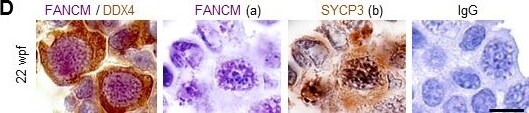
Immunohistochemistry: FANCM Antibody (CV5.1) - BSA Free [NBP2-50418] -
FANCM expression in human fetal ovaries.(A) Relative FANCM mRNA abundance was measured by RT-qPCR in human fetal ovaries from 5 to 32 weeks post-fertilization (wpf). (B) Germ cells (D2-40+) & somatic cells (D2-40-) were sorted from three ovaries ranging from 8 to 12 wpf & FANCM expression was measured. ACTB was used to normalize FANCM expression in all samples. Dots represent different ovaries & the mean is indicated by the line. (C) Immunohistochemistry of FANCM in human fetal & adult ovaries. Fetal ovaries at 8 & 22 wpf & adult ovaries were studied. FANCM positive cells appear in yellow/brown color (monoclonal FANCM CV5.1 antibody, Novus Biologicals, Abingdon, UK). Ovarian sections were counterstained with hematoxylin (blue staining). Oo, oogonia; Pa, oocyte at the pachytene stage of meiosis I, D, oocyte at the diplotene stage of meiosis I; Pr, oocyte in primordial follicle. (D) Co-staining in 22 wpf ovaries, for FANCM (purple) & DDX4 (brown) confirmed the germ cell identity of FANCM-positive cells (left). Successive staining for FANCM & SYCP3 in the same section (panels a & b). Negative control performed with non-immune mouse IgG (right). Scale bar: 10 μm. Image collected & cropped by CiteAb from the following publication (https://pubmed.ncbi.nlm.nih.gov/29231814), licensed under a CC-BY license. Not internally tested by Novus Biologicals.Applications for FANCM Antibody (CV5.1) - BSA Free
Immunocytochemistry/ Immunofluorescence
Immunoprecipitation
Western Blot
Reviewed Applications
Read 1 review rated 4 using NBP2-50418 in the following applications:
Formulation, Preparation, and Storage
Purification
Formulation
Format
Preservative
Concentration
Shipping
Stability & Storage
Background: FANCM
Alternate Names
Gene Symbol
Additional FANCM Products
Product Documents for FANCM Antibody (CV5.1) - BSA Free
Certificate of Analysis
To download a Certificate of Analysis, please enter a lot or batch number in the search box below.
Product Specific Notices for FANCM Antibody (CV5.1) - BSA Free
This product is for research use only and is not approved for use in humans or in clinical diagnosis. Primary Antibodies are guaranteed for 1 year from date of receipt.
Citations for FANCM Antibody (CV5.1) - BSA Free
 Powered by Bioz
Customer Reviews for FANCM Antibody (CV5.1) - BSA Free (1)
Have you used FANCM Antibody (CV5.1) - BSA Free?
Submit a review and receive an Amazon gift card!
$25/€18/£15/$25CAN/¥2500 for a review with an image
$10/€7/£6/$10CAN/¥1110 for a review without an image
Submit a review
Customer Images
-
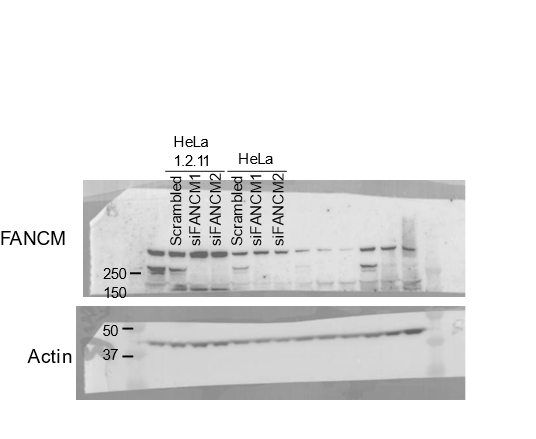
Application: Western BlotSample Tested: Hela whole cell lysateSpecies: HumanVerified Customer | Posted 10/07/2020Uncropped Western blot showing FANCM depletion using two different siRNA's (Life Technologies - siRNA ID s33619, s33621 respectively). Note that there is a prominent non-specific band at about 350-450kD.Cells were lysed using RIPA buffer supplemented with protease inhibitor cocktail. 20ug protein per lane. PVDF membrane was blocked with 5% milk in PBST. Diluted in 0.5% milk in PBST. Band signal requires requires femtomolar ECL reagent in order to detect in under 3 minutes.

There are no reviews that match your criteria.
Protocols
Find general support by application which include: protocols, troubleshooting, illustrated assays, videos and webinars.
- Antigen Retrieval Protocol (PIER)
- Antigen Retrieval for Frozen Sections Protocol
- Appropriate Fixation of IHC/ICC Samples
- Cellular Response to Hypoxia Protocols
- Chromogenic IHC Staining of Formalin-Fixed Paraffin-Embedded (FFPE) Tissue Protocol
- Chromogenic Immunohistochemistry Staining of Frozen Tissue
- ClariTSA™ Fluorophore Kits
- Detection & Visualization of Antibody Binding
- Fluorescent IHC Staining of Frozen Tissue Protocol
- Graphic Protocol for Heat-induced Epitope Retrieval
- Graphic Protocol for the Preparation and Fluorescent IHC Staining of Frozen Tissue Sections
- Graphic Protocol for the Preparation and Fluorescent IHC Staining of Paraffin-embedded Tissue Sections
- Graphic Protocol for the Preparation of Gelatin-coated Slides for Histological Tissue Sections
- ICC Cell Smear Protocol for Suspension Cells
- ICC Immunocytochemistry Protocol Videos
- ICC for Adherent Cells
- IHC Sample Preparation (Frozen sections vs Paraffin)
- Immunocytochemistry (ICC) Protocol
- Immunocytochemistry Troubleshooting
- Immunofluorescence of Organoids Embedded in Cultrex Basement Membrane Extract
- Immunofluorescent IHC Staining of Formalin-Fixed Paraffin-Embedded (FFPE) Tissue Protocol
- Immunohistochemistry (IHC) and Immunocytochemistry (ICC) Protocols
- Immunohistochemistry Frozen Troubleshooting
- Immunohistochemistry Paraffin Troubleshooting
- Immunoprecipitation Protocol
- Preparing Samples for IHC/ICC Experiments
- Preventing Non-Specific Staining (Non-Specific Binding)
- Primary Antibody Selection & Optimization
- Protocol for Heat-Induced Epitope Retrieval (HIER)
- Protocol for Making a 4% Formaldehyde Solution in PBS
- Protocol for VisUCyte™ HRP Polymer Detection Reagent
- Protocol for the Fluorescent ICC Staining of Cell Smears - Graphic
- Protocol for the Fluorescent ICC Staining of Cultured Cells on Coverslips - Graphic
- Protocol for the Preparation & Fixation of Cells on Coverslips
- Protocol for the Preparation and Chromogenic IHC Staining of Frozen Tissue Sections
- Protocol for the Preparation and Chromogenic IHC Staining of Frozen Tissue Sections - Graphic
- Protocol for the Preparation and Chromogenic IHC Staining of Paraffin-embedded Tissue Sections
- Protocol for the Preparation and Chromogenic IHC Staining of Paraffin-embedded Tissue Sections - Graphic
- Protocol for the Preparation and Fluorescent ICC Staining of Cells on Coverslips
- Protocol for the Preparation and Fluorescent ICC Staining of Non-adherent Cells
- Protocol for the Preparation and Fluorescent ICC Staining of Stem Cells on Coverslips
- Protocol for the Preparation and Fluorescent IHC Staining of Frozen Tissue Sections
- Protocol for the Preparation and Fluorescent IHC Staining of Paraffin-embedded Tissue Sections
- Protocol for the Preparation of Gelatin-coated Slides for Histological Tissue Sections
- Protocol for the Preparation of a Cell Smear for Non-adherent Cell ICC - Graphic
- R&D Systems Quality Control Western Blot Protocol
- TUNEL and Active Caspase-3 Detection by IHC/ICC Protocol
- The Importance of IHC/ICC Controls
- Troubleshooting Guide: Immunohistochemistry
- Troubleshooting Guide: Western Blot Figures
- Western Blot Conditions
- Western Blot Protocol
- Western Blot Protocol for Cell Lysates
- Western Blot Troubleshooting
- Western Blot Troubleshooting Guide
- View all Protocols, Troubleshooting, Illustrated assays and Webinars