
Fatty Acid Synthase/FASN Antibody - BSA Free
Novus Biologicals | Catalog # NB400-114

![Western Blot: Fatty Acid Synthase/FASN Antibody [NB400-114]](https://resources.rndsystems.com/images/products/Fatty-Acid-Synthase-FASN-Antibody-Western-Blot-NB400-114-img0011.jpg "Western Blot: Fatty Acid Synthase/FASN Antibody [NB400-114]")
Scientific images may be resized, cropped, or adjusted for brightness or contrast for presentation purposes. These updates are limited to presentation and do not affect the underlying scientific interpretation of the data. Where available, additional source data may be provided upon request.
Key Product Details
Validated by
Species Reactivity
Validated:
Cited:
Applications
Validated:
Cited:
Label
Antibody Source
Format
Product Specifications
Immunogen
Reactivity Notes
Localization
Clonality
Host
Isotype
Theoretical MW
Disclaimer note: The observed molecular weight of the protein may vary from the listed predicted molecular weight due to post translational modifications, post translation cleavages, relative charges, and other experimental factors.
Scientific Data Images for Fatty Acid Synthase/FASN Antibody - BSA Free
Western Blot: Fatty Acid Synthase/FASN Antibody [NB400-114]
Western Blot: Fatty Acid Synthase/FASN Antibody [NB400-114] - Expression of Fatty Acid Synthase in chicken hypothalamus. A: total RNA (1 ug) isolated from different tissues (brain, hypothalamus, liver and muscle) was subjected to RT-PCR using specific primers for chicken Fatty Acid Synthase (GenBank accession JO4485) or ribosomal 18S as a control (GenBank accession AF173612) B: tissue lysates (brain, hypothalmus, liver and muscle) were subjected to Western blot as described in MATERIALS AND METHODS. Blots were incubated with anti-Fatty Acid Synthase antibody and revealed by enhanced chemiluminescence. Picture compliments of Dridi S. et al, Am J Physiol Regul Integr Comp Physiol. 2006 Jul;291(1):R138-47. Epub 2006 Feb 2.![Immunocytochemistry/ Immunofluorescence: Fatty Acid Synthase/FASN Antibody [NB400-114]](https://resources.rndsystems.com/images/products/Fatty-Acid-Synthase-FASN-Antibody-Immunocytochemistry-Immunofluorescence-NB400-114-img0010.jpg "Immunocytochemistry/ Immunofluorescence: Fatty Acid Synthase/FASN Antibody [NB400-114]")
Immunocytochemistry/ Immunofluorescence: Fatty Acid Synthase/FASN Antibody [NB400-114]
Immunocytochemistry/Immunofluorescence: Fatty Acid Synthase/FASN Antibody [NB400-114] - The Fas antibody was tested in MCF-7 cells at a 1:2000 dilution against Dylight 488 (Green). Alpha tubulin and nuclei were counterstained against Dylight 550 (Red) and DAPI (Blue), respectively.![Immunohistochemistry-Paraffin: Fatty Acid Synthase/FASN Antibody [NB400-114]](https://resources.rndsystems.com/images/products/Fatty-Acid-Synthase-FASN-Antibody-Immunohistochemistry-Paraffin-NB400-114-img0009.jpg "Immunohistochemistry-Paraffin: Fatty Acid Synthase/FASN Antibody [NB400-114]")
Immunohistochemistry-Paraffin: Fatty Acid Synthase/FASN Antibody [NB400-114]
Immunohistochemistry-Paraffin: Fatty Acid Synthase/FASN Antibody [NB400-114] - Immunohistochemical localization of FAS in chicken hypothalmus. Paraffin sections were obtained from 3-wk-old broiler chickens.![Western Blot: Fatty Acid Synthase/FASN Antibody [NB400-114]](https://resources.rndsystems.com/images/products/Fatty-Acid-Synthase-FASN-Antibody-Western-Blot-NB400-114-img0007.jpg "Western Blot: Fatty Acid Synthase/FASN Antibody [NB400-114]")
Western Blot: Fatty Acid Synthase/FASN Antibody [NB400-114]
Western Blot: Fatty Acid Synthase/FASN Antibody [NB400-114] - Analysis of Fatty Acid Synthase, using NB400-114. Samples: 50 ug of total mouse liver lysate.![Immunocytochemistry/ Immunofluorescence: Fatty Acid Synthase/FASN Antibody [NB400-114]](https://resources.rndsystems.com/images/products/Fatty-Acid-Synthase-FASN-Antibody-Immunocytochemistry-Immunofluorescence-NB400-114-img0012.jpg "Immunocytochemistry/ Immunofluorescence: Fatty Acid Synthase/FASN Antibody [NB400-114]")
Immunocytochemistry/ Immunofluorescence: Fatty Acid Synthase/FASN Antibody [NB400-114]
Fatty-Acid-Synthase-FASN-Antibody-Immunocytochemistry-Immunofluorescence-NB400-114-img0012.jpg![Knockdown Validated: Fatty Acid Synthase/FASN Antibody [NB400-114]](https://resources.rndsystems.com/images/products/Fatty-Acid-Synthase-FASN-Antibody-Knockdown-Validated-NB400-114-img0013.jpg "Western Blot: Fatty Acid Synthase/FASN Antibody [NB400-114]")
Western Blot: Fatty Acid Synthase/FASN Antibody [NB400-114]
Western Blot: Fatty Acid Synthase/FASN Antibody [NB400-114] - Fatty acid synthesis requirement for CHIKV life cycle. Western blot showing silencing efficiency of FASN-, ACC- and ACLY-specific siRNAs on CHIKV replication (n=10 for each data set).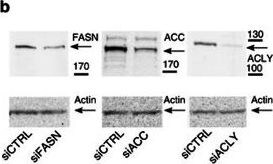
Western Blot: Fatty Acid Synthase/FASN Antibody [NB400-114] -
Western Blot: Fatty Acid Synthase/FASN Antibody [NB400-114] - Fatty acid synthesis requirement for CHIKV life cycle.(a) Impact of FASN or ACLY knockdown on CHIKV replication. Closed & open symbols indicate replicates from the primary screen & during validation, respectively. (b) Western blot showing silencing efficiency of siRNAs used in c. (c) Impact of FASN-, ACC- & ACLY-specific siRNAs on CHIKV replication (n=10 for each data set). (d) Confocal section of CHIKV replicon-infected HeLa cells labelled for FASN, dsRNA & 4,6-diamidino-2-phenylindole (DAPI; blue). Scale bar, 10 μm. (e) Co-localization analysis of cells labelled as in d & in Supplementary Fig. 3b, plotted as Pearson's coefficient per cell. Each symbol corresponds to a cell stack from three independent experiments (n=29 cells for FASN, 30 cells for ACC & 31 cells for ACLY); median values shown in red. (f) Effect of FASN (cerulenin, n=12 for each data set), ACC (TOFA, n=11 for each data set) & ACLY (BMS-303141 n=11 for each data set) inhibitors on CHIKV replication. (g) Real-time cell toxicity assay performed on HeLa cells (n=3 for each point). Excepted for b & d where representative images are shown & for g where the mean±s.d. is shown for each point of a representative experiment, all data represent the means±s.e.m. of three independent experiments analysed using one-way analysis of variance with Tukey's post test (*P<0.05; **P<0.01; ***P<0.001; NSP≥0.05). NS, not significant. Image collected & cropped by CiteAb from the following publication (https://pubmed.ncbi.nlm.nih.gov/27177310), licensed under a CC-BY license. Not internally tested by Novus Biologicals.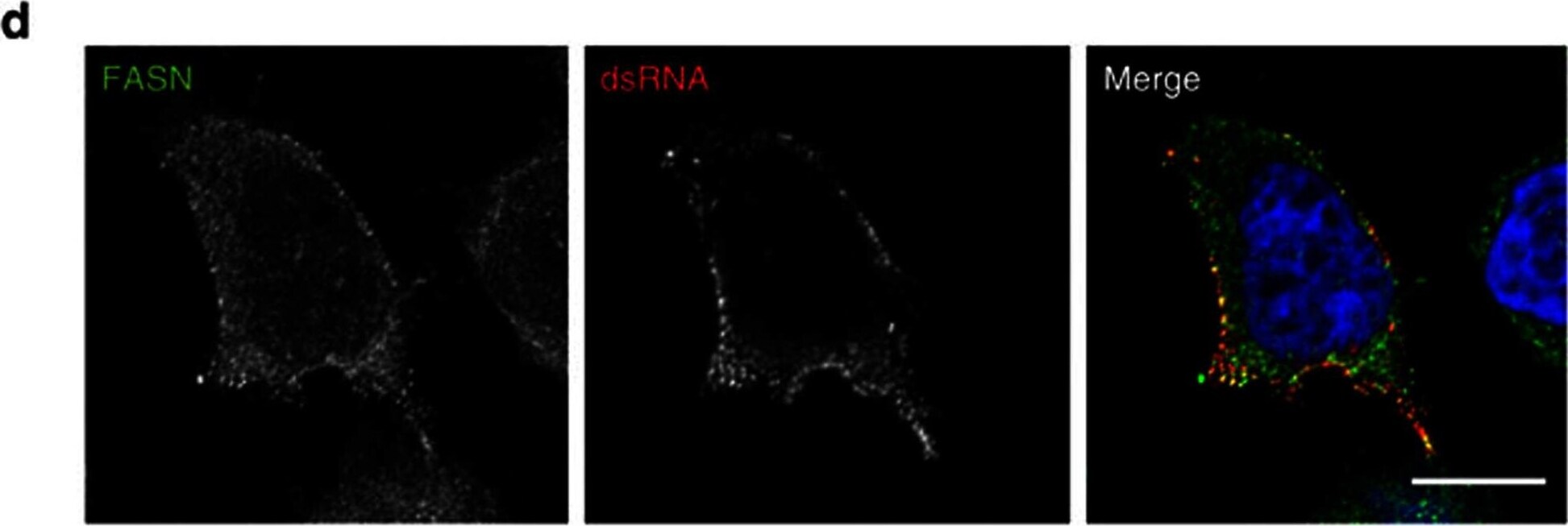
Immunocytochemistry/ Immunofluorescence: Fatty Acid Synthase/FASN Antibody - BSA Free [NB400-114] -
Fatty acid synthesis requirement for CHIKV life cycle.(a) Impact of FASN or ACLY knockdown on CHIKV replication. Closed and open symbols indicate replicates from the primary screen and during validation, respectively. (b) Western blot showing silencing efficiency of siRNAs used in c. (c) Impact of FASN-, ACC- and ACLY-specific siRNAs on CHIKV replication (n=10 for each data set). (d) Confocal section of CHIKV replicon-infected HeLa cells labelled for FASN, dsRNA and 4,6-diamidino-2-phenylindole (DAPI; blue). Scale bar, 10 μm. (e) Co-localization analysis of cells labelled as in d and in Supplementary Fig. 3b, plotted as Pearson's coefficient per cell. Each symbol corresponds to a cell stack from three independent experiments (n=29 cells for FASN, 30 cells for ACC and 31 cells for ACLY); median values shown in red. (f) Effect of FASN (cerulenin, n=12 for each data set), ACC (TOFA, n=11 for each data set) and ACLY (BMS-303141 n=11 for each data set) inhibitors on CHIKV replication. (g) Real-time cell toxicity assay performed on HeLa cells (n=3 for each point). Excepted for b and d where representative images are shown and for g where the mean+/-s.d. is shown for each point of a representative experiment, all data represent the means+/-s.e.m. of three independent experiments analysed using one-way analysis of variance with Tukey's post test (*P<0.05; **P<0.01; ***P<0.001; NSP≥0.05). NS, not significant. Image collected and cropped by CiteAb from the following open publication (https://pubmed.ncbi.nlm.nih.gov/27177310), licensed under a CC-BY license. Not internally tested by Novus Biologicals.Applications for Fatty Acid Synthase/FASN Antibody - BSA Free
Immunocytochemistry/ Immunofluorescence
Immunohistochemistry
Immunohistochemistry-Paraffin
Immunoprecipitation
Western Blot
Reviewed Applications
Read 2 reviews rated 4 using NB400-114 in the following applications:
Formulation, Preparation, and Storage
Purification
Formulation
Format
Preservative
Concentration
Shipping
Stability & Storage
Background: Fatty Acid Synthase/FASN
Alternate Names
Gene Symbol
UniProt
Additional Fatty Acid Synthase/FASN Products
Product Documents for Fatty Acid Synthase/FASN Antibody - BSA Free
Certificate of Analysis
To download a Certificate of Analysis, please enter a lot or batch number in the search box below.
Product Specific Notices for Fatty Acid Synthase/FASN Antibody - BSA Free
This product is for research use only and is not approved for use in humans or in clinical diagnosis. Primary Antibodies are guaranteed for 1 year from date of receipt.
Citations for Fatty Acid Synthase/FASN Antibody - BSA Free
 Powered by Bioz
Customer Reviews for Fatty Acid Synthase/FASN Antibody - BSA Free (2)
Have you used Fatty Acid Synthase/FASN Antibody - BSA Free?
Submit a review and receive an Amazon gift card!
$25/€18/£15/$25CAN/¥2500 for a review with an image
$10/€7/£6/$10CAN/¥1110 for a review without an image
Submit a review
-
Application: ImmunofluorescenceSample Tested: Mouse Liver, Xenograft tumorsSpecies: MouseVerified Customer | Posted 03/12/2013
-
Application: Western BlotSample Tested: RatSpecies: RatVerified Customer | Posted 12/06/2011
There are no reviews that match your criteria.
Protocols
View specific protocols for Fatty Acid Synthase/FASN Antibody - BSA Free (NB400-114):
1. Run ~50 ug of total protein on a 4-15% SDS polyacrylamide gel.
2. Transfer protein to a nitrocellulose membrane.
3. Block membrane with 1XPBS/5% non-fat milk/0.1% Tween-20 for 1 hour at room temperature (~23-27C).
4. Incubate membrane with 1:1000 dilution of NB400-114, diluted in 1XPBS/1% BSA, for 1 hour at room temperature.
5. Wash membrane once for 15 minutes, then four times for 5 minutes each, with PBST.
6. Incubate membrane with anti-rabbit IgG-HRP, diluted in 1XPBS/1% BSA, for 30 minutes-1 hour at room temperature.
7. Wash membrane once for 15 minutes, then four times for 5 minutes each, with PBST.
8. Detect cross-reacting proteins using a Chemiluminescence Reagent kit: expose ~1 minute.
NOTE: mouse liver lysates were used as a positive control for this antibody.
Find general support by application which include: protocols, troubleshooting, illustrated assays, videos and webinars.
- Antigen Retrieval Protocol (PIER)
- Antigen Retrieval for Frozen Sections Protocol
- Appropriate Fixation of IHC/ICC Samples
- Cellular Response to Hypoxia Protocols
- Chromogenic IHC Staining of Formalin-Fixed Paraffin-Embedded (FFPE) Tissue Protocol
- Chromogenic Immunohistochemistry Staining of Frozen Tissue
- ClariTSA™ Fluorophore Kits
- Detection & Visualization of Antibody Binding
- Fluorescent IHC Staining of Frozen Tissue Protocol
- Graphic Protocol for Heat-induced Epitope Retrieval
- Graphic Protocol for the Preparation and Fluorescent IHC Staining of Frozen Tissue Sections
- Graphic Protocol for the Preparation and Fluorescent IHC Staining of Paraffin-embedded Tissue Sections
- Graphic Protocol for the Preparation of Gelatin-coated Slides for Histological Tissue Sections
- ICC Cell Smear Protocol for Suspension Cells
- ICC Immunocytochemistry Protocol Videos
- ICC for Adherent Cells
- IHC Sample Preparation (Frozen sections vs Paraffin)
- Immunocytochemistry (ICC) Protocol
- Immunocytochemistry Troubleshooting
- Immunofluorescence of Organoids Embedded in Cultrex Basement Membrane Extract
- Immunofluorescent IHC Staining of Formalin-Fixed Paraffin-Embedded (FFPE) Tissue Protocol
- Immunohistochemistry (IHC) and Immunocytochemistry (ICC) Protocols
- Immunohistochemistry Frozen Troubleshooting
- Immunohistochemistry Paraffin Troubleshooting
- Immunoprecipitation Protocol
- Preparing Samples for IHC/ICC Experiments
- Preventing Non-Specific Staining (Non-Specific Binding)
- Primary Antibody Selection & Optimization
- Protocol for Heat-Induced Epitope Retrieval (HIER)
- Protocol for Making a 4% Formaldehyde Solution in PBS
- Protocol for VisUCyte™ HRP Polymer Detection Reagent
- Protocol for the Fluorescent ICC Staining of Cell Smears - Graphic
- Protocol for the Fluorescent ICC Staining of Cultured Cells on Coverslips - Graphic
- Protocol for the Preparation & Fixation of Cells on Coverslips
- Protocol for the Preparation and Chromogenic IHC Staining of Frozen Tissue Sections
- Protocol for the Preparation and Chromogenic IHC Staining of Frozen Tissue Sections - Graphic
- Protocol for the Preparation and Chromogenic IHC Staining of Paraffin-embedded Tissue Sections
- Protocol for the Preparation and Chromogenic IHC Staining of Paraffin-embedded Tissue Sections - Graphic
- Protocol for the Preparation and Fluorescent ICC Staining of Cells on Coverslips
- Protocol for the Preparation and Fluorescent ICC Staining of Non-adherent Cells
- Protocol for the Preparation and Fluorescent ICC Staining of Stem Cells on Coverslips
- Protocol for the Preparation and Fluorescent IHC Staining of Frozen Tissue Sections
- Protocol for the Preparation and Fluorescent IHC Staining of Paraffin-embedded Tissue Sections
- Protocol for the Preparation of Gelatin-coated Slides for Histological Tissue Sections
- Protocol for the Preparation of a Cell Smear for Non-adherent Cell ICC - Graphic
- R&D Systems Quality Control Western Blot Protocol
- TUNEL and Active Caspase-3 Detection by IHC/ICC Protocol
- The Importance of IHC/ICC Controls
- Troubleshooting Guide: Immunohistochemistry
- Troubleshooting Guide: Western Blot Figures
- Western Blot Conditions
- Western Blot Protocol
- Western Blot Protocol for Cell Lysates
- Western Blot Troubleshooting
- Western Blot Troubleshooting Guide
- View all Protocols, Troubleshooting, Illustrated assays and Webinars
FAQs for Fatty Acid Synthase/FASN Antibody - BSA Free
-
Q: We are interested in your item, NB400-114. Could you please provide us specific protocol of NB400-114 for IHC-P?
A: If you were requesting the protocol for WB, then we have a special one for this antibody because it is highly acetylated and tightly associated with membrane. However, we don't have any special IHC-P protocol for NB400-114, and the general one can be used: view protocol. (If there was a special IHC-P protocol for this antibody, it would have posted on the webpage for this product; but it does not) The only thing you will concern for using this general IHC-P would be how to do antigen retrieval. Human Protein Atlas shows that for performing antigen retrieval during IHC-P experiments ProteinAtlas site, HIER pH 6 can be applied. For this, both human and mouse tissues are applicable to HIER pH 6.