
GMF-beta Antibody - BSA Free
Novus Biologicals | Catalog # NBP1-89755

![GMF-beta Antibody - BSA Free Immunohistochemistry-Paraffin: GMF-beta Antibody - BSA Free [NBP1-89755]](https://resources.rndsystems.com/images/products/nbp1-89755_rabbit-polyclonal-gmf-beta-antibody-15520258303325.jpg "Immunohistochemistry-Paraffin: GMF-beta Antibody - BSA Free [NBP1-89755]")
Scientific images may be resized, cropped, or adjusted for brightness or contrast for presentation purposes. These updates are limited to presentation and do not affect the underlying scientific interpretation of the data. Where available, additional source data may be provided upon request.
Key Product Details
Validated by
Species Reactivity
Validated:
Cited:
Applications
Validated:
Cited:
Label
Antibody Source
Format
Product Specifications
Immunogen
Reactivity Notes
Clonality
Host
Isotype
Theoretical MW
Disclaimer note: The observed molecular weight of the protein may vary from the listed predicted molecular weight due to post translational modifications, post translation cleavages, relative charges, and other experimental factors.
Scientific Data Images for GMF-beta Antibody - BSA Free
Immunohistochemistry-Paraffin: GMF-beta Antibody - BSA Free [NBP1-89755]
Staining of mouse cerebellum shows strong positivity in Purkinje cells.![GMF-beta Antibody - BSA Free Immunohistochemistry-Paraffin: GMF-beta Antibody - BSA Free [NBP1-89755]](https://resources.rndsystems.com/images/products/nbp1-89755_rabbit-polyclonal-gmf-beta-antibody-15520258515154.jpg "Immunohistochemistry-Paraffin: GMF-beta Antibody - BSA Free [NBP1-89755]")
Immunohistochemistry-Paraffin: GMF-beta Antibody - BSA Free [NBP1-89755]
Staining of mouse brain shows strong positivity in neurons and dendrites in cerebral cortex.![GMF-beta Antibody - BSA Free Immunohistochemistry-Paraffin: GMF-beta Antibody - BSA Free [NBP1-89755]](https://resources.rndsystems.com/images/products/nbp1-89755_rabbit-polyclonal-gmf-beta-antibody-15520258515171.jpg "Immunohistochemistry-Paraffin: GMF-beta Antibody - BSA Free [NBP1-89755]")
Immunohistochemistry-Paraffin: GMF-beta Antibody - BSA Free [NBP1-89755]
Staining of human skeletal muscle shows no cytoplasmic positivity in myocytes as expected.![GMF-beta Antibody - BSA Free Immunohistochemistry-Paraffin: GMF-beta Antibody - BSA Free [NBP1-89755]](https://resources.rndsystems.com/images/products/nbp1-89755_rabbit-polyclonal-gmf-beta-antibody-13520251671213.jpg "Immunohistochemistry-Paraffin: GMF-beta Antibody - BSA Free [NBP1-89755]")
Immunohistochemistry-Paraffin: GMF-beta Antibody - BSA Free [NBP1-89755]
Staining of human cerebral cortex shows moderate cytoplasmic positivity in neurons.![GMF-beta Antibody - BSA Free Immunohistochemistry-Paraffin: GMF-beta Antibody - BSA Free [NBP1-89755]](https://resources.rndsystems.com/images/products/nbp1-89755_rabbit-polyclonal-gmf-beta-antibody-15520258574110.jpg "Immunohistochemistry-Paraffin: GMF-beta Antibody - BSA Free [NBP1-89755]")
Immunohistochemistry-Paraffin: GMF-beta Antibody - BSA Free [NBP1-89755]
Staining of human liver shows no cytoplasmic positivity in hepatocytes as expected.![GMF-beta Antibody - BSA Free Immunohistochemistry-Paraffin: GMF-beta Antibody - BSA Free [NBP1-89755]](https://resources.rndsystems.com/images/products/nbp1-89755_rabbit-polyclonal-gmf-beta-antibody-15520258303372.jpg "Immunohistochemistry-Paraffin: GMF-beta Antibody - BSA Free [NBP1-89755]")
Immunohistochemistry-Paraffin: GMF-beta Antibody - BSA Free [NBP1-89755]
Staining of human cerebellum shows moderate cytoplasmic positivity in Purkinje cells.![GMF-beta Antibody - BSA Free Western Blot: GMF-beta Antibody - BSA Free [NBP1-89755]](https://resources.rndsystems.com/images/products/nbp1-89755_rabbit-polyclonal-gmf-beta-antibody-15520258515151.jpg "Western Blot: GMF-beta Antibody - BSA Free [NBP1-89755]")
Western Blot: GMF-beta Antibody - BSA Free [NBP1-89755]
Analysis in human cell line A-431.![GMF-beta Antibody - BSA Free Western Blot: GMF-beta Antibody - BSA Free [NBP1-89755]](https://resources.rndsystems.com/images/products/nbp1-89755_rabbit-polyclonal-gmf-beta-antibody-135202517442135.jpg "Western Blot: GMF-beta Antibody - BSA Free [NBP1-89755]")
Western Blot: GMF-beta Antibody - BSA Free [NBP1-89755]
Analysis in mouse cell line NIH-3T3 and rat cell line NBT-II.![Immunocytochemistry/ Immunofluorescence: GMF-beta Antibody [NBP1-89755]](https://resources.rndsystems.com/images/products/GMF-beta-Antibody-Immunocytochemistry-Immunofluorescence-NBP1-89755-img0020.jpg "Immunocytochemistry/ Immunofluorescence: GMF-beta Antibody [NBP1-89755]")
Immunocytochemistry/ Immunofluorescence: GMF-beta Antibody [NBP1-89755]
GMF-beta-Antibody-Immunocytochemistry-Immunofluorescence-NBP1-89755-img0020.jpg![Immunohistochemistry: GMF-beta Antibody [NBP1-89755]](https://resources.rndsystems.com/images/products/GMF-beta-Antibody-Immunohistochemistry-NBP1-89755-img0019.jpg "Immunohistochemistry: GMF-beta Antibody [NBP1-89755]")
Immunohistochemistry: GMF-beta Antibody [NBP1-89755]
GMF-beta-Antibody-Immunohistochemistry-NBP1-89755-img0019.jpg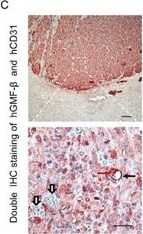
Immunohistochemistry: GMF-beta Antibody [NBP1-89755] -
Immunohistochemistry: GMF-beta Antibody [NBP1-89755] - GMF-beta knockdown suppresses tumor growth & the formation of human-CD31 positive microvessels (hCD31-MVs) in orthotopic U87 xenograft modelsA. The cross-sectional appearance of xenografted gliomas from U87-mock group B. The cross-sectional appearance of xenografted gliomas from U87-shGMF-beta group. Gross tumor boundaries were delineated by white dotlines. C. A hCD31-microvessel & several hCD31-negative vessels in U87-mock tumor. D. No hCD31-MVs, only hCD31-negative vessels in U87-shGMF-beta tumor. Red solid arrows indicate hGMF-beta staining in tumor cells, black solid arrows show hCD31 staining on microvasular endothelia, & open arrows denote vessels negative for hCD31. Scale bar: 100 μm in upper pannels; 50 μm in lower pannels. E. Quantitative comparisons of gross tumor volume between U87-mock & U87-shGMF-beta group. F. Quantitative comparisons of hCD31-microvessel densities (MVDs) between U87-mock & U87-shGMF-beta group. Image collected & cropped by CiteAb from the following publication (https://pubmed.ncbi.nlm.nih.gov/26515590), licensed under a CC-BY license. Not internally tested by Novus Biologicals.![Western Blot: GMF-beta Antibody [NBP1-89755]](https://resources.rndsystems.com/images/products/GMF-beta-Antibody-Western-Blot-NBP1-89755-img0022.jpg "Western Blot: GMF-beta Antibody [NBP1-89755]")
![Knockdown Validated: GMF-beta Antibody [NBP1-89755]](https://resources.rndsystems.com/images/products/GMF-beta-Antibody-Knockdown-Validated-NBP1-89755-img0021.jpg "Western Blot: GMF-beta Antibody [NBP1-89755]")
Western Blot: GMF-beta Antibody [NBP1-89755] -
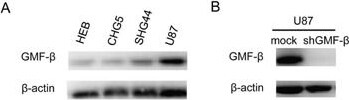
Western Blot: GMF-beta Antibody [NBP1-89755] - Tubulogenesis of human U87 glioblastoma cells is inhibited by GMF-beta knockdownA. Protein levels of GMF-beta in human glial cell line (HEB) & human glioma cell lines of the different grades (CHG5, SHG44, U87). B. Assessment of GMF-beta knockdown in U87 cells by western blotting. C. Tube formation by U87 mock cells (left panel); impaired tube formation by U87-shGMF-beta cells (right panel). Inspection under a phase contrast fluorescent microscope (× 100). D. Quantified tubulogenesis of U87 mock cells & U87-shGMF-beta cells by pattern recognition system (left panel) & branch point counting system (right panel).*** indicates significant difference with P < 0.001. Image collected & cropped by CiteAb from the following publication (https://pubmed.ncbi.nlm.nih.gov/26515590), licensed under a CC-BY license. Not internally tested by Novus Biologicals.![GMF-beta Antibody - BSA Free Immunocytochemistry/ Immunofluorescence: GMF-beta Antibody [NBP1-89755]](https://resources.rndsystems.com/images/products/nbp1-89755_-immunocytochemistry-immunofluorescence-639174076793457276.jpg "Immunocytochemistry/ Immunofluorescence: GMF-beta Antibody [NBP1-89755]")
Immunocytochemistry/ Immunofluorescence: GMF-beta Antibody [NBP1-89755]
Staining of human cell line U-251 MG shows localization to nucleoplasm, nuclear bodies & cytosol.Applications for GMF-beta Antibody - BSA Free
Immunocytochemistry/ Immunofluorescence
Immunohistochemistry
Immunohistochemistry-Paraffin
Western Blot
Formulation, Preparation, and Storage
Purification
Formulation
Format
Preservative
Concentration
Shipping
Stability & Storage
Background: GMF-beta
Long Name
Alternate Names
Gene Symbol
UniProt
Additional GMF-beta Products
Product Documents for GMF-beta Antibody - BSA Free
Certificate of Analysis
To download a Certificate of Analysis, please enter a lot or batch number in the search box below.
Product Specific Notices for GMF-beta Antibody - BSA Free
This product is for research use only and is not approved for use in humans or in clinical diagnosis. Primary Antibodies are guaranteed for 1 year from date of receipt.
Related Research Areas
Citations for GMF-beta Antibody - BSA Free
 Powered by Bioz
Customer Reviews for GMF-beta Antibody - BSA Free
There are currently no reviews for this product. Be the first to review GMF-beta Antibody - BSA Free and earn rewards!
Have you used GMF-beta Antibody - BSA Free?
Submit a review and receive an Amazon gift card!
$25/€18/£15/$25CAN/¥2500 for a review with an image
$10/€7/£6/$10CAN/¥1110 for a review without an image
Submit a review
Protocols
Find general support by application which include: protocols, troubleshooting, illustrated assays, videos and webinars.
- Antigen Retrieval Protocol (PIER)
- Antigen Retrieval for Frozen Sections Protocol
- Appropriate Fixation of IHC/ICC Samples
- Cellular Response to Hypoxia Protocols
- Chromogenic IHC Staining of Formalin-Fixed Paraffin-Embedded (FFPE) Tissue Protocol
- Chromogenic Immunohistochemistry Staining of Frozen Tissue
- ClariTSA™ Fluorophore Kits
- Detection & Visualization of Antibody Binding
- Fluorescent IHC Staining of Frozen Tissue Protocol
- Graphic Protocol for Heat-induced Epitope Retrieval
- Graphic Protocol for the Preparation and Fluorescent IHC Staining of Frozen Tissue Sections
- Graphic Protocol for the Preparation and Fluorescent IHC Staining of Paraffin-embedded Tissue Sections
- Graphic Protocol for the Preparation of Gelatin-coated Slides for Histological Tissue Sections
- ICC Cell Smear Protocol for Suspension Cells
- ICC Immunocytochemistry Protocol Videos
- ICC for Adherent Cells
- IHC Sample Preparation (Frozen sections vs Paraffin)
- Immunocytochemistry (ICC) Protocol
- Immunocytochemistry Troubleshooting
- Immunofluorescence of Organoids Embedded in Cultrex Basement Membrane Extract
- Immunofluorescent IHC Staining of Formalin-Fixed Paraffin-Embedded (FFPE) Tissue Protocol
- Immunohistochemistry (IHC) and Immunocytochemistry (ICC) Protocols
- Immunohistochemistry Frozen Troubleshooting
- Immunohistochemistry Paraffin Troubleshooting
- Preparing Samples for IHC/ICC Experiments
- Preventing Non-Specific Staining (Non-Specific Binding)
- Primary Antibody Selection & Optimization
- Protocol for Heat-Induced Epitope Retrieval (HIER)
- Protocol for Making a 4% Formaldehyde Solution in PBS
- Protocol for VisUCyte™ HRP Polymer Detection Reagent
- Protocol for the Fluorescent ICC Staining of Cell Smears - Graphic
- Protocol for the Fluorescent ICC Staining of Cultured Cells on Coverslips - Graphic
- Protocol for the Preparation & Fixation of Cells on Coverslips
- Protocol for the Preparation and Chromogenic IHC Staining of Frozen Tissue Sections
- Protocol for the Preparation and Chromogenic IHC Staining of Frozen Tissue Sections - Graphic
- Protocol for the Preparation and Chromogenic IHC Staining of Paraffin-embedded Tissue Sections
- Protocol for the Preparation and Chromogenic IHC Staining of Paraffin-embedded Tissue Sections - Graphic
- Protocol for the Preparation and Fluorescent ICC Staining of Cells on Coverslips
- Protocol for the Preparation and Fluorescent ICC Staining of Non-adherent Cells
- Protocol for the Preparation and Fluorescent ICC Staining of Stem Cells on Coverslips
- Protocol for the Preparation and Fluorescent IHC Staining of Frozen Tissue Sections
- Protocol for the Preparation and Fluorescent IHC Staining of Paraffin-embedded Tissue Sections
- Protocol for the Preparation of Gelatin-coated Slides for Histological Tissue Sections
- Protocol for the Preparation of a Cell Smear for Non-adherent Cell ICC - Graphic
- R&D Systems Quality Control Western Blot Protocol
- TUNEL and Active Caspase-3 Detection by IHC/ICC Protocol
- The Importance of IHC/ICC Controls
- Troubleshooting Guide: Immunohistochemistry
- Troubleshooting Guide: Western Blot Figures
- Western Blot Conditions
- Western Blot Protocol
- Western Blot Protocol for Cell Lysates
- Western Blot Troubleshooting
- Western Blot Troubleshooting Guide
- View all Protocols, Troubleshooting, Illustrated assays and Webinars
FAQs for GMF-beta Antibody - BSA Free
-
Q: I am interested in purchasing this antibody (glial maturation factor-beta) but I have a trivial question before. As far as I know, gmf-beta has being described as an astrocytic factor, therefore I am quite puzzled observing the IHC that you reported. In fact, the signal appear concentrated in the soma (or nucleus) of some neurons. How do you justify that? Do you expect such a staining?
A:
Based on what we know about this protein, we are seeing the expected staining pattern. Please see other instances of nuclear staining at the human protein atlas informational site (https://www.proteinatlas.org/ENSG00000197045-GMFB/subcellular). I think you may find it useful. Please let me know if you have any additional questions, technical@novusbio.com.
-
Q: I am sure that based on your knowledge you are seeing the expected staining pattern. What concerns me is that the literature on gmf-beta is very poor and it all describes a maturation factor produced in astrocytes and retained in the cytosol. Could you please give me some reference to justify the fact that the signal is not in astrocytes but in neurons?
A:
Here is the information that I received from the lab: We have tested this antibody (Anti-GMFB) in different tissues and have indeed seen some staining of glia cells as well. The image chosen to represent this product shows staining of neurons, and we believe this staining pattern to be accurate and representative based on the comment in UniProt regarding the function for this target: This protein causes differentiation of brain cells, stimulation of neural regeneration, and inhibition of proliferation of tumor cells. (https://www.uniprot.org/uniprotkb/P60983/entry) Expression of this protein in neurons is also described in the following article; Wang et al. Polyclonal antibody localizes glia maturation factor fl-like immunoreactivity in neurons and glia, Brain Research, 591 (1992) 1-7 (PubMed ID 1446220).
-
Q: I am interested in purchasing this antibody (glial maturation factor-beta) but I have a trivial question before. As far as I know, gmf-beta has being described as an astrocytic factor, therefore I am quite puzzled observing the IHC that you reported. In fact, the signal appear concentrated in the soma (or nucleus) of some neurons. How do you justify that? Do you expect such a staining?
A:
Based on what we know about this protein, we are seeing the expected staining pattern. Please see other instances of nuclear staining at the human protein atlas informational site (https://www.proteinatlas.org/ENSG00000197045-GMFB/subcellular). I think you may find it useful. Please let me know if you have any additional questions, technical@novusbio.com.
-
Q: I am sure that based on your knowledge you are seeing the expected staining pattern. What concerns me is that the literature on gmf-beta is very poor and it all describes a maturation factor produced in astrocytes and retained in the cytosol. Could you please give me some reference to justify the fact that the signal is not in astrocytes but in neurons?
A:
Here is the information that I received from the lab: We have tested this antibody (Anti-GMFB) in different tissues and have indeed seen some staining of glia cells as well. The image chosen to represent this product shows staining of neurons, and we believe this staining pattern to be accurate and representative based on the comment in UniProt regarding the function for this target: This protein causes differentiation of brain cells, stimulation of neural regeneration, and inhibition of proliferation of tumor cells. (https://www.uniprot.org/uniprotkb/P60983/entry) Expression of this protein in neurons is also described in the following article; Wang et al. Polyclonal antibody localizes glia maturation factor fl-like immunoreactivity in neurons and glia, Brain Research, 591 (1992) 1-7 (PubMed ID 1446220).