
HNF-3 beta/FoxA2 Antibody (OTI3C10)
Novus Biologicals | Catalog # NBP2-02088

![Immunocytochemistry/ Immunofluorescence: HNF-3 beta/FoxA2 Antibody (OTI3C10) [NBP2-02088]](https://resources.rndsystems.com/images/products/HNF-3-beta-FoxA2-Antibody-3C10-Immunocytochemistry-Immunofluorescence-NBP2-02088-img0017.jpg "Immunocytochemistry/ Immunofluorescence: HNF-3 beta/FoxA2 Antibody (OTI3C10) [NBP2-02088]")
Scientific images may be resized, cropped, or adjusted for brightness or contrast for presentation purposes. These updates are limited to presentation and do not affect the underlying scientific interpretation of the data. Where available, additional source data may be provided upon request.
Key Product Details
Species Reactivity
Validated:
Cited:
Applications
Validated:
Cited:
Label
Antibody Source
Product Specifications
Immunogen
Reactivity Notes
Clonality
Host
Isotype
Theoretical MW
Disclaimer note: The observed molecular weight of the protein may vary from the listed predicted molecular weight due to post translational modifications, post translation cleavages, relative charges, and other experimental factors.
Scientific Data Images for HNF-3 beta/FoxA2 Antibody (OTI3C10)
In support of our commitment to scientific transparency, some data images have been temporarily removed from this page pending internal review. Contact us for more information.
Immunocytochemistry/ Immunofluorescence: HNF-3 beta/FoxA2 Antibody (OTI3C10) [NBP2-02088]
Immunocytochemistry/Immunofluorescence: HNF-3 beta/FoxA2 Antibody (OTI3C10) [NBP2-02088] - Staining of HepG2 cells using anti HNF-3 beta/FoxA2 mouse monoclonal antibody at 1:50 dilution.![Immunohistochemistry-Paraffin: HNF-3 beta/FoxA2 Antibody (OTI3C10) [NBP2-02088]](https://resources.rndsystems.com/images/products/HNF-3-beta-FoxA2-Antibody-3C10-Immunohistochemistry-Paraffin-NBP2-02088-img0009.jpg "Immunohistochemistry-Paraffin: HNF-3 beta/FoxA2 Antibody (OTI3C10) [NBP2-02088]")
Immunohistochemistry-Paraffin: HNF-3 beta/FoxA2 Antibody (OTI3C10) [NBP2-02088]
Immunohistochemistry-Paraffin: HNF-3 beta/FoxA2 Antibody (OTI3C10) [NBP2-02088] - Staining of paraffin-embedded lung using anti-FOXA2 mouse monoclonal antibody.![Flow Cytometry: HNF-3 beta/FoxA2 Antibody (OTI3C10) [NBP2-02088]](https://resources.rndsystems.com/images/products/HNF-3-beta-FoxA2-Antibody-3C10-Flow-Cytometry-NBP2-02088-img0006.jpg "Flow Cytometry: HNF-3 beta/FoxA2 Antibody (OTI3C10) [NBP2-02088]")
Flow Cytometry: HNF-3 beta/FoxA2 Antibody (OTI3C10) [NBP2-02088]
Flow Cytometry: HNF-3 beta/FoxA2 Antibody (OTI3C10) [NBP2-02088] - HEK293T cells transfected with either pCMV6-ENTRY FOXA2.(Red) or empty vector control plasmid (Blue) were immunostained with anti-FOXA2 mouse monoclonal, and then analyzed by flow cytometry.![Western Blot: HNF-3 beta/FoxA2 Antibody (OTI3C10) [NBP2-02088]](https://resources.rndsystems.com/images/products/HNF-3-beta-FoxA2-Antibody-3C10-Western-Blot-NBP2-02088-img0010.jpg "Western Blot: HNF-3 beta/FoxA2 Antibody (OTI3C10) [NBP2-02088]")
Western Blot: HNF-3 beta/FoxA2 Antibody (OTI3C10) [NBP2-02088]
Western Blot: HNF-3 beta/FoxA2 Antibody (OTI3C10) [NBP2-02088] - HEK293T cells were transfected with the pCMV6-ENTRY control (Left lane) or pCMV6-ENTRY FOXA2 (Right lane) cDNA for 48 hrs and lysed. Equivalent amounts of cell lysates (5 ug per lane) were separated by SDS-PAGE and immunoblotted with anti-FOXA2.![Immunocytochemistry/ Immunofluorescence: HNF-3 beta/FoxA2 Antibody (OTI3C10) [NBP2-02088]](https://resources.rndsystems.com/images/products/HNF-3-beta-FoxA2-Antibody-3C10-Immunocytochemistry-Immunofluorescence-NBP2-02088-img0007.jpg "Immunocytochemistry/ Immunofluorescence: HNF-3 beta/FoxA2 Antibody (OTI3C10) [NBP2-02088]")
Immunocytochemistry/ Immunofluorescence: HNF-3 beta/FoxA2 Antibody (OTI3C10) [NBP2-02088]
Immunocytochemistry/Immunofluorescence: HNF-3 beta/FoxA2 Antibody (OTI3C10) [NBP2-02088] - Staining of HeLa cells transiently transfected by pCMV6-ENTRY FOXA2.![Immunohistochemistry-Paraffin: HNF-3 beta/FoxA2 Antibody (OTI3C10) [NBP2-02088]](https://resources.rndsystems.com/images/products/HNF-3-beta-FoxA2-Antibody-3C10-Immunohistochemistry-Paraffin-NBP2-02088-img0008.jpg "Immunohistochemistry-Paraffin: HNF-3 beta/FoxA2 Antibody (OTI3C10) [NBP2-02088]")
Immunohistochemistry-Paraffin: HNF-3 beta/FoxA2 Antibody (OTI3C10) [NBP2-02088]
Immunohistochemistry-Paraffin: HNF-3 beta/FoxA2 Antibody (OTI3C10) [NBP2-02088] - Staining of paraffin-embedded Carcinoma of liver using anti-FOXA2 mouse monoclonal antibody.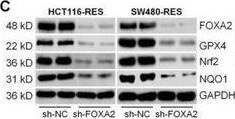
Western Blot: HNF-3 beta/FoxA2 Antibody (OTI3C10) [NBP2-02088] -
FOXA2 knockdown induces ferroptosis in chemoresistant CRC cell lines. A) RT‐qPCR analysis for Nrf2, NQO1, SOD1, GPX4 and SLC7A11 gene expression levels in drug‐sensitive or ‐resistant HCT‐116 and SW480 cells (n = 3). B) Western blot assay for GPX4, Nrf2, and NQO1 protein expression levels in HCT‐116 and SW480 cells with or without chemoresistance (n = 4). C) Western blot assay for FOXA2, GPX4, Nrf2, and NQO1 protein expression levels in chemoresistant HCT‐116 and SW480 cells with or without FOXA2 knockdown (n = 4). (D) GPX4 expression by IF staining in drug‐resistant CRC cells after transfection with sh‐FOXA2 (n = 4). Scale bar = 20 um. E) ROS and (F) lipid ROS production by DCF‐DA (Scale bar = 50 um) and C11‐BODIPY581/591 (Scale bar = 20 um) staining, respectively, in chemoresistant HCT‐116 and SW480 cells with FOXA2 knockdown (n = 4). G) MDA levels, H) GSH contents, and I) iron currents in drug‐resistant HCT‐116 and SW480 cells after FOXA2 knockdown (n = 4). Data are marked as the means +/- SD. *p < 0.05, **p < 0.01, ***p < 0.001, ****p < 0.0001. Image collected and cropped by CiteAb from the following open publication (https://pubmed.ncbi.nlm.nih.gov/37875418), licensed under a CC-BY license. Not internally tested by Novus Biologicals.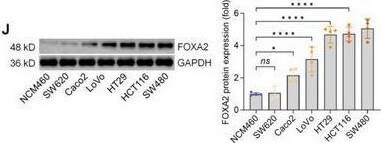
Western Blot: HNF-3 beta/FoxA2 Antibody (OTI3C10) [NBP2-02088] -
FOXA2 expression is up‐regulated in CRC patients. A,B) FOXA2 expression profile in CRC tissues from TCGA cohort. C) Representative IHC images for FOXA2 in CRC tissues and normal tissues (https://www.proteinatlas.org/). D) Kaplan‐Meier analysis for relapse‐free‐survival (RFS) of CRC patients with high (n = 709) or low (n = 633) FOXA2 expression based on the median expression of FOXA2 from the Kaplan‐Meier Plotter (https://kmplot.com/analysis/index.php?p = service). E) Images of IHC staining for FOXA2 in CRC tissues and the paired adjacent normal tissues from our cohort. Scale bar = 120 um. F) IHC scores of FOXA2 expression levels in paired normal and CRC samples were quantified. G) RT‐qPCR analysis for FOXA2 gene expression in human CRC tissues and the matched adjacent normal tissues (ANT) from our cohort (n = 60). H) FOXA2 protein expression in eighteen paired CRC tissues was examined using western blot. I) RT‐qPCR (n = 5) and J) western blot (n = 4) assays for FOXA2 gene and protein expression levels in six CRC cell lines and non‐tumor cell line NCM460. Data are marked as the means +/- SD. *p < 0.05, **p < 0.01, ****p < 0.0001. Image collected and cropped by CiteAb from the following open publication (https://pubmed.ncbi.nlm.nih.gov/37875418), licensed under a CC-BY license. Not internally tested by Novus Biologicals.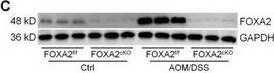
Western Blot: HNF-3 beta/FoxA2 Antibody (OTI3C10) [NBP2-02088] -
Conditional knockout of FOXA2 in IECs ameliorates colitis‐associated tumorigenesis in vivo. A) Scheme protocols of recombination in Villin‐Cre; FOXA2f/f mice. B,C) RT‐qPCR and western blot assays for FOXA2 gene and protein expression levels in colon crypts from the mice treated with or without AOM/DSS (n = 6). D) H&E and IHC staining of FOXA2 in colon from FOXA2f/f and FOXA2cKO mice (n = 8). Scale bar = 120 um. E) Inflammation scores were quantified. (F) FOXA2 expression by IHC staining was calculated. G) Body weights of mice were recorded (n = 10–15 in each group). H) Overall survival rates for each group of mice (n = 10–15 in each group). I) Images for colons from all groups of mice. J) Colon length was measured (n = 15). (K) Tumor number on colon was examined (n = 15). L) IHC staining for KI‐67 in colon tissues was performed (n = 5). Scale bar = 50 um. Data are marked as the means +/- SD. *p < 0.05, **p < 0.01, ***p < 0.001, ****p < 0.0001; ns, no significant difference. Image collected and cropped by CiteAb from the following open publication (https://pubmed.ncbi.nlm.nih.gov/37875418), licensed under a CC-BY license. Not internally tested by Novus Biologicals.
Knockdown Validated: HNF-3 beta/FoxA2 Antibody (OTI3C10) [NBP2-02088] -
Positive correlation between FOXA2 and Nrf2/GPX4 signaling in CRC cell lines. A) Positive correlation between FOXA2 expression and GPX4, NFE2L2 (Nrf2), NQO1, G6PD, and SLC7A11 in CRC patients from TCGA database. B) RT‐qPCR analysis for genes including Nrf2, GCLC, NQO1, SOD1, GPX4, SLC7A11 and G6PD in HCT‐116 and SW480 cells with FOXA2 knockdown or over‐expression (n = 3). C,D) IF staining for GPX4 expression in CRC cell lines transfected with sh‐FOXA2 or oe‐FOXA2 (n = 4). Scale bar = 20 um. E) Western blot analysis for GPX4, Nrf2, and NQO1 protein expression levels in FOXA2‐diminished or ‐over‐expressed HCT‐116 and SW480 cells (n = 3). Data are marked as the means +/- SD. *p < 0.05, **p < 0.01, ***p < 0.001, ****p < 0.0001. Image collected and cropped by CiteAb from the following open publication (https://pubmed.ncbi.nlm.nih.gov/37875418), licensed under a CC-BY license. Not internally tested by Novus Biologicals.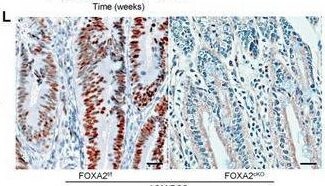
Immunohistochemistry: HNF-3 beta/FoxA2 Antibody (OTI3C10) [NBP2-02088] -
Conditional knockout of FOXA2 in IECs ameliorates colitis‐associated tumorigenesis in vivo. A) Scheme protocols of recombination in Villin‐Cre; FOXA2f/f mice. B,C) RT‐qPCR and western blot assays for FOXA2 gene and protein expression levels in colon crypts from the mice treated with or without AOM/DSS (n = 6). D) H&E and IHC staining of FOXA2 in colon from FOXA2f/f and FOXA2cKO mice (n = 8). Scale bar = 120 um. E) Inflammation scores were quantified. (F) FOXA2 expression by IHC staining was calculated. G) Body weights of mice were recorded (n = 10–15 in each group). H) Overall survival rates for each group of mice (n = 10–15 in each group). I) Images for colons from all groups of mice. J) Colon length was measured (n = 15). (K) Tumor number on colon was examined (n = 15). L) IHC staining for KI‐67 in colon tissues was performed (n = 5). Scale bar = 50 um. Data are marked as the means +/- SD. *p < 0.05, **p < 0.01, ***p < 0.001, ****p < 0.0001; ns, no significant difference. Image collected and cropped by CiteAb from the following open publication (https://pubmed.ncbi.nlm.nih.gov/37875418), licensed under a CC-BY license. Not internally tested by Novus Biologicals.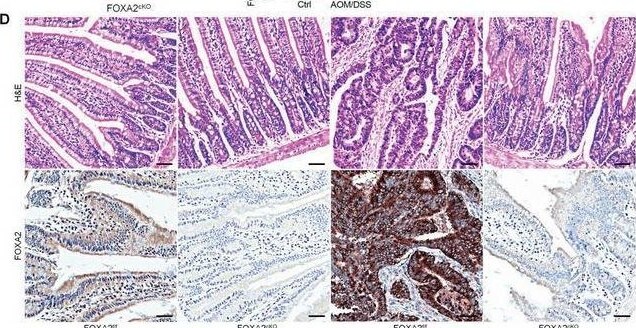
Immunohistochemistry: HNF-3 beta/FoxA2 Antibody (OTI3C10) [NBP2-02088] -
Conditional knockout of FOXA2 in IECs ameliorates colitis‐associated tumorigenesis in vivo. A) Scheme protocols of recombination in Villin‐Cre; FOXA2f/f mice. B,C) RT‐qPCR and western blot assays for FOXA2 gene and protein expression levels in colon crypts from the mice treated with or without AOM/DSS (n = 6). D) H&E and IHC staining of FOXA2 in colon from FOXA2f/f and FOXA2cKO mice (n = 8). Scale bar = 120 um. E) Inflammation scores were quantified. (F) FOXA2 expression by IHC staining was calculated. G) Body weights of mice were recorded (n = 10–15 in each group). H) Overall survival rates for each group of mice (n = 10–15 in each group). I) Images for colons from all groups of mice. J) Colon length was measured (n = 15). (K) Tumor number on colon was examined (n = 15). L) IHC staining for KI‐67 in colon tissues was performed (n = 5). Scale bar = 50 um. Data are marked as the means +/- SD. *p < 0.05, **p < 0.01, ***p < 0.001, ****p < 0.0001; ns, no significant difference. Image collected and cropped by CiteAb from the following open publication (https://pubmed.ncbi.nlm.nih.gov/37875418), licensed under a CC-BY license. Not internally tested by Novus Biologicals.Applications for HNF-3 beta/FoxA2 Antibody (OTI3C10)
Flow Cytometry
Immunocytochemistry/ Immunofluorescence
Immunohistochemistry
Immunohistochemistry-Paraffin
Western Blot
Flow Cytometry Panel Builder
Bio-Techne Knows Flow Cytometry
Save time and reduce costly mistakes by quickly finding compatible reagents using the Panel Builder Tool.
Advanced Features
- Spectra Viewer - Custom analysis of spectra from multiple fluorochromes
- Spillover Popups - Visualize the spectra of individual fluorochromes
- Antigen Density Selector - Match fluorochrome brightness with antigen density

Formulation, Preparation, and Storage
Purification
Formulation
Preservative
Concentration
Shipping
Stability & Storage
Background: HNF-3 beta/FoxA2
Long Name
Alternate Names
Entrez Gene IDs
Gene Symbol
Additional HNF-3 beta/FoxA2 Products
Product Documents for HNF-3 beta/FoxA2 Antibody (OTI3C10)
Certificate of Analysis
To download a Certificate of Analysis, please enter a lot or batch number in the search box below.
Product Specific Notices for HNF-3 beta/FoxA2 Antibody (OTI3C10)
This product is for research use only and is not approved for use in humans or in clinical diagnosis. Primary Antibodies are guaranteed for 1 year from date of receipt.
Citations for HNF-3 beta/FoxA2 Antibody (OTI3C10)
 Powered by Bioz
Customer Reviews for HNF-3 beta/FoxA2 Antibody (OTI3C10)
There are currently no reviews for this product. Be the first to review HNF-3 beta/FoxA2 Antibody (OTI3C10) and earn rewards!
Have you used HNF-3 beta/FoxA2 Antibody (OTI3C10)?
Submit a review and receive an Amazon gift card!
$25/€18/£15/$25CAN/¥2500 for a review with an image
$10/€7/£6/$10CAN/¥1110 for a review without an image
Submit a review
Protocols
Find general support by application which include: protocols, troubleshooting, illustrated assays, videos and webinars.
- 7-Amino Actinomycin D (7-AAD) Cell Viability Flow Cytometry Protocol
- Antigen Retrieval Protocol (PIER)
- Antigen Retrieval for Frozen Sections Protocol
- Appropriate Fixation of IHC/ICC Samples
- Cellular Response to Hypoxia Protocols
- Chromogenic IHC Staining of Formalin-Fixed Paraffin-Embedded (FFPE) Tissue Protocol
- Chromogenic Immunohistochemistry Staining of Frozen Tissue
- ClariTSA™ Fluorophore Kits
- Detection & Visualization of Antibody Binding
- Extracellular Membrane Flow Cytometry Protocol
- Flow Cytometry Protocol for Cell Surface Markers
- Flow Cytometry Protocol for Staining Membrane Associated Proteins
- Flow Cytometry Staining Protocols
- Flow Cytometry Troubleshooting Guide
- Fluorescent IHC Staining of Frozen Tissue Protocol
- Graphic Protocol for Heat-induced Epitope Retrieval
- Graphic Protocol for the Preparation and Fluorescent IHC Staining of Frozen Tissue Sections
- Graphic Protocol for the Preparation and Fluorescent IHC Staining of Paraffin-embedded Tissue Sections
- Graphic Protocol for the Preparation of Gelatin-coated Slides for Histological Tissue Sections
- ICC Cell Smear Protocol for Suspension Cells
- ICC Immunocytochemistry Protocol Videos
- ICC for Adherent Cells
- IHC Sample Preparation (Frozen sections vs Paraffin)
- Immunocytochemistry (ICC) Protocol
- Immunocytochemistry Troubleshooting
- Immunofluorescence of Organoids Embedded in Cultrex Basement Membrane Extract
- Immunofluorescent IHC Staining of Formalin-Fixed Paraffin-Embedded (FFPE) Tissue Protocol
- Immunohistochemistry (IHC) and Immunocytochemistry (ICC) Protocols
- Immunohistochemistry Frozen Troubleshooting
- Immunohistochemistry Paraffin Troubleshooting
- Intracellular Flow Cytometry Protocol Using Alcohol (Methanol)
- Intracellular Flow Cytometry Protocol Using Detergents
- Intracellular Nuclear Staining Flow Cytometry Protocol Using Detergents
- Intracellular Staining Flow Cytometry Protocol Using Alcohol Permeabilization
- Intracellular Staining Flow Cytometry Protocol Using Detergents to Permeabilize Cells
- Preparing Samples for IHC/ICC Experiments
- Preventing Non-Specific Staining (Non-Specific Binding)
- Primary Antibody Selection & Optimization
- Propidium Iodide Cell Viability Flow Cytometry Protocol
- Protocol for Heat-Induced Epitope Retrieval (HIER)
- Protocol for Liperfluo
- Protocol for Making a 4% Formaldehyde Solution in PBS
- Protocol for VisUCyte™ HRP Polymer Detection Reagent
- Protocol for the Characterization of Human Th22 Cells
- Protocol for the Characterization of Human Th9 Cells
- Protocol for the Fluorescent ICC Staining of Cell Smears - Graphic
- Protocol for the Fluorescent ICC Staining of Cultured Cells on Coverslips - Graphic
- Protocol for the Preparation & Fixation of Cells on Coverslips
- Protocol for the Preparation and Chromogenic IHC Staining of Frozen Tissue Sections
- Protocol for the Preparation and Chromogenic IHC Staining of Frozen Tissue Sections - Graphic
- Protocol for the Preparation and Chromogenic IHC Staining of Paraffin-embedded Tissue Sections
- Protocol for the Preparation and Chromogenic IHC Staining of Paraffin-embedded Tissue Sections - Graphic
- Protocol for the Preparation and Fluorescent ICC Staining of Cells on Coverslips
- Protocol for the Preparation and Fluorescent ICC Staining of Non-adherent Cells
- Protocol for the Preparation and Fluorescent ICC Staining of Stem Cells on Coverslips
- Protocol for the Preparation and Fluorescent IHC Staining of Frozen Tissue Sections
- Protocol for the Preparation and Fluorescent IHC Staining of Paraffin-embedded Tissue Sections
- Protocol for the Preparation of Gelatin-coated Slides for Histological Tissue Sections
- Protocol for the Preparation of a Cell Smear for Non-adherent Cell ICC - Graphic
- Protocol: Annexin V and PI Staining by Flow Cytometry
- Protocol: Annexin V and PI Staining for Apoptosis by Flow Cytometry
- R&D Systems Quality Control Western Blot Protocol
- TUNEL and Active Caspase-3 Detection by IHC/ICC Protocol
- The Importance of IHC/ICC Controls
- Troubleshooting Guide: Fluorokine Flow Cytometry Kits
- Troubleshooting Guide: Immunohistochemistry
- Troubleshooting Guide: Western Blot Figures
- Western Blot Conditions
- Western Blot Protocol
- Western Blot Protocol for Cell Lysates
- Western Blot Troubleshooting
- Western Blot Troubleshooting Guide
- View all Protocols, Troubleshooting, Illustrated assays and Webinars
Associated Pathways
