
HSP90 alpha Antibody
Novus Biologicals | Catalog # NB120-2928

![Western Blot: HSP90 alpha Antibody [NB120-2928]](https://resources.rndsystems.com/images/products/HSP90-alpha-Antibody-Western-Blot-NB120-2928-img0023.jpg "Western Blot: HSP90 alpha Antibody [NB120-2928]")
Loading...
Key Product Details
Validated by
Biological Validation
Species Reactivity
Validated:
Human, Mouse, Rat, Primate, Rabbit, Sheep
Cited:
Mouse
Applications
Validated:
Immunohistochemistry, Immunohistochemistry-Paraffin, Western Blot, Immunocytochemistry/ Immunofluorescence, Immunoprecipitation
Cited:
Immunohistochemistry-Paraffin, IF/IHC
Label
Unconjugated
Antibody Source
Polyclonal Rabbit IgG
Loading...
Product Specifications
Immunogen
Synthetic peptide corresponding to residues P(2) E E T Q T Q D Q P M(12) of mouse HSP86.
Reactivity Notes
Rabbit reactivity reported in scientific literature (PMID: 21129982).
Localization
Cell Membrane and Nuclear
Specificity
Detects Heat Shock Protein 86 (HSP 86). This does not detect HSP 84.
Clonality
Polyclonal
Host
Rabbit
Isotype
IgG
Scientific Data Images for HSP90 alpha Antibody
Western Blot: HSP90 alpha Antibody [NB120-2928]
Western Blot: HSP90 alpha Antibody [NB120-2928] - Analysis of 2-fold serial dilutions of HeLa cell lysate, starting at 10 ug, per well.![Immunocytochemistry/ Immunofluorescence: HSP90 alpha Antibody [NB120-2928]](https://resources.rndsystems.com/images/products/HSP90-alpha-Antibody-Immunocytochemistry-Immunofluorescence-NB120-2928-img0012.jpg "Immunocytochemistry/ Immunofluorescence: HSP90 alpha Antibody [NB120-2928]")
Immunocytochemistry/ Immunofluorescence: HSP90 alpha Antibody [NB120-2928]
Immunocytochemistry/Immunofluorescence: HSP90 alpha Antibody [NB120-2928] - Analysis of Heat Shock Protein 86 (HSP86, green) in HeLa cells and NIH3T3 cells. Formalin fixed cells were permeabilized with 0.1% Triton X-100 in TBS for 10 minutes at room temperature and blocked with 1% Blocker BSA for 15 minutes at room temperature. Cells were probed with a HSP86 polyclonal antibody, at a dilution of 1:100 for at least 1 hour at room temperature, washed with PBS, and incubated with DyLight 488 goat-anti-rabbit IgG secondary antibody at a dilution of 1:400 for 30 minutes at room temperature. Nuclei (blue) were stained with Hoechst 33342 dye.![Immunohistochemistry-Paraffin: HSP90 alpha Antibody [NB120-2928]](https://resources.rndsystems.com/images/products/HSP90-alpha-Antibody-Immunohistochemistry-Paraffin-NB120-2928-img0026.jpg "Immunohistochemistry-Paraffin: HSP90 alpha Antibody [NB120-2928]")
![Western Blot: HSP90 alpha Antibody [NB120-2928]](https://resources.rndsystems.com/images/products/HSP90-alpha-Antibody-Western-Blot-NB120-2928-img0015.jpg "Western Blot: HSP90 alpha Antibody [NB120-2928]")
Western Blot: HSP90 alpha Antibody [NB120-2928]
Western Blot: HSP90 alpha Antibody [NB120-2928] - Figure 1 shows a Western blot of mouse HSP84 and HSP86 using NB120-2928 and NB120-2927 respectively.![Western Blot: HSP90 alpha Antibody [NB120-2928]](https://resources.rndsystems.com/images/products/HSP90-alpha-Antibody-Western-Blot-NB120-2928-img0016.jpg "Western Blot: HSP90 alpha Antibody [NB120-2928]")
Western Blot: HSP90 alpha Antibody [NB120-2928]
Western Blot: HSP90 alpha Antibody [NB120-2928] - Analysis of epidermoid carcinoma (A431) cells using Heat Shock Protein 86 Polyclonal Antibody. Decreasing amounts of A431 whole cell lysates were probed with PA3-013 at a dilution of 1:2000 followed by an anti-rabbit IgG secondary antibody and SuperSignal West Pico Chemiluminescent Substrate. Lanes 1 and 2 are control samples of purified, recombinant Hsp86 (rHsp86) and Hsp84 (rHsp84), respectively. Data courtesy of the Innovators Program.![Western Blot: HSP90 alpha Antibody [NB120-2928]](https://resources.rndsystems.com/images/products/HSP90-alpha-Antibody-Western-Blot-NB120-2928-img0017.jpg "Western Blot: HSP90 alpha Antibody [NB120-2928]")
Western Blot: HSP90 alpha Antibody [NB120-2928]
Western Blot: HSP90 alpha Antibody [NB120-2928] - Proteins were transferred to a PVDF membrane and blocked with 5% BSA/TBST for at least 1 hour. The membrane was probed with a HSP86 polyclonal antibody at a dilution of 1:1000 overnight at 4C on a rocking platform, washed in TBS-0.1%Tween 20, and probed with a goat anti-rabbit IgG HRP secondary antibody at a dilution of 1:20,000 for at least 1 hour.![Western Blot: HSP90 alpha Antibody [NB120-2928]](https://resources.rndsystems.com/images/products/HSP90-alpha-Antibody-Western-Blot-NB120-2928-img0022.jpg "Western Blot: HSP90 alpha Antibody [NB120-2928]")
Western Blot: HSP90 alpha Antibody [NB120-2928]
Western Blot: HSP90 alpha Antibody [NB120-2928] - Analysis of 2-fold serial dilutions of HeLa cell lysate, starting at 10 ug, per well.![Immunohistochemistry-Paraffin: HSP90 alpha Antibody [NB120-2928]](https://resources.rndsystems.com/images/products/HSP90-alpha-Antibody-Immunohistochemistry-Paraffin-NB120-2928-img0010.jpg "Immunohistochemistry-Paraffin: HSP90 alpha Antibody [NB120-2928]")
Immunohistochemistry-Paraffin: HSP90 alpha Antibody [NB120-2928]
Immunohistochemistry-Paraffin: HSP90 alpha Antibody [NB120-2928] - Both normal and cancer biopsies of deparaffinized Human kidney tissues.![Immunohistochemistry-Paraffin: HSP90 alpha Antibody [NB120-2928]](https://resources.rndsystems.com/images/products/HSP90-alpha-Antibody-Immunohistochemistry-Paraffin-NB120-2928-img0018.jpg "Immunohistochemistry-Paraffin: HSP90 alpha Antibody [NB120-2928]")
Immunohistochemistry-Paraffin: HSP90 alpha Antibody [NB120-2928]
Immunohistochemistry-Paraffin: HSP90 alpha Antibody [NB120-2928] - Both normal and cancer biopsies of deparaffinized Human tonsil tissues.![Immunohistochemistry-Paraffin: HSP90 alpha Antibody [NB120-2928]](https://resources.rndsystems.com/images/products/HSP90-alpha-Antibody-Immunohistochemistry-Paraffin-NB120-2928-img0019.jpg "Immunohistochemistry-Paraffin: HSP90 alpha Antibody [NB120-2928]")
Immunohistochemistry-Paraffin: HSP90 alpha Antibody [NB120-2928]
Immunohistochemistry-Paraffin: HSP90 alpha Antibody [NB120-2928] - Heat-induced epitope retrieval was performed using 10mM sodium citrate (pH 6.0) buffer for 20 mins at 95C. Following antigen retrieval, tissues blocked in 3% BSA in PBST for 30 mins at RT & then probed with Heat Shock Protein 86 (Hsp86) polyclonal antibody at 1:100 for 1 hr in a humidified chamber (right panel). As a -ve control, primary antibody eliminated from the staining procedure (left panel). Tissues washed with PBS/0.025% Tween-20 & endogenous peroxidase activity quenched with Peroxidase Suppressor for 30 mins at RT. Detection performed using an HRP-conjugated goat anti-rabbit IgG-HRP secondary antibody at a dilution of 1:250 followed by colorimetric detection using Metal Enhanced DAB Substrate Kit. Tissues were counterstained with hematoxylin & prepped for mouting. Images were taken on a Zeiss Axiovision microscope at 40X magnification (x1.6 Optovar).![Immunohistochemistry-Paraffin: HSP90 alpha Antibody [NB120-2928]](https://resources.rndsystems.com/images/products/HSP90-alpha-Antibody-Immunohistochemistry-Paraffin-NB120-2928-img0020.jpg "Immunohistochemistry-Paraffin: HSP90 alpha Antibody [NB120-2928]")
Immunohistochemistry-Paraffin: HSP90 alpha Antibody [NB120-2928]
Immunohistochemistry-Paraffin: HSP90 alpha Antibody [NB120-2928] - Both normal and cancer biopsies of deparaffinized Human breast carcinoma tissues.![Immunohistochemistry: HSP90 alpha Antibody [NB120-2928]](https://resources.rndsystems.com/images/products/HSP90-alpha-Antibody-Immunohistochemistry-NB120-2928-img0024.jpg "Immunohistochemistry: HSP90 alpha Antibody [NB120-2928]")
Immunohistochemistry: HSP90 alpha Antibody [NB120-2928]
HSP90-alpha-Antibody-Immunohistochemistry-NB120-2928-img0024.jpg![Immunohistochemistry: HSP90 alpha Antibody [NB120-2928]](https://resources.rndsystems.com/images/products/HSP90-alpha-Antibody-Immunohistochemistry-NB120-2928-img0025.jpg "Immunohistochemistry: HSP90 alpha Antibody [NB120-2928]")
Immunohistochemistry: HSP90 alpha Antibody [NB120-2928]
HSP90-alpha-Antibody-Immunohistochemistry-NB120-2928-img0025.jpg![Immunoprecipitation: HSP90 alpha Antibody [NB120-2928]](https://resources.rndsystems.com/images/products/HSP90-alpha-Antibody-Immunoprecipitation-NB120-2928-img0021.jpg "Immunoprecipitation: HSP90 alpha Antibody [NB120-2928]")
Immunoprecipitation: HSP90 alpha Antibody [NB120-2928]
Immunoprecipitation: HSP90 alpha Antibody [NB120-2928] - Analysis of Heat Shock Protein (HSP86) was performed on HeLa cells. Antigen-antibody complexes formed by incubating 500ug whole cell lysate with 2ug of HSP86 polyclonal antibody overnight on a rocking platform at 4C. The immune complexes were captured on 50ul Protein A/G Plus Agarose, washed extensively, and eluted with Lane Marker Reducing Sample Buffer. Samples were then resolved on a 4-20% Tris-HCl polyacrylamide gel, transferred to a PVDF membrane and blocked with 5% BSA/TBST for at least 1 hour. The membrane was probed with a HSP86 polyclonal antibody at a dilution of 1:1000 overnight rotating at 4C. The membrane was washed in TBST, and probed with Clean-Blot IP detection Reagent at a dilution of 1:1000 for at least 1 hour. Chemiluminescent detection was performed using SuperSignal West Dura.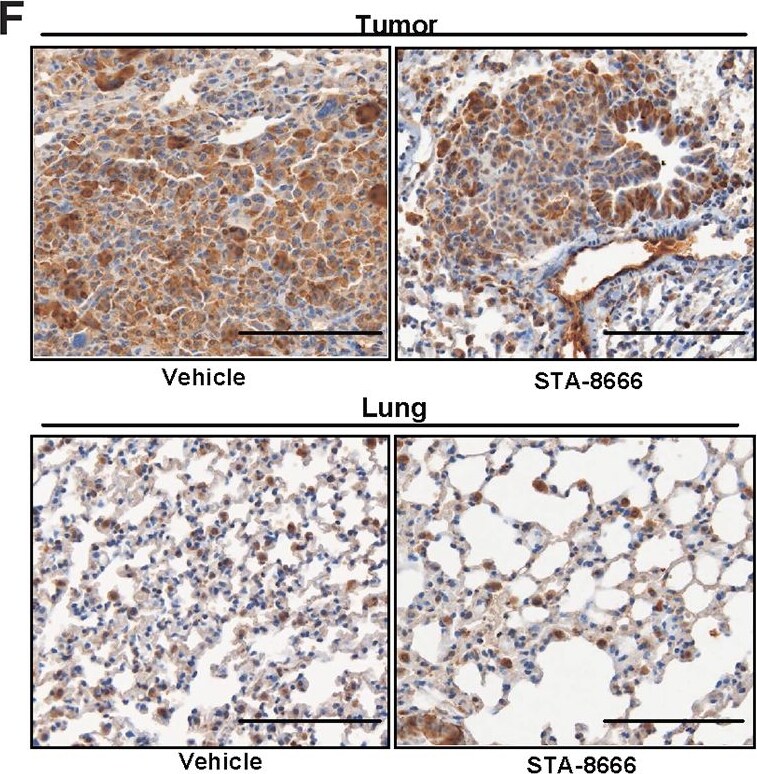
Immunohistochemistry-Paraffin: HSP90 alpha Antibody [NB120-2928] -
Signaling consequences of STA-8666 treatment.A.-F. Left, Representative images and right, quantification of IHC or immunofluorescence for Ki-67 (A), cleaved caspase 3 (B), pS824-KAP1 (C), pT202/Y204-ERK1/2 (D), vimentin (light red) and DAPI (blue) (E) and HSP90 (F). Magnification: 20x. Scale bars: 75 μm, except for vimentin, where scale bar is 40 μm.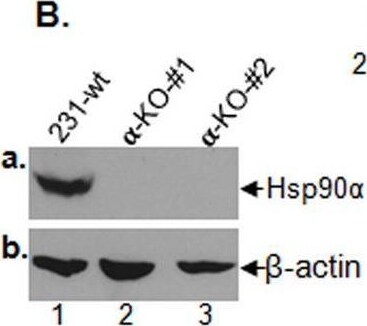
Western Blot: HSP90 alpha Antibody [NB120-2928] -
The “eHsp90 alpha > LRP-1 autocrine loop" only accounts for 50% of the constitutive motility of the tumour cells. (A) A schematic illustration of the “eHsp90 alpha > LRP-1 autocrine loop" that promotes cell motility. (B) Western blot shows 231-wt and two clones of 231-Hsp90 alpha -knockout (231-alpha -KO) cells (panel a). (C) Anti-Hsp90 alpha antibody blotting of secreted Hsp90 alpha in serum-free conditioned medium (CM, 10X) from 231-wt, 231-alpha -KO (panel c) or 231-LRP-1-KD (panel d) cells. (D) Western blot analysis shows the total Hsp90 alpha level in 231-wt or 231-LRP-1-KD cells under normoxia or hypoxia. (E) Western blot analysis shows the relative levels of LRP-1 in indicated cell lines. (F) CM from 231-wt, but not 231-alpha -KO, cells stimulated B16 melanoma cell migration (panels k and l vs. panel i), with human recombinant (hr) Hsp90 alpha protein (panel j) as positive control. (G) Computer-assisted quantitation of the B16 cell migration shown in panel F as Migration Index (%) (“Methods"). CM from 231-alpha -KO cells completely lost pro-motility activity (panel l). Asterisks indicate significance of the induced migration by indicated stimuli (panels j, k) versus the serum-free control (panel i). (H) The indicated cells were simultaneously compared for their motility under serum-fee conditions. Neither total alpha -KO (panels o and s) nor extracellular blockade of secreted Hsp90 alpha function by mAb1G7-D7 (panels p, t) re-produced the degree of inhibition of cell motility by LRP-1-KD (panels n and u), in reference to 231-wt cells (panels m and q). (L) Computer-assisted quantitation of the cell migration data with indicated panels. Asterisks indicate the significance of indicated cell motility over that of the LRP-1-KD cells. All experiments were repeated multiple times to reach the final conclusion. Image collected and cropped by CiteAb from the following open publication (https://pubmed.ncbi.nlm.nih.gov/35835845), licensed under a CC-BY license. Not internally tested by Novus Biologicals.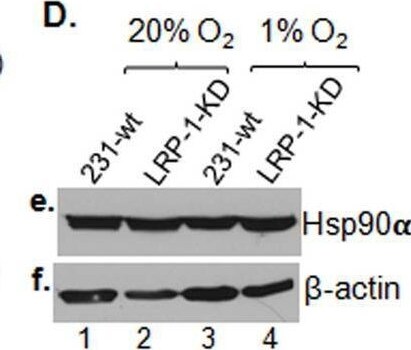
Western Blot: HSP90 alpha Antibody [NB120-2928] -
The “eHsp90 alpha > LRP-1 autocrine loop" only accounts for 50% of the constitutive motility of the tumour cells. (A) A schematic illustration of the “eHsp90 alpha > LRP-1 autocrine loop" that promotes cell motility. (B) Western blot shows 231-wt and two clones of 231-Hsp90 alpha -knockout (231-alpha -KO) cells (panel a). (C) Anti-Hsp90 alpha antibody blotting of secreted Hsp90 alpha in serum-free conditioned medium (CM, 10X) from 231-wt, 231-alpha -KO (panel c) or 231-LRP-1-KD (panel d) cells. (D) Western blot analysis shows the total Hsp90 alpha level in 231-wt or 231-LRP-1-KD cells under normoxia or hypoxia. (E) Western blot analysis shows the relative levels of LRP-1 in indicated cell lines. (F) CM from 231-wt, but not 231-alpha -KO, cells stimulated B16 melanoma cell migration (panels k and l vs. panel i), with human recombinant (hr) Hsp90 alpha protein (panel j) as positive control. (G) Computer-assisted quantitation of the B16 cell migration shown in panel F as Migration Index (%) (“Methods"). CM from 231-alpha -KO cells completely lost pro-motility activity (panel l). Asterisks indicate significance of the induced migration by indicated stimuli (panels j, k) versus the serum-free control (panel i). (H) The indicated cells were simultaneously compared for their motility under serum-fee conditions. Neither total alpha -KO (panels o and s) nor extracellular blockade of secreted Hsp90 alpha function by mAb1G7-D7 (panels p, t) re-produced the degree of inhibition of cell motility by LRP-1-KD (panels n and u), in reference to 231-wt cells (panels m and q). (L) Computer-assisted quantitation of the cell migration data with indicated panels. Asterisks indicate the significance of indicated cell motility over that of the LRP-1-KD cells. All experiments were repeated multiple times to reach the final conclusion. Image collected and cropped by CiteAb from the following open publication (https://pubmed.ncbi.nlm.nih.gov/35835845), licensed under a CC-BY license. Not internally tested by Novus Biologicals.Applications for HSP90 alpha Antibody
Application
Recommended Usage
Immunocytochemistry/ Immunofluorescence
1:50 - 1:200
Immunohistochemistry
5 ug/ml
Immunohistochemistry-Paraffin
5 ug/ml
Immunoprecipitation
2 ug
Western Blot
1:500 - 1:2000
Application Notes
IP: HSP 86 exists primarily as homodimers in HeLa cells. This antibody is capable of precipitating HSP 86 that is complexed with other proteins such as the aryl hydrocarbon (Ah) receptor.
Formulation, Preparation, and Storage
Purification
Immunogen affinity purified
Formulation
PBS with 1 mg/ml BSA
Preservative
0.05% Sodium Azide
Concentration
1 mg/ml
Shipping
The product is shipped with polar packs. Upon receipt, store it immediately at the temperature recommended below.
Stability & Storage
Store at -20C. Avoid freeze-thaw cycles.
Background: HSP90 alpha
Long Name
Heat Shock Protein 90 alpha
Alternate Names
HSP86, HSP89A, HSP90A, HSP90AA1, HSP90N, HSPC1, HSPCA, HSPCAL1, HSPCAL4, HSPN, LAP2
Gene Symbol
HSP90AA1
UniProt
Additional HSP90 alpha Products
Product Documents for HSP90 alpha Antibody
Certificate of Analysis
To download a Certificate of Analysis, please enter a lot or batch number in the search box below.
Product Specific Notices for HSP90 alpha Antibody
This product is for research use only and is not approved for use in humans or in clinical diagnosis. Primary Antibodies are guaranteed for 1 year from date of receipt.
Related Research Areas
Citations for HSP90 alpha Antibody
 Powered by Bioz
Customer Reviews for HSP90 alpha Antibody
There are currently no reviews for this product. Be the first to review HSP90 alpha Antibody and earn rewards!
Have you used HSP90 alpha Antibody?
Submit a review and receive an Amazon gift card!
$25/€18/£15/$25CAN/¥2500 for a review with an image
$10/€7/£6/$10CAN/¥1110 for a review without an image
Submit a review
Protocols
Find general support by application which include: protocols, troubleshooting, illustrated assays, videos and webinars.
- Antigen Retrieval Protocol (PIER)
- Antigen Retrieval for Frozen Sections Protocol
- Appropriate Fixation of IHC/ICC Samples
- Cellular Response to Hypoxia Protocols
- Chromogenic IHC Staining of Formalin-Fixed Paraffin-Embedded (FFPE) Tissue Protocol
- Chromogenic Immunohistochemistry Staining of Frozen Tissue
- ClariTSA™ Fluorophore Kits
- Detection & Visualization of Antibody Binding
- Fluorescent IHC Staining of Frozen Tissue Protocol
- Graphic Protocol for Heat-induced Epitope Retrieval
- Graphic Protocol for the Preparation and Fluorescent IHC Staining of Frozen Tissue Sections
- Graphic Protocol for the Preparation and Fluorescent IHC Staining of Paraffin-embedded Tissue Sections
- Graphic Protocol for the Preparation of Gelatin-coated Slides for Histological Tissue Sections
- ICC Cell Smear Protocol for Suspension Cells
- ICC Immunocytochemistry Protocol Videos
- ICC for Adherent Cells
- IHC Sample Preparation (Frozen sections vs Paraffin)
- Immunocytochemistry (ICC) Protocol
- Immunocytochemistry Troubleshooting
- Immunofluorescence of Organoids Embedded in Cultrex Basement Membrane Extract
- Immunofluorescent IHC Staining of Formalin-Fixed Paraffin-Embedded (FFPE) Tissue Protocol
- Immunohistochemistry (IHC) and Immunocytochemistry (ICC) Protocols
- Immunohistochemistry Frozen Troubleshooting
- Immunohistochemistry Paraffin Troubleshooting
- Immunoprecipitation Protocol
- Preparing Samples for IHC/ICC Experiments
- Preventing Non-Specific Staining (Non-Specific Binding)
- Primary Antibody Selection & Optimization
- Protocol for Heat-Induced Epitope Retrieval (HIER)
- Protocol for Making a 4% Formaldehyde Solution in PBS
- Protocol for VisUCyte™ HRP Polymer Detection Reagent
- Protocol for the Fluorescent ICC Staining of Cell Smears - Graphic
- Protocol for the Fluorescent ICC Staining of Cultured Cells on Coverslips - Graphic
- Protocol for the Preparation & Fixation of Cells on Coverslips
- Protocol for the Preparation and Chromogenic IHC Staining of Frozen Tissue Sections
- Protocol for the Preparation and Chromogenic IHC Staining of Frozen Tissue Sections - Graphic
- Protocol for the Preparation and Chromogenic IHC Staining of Paraffin-embedded Tissue Sections
- Protocol for the Preparation and Chromogenic IHC Staining of Paraffin-embedded Tissue Sections - Graphic
- Protocol for the Preparation and Fluorescent ICC Staining of Cells on Coverslips
- Protocol for the Preparation and Fluorescent ICC Staining of Non-adherent Cells
- Protocol for the Preparation and Fluorescent ICC Staining of Stem Cells on Coverslips
- Protocol for the Preparation and Fluorescent IHC Staining of Frozen Tissue Sections
- Protocol for the Preparation and Fluorescent IHC Staining of Paraffin-embedded Tissue Sections
- Protocol for the Preparation of Gelatin-coated Slides for Histological Tissue Sections
- Protocol for the Preparation of a Cell Smear for Non-adherent Cell ICC - Graphic
- R&D Systems Quality Control Western Blot Protocol
- TUNEL and Active Caspase-3 Detection by IHC/ICC Protocol
- The Importance of IHC/ICC Controls
- Troubleshooting Guide: Immunohistochemistry
- Troubleshooting Guide: Western Blot Figures
- Western Blot Conditions
- Western Blot Protocol
- Western Blot Protocol for Cell Lysates
- Western Blot Troubleshooting
- Western Blot Troubleshooting Guide
- View all Protocols, Troubleshooting, Illustrated assays and Webinars
Loading...
Associated Pathways
