
AKR1C4 (Aldo-Keto Reductase family 1 member C4; also 3-alpha HSD1/3-alpha HSD type 1, Chlordecone/kepone reductase/CDR and DD4) is a monomeric, 36-38 kDa member of the four gene 3-alpha HSD family, aldo-keto reductase superfamily of enzymes. AKRs catalyse the reduction of aldehydes and ketones into alcohols through a NADPH-dependent process. The resulting alcohols become the target of subsequent conjugation reactions. AKR1C4 in particular is noted for its action on dihydroxytestosterone, converting it to a less active 3 alpha -diol. In addition, it also converts progesterone into 20 alpha -hydroxyprogesterone, a molecule that both induces GnRH release, and blocks the generation of (deoxy)cortisol from 17 alpha -hydroxyprogesterone. Finally, AKR1C4 likely is involved in the tetoxification of xenobiotics and drugs. AKR1C4 expression is essentially limited to hepatocytes and likely breast epithelium. Human AKR1C4 is 323 amino acids (aa) in length. Full-length human AKR1C4 shares 83% and 76% aa sequence identity with human AKR1C1 and mouse AKR1C4, respectively.
Human Aldo-keto Reductase 1C4/AKR1C4 Antibody
R&D Systems | Catalog # AF6957

Scientific images may be resized, cropped, or adjusted for brightness or contrast for presentation purposes. These updates are limited to presentation and do not affect the underlying scientific interpretation of the data. Where available, additional source data may be provided upon request.
Key Product Details
Species Reactivity
Applications
Label
Antibody Source
Product Specifications
Immunogen
Met1-Tyr323
Accession # NP_001809
Specificity
Clonality
Host
Isotype
Scientific Data Images for Human Aldo-keto Reductase 1C4/AKR1C4 Antibody
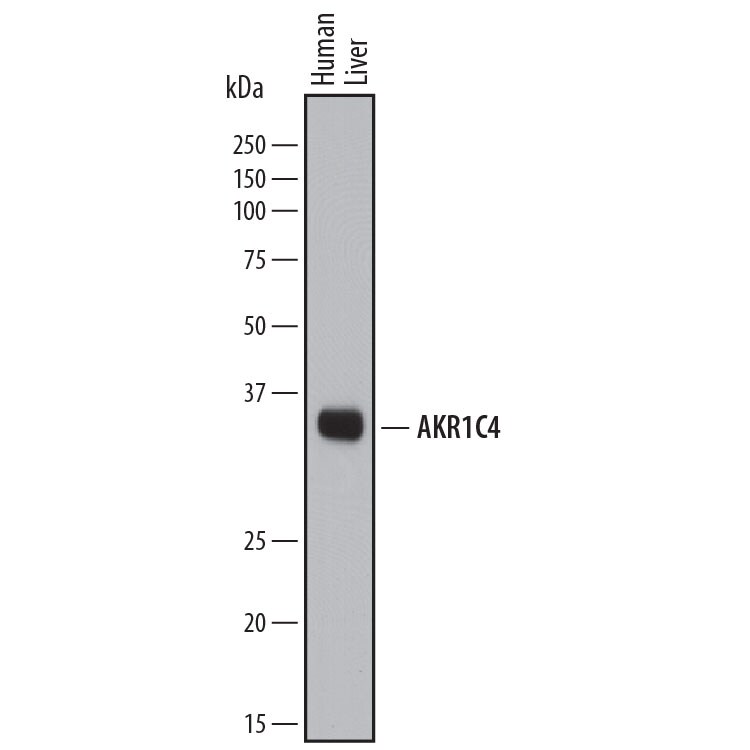
Detection of Human Aldo‑keto Reductase 1C4/AKR1C4 by Western Blot.
Western blot shows lysates of human liver tissue. PVDF membrane was probed with 0.5 µg/mL of Sheep Anti-Human Aldo-keto Reductase 1C4/AKR1C4 Antigen Affinity-purified Polyclonal Antibody (Catalog # AF6957) followed by HRP-conjugated Anti-Sheep IgG Secondary Antibody (Catalog # HAF016). A specific band was detected for Aldo-keto Reductase 1C4/AKR1C4 at approximately 35-36 kDa (as indicated). This experiment was conducted under reducing conditions and using Immunoblot Buffer Group 1.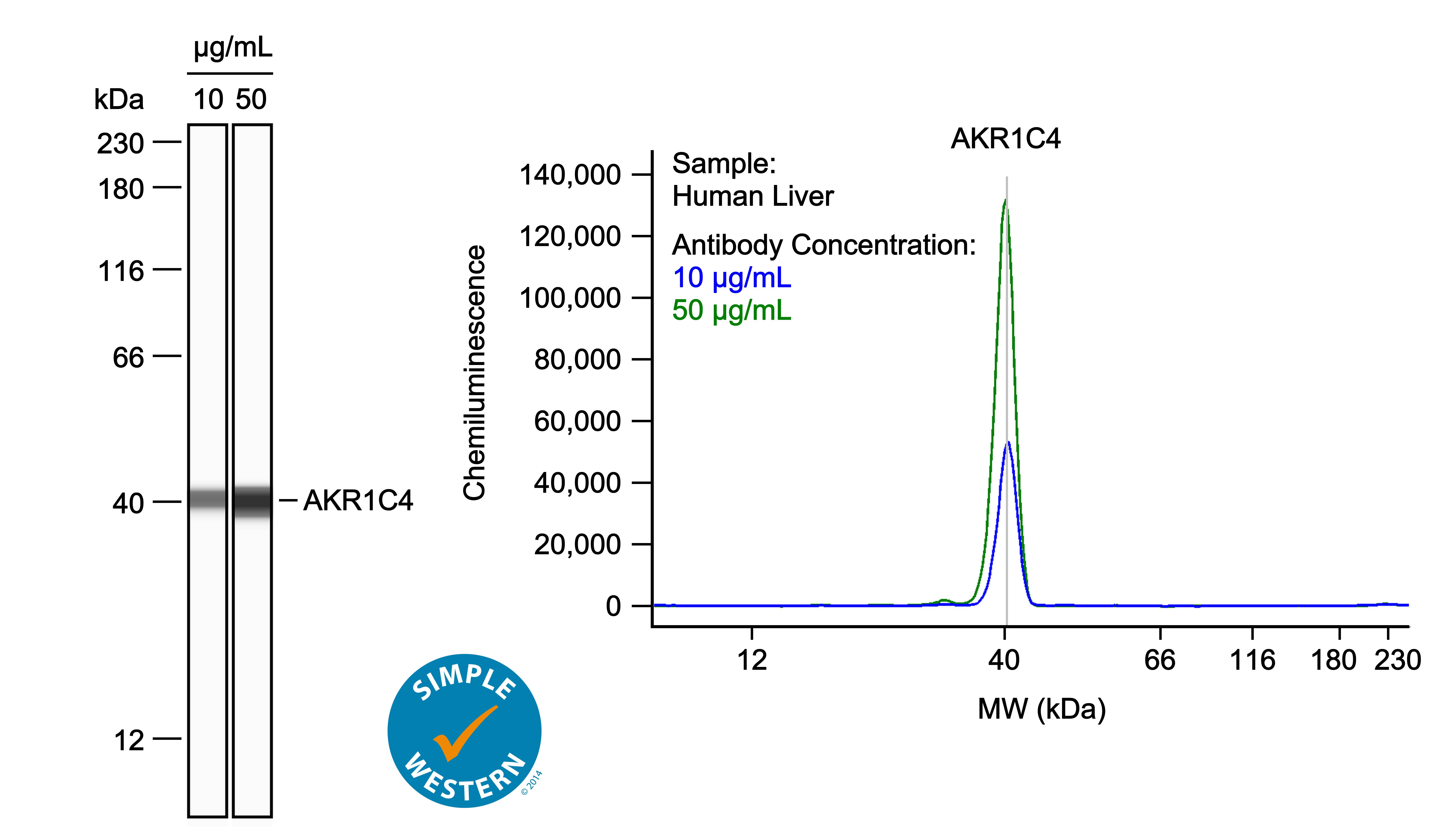
Detection of Human Aldo‑keto Reductase 1C4/AKR1C4 by Simple WesternTM.
Left: Simple Western lane view shows lysates of human liver, loaded at 0.1 mg/ml. A specific band was detected for Aldo‑keto Reductase 1C4/AKR1C4 at approximately 40 kDa (as indicated) using both 10 µg/ml and 50 µg/ml of Sheep Anti-Human Aldo‑keto Reductase 1C4/AKR1C4 Antigen Affinity-purified Polyclonal Antibody (Catalog # AF6957) followed by 1:50 dilution of HRP-conjugated Anti-Sheep IgG Secondary Antibody (Catalog # HAF016) in Milk-free Antibody Diluent (Catalog # 043-524). This experiment was conducted under reducing conditions and using the 12-230kDa separation system. Right: Simple Western electropherogram showing the same Sheep Anti-Human Aldo‑keto Reductase 1C4/AKR1C4 Antigen Affinity-purified Polyclonal Antibody (Catalog # AF6957) tested at 10 µg/ml (blue line) and 50 µg/ml (green line) in the human liver.Applications for Human Aldo-keto Reductase 1C4/AKR1C4 Antibody
Simple Western
Sample: Human liver tissue
Western Blot
Sample: Human liver tissue
Formulation, Preparation, and Storage
Purification
Reconstitution
Reconstitute at 0.2 mg/mL in sterile PBS. For liquid material, refer to CoA for concentration.
Formulation
Shipping
Stability & Storage
- 12 months from date of receipt, -20 to -70 °C as supplied.
- 1 month, 2 to 8 °C under sterile conditions after reconstitution.
- 6 months, -20 to -70 °C under sterile conditions after reconstitution.
Calculators
Background: Aldo-keto Reductase 1C4/AKR1C4
Long Name
Alternate Names
Entrez Gene IDs
Gene Symbol
UniProt
Additional Aldo-keto Reductase 1C4/AKR1C4 Products
Product Documents for Human Aldo-keto Reductase 1C4/AKR1C4 Antibody
Certificate of Analysis
To download a Certificate of Analysis, please enter a lot or batch number in the search box below.
Note: Certificate of Analysis not available for kit components.
Product Specific Notices for Human Aldo-keto Reductase 1C4/AKR1C4 Antibody
For research use only
Related Research Areas
Citations for Human Aldo-keto Reductase 1C4/AKR1C4 Antibody
 Powered by Bioz
Customer Reviews for Human Aldo-keto Reductase 1C4/AKR1C4 Antibody
There are currently no reviews for this product. Be the first to review Human Aldo-keto Reductase 1C4/AKR1C4 Antibody and earn rewards!
Have you used Human Aldo-keto Reductase 1C4/AKR1C4 Antibody?
Submit a review and receive an Amazon gift card!
$25/€18/£15/$25CAN/¥2500 for a review with an image
$10/€7/£6/$10CAN/¥1110 for a review without an image
Submit a review
Protocols
Find general support by application which include: protocols, troubleshooting, illustrated assays, videos and webinars.
- Cellular Response to Hypoxia Protocols
- R&D Systems Quality Control Western Blot Protocol
- Troubleshooting Guide: Western Blot Figures
- Western Blot Conditions
- Western Blot Protocol
- Western Blot Protocol for Cell Lysates
- Western Blot Troubleshooting
- Western Blot Troubleshooting Guide
- View all Protocols, Troubleshooting, Illustrated assays and Webinars