
CD155 [also known as PVR (poliovirus receptor) and Necl-5 (nectin-like molecule-5)] is a 70 kDa type I transmembrane (TM) glycoprotein that is a member of the nectin-like (Necl) family of nectin-related molecules (1). Like nectins, Necl molecules are Ig superfamily members that contain three Ig-like extracellular domains, a TM segment, and a cytoplasmic tail. Unlike nectins, Necl molecules cannot interact with cytoplasmic afadin (1). While Nectins serve as cell adhesion molecules, the actual functions of most Necls are yet-to-be determined. CD155/PVR was originally isolated based on its ability to mediate polio virus attachment to host cells (2, 3). The full-length (or CD155 alpha isoform) is synthesized as a 417 amino acid (aa) precursor that contains a 20 aa signal sequence, a 323 aa extracellular region, a 24 aa TM segment and a 50 aa cytoplasmic tail. The extracellular region contains one N-terminal V-type and two C2-type Ig-like domains (2, 3). The V-type domain mediates polio virus binding (4). Three other isoforms exist, all of which retain the Ig-like domains. CD155 delta is transmembrane with a shortened cytoplasmic tail of 25 aa. CD155 beta (352 aa) and CD155 gamma (344 aa) are 60‑65 kDa soluble forms that show removal of the TM segment and surrounding amino acids (2, 5). The soluble forms will bind the polio virus (due to the presence of the V-type Ig domain) but afford no protection against polio infection because of low circulating levels (5). CD155 has been demonstrated to bind vitronectin, nectin-3, and DNAM-1 (6‑8). DNAM-1 binding promotes monocyte migration and NK cell killing. CD155 is expressed in all normal tissues and is highly expressed in tumor cells of epithelial and neuronal origin.
Human CD155/PVR Antibody (300903)
R&D Systems | Catalog # MAB2530

Scientific images may be resized, cropped, or adjusted for brightness or contrast for presentation purposes. These updates are limited to presentation and do not affect the underlying scientific interpretation of the data. Where available, additional source data may be provided upon request.
Key Product Details
Species Reactivity
Validated:
Cited:
Applications
Validated:
Cited:
Label
Antibody Source
Product Specifications
Immunogen
Gly27-Asn343
Accession # ABM85069
Specificity
Clonality
Host
Isotype
Scientific Data Images for Human CD155/PVR Antibody (300903)
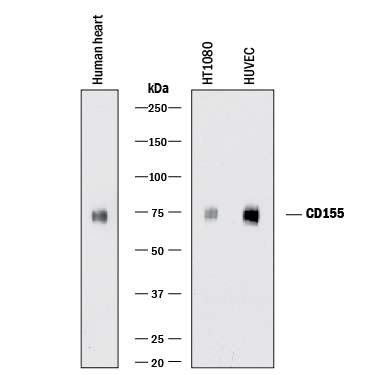
Detection of Human CD155/PVR by Western Blot.
Western blot shows lysates of human heart tissue, HT1080 human fibrosarcoma cell line, and HUVEC human umbilical vein endothelial cells. PVDF membrane was probed with 1 µg/mL of Mouse Anti-Human CD155/PVR Monoclonal Antibody (Catalog # MAB2530) followed by HRP-conjugated Anti-Mouse IgG Secondary Antibody (Catalog # HAF018). A specific band was detected for CD155/PVR at approximately 75 kDa (as indicated). This experiment was conducted under reducing conditions and using Immunoblot Buffer Group 1.Applications for Human CD155/PVR Antibody (300903)
Western Blot
Sample: Human heart tissue, HT1080 human fibrosarcoma cell line, and HUVEC human umbilical vein endothelial cells
Formulation, Preparation, and Storage
Purification
Reconstitution
Reconstitute at 0.5 mg/mL in sterile PBS. For liquid material, refer to CoA for concentration.
Formulation
Shipping
Stability & Storage
- 12 months from date of receipt, -20 to -70 °C as supplied.
- 1 month, 2 to 8 °C under sterile conditions after reconstitution.
- 6 months, -20 to -70 °C under sterile conditions after reconstitution.
Calculators
Background: CD155/PVR
References
- Takai, Y. et al. (2003) Cancer Sci. 94:655.
- Mendelsohn, C.L. et al. (1989) Cell 56:855.
- Koike, H. et al. (1990) EMBO J. 9:3217.
- Koike, S. et al. (1991) Proc. Natl. Acad. Sci. USA 88:4104.
- Baury, B. et al. (2003) Biochem. Biophys. Res. Commun. 309:175.
- Mueller, S. and E. Wimmer (2003) J. Biol. Chem. 278:31251.
- Reymond, N. et al. (2004) J. Exp. Med. 199:1331.
- Lange, R. et al. (2001) Virology 285:218.
Long Name
Alternate Names
Entrez Gene IDs
Gene Symbol
UniProt
Additional CD155/PVR Products
Product Documents for Human CD155/PVR Antibody (300903)
Certificate of Analysis
To download a Certificate of Analysis, please enter a lot or batch number in the search box below.
Note: Certificate of Analysis not available for kit components.
Product Specific Notices for Human CD155/PVR Antibody (300903)
For research use only
Citations for Human CD155/PVR Antibody (300903)
 Powered by Bioz
Customer Reviews for Human CD155/PVR Antibody (300903)
There are currently no reviews for this product. Be the first to review Human CD155/PVR Antibody (300903) and earn rewards!
Have you used Human CD155/PVR Antibody (300903)?
Submit a review and receive an Amazon gift card!
$25/€18/£15/$25CAN/¥2500 for a review with an image
$10/€7/£6/$10CAN/¥1110 for a review without an image
Submit a review
Protocols
Find general support by application which include: protocols, troubleshooting, illustrated assays, videos and webinars.
- Cellular Response to Hypoxia Protocols
- R&D Systems Quality Control Western Blot Protocol
- Troubleshooting Guide: Western Blot Figures
- Western Blot Conditions
- Western Blot Protocol
- Western Blot Protocol for Cell Lysates
- Western Blot Troubleshooting
- Western Blot Troubleshooting Guide
- View all Protocols, Troubleshooting, Illustrated assays and Webinars