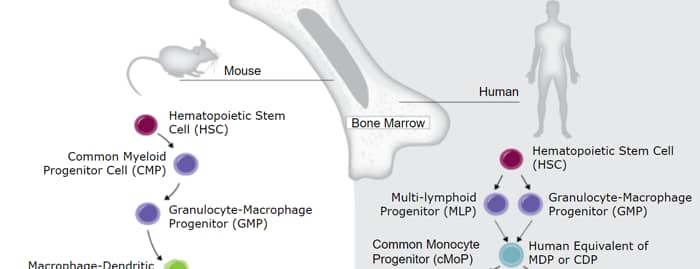
CD163, previously called M130 or p155, is a 130‑160 kDa type I transmembrane glycoprotein that belongs to group B of the cysteine-rich scavenger receptor family (1‑3). It is essential for clearance of hemoglobin-haptoglobin (Hb-Hp) complexes in the liver, spleen and circulation (4). The human CD163 contains a 41 amino acid (aa) signal sequence, a 1009 aa extracellular domain (ECD) with 9 scavenger receptor cysteine-rich (SRCR) domains, a 22 aa transmembrane segment, and a 39‑84 aa cytoplasmic region (1). The third SRCR domain is crucial for calcium-dependent binding of hemoglobin/haptoglobin complexes (3). Three splice forms (isoforms 2, 3 and 4) vary within their intracellular regions (1, 5), while one isoform (# 4) also has a 34 aa insert between SRCR domains 5 and 6 within the ECD. While all are expressed, isoform 3 is the most abundant, being generally expressed on the cell surface and most active in endocytosis (5). An approximately 130 kDa soluble form of human CD163 (sCD163) is assumed to contain virtually all of the ECD, which shares 74%, 75%, 84%, 86%, 86% and 87% aa identity with mouse, rat, bovine, equine, porcine and canine CD163 ECD, respectively (6, 7). It is released from the cell surface by proteolysis after oxidative stress or inflammatory stimuli, including bacterial endotoxins and activation of the Toll-like receptors TLR2 or TLR5 (7‑10). Expression of CD163 is constitutive, and induced by glucocorticoids, IL‑10, IL‑6 or endotoxin on circulating monocytes, tissue macrophages, and at low levels on monocyte-derived dendritic cells (1, 2, 11, 12). In addition to clearing Hb‑Hp complexes, CD163 is also a scavenger receptor for free Hb (if Hp is depleted) and TWEAK (TNF-like weak inducer of apoptosis), and can function as an erythroblast adhesion receptor (4, 13‑15).
Human CD163 Antibody (215927) [PE]
R&D Systems | Catalog # FAB1607P

Scientific images may be resized, cropped, or adjusted for brightness or contrast for presentation purposes. These updates are limited to presentation and do not affect the underlying scientific interpretation of the data. Where available, additional source data may be provided upon request.
Key Product Details
Species Reactivity
Validated:
Cited:
Applications
Validated:
Cited:
Label
Antibody Source
Product Specifications
Immunogen
Gly46-Ser1050
Accession # Q86VB7
Specificity
Clonality
Host
Isotype
Scientific Data Images for Human CD163 Antibody (215927) [PE]
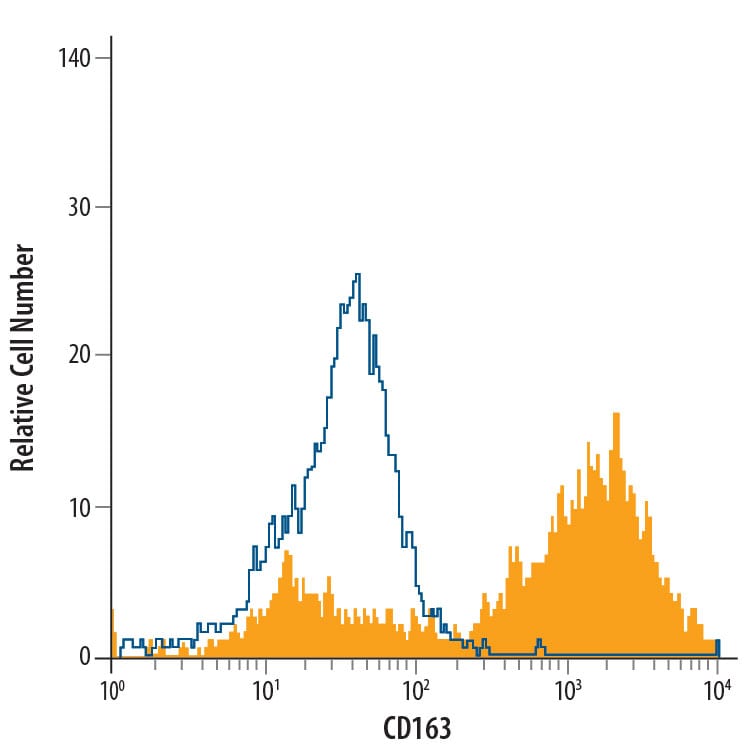
Detection of CD163 in Human Blood Monocytes by Flow Cytometry.
Human peripheral blood monocytes were stained with Mouse Anti-Human CD163 PE-conjugated Monoclonal Antibody (Catalog # FAB1607P, filled histogram) or isotype control antibody (Catalog # IC002P, open histogram). View our protocol for Staining Membrane-associated Proteins.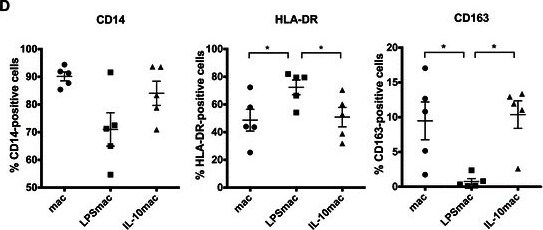
Detection of Human CD163 by Flow Cytometry
Phenotypic characterization of LPS- and IL-10-stimulated macrophages derived from human CD14+ peripheral blood monocytes. a Representative images of actin and tubulin stainings of LPS- and IL-10-stimulated macrophages polarized in absence of other external stimuli (mac) or in the presence of 10ng/ml LPS (LPSmac) or IL-10 (IL-10mac), respectively. F-actin was stained with Phalloidin-FITC (green), alpha –tubulin with a specific monoclonal antibody followed by incubation with AlexaFluor594 secondary antibody (red) and nuclei were counterstained with DAPI (blue). Scale bars represent 50 μm. b Morphological differences between macrophage populations were quantified by calculating the cell aspect ratio (quotient between cell major and minor axes) of actin/tubulin stained cells. Chart reflects measurements of at least 100 cells per donor from, at least, 3 distinct donors. Bars represent mean values and flags indicate standard deviations. c Cytokine production profile of LPS- and IL-10-stimulated macrophages. Cytokine concentration was measured by ELISA in conditioned media from distinct macrophage populations. Charts indicate fold increase in IL-6, IL-10 and TNF-alpha expression, in comparison to unstimulated macrophages. Data is representative of the cytokine profile of cells derived from at least 7 different donors. Bars represent mean values and flags indicate standard deviations. d Expression of typical macrophage lineage (CD14) and polarization markers (HLA-DR and CD163) was determined by flow cytometry of unstimulated, LPS- and IL-10-stimulated macrophages. Scatter charts represent percentage of positive cells for each cell surface marker considering data obtained with cells derived from 5 different donors. *, significantly different at p < 0.05. IL-10, interleukin-10; LPS, lipopolysaccharide Image collected and cropped by CiteAb from the following publication (https://pubmed.ncbi.nlm.nih.gov/26043921), licensed under a CC-BY license. Not internally tested by R&D Systems.Applications for Human CD163 Antibody (215927) [PE]
Flow Cytometry
Sample: Human peripheral blood monocytes
Reviewed Applications
Read 2 reviews rated 4.5 using FAB1607P in the following applications:
Spectra Viewer
Plan Your Experiments
Use our spectra viewer to interactively plan your experiments, assessing multiplexing options. View the excitation and emission spectra for our fluorescent dye range and other commonly used dyes.
Spectra Viewer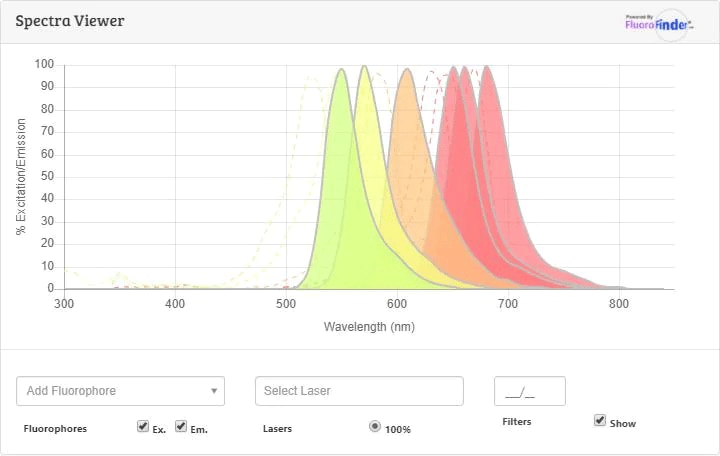
Flow Cytometry Panel Builder
Bio-Techne Knows Flow Cytometry
Save time and reduce costly mistakes by quickly finding compatible reagents using the Panel Builder Tool.
Advanced Features
- Spectra Viewer - Custom analysis of spectra from multiple fluorochromes
- Spillover Popups - Visualize the spectra of individual fluorochromes
- Antigen Density Selector - Match fluorochrome brightness with antigen density

Formulation, Preparation, and Storage
Purification
Formulation
Shipping
Stability & Storage
- 12 months from date of receipt, 2 to 8 °C as supplied.
Background: CD163
References
- Law, S.K.A. et al. (1993) Eur. J. Immunol. 23:2320.
- Sulahian, T.H. et al. (2000) Cytokine 12:1312.
- Madsen, M. et al. (2004) J. Biol. Chem. 279:51561.
- Kristiansen, M. et al. (2001) Nature 409:198.
- Nielsen, M.J. et al. (2006) J. Leukoc. Biol. 79:837.
- Moller, H.J. et al. (2002) Blood 99:378.
- Droste, A. et al. (1999) Biochem. Biophys. Res. Commun. 256:110.
- Hintz, K. A. et al. (2002) J. Leukoc. Biol. 72:711.
- Weaver, L.K. et al. (2006) J. Leukoc. Biol. 80:26.
- Timmerman, M. and P. Hogger (2005) Free Radic. Biol. Med. 39:98.
- Buechler, C. et al. (2000) J. Leukoc. Biol. 67:97.
- Pulford, K.A. et al. (1989) J. Clin. Pathol. 42:414.
- Schaer, D.J. et al. (2006) Blood 107:373.
- Bover, L.C. et al. (2007) J. Immunol. 178:8183.
- Fabriek, B.O. et al. (2007) Blood 109:5223.
Alternate Names
Gene Symbol
UniProt
Additional CD163 Products
Product Documents for Human CD163 Antibody (215927) [PE]
Certificate of Analysis
To download a Certificate of Analysis, please enter a lot or batch number in the search box below.
Note: Certificate of Analysis not available for kit components.
Product Specific Notices for Human CD163 Antibody (215927) [PE]
For research use only
Citations for Human CD163 Antibody (215927) [PE]
 Powered by Bioz
Customer Reviews for Human CD163 Antibody (215927) [PE] (2)
Have you used Human CD163 Antibody (215927) [PE]?
Submit a review and receive an Amazon gift card!
$25/€18/£15/$25CAN/¥2500 for a review with an image
$10/€7/£6/$10CAN/¥1110 for a review without an image
Submit a review
-
Application: Flow CytometrySample Tested: See PMID: 21240265Species: HumanVerified Customer | Posted 01/21/2015
-
Application: Flow CytometrySample Tested: See PMID: 23431165Species: HumanVerified Customer | Posted 01/21/2015
There are no reviews that match your criteria.
Protocols
Find general support by application which include: protocols, troubleshooting, illustrated assays, videos and webinars.
- 7-Amino Actinomycin D (7-AAD) Cell Viability Flow Cytometry Protocol
- Extracellular Membrane Flow Cytometry Protocol
- Flow Cytometry Protocol for Cell Surface Markers
- Flow Cytometry Protocol for Staining Membrane Associated Proteins
- Flow Cytometry Staining Protocols
- Flow Cytometry Troubleshooting Guide
- Intracellular Flow Cytometry Protocol Using Alcohol (Methanol)
- Intracellular Flow Cytometry Protocol Using Detergents
- Intracellular Nuclear Staining Flow Cytometry Protocol Using Detergents
- Intracellular Staining Flow Cytometry Protocol Using Alcohol Permeabilization
- Intracellular Staining Flow Cytometry Protocol Using Detergents to Permeabilize Cells
- Propidium Iodide Cell Viability Flow Cytometry Protocol
- Protocol for Liperfluo
- Protocol for the Characterization of Human Th22 Cells
- Protocol for the Characterization of Human Th9 Cells
- Protocol: Annexin V and PI Staining by Flow Cytometry
- Protocol: Annexin V and PI Staining for Apoptosis by Flow Cytometry
- Troubleshooting Guide: Fluorokine Flow Cytometry Kits
- View all Protocols, Troubleshooting, Illustrated assays and Webinars
FAQs for Human CD163 Antibody (215927) [PE]
-
Q: Does this antibody (CD163 Antibody, 215927) require permeabilization? I saw that your flow cytometry protocol calls for fixation and permeabilization, but I am looking for an antibody that can be used on intact cells.
A: Our standard Flow protocol involves using permeabilization solution for all of our targets. It is due to our mass validation of multiple antibodies. The CD163 antibody FAB1607P is made specifically to the extracellular domain of this protein and as such, will not require the use of permeablization. For use in your experiment, you can skip the permeabilization step in our protocol.
Associated Pathways