

Key Product Details

Species Reactivity

Validated:

Human

Cited:

Human, Mouse

Applications

Validated:

Immunohistochemistry, Western Blot, Neutralization

Cited:

Immunohistochemistry, Western Blot, Neutralization, Immunocytochemistry, Bioassay

Label

Unconjugated

Antibody Source

Polyclonal Goat IgG
Loading...

Product Specifications

Immunogen

E. coli-derived recombinant human FGF-5
Glu23-Gly268 (Lys238Asn, Pro245Ser)
Accession # Q8NF90

Specificity

Detects human FGF‑5 in direct ELISAs and Western blots. In direct ELISAs, less than 1% cross-reactivity with recombinant human (rh) FGF‑4, rhFGF-6, rhFGF-7, recombinant mouse FGF-8b, rhFGF-9, rhFGF acidic, and rhFGF basic is observed.

Clonality

Polyclonal

Host

Goat

Isotype

IgG

Endotoxin Level

<0.10 EU per 1 μg of the antibody by the LAL method.

Scientific Data Images for Human FGF‑5 Antibody

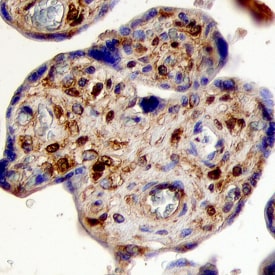
FGF-5 antibody in Human Placenta by Immunohistochemistry (IHC-P).

FGF‑5 in Human Placenta.

FGF-5 was detected in immersion fixed paraffin-embedded sections of human placenta using Goat Anti-Human FGF-5 Antigen Affinity-purified Polyclonal Antibody (Catalog # AF-237-NA) at 10 µg/mL overnight at 4 °C. Before incubation with the primary antibody, tissue was subjected to heat-induced epitope retrieval using Antigen Retrieval Reagent-Basic (Catalog # CTS013). Tissue was stained using the Anti-Goat HRP-DAB Cell & Tissue Staining Kit (brown; Catalog # CTS008) and counterstained with hematoxylin (blue). Specific staining was localized to trophoblast cells in chorionic villi. View our protocol for Chromogenic IHC Staining of Paraffin-embedded Tissue Sections.

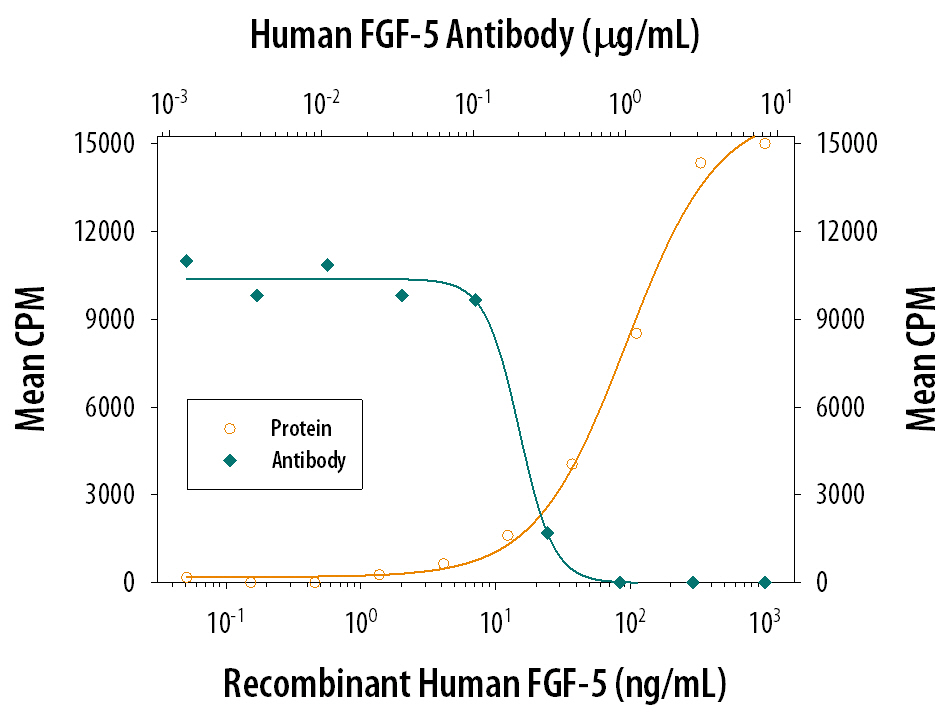
Cell Proliferation Induced by FGF‑5 and Neutralization by Human FGF‑5 Antibody.

Cell Proliferation Induced by FGF‑5 and Neutralization by Human FGF‑5 Antibody.

Recombinant Human FGF‑5 (Catalog # 237-F5) stimulates proliferation in the the NR6R‑3T3 mouse fibroblast cell line in a dose-dependent manner (orange line). Proliferation elicited by Recombinant Human FGF‑5 (20 ng/mL) is neutralized (green line) by increasing concentrations of Goat Anti-Human FGF‑5 Antigen Affinity-purified Polyclonal Antibody (Catalog # AF-237-NA). The ND50 is typically 0.2-0.8 µg/mL in the presence of heparin (1 µg/mL).

Applications for Human FGF‑5 Antibody

Application
Recommended Usage

Immunohistochemistry

5-15 µg/mL
Sample: Immersion fixed paraffin-embedded sections of human placenta subjected to Antigen Retrieval Reagent-Basic (Catalog # CTS013)

Western Blot

0.1 µg/mL
Sample: Recombinant Human FGF‑5 (Catalog # 237-F5)

Neutralization

Measured by its ability to neutralize FGF‑5-induced proliferation in the NR6R‑3T3 mouse fibroblast cell line. Rizzino, A. et al. (1988) Cancer Res. 48:4266. The Neutralization Dose (ND50) is typically 0.2-0.8 µg/mL in the presence of 20 ng/mL Recombinant Human FGF‑5 and 1 µg/mL heparin.

Formulation, Preparation, and Storage

Purification

Antigen Affinity-purified

Reconstitution

Reconstitute at 0.2 mg/mL in sterile PBS. For liquid material, refer to CoA for concentration.


Loading...

Formulation

Lyophilized from a 0.2 μm filtered solution in PBS with Trehalose. *Small pack size (SP) is supplied either lyophilized or as a 0.2 µm filtered solution in PBS.

Shipping

Lyophilized product is shipped at ambient temperature. Liquid small pack size (-SP) is shipped with polar packs. Upon receipt, store immediately at the temperature recommended below.

Stability & Storage

Use a manual defrost freezer and avoid repeated freeze-thaw cycles.
  • 12 months from date of receipt, -20 to -70 °C as supplied.
  • 1 month, 2 to 8 °C under sterile conditions after reconstitution.
  • 6 months, -20 to -70 °C under sterile conditions after reconstitution.

Calculators

The reconstitution calculator allows you to quickly calculate the volume of a reagent to reconstitute your vial. Simply enter the mass of reagent and the target concentration and the calculator will determine the rest.

=
÷

Background: FGF-5

The FGF family is comprised of at least seven polypeptides that are potent regulators of cell proliferation, differentiation and function. All FGFs have two conserved cysteine residues and share 30-50% sequence homology at the amino acid level. FGF-5 was originally identified as a transforming gene by the NIH-3T3 focus formation assay using DNA derived from human tumors. FGF-5 cDNA encodes a 267 amino acid residue protein with a putative 22 amino acid residue signal peptide. The murine homologue of FGF-5 was cloned and found to be 84% homologous to the human protein at the amino acid sequence level. Human and murine FGF-5 exhibit cross species activity.

In vitro, recombinant human FGF-5 is a mitogen for Balb/3T3 fibroblasts and bovine heart endothelial cells. FGF-5 was also reported to be a major muscle-derived survival factor for cultured spinal motoneurons. In vivo, FGF-5 is suggested to play important roles in both embryology and neurobiology. Developmentally, FGF-5 mRNA is initially found in the embryoblast followed by the lateral somatic mesoderm, where it may play a role in angiogenesis, plus the myotomes cranial to the tail region, where it may delay terminal myoblast differentiation during cell migration. FGF-5 continues to impact muscle post-natally where it is believed to function as a target-derived neurotrophic factor of skeletal muscle. In the nervous system, FGF-5 has been most often identified in neurons associated with the limbic system, notably in neurons of the olfactory bulb and pyramidal cells of the hippocampus. Hippocampal FGF-5 is suggested to serve as a neurotrophic and differentiative factor for cholinergic and serotonergic neurons projecting to this region.

Long Name

Fibroblast Growth Factor 5

Alternate Names

FGF5

Entrez Gene IDs

2250 (Human)

Gene Symbol

FGF5

UniProt

Additional FGF-5 Products

Product Documents for Human FGF‑5 Antibody

Certificate of Analysis

To download a Certificate of Analysis, please enter a lot or batch number in the search box below.

Note: Certificate of Analysis not available for kit components.

Product Specific Notices for Human FGF‑5 Antibody

For research use only

Citations for Human FGF‑5 Antibody

Customer Reviews for Human FGF‑5 Antibody

There are currently no reviews for this product. Be the first to review Human FGF‑5 Antibody and earn rewards!

Have you used Human FGF‑5 Antibody?

Submit a review and receive an Amazon gift card!

$25/€18/£15/$25CAN/¥2500 Yen for a review with an image

$10/€7/£6/$10CAN/¥1110 Yen for a review without an image

Submit a review
Amazon Gift Card

Protocols

Find general support by application which include: protocols, troubleshooting, illustrated assays, videos and webinars.

FAQs

No product specific FAQs exist for this product.

View all FAQs for Antibodies
