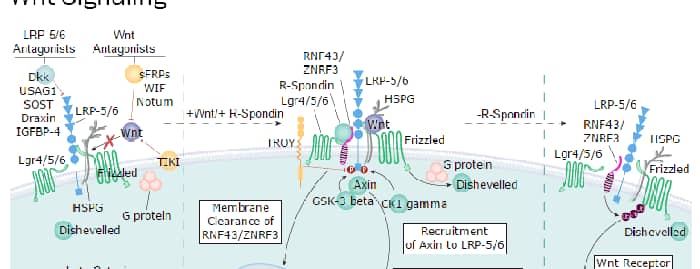
The Glypicans (glypiated proteoglycans) are a small multigene family of GPI-linked proteoglycans that play a key role in growth factor signaling (1, 2, 3, 4). There are six known mammalian Glypicans. They all share a common-sized protein core of 60‑70 kDa, an N-terminus which likely forms a compact globular domain, 14 conserved cysteines that form multiple intrachain disulfide bonds, and a number of C-terminal N- and O-linked carbohydrate attachment sites. Based on exon organization and the location of O-linked glycosylation sites, at least two subfamilies of Glypicans are known, with one subfamily containing Glypicans 1, 2, 4 and 6, and another subfamily containing Glypicans 3 and 5 (3, 5). Human Glypican 1 (GPC-1) is synthesized as a 558 amino acid (aa) preproprecursor that contains a 23 aa signal sequence, a 507 aa mature segment, and a 28 aa C-terminal prosegment (6, 7). There are two potential N-linked and four potential O-linked sites for glycosylation or glycanation. There are potentially two heparan sulfate (HS) modifications on GPC-1 that could contribute to a native molecular weight of approximately 200 kDa (7, 8, 9). Mature human GPC-1 shares 91% aa identity with mature mouse GPC-1. There are two potential splice variants of human GPC-1. Both show an alternate start site at Met73, while one has an additional 65 aa substitution for the C-terminal 264 amino acids (10, 11). Cells known to express GPC-1 include neurons, smooth and skeletal muscle cells, keratinocytes, osteoblasts, Schwann cells, immature dendritic cells, and tumor, plus tumor-associated vascular endothelial cells (8, 9, 12‑15). The function of GPC-1 is complex and varied. As a proteoglycan, it appears to make use of its HS adduct to impact select growth factor activity (16). This is accomplished by having juxtramembrane HS attachment sites, and a flexible, GPI-linkage (17). Data suggests GPC-1 and sulfation enzymes may collaborate to regulate FGF signaling. HS modules that are rich in 2-O- and 6-O- sulfate upregulate FGF-2 activation of FGFR1c (18). Similarly, FGF-1 requires both 2-O- and 6-O-sulfation to bind to FGFR2c and 3c. By contract, FGF-1 requires no sulfation to bind to FGFR2b, and FGF-8b needs only 6-O-sulfation to activate FGFR3c. Thus, many FGF receptor isoform specific effects may be attributed to an interaction between Glypican family members and the cell sulfation system (19).
Human Glypican 1 Antibody [Biotin]
R&D Systems | Catalog # BAF4519

Scientific images may be resized, cropped, or adjusted for brightness or contrast for presentation purposes. These updates are limited to presentation and do not affect the underlying scientific interpretation of the data. Where available, additional source data may be provided upon request.
Key Product Details
Species Reactivity
Validated:
Cited:
Applications
Validated:
Cited:
Label
Antibody Source
Product Specifications
Immunogen
Asp24-Ser530
Accession # P35052
Specificity
Clonality
Host
Isotype
Scientific Data Images for Human Glypican 1 Antibody [Biotin]
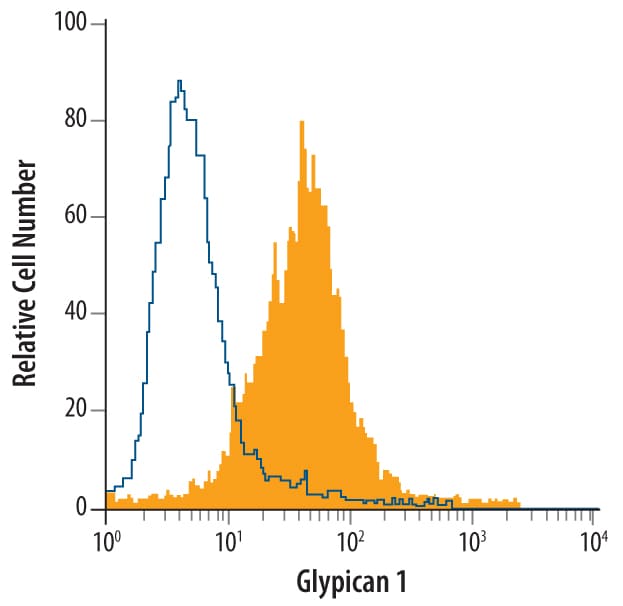
Detection of Glypican 1 in MDA‑MB‑231 Human Cell Line by Flow Cytometry.
MDA-MB-231 human breast cancer cell line was stained with Goat Anti-Human Glypican 1 Biotinylated Antigen Affinity-purified Polyclonal Antibody (Catalog # BAF4519, filled histogram) or isotype control antibody (BAF108), open histogram), followed by Streptavidin-Phycoerythrin (F0040).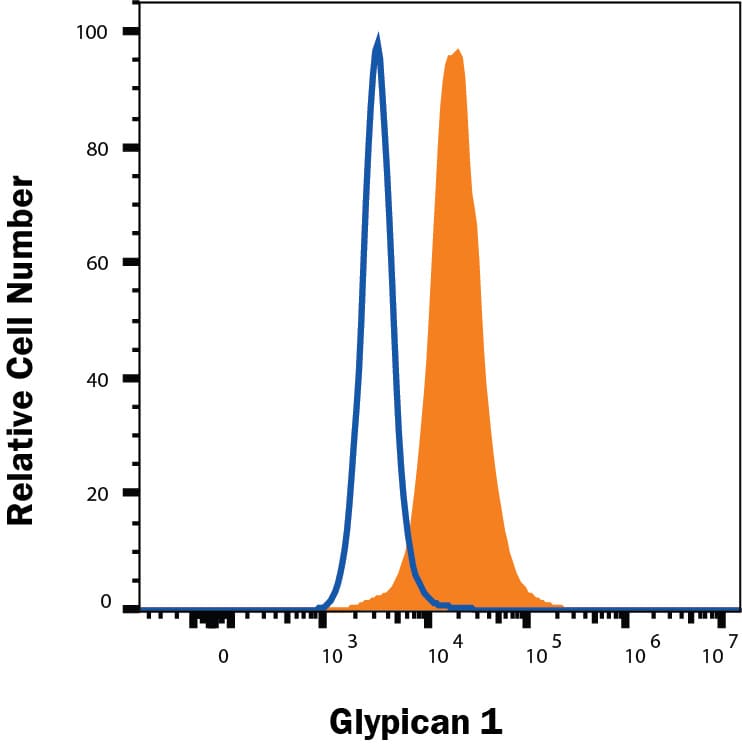
Detection of Glypican 1 in A549 cells by Flow Cytometry.
A549 cells were stained with Goat Anti-Human Glypican 1 Biotinylated Antigen Affinity-purified Polyclonal Antibody (Catalog # BAF4519, filled histogram) or isotype control antibody (Catalog # BAF108, open histogram), followed by Streptavidin-Phycoerythrin (Catalog # F0040). View our protocol for Staining Membrane-associated Proteins.Applications for Human Glypican 1 Antibody [Biotin]
Flow Cytometry
Sample: MDA‑MB‑231 human breast cancer cell line and A549 human lung carcinoma cell line
Western Blot
Sample: Recombinant Human Glypican 1 (Catalog # 4519-GP)
Flow Cytometry Panel Builder
Bio-Techne Knows Flow Cytometry
Save time and reduce costly mistakes by quickly finding compatible reagents using the Panel Builder Tool.
Advanced Features
- Spectra Viewer - Custom analysis of spectra from multiple fluorochromes
- Spillover Popups - Visualize the spectra of individual fluorochromes
- Antigen Density Selector - Match fluorochrome brightness with antigen density

Formulation, Preparation, and Storage
Purification
Reconstitution
Reconstitute at 0.2 mg/mL in sterile PBS.
Formulation
Shipping
Stability & Storage
- 12 months from date of receipt, -20 to -70 °C as supplied.
- 1 month, 2 to 8 °C under sterile conditions after reconstitution.
- 6 months, -20 to -70 °C under sterile conditions after reconstitution.
Calculators
Background: Glypican 1
References
- Song, H.H. and J. Filmus (2002) Biochim. Biophys. Acta 1573:241.
- Fransson, L-A. et al. (2004) Cell. Mol. Life Sci. 61:1016.
- De Cat, B. and G. David (2001) Semin. Cell Dev. Biol. 12:117.
- Lamoureux, F. et al. (2007) BioEssays 29:758.
- Veugelers, M. et al. (1999) J. Biol. Chem. 274:26968.
- GenBank Accession # P35052.
- David, G. et al. (1990) J. Cell Biol. 111:3165.
- Lories, V. et al. (1992) J. Biol. Chem. 267:1116.
- Lories, V. et al. (1989) J. Biol. Chem. 264:7009.
- GenBank Accession # EAW71184.
- GenBank Accession # EAW71183.
- Chernousov, M.A. et al. (2006) J. Neurosci. 26:508.
- Wegrowski, Y. et al. (2006) Clin. Exp. Immunol. 144:485.
- Qiao, D. et al. (2003) J. Biol. Chem. 278:16045.
- Kayed, H. et al. (2006) Int. J. Oncol. 29:1139.
- Selleck, S.B. (2006) SciSTKE, April 4:pe17.
- Qiao, D. et al. (2003) J. Biol. Chem. 278:16045.
- Su, G. et al. (2006) Am. J. Pathol. 168:2014.
- Allen, B.L. and A.C. Rapraeger (2003) J. Cell Biol. 163:637.
Alternate Names
Gene Symbol
UniProt
Additional Glypican 1 Products
Product Documents for Human Glypican 1 Antibody [Biotin]
Certificate of Analysis
To download a Certificate of Analysis, please enter a lot or batch number in the search box below.
Note: Certificate of Analysis not available for kit components.
Product Specific Notices for Human Glypican 1 Antibody [Biotin]
For research use only
Related Research Areas
Citations for Human Glypican 1 Antibody [Biotin]
 Powered by Bioz
Customer Reviews for Human Glypican 1 Antibody [Biotin]
There are currently no reviews for this product. Be the first to review Human Glypican 1 Antibody [Biotin] and earn rewards!
Have you used Human Glypican 1 Antibody [Biotin]?
Submit a review and receive an Amazon gift card!
$25/€18/£15/$25CAN/¥2500 for a review with an image
$10/€7/£6/$10CAN/¥1110 for a review without an image
Submit a review
Protocols
Find general support by application which include: protocols, troubleshooting, illustrated assays, videos and webinars.
- 7-Amino Actinomycin D (7-AAD) Cell Viability Flow Cytometry Protocol
- Cellular Response to Hypoxia Protocols
- Extracellular Membrane Flow Cytometry Protocol
- Flow Cytometry Protocol for Cell Surface Markers
- Flow Cytometry Protocol for Staining Membrane Associated Proteins
- Flow Cytometry Staining Protocols
- Flow Cytometry Troubleshooting Guide
- Intracellular Flow Cytometry Protocol Using Alcohol (Methanol)
- Intracellular Flow Cytometry Protocol Using Detergents
- Intracellular Nuclear Staining Flow Cytometry Protocol Using Detergents
- Intracellular Staining Flow Cytometry Protocol Using Alcohol Permeabilization
- Intracellular Staining Flow Cytometry Protocol Using Detergents to Permeabilize Cells
- Propidium Iodide Cell Viability Flow Cytometry Protocol
- Protocol for Liperfluo
- Protocol for the Characterization of Human Th22 Cells
- Protocol for the Characterization of Human Th9 Cells
- Protocol: Annexin V and PI Staining by Flow Cytometry
- Protocol: Annexin V and PI Staining for Apoptosis by Flow Cytometry
- R&D Systems Quality Control Western Blot Protocol
- Troubleshooting Guide: Fluorokine Flow Cytometry Kits
- Troubleshooting Guide: Western Blot Figures
- Western Blot Conditions
- Western Blot Protocol
- Western Blot Protocol for Cell Lysates
- Western Blot Troubleshooting
- Western Blot Troubleshooting Guide
- View all Protocols, Troubleshooting, Illustrated assays and Webinars
Associated Pathways