
IL-28 R alpha (IL-28 receptor alpha subunit; also named interferon-lambda R1) is a type I transmembrane glycoprotein that is the cytokine receptor family 2 member 12
(CRF2-12) (1-4). It pairs with the IL-10 receptor beta subunit (IL-10 R beta, CRF2-4) to form the IL-28 R (1-4). Each subunit of this receptor can interact with the
interferon-like cytokines (type III interferons) IL-28A (IFN-lambda 2), IL-28B (IFN-lambda 3) or IL-29 (IFN-lambda 1) (1-4). Human IL-28 R alpha cDNA encodes a 520 amino acid (aa) protein with a 20 aa signal peptide, a 208 aa extracellular domain (ECD) with a fibronectin type III motif and four potential N-glycosylation sites, a 21 aa transmembrane sequence, and a proline-rich and acidic 271 aa cytoplasmic domain. Eight isoforms have been sequenced, but their significance is unknown (3, 5). Isoforms of 211 and 244 aa appear to lack transmembrane sequences. These and other isoforms of 491, 437, 322, 283 and 184 aa have alternate N- or C-termini, or lack an internal sequence (aa 268-296). The mature human IL-28 R alpha ECD shares 67%, 66%, 78% and 74% aa sequence identity with mouse, rat, canine and bovine IL-28 R alpha, respectively. Some cross-species reactivity has been shown (6). IL-28 R is constitutively expressed in most tissues, but its ligands are mainly produced by antigen presenting cells in response to viruses and their products (2-6). Signaling through IL-28 R alpha is similar to that of receptors for type I IFNs, including tyrosine phosphorylation, activation of JAK tyrosine kinases, STAT phosphorylation and formation of the IFN-stimulated gene factor 3 (ISGF-3) transcription factor complex
(1-7). This signaling pathway induces antiviral activity and up-regulates MHC class I antigen expression (2-7). Anti-proliferative activity has also been shown for
IL-28/IL-28 R (7).
Human IL-28 R alpha/IFN-lambda R1 Antibody
R&D Systems | Catalog # AF5260

Scientific images may be resized, cropped, or adjusted for brightness or contrast for presentation purposes. These updates are limited to presentation and do not affect the underlying scientific interpretation of the data. Where available, additional source data may be provided upon request.
Key Product Details
Species Reactivity
Validated:
Cited:
Applications
Validated:
Cited:
Label
Antibody Source
Product Specifications
Immunogen
Arg21-Ala228
Accession # Q8IU57
Specificity
Clonality
Host
Isotype
Scientific Data Images for Human IL-28 R alpha/IFN-lambda R1 Antibody
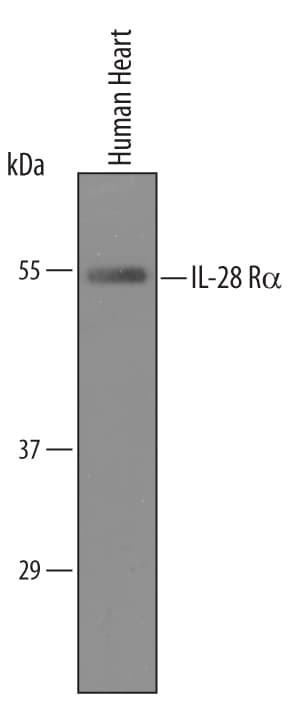
Detection of Human IL‑28 R alpha /IFN‑ lambda R1 by Western Blot.
Western blot shows lysates of human heart tissue. PVDF Membrane was probed with 2 µg/mL of Human IL-28 Ra/IFN-lambda R1 Antigen Affinity-purified Polyclonal Antibody (Catalog # AF5260) followed by HRP-conjugated Anti-Sheep IgG Secondary Antibody (Catalog # HAF016). A specific band was detected for IL-28 Ra/IFN-lambda R1 at approximately 55 kDa (as indicated). This experiment was conducted under reducing conditions and using Immunoblot Buffer Group 8.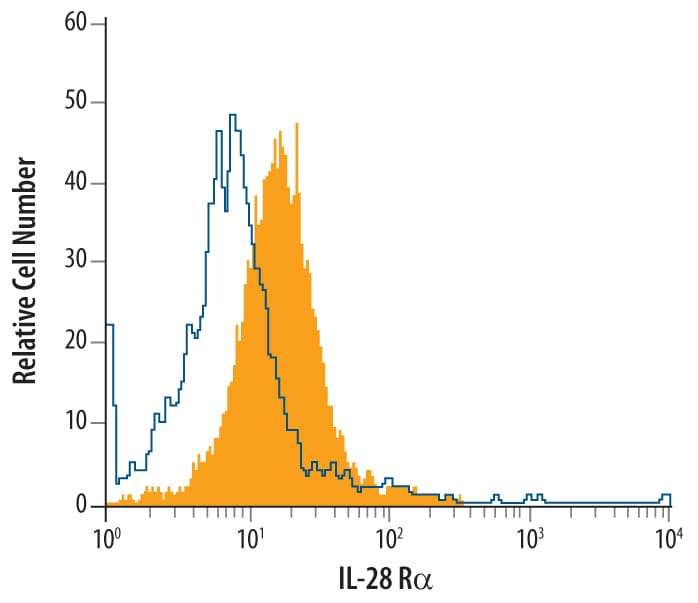
Detection of IL‑28 R alpha /IFN‑ lambda R1 in Daudi Human Cell Line by Flow Cytometry.
Daudi human Burkitt's lymphoma cell line was stained with Human IL-28 Ra/IFN-lambda R1 Antigen Affinity-purified Polyclonal Antibody (Catalog # AF5260, filled histogram) or isotype control antibody (Catalog # 5-001-A, open histogram), followed by NorthernLights™ 637-conjugated Anti-Sheep IgG Secondary Antibody (Catalog # NL011).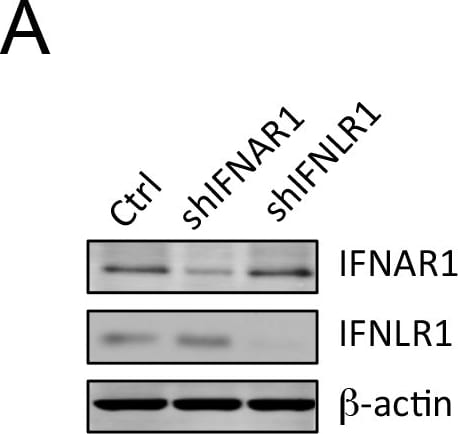
Detection of IL-28 R alpha /IFN-lambda R1 by Western Blot
Type III IFN response regulates HEV replication.(A) Immunoblots of IFNAR1, IFNLR1 and beta -actin in HepG2 cells transduced with lentiviruses expressing gene-specific shRNA or GFP (Ctrl). (B) ISRE promoter activity in different cells after IFN-alpha or IFN-lambda treatment. HepG2 cells were transfected with an interferon-sensitive response element (ISRE) promoter-driven firefly luciferase reporter plasmid ISRE-Luc and a herpes simplex virus thymidine kinase promoter-driven Renilla luciferase (TK-RLuc) plasmid for 24 h, then treated with IFN-alpha (100ng/ml) or IFN-lambda 1 (220ng/ml) for 24 h. Data are expressed as fold changes relative to non-treated cells based on the relative luciferase activities (firefly luciferase vs. Renilla luciferase). Shown are representative results (mean ± SEM) from two independent experiments each performed in triplicate. (C-E) Effects of IFN receptor knockdown on ISG expression and HEV replication. HepG2 cells transduced with lentiviruses expressing gene-specific shRNA or GFP (Ctrl) were infected with HEV for 5 days. (C) Intracellular IFIT1 mRNA expression determined by qRT-PCR. Results are represented as fold changes relative to HEV-infected control cells. (D) HEV RNA abundance determined by qRT-PCR (fold changes relative to HEV-infected control cells). (E) Cells expressing different shRNA or GFP (Ctrl) were infected with HEV for 5 days, harvested and subjected to three rounds of freeze-thaws prior to inoculation to naïve HepG2 cells. Infected cells were detected by IFA and HEV foci were counted after 5 days. Each data point represents the mean ± SEM of at least 2 independent experiments in duplicate each. * P<0.05; ** P<0.01. Image collected and cropped by CiteAb from the following open publication (https://pubmed.ncbi.nlm.nih.gov/28558073), licensed under a CC-BY license. Not internally tested by R&D Systems.Applications for Human IL-28 R alpha/IFN-lambda R1 Antibody
CyTOF-ready
Flow Cytometry
Sample: Daudi human Burkitt's lymphoma cell line
Western Blot
Sample: Human heart tissue
Flow Cytometry Panel Builder
Bio-Techne Knows Flow Cytometry
Save time and reduce costly mistakes by quickly finding compatible reagents using the Panel Builder Tool.
Advanced Features
- Spectra Viewer - Custom analysis of spectra from multiple fluorochromes
- Spillover Popups - Visualize the spectra of individual fluorochromes
- Antigen Density Selector - Match fluorochrome brightness with antigen density

Formulation, Preparation, and Storage
Purification
Reconstitution
Reconstitute at 0.2 mg/mL in sterile PBS. For liquid material, refer to CoA for concentration.
Formulation
Shipping
Stability & Storage
- 12 months from date of receipt, -20 to -70 °C as supplied.
- 1 month, 2 to 8 °C under sterile conditions after reconstitution.
- 6 months, -20 to -70 °C under sterile conditions after reconstitution.
Calculators
Background: IL-28 R alpha/IFN-lambda R1
References
- Chen, Q. et al. (2006) Vitam. Horm. 74:207.
- Meager, A. et al. (2005) Cytokine 31:109.
- Sheppard, P. et al. (2003) Nat. Immunol. 4:63.
- Kotenko, S.V. et al. (2003) Nat. Immunol. 4:69.
- Entrez Accession # NP_775088, EAW95113, EAW95115, EAW95116, AAI39723, AAI01409.
- Lasfar, A. et al. (2006) Cancer Res. 66:4468.
- Dumoutier, L. et al. (2004) J. Biol. Chem. 279:32269.
Long Name
Alternate Names
Gene Symbol
UniProt
Additional IL-28 R alpha/IFN-lambda R1 Products
Product Documents for Human IL-28 R alpha/IFN-lambda R1 Antibody
Certificate of Analysis
To download a Certificate of Analysis, please enter a lot or batch number in the search box below.
Note: Certificate of Analysis not available for kit components.
Product Specific Notices for Human IL-28 R alpha/IFN-lambda R1 Antibody
For research use only
Related Research Areas
Citations for Human IL-28 R alpha/IFN-lambda R1 Antibody
 Powered by Bioz
Customer Reviews for Human IL-28 R alpha/IFN-lambda R1 Antibody
There are currently no reviews for this product. Be the first to review Human IL-28 R alpha/IFN-lambda R1 Antibody and earn rewards!
Have you used Human IL-28 R alpha/IFN-lambda R1 Antibody?
Submit a review and receive an Amazon gift card!
$25/€18/£15/$25CAN/¥2500 for a review with an image
$10/€7/£6/$10CAN/¥1110 for a review without an image
Submit a review
Protocols
Find general support by application which include: protocols, troubleshooting, illustrated assays, videos and webinars.
- 7-Amino Actinomycin D (7-AAD) Cell Viability Flow Cytometry Protocol
- Cellular Response to Hypoxia Protocols
- Extracellular Membrane Flow Cytometry Protocol
- Flow Cytometry Protocol for Cell Surface Markers
- Flow Cytometry Protocol for Staining Membrane Associated Proteins
- Flow Cytometry Staining Protocols
- Flow Cytometry Troubleshooting Guide
- Intracellular Flow Cytometry Protocol Using Alcohol (Methanol)
- Intracellular Flow Cytometry Protocol Using Detergents
- Intracellular Nuclear Staining Flow Cytometry Protocol Using Detergents
- Intracellular Staining Flow Cytometry Protocol Using Alcohol Permeabilization
- Intracellular Staining Flow Cytometry Protocol Using Detergents to Permeabilize Cells
- Propidium Iodide Cell Viability Flow Cytometry Protocol
- Protocol for Liperfluo
- Protocol for the Characterization of Human Th22 Cells
- Protocol for the Characterization of Human Th9 Cells
- Protocol: Annexin V and PI Staining by Flow Cytometry
- Protocol: Annexin V and PI Staining for Apoptosis by Flow Cytometry
- R&D Systems Quality Control Western Blot Protocol
- Troubleshooting Guide: Fluorokine Flow Cytometry Kits
- Troubleshooting Guide: Western Blot Figures
- Western Blot Conditions
- Western Blot Protocol
- Western Blot Protocol for Cell Lysates
- Western Blot Troubleshooting
- Western Blot Troubleshooting Guide
- View all Protocols, Troubleshooting, Illustrated assays and Webinars