
Kirrel2 (kin of irregular chiasm-1-like 2), also known as filtrin, NEPH3 (nephrin-like 3) or NLG1 (nephrin-like gene 1), is a 107 kDa type I transmembrane adhesion protein belonging to the immunoglobulin (Ig) superfamily (1, 2). Kirrel2 is expressed both in pancreatic islet beta cells and kidney glomerulus, and is also found in brain and lymph nodes (1‑9). Human Kirrel2 cDNA encodes a 708 amino acid (aa) protein that contains a 19 aa signal sequence, a 491 aa extracellular domain with five C2‑type Ig-like domains, a 21 aa transmembrane sequence and a 177 aa intracellular domain with a nephrin-like podocin binding site (aa 597‑606) (4, 5). An extracellular RGD sequence allows for cell attachment (4). The extracellular domain of human Kirrel2 shares 86%, 84%, 89% and 87% aa identity with mouse, rat, equine and bovine Kirrel2, respectively. Alternately spliced human Kirrel2 isoforms of 688, 633 and 583 aa have been described (6). These are, respectively, either missing aa 192‑211, or have a 23 aa alternate C-terminus in place of aa 611‑708, with or without aa 22‑71 at the N-terminus. Human Kirrel2 is downregulated in glomeruli of patients with proteinuria, suggesting an involvement in the maintenance of the glomerular filtration barrier (7). Autoantibodies to Kirrel2 have been identified in a subset of humans with type I diabetes, indicating its involvement with islet beta cell function (8). In the brain, Kirrel2 is present in olfactory neurons, but only when they are active; homophilic adhesion of Kirrel2 is postulated to help correlate nerves identifying the same odorant (9). It is also a marker for mouse early postmitotic neural precursors in the ventricular zone of the developing mouse spinal cord (10).
Human Kirrel2/NEPH3 Antibody
R&D Systems | Catalog # AF2564

Scientific images may be resized, cropped, or adjusted for brightness or contrast for presentation purposes. These updates are limited to presentation and do not affect the underlying scientific interpretation of the data. Where available, additional source data may be provided upon request.
Key Product Details
Species Reactivity
Validated:
Cited:
Applications
Validated:
Cited:
Label
Antibody Source
Product Specifications
Immunogen
Gly21-Arg503
Accession # Q6UWL6
Specificity
Clonality
Host
Isotype
Scientific Data Images for Human Kirrel2/NEPH3 Antibody
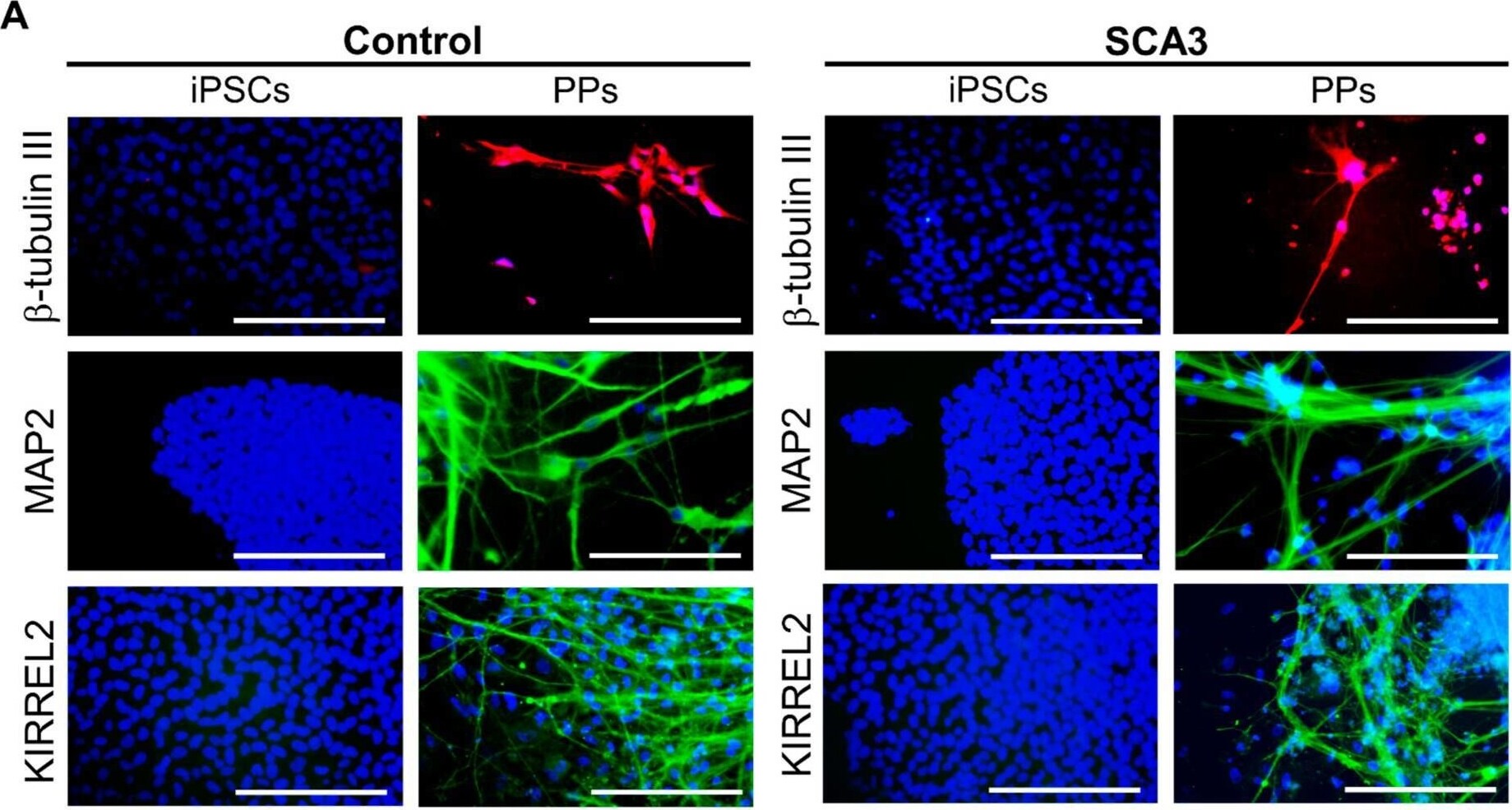
Detection of Kirrel2/NEPH3 by Immunocytochemistry/ Immunofluorescence
The differentiation of control and SCA3 iPSCs into Purkinje progenitor cells (PPs). The control and SCA3 iPSCs were differentiated with gfCDM as described in Materials and Methods. At 35 days of differentiation, both control and SCA3 iPSCs exhibited similar characteristics of PPs when compared with a previous study [29]; (A) morphological patterns of neural markers beta -tubulin III and MAP2, and Purkinje lineage markers KIRREL2, as reflected by ICC staining. Scale bar = 100 μm; (B) the flow cytometry examination of neural marker beta -tubulin III and Purkinje lineage marker KIRREL2 to determine the differentiation yield. Image collected and cropped by CiteAb from the following open publication (https://pubmed.ncbi.nlm.nih.gov/35163312), licensed under a CC-BY license. Not internally tested by R&D Systems.Applications for Human Kirrel2/NEPH3 Antibody
Western Blot
Sample: Recombinant Human Kirrel2/NEPH3 (Catalog # 2564-K2)
Formulation, Preparation, and Storage
Purification
Reconstitution
Reconstitute at 0.2 mg/mL in sterile PBS. For liquid material, refer to CoA for concentration.
Formulation
Shipping
Stability & Storage
- 12 months from date of receipt, -20 to -70 °C as supplied.
- 1 month, 2 to 8 °C under sterile conditions after reconstitution.
- 6 months, -20 to -70 °C under sterile conditions after reconstitution.
Calculators
Background: Kirrel2/NEPH3
References
- Sun C. et al. (2003) Genomics 82:130.
- Ihalmo, P. et al. (2003) Biochem. Biophys. Res. Commun. 300:364.
- Rinta-Valkama, J. et al. (2007) Mol. Cell. Biochem. 294:117.
- Sellin, L. et al. (2003) FASEB J. 17:115.
- NCBI Protein Accession # Q6UWL6.
- NCBI Protein Accession # AAH64925, NP_115499, and NP_954648.
- Ihalmo, P. et al. (2007) Nephrol. Dial. Transplant 22:1903.
- Rinta-Valkama, J. et al. (2007) Diabetes Metab. Res. Rev. 23:119.
- Serizawa, S. et al. (2006) Cell 127:1057.
- Minaki, Y. et al. (2005) Neurosci. Res. 52:250.
Long Name
Alternate Names
Gene Symbol
UniProt
Additional Kirrel2/NEPH3 Products
Product Documents for Human Kirrel2/NEPH3 Antibody
Certificate of Analysis
To download a Certificate of Analysis, please enter a lot or batch number in the search box below.
Note: Certificate of Analysis not available for kit components.
Product Specific Notices for Human Kirrel2/NEPH3 Antibody
For research use only
Related Research Areas
Citations for Human Kirrel2/NEPH3 Antibody
 Powered by Bioz
Customer Reviews for Human Kirrel2/NEPH3 Antibody
There are currently no reviews for this product. Be the first to review Human Kirrel2/NEPH3 Antibody and earn rewards!
Have you used Human Kirrel2/NEPH3 Antibody?
Submit a review and receive an Amazon gift card!
$25/€18/£15/$25CAN/¥2500 for a review with an image
$10/€7/£6/$10CAN/¥1110 for a review without an image
Submit a review
Protocols
Find general support by application which include: protocols, troubleshooting, illustrated assays, videos and webinars.
- Cellular Response to Hypoxia Protocols
- R&D Systems Quality Control Western Blot Protocol
- Troubleshooting Guide: Western Blot Figures
- Western Blot Conditions
- Western Blot Protocol
- Western Blot Protocol for Cell Lysates
- Western Blot Troubleshooting
- Western Blot Troubleshooting Guide
- View all Protocols, Troubleshooting, Illustrated assays and Webinars