

Key Product Details
Species Reactivity
Human
Applications
Blockade of Receptor-ligand Interaction, Flow Cytometry, CyTOF-ready
Label
Unconjugated
Antibody Source
Polyclonal Sheep IgG
Loading...
Product Specifications
Immunogen
Chinese hamster ovary cell line CHO-derived recombinant human LILRA5/CD85f
Gly42-Arg268
Accession # A6NI73
Gly42-Arg268
Accession # A6NI73
Specificity
Detects human LILRA5/CD85f in direct ELISAs.
Clonality
Polyclonal
Host
Sheep
Isotype
IgG
Scientific Data Images for Human LILRA5/CD85f Antibody
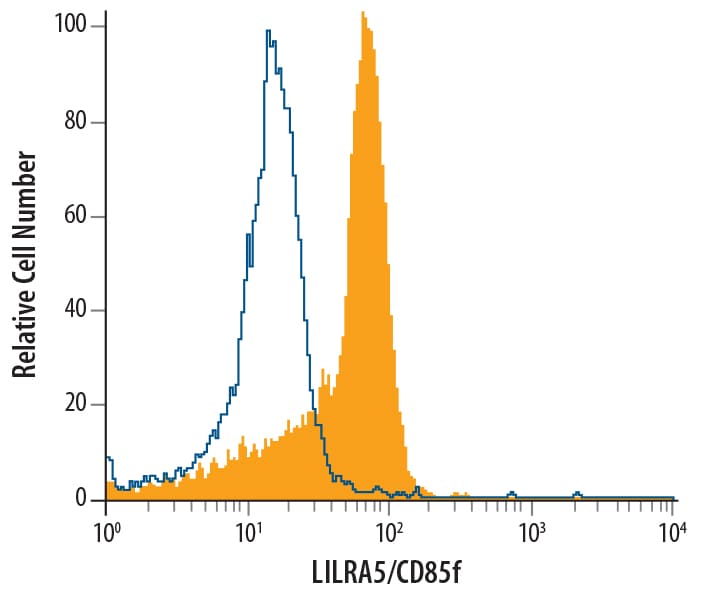
Detection of LILRA5/CD85f in Human peripheral blood monocytes by Flow Cytometry.
Human peripheral blood monocytes were stained with Sheep Anti-Human LILRA5/CD85f Antigen Affinity-purified Polyclonal Antibody (Catalog # AF6754, filled histogram) or control antibody (5-001-A, open histogram), followed by NorthernLights™ 557-conjugated Anti-Sheep IgG Secondary Antibody (Catalog # NL010).Applications for Human LILRA5/CD85f Antibody
Application
Recommended Usage
Blockade of Receptor-ligand Interaction
In a functional ELISA binding assay, 1-7 μg/mL of this antibody will block 50% of the binding of 1 μg/mL of Recombinant Human Angiopoietin-like 7 (Catalog # 914-AN) to immobilized Recombinant Human LILRA5/CD85f/LIR-9 (Catalog # 8956-T4) coated at 2 µg/mL (100 µL/well). At 15 µg/mL, this antibody will block >90% of the binding.
CyTOF-ready
Ready to be labeled using established conjugation methods. No BSA or other carrier proteins that could interfere with conjugation.
Flow Cytometry
2.5 µg/106 cells
Sample: Human peripheral blood monocytes
Sample: Human peripheral blood monocytes
Flow Cytometry Panel Builder
Bio-Techne Knows Flow Cytometry
Save time and reduce costly mistakes by quickly finding compatible reagents using the Panel Builder Tool.
Advanced Features
- Spectra Viewer - Custom analysis of spectra from multiple fluorochromes
- Spillover Popups - Visualize the spectra of individual fluorochromes
- Antigen Density Selector - Match fluorochrome brightness with antigen density

Formulation, Preparation, and Storage
Purification
Antigen Affinity-purified
Reconstitution
Sterile PBS to a final concentration of 0.2 mg/mL. For liquid material, refer to CoA for concentration.
Loading...
Formulation
Lyophilized from a 0.2 μm filtered solution in PBS with Trehalose. *Small pack size (SP) is supplied either lyophilized or as a 0.2 µm filtered solution in PBS.
Shipping
Lyophilized product is shipped at ambient temperature. Liquid small pack size (-SP) is shipped with polar packs. Upon receipt, store immediately at the temperature recommended below.
Stability & Storage
Use a manual defrost freezer and avoid repeated freeze-thaw cycles.
- 12 months from date of receipt, -20 to -70 °C as supplied.
- 1 month, 2 to 8 °C under sterile conditions after reconstitution.
- 6 months, -20 to -70 °C under sterile conditions after reconstitution.
Calculators
Background: LILRA5/CD85f
(aa 51‑136 and 142-230), and a 10 aa cytoplasmic tail. LIR-9 has three potential splice forms. One is a 35 kDa soluble form of the molecule described above that shows a 27 aa substitution for aa 239-299. The other two splice forms are analogous to the above membrane and soluble forms, but demonstrate signal sequence cleavage further downstream after Ala51. Over aa 41‑268, human LIR-9 shares 58% aa identity with mouse LIR-9.
Long Name
Leukocyte Immunoglobulin-like Receptor Subfamily A Member 5
Alternate Names
CD85f, ILT11, LILRB7, LIR9
Gene Symbol
LILRA5
UniProt
Additional LILRA5/CD85f Products
Product Documents for Human LILRA5/CD85f Antibody
Certificate of Analysis
To download a Certificate of Analysis, please enter a lot or batch number in the search box below.
Note: Certificate of Analysis not available for kit components.
Product Specific Notices for Human LILRA5/CD85f Antibody
For research use only
Customer Reviews for Human LILRA5/CD85f Antibody
There are currently no reviews for this product. Be the first to review Human LILRA5/CD85f Antibody and earn rewards!
Have you used Human LILRA5/CD85f Antibody?
Submit a review and receive an Amazon gift card!
$25/€18/£15/$25CAN/¥2500 for a review with an image
$10/€7/£6/$10CAN/¥1110 for a review without an image
Submit a review
Protocols
Find general support by application which include: protocols, troubleshooting, illustrated assays, videos and webinars.
- 7-Amino Actinomycin D (7-AAD) Cell Viability Flow Cytometry Protocol
- Extracellular Membrane Flow Cytometry Protocol
- Flow Cytometry Protocol for Cell Surface Markers
- Flow Cytometry Protocol for Staining Membrane Associated Proteins
- Flow Cytometry Staining Protocols
- Flow Cytometry Troubleshooting Guide
- Intracellular Flow Cytometry Protocol Using Alcohol (Methanol)
- Intracellular Flow Cytometry Protocol Using Detergents
- Intracellular Nuclear Staining Flow Cytometry Protocol Using Detergents
- Intracellular Staining Flow Cytometry Protocol Using Alcohol Permeabilization
- Intracellular Staining Flow Cytometry Protocol Using Detergents to Permeabilize Cells
- Propidium Iodide Cell Viability Flow Cytometry Protocol
- Protocol for Liperfluo
- Protocol for the Characterization of Human Th22 Cells
- Protocol for the Characterization of Human Th9 Cells
- Protocol: Annexin V and PI Staining by Flow Cytometry
- Protocol: Annexin V and PI Staining for Apoptosis by Flow Cytometry
- Troubleshooting Guide: Fluorokine Flow Cytometry Kits
- View all Protocols, Troubleshooting, Illustrated assays and Webinars
Loading...