

Human Lymphotoxin-alpha /TNF-beta Antibody

Newer Version Available: MAB621R
NEW

Discontinued Product

MAB621 has been discontinued and is replaced by MAB621R.

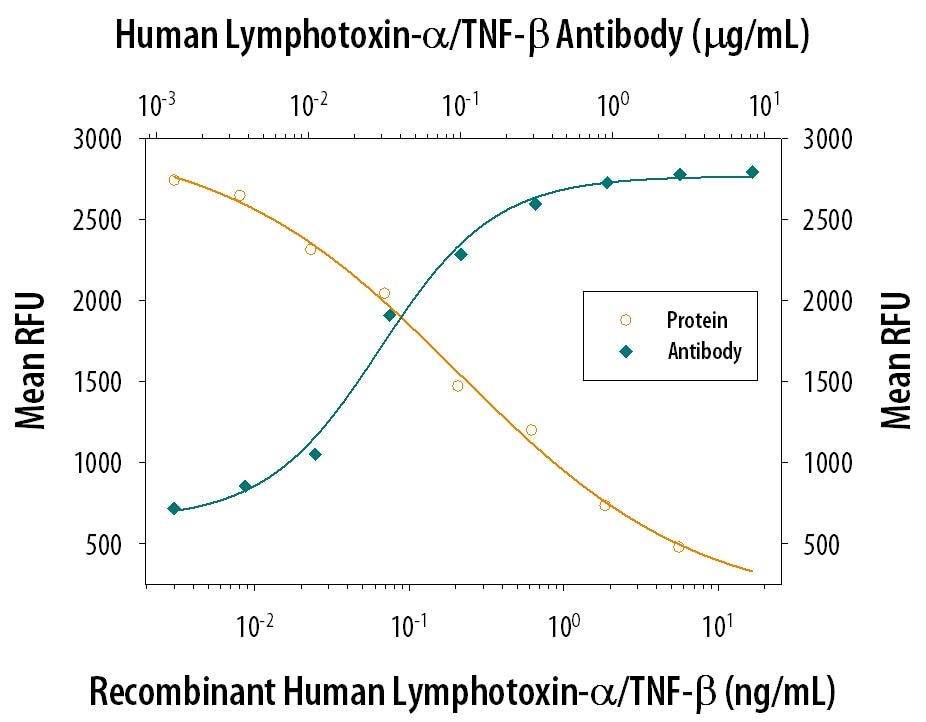
Cytotoxicity Induced by Lymphotoxin‑ alpha /TNF‑ beta  and Neutral-ization by Human Lymphotoxin‑ alpha /TNF‑ beta  Antibody.
1 Image
Product Details
Citations (1)
FAQs
Reviews

Human Lymphotoxin-alpha /TNF-beta Antibody Summary

Species Reactivity
Human
Specificity
Detects human Lymphotoxin‑ alpha /TNF‑ beta in ELISAs. In sandwich immunoassays, approximately 10% cross‑reactivity with recombinant mouse TNF‑ beta is observed and no cross-reactivity with bovine FGF acidic, recombinant human (rh) GM‑CSF, rhIL‑1 alpha, rhIL‑1 beta, rhIL‑2, rhIL‑3, rhIL‑4, rhIL‑6, rhIL‑8, rhTNF‑ alpha, rhPDGF, rpPDGF, rhTGF‑ beta 1, recombinant porcine (rp) TGF‑ beta 1, rpTGF‑ beta 1.2, or rpTGF‑ beta 2 is observed.
Source
Monoclonal Mouse IgG2A Clone # 5807
Purification
Protein A or G purified from ascites
Immunogen
E. coli-derived recombinant human Lymphotoxin‑ alpha /TNF‑ beta
Formulation
Lyophilized from a 0.2 μm filtered solution in PBS with Trehalose. *Small pack size (SP) is supplied either lyophilized or as a 0.2 µm filtered solution in PBS.
Endotoxin Level
<0.10 EU per 1 μg of the antibody by the LAL method.
Label
Unconjugated

Applications

Recommended Concentration
Sample

Human Lymphotoxin-alpha /TNF-beta Sandwich Immunoassay

Recommended Concentration
Reagent
ELISA Capture (Matched Antibody Pair)
2-8 µg/mL 

Use in combination with:

Detection Reagent: Human Lymphotoxin‑ alpha /TNF‑ beta Biotinylated Antibody (Catalog # BAF211)

Standard: Recombinant Human Lymphotoxin-alpha/TNF-beta Protein (Catalog # 211-TBB)

Neutralization
Measured by its ability to neutralize Lymphotoxin‑ alpha /TNF‑ beta -induced cytotoxicity in the L‑929 mouse fibroblast cell line. Matthews, N. and M.L. Neale (1987) in Lymphokines and Interferons, A Practical Approach. Clemens, M.J. et al. (eds): IRL Press. 221. The Neutralization Dose (ND50) is typically 0.03-0.09 µg/mL in the presence of 0.25 ng/mL Recombinant Human Lymphotoxin‑ alpha /TNF‑ beta and actinomycin D.

Please Note: Optimal dilutions should be determined by each laboratory for each application. General Protocols are available in the Technical Information section on our website.

Scientific Data

Neutralization Cytotoxicity Induced by Lymphotoxin‑ alpha /TNF‑ beta  and Neutral-ization by Human Lymphotoxin‑ alpha /TNF‑ beta  Antibody. View Larger

Cytotoxicity Induced by Lymphotoxin‑ alpha /TNF‑ beta and Neutral-ization by Human Lymphotoxin‑ alpha /TNF‑ beta Antibody. Recombinant Human Lymphotoxin-a/TNF-beta (Catalog # 211-TBB) induces cytotoxicity in the the L-929 mouse fibroblast cell line in a dose-dependent manner (orange line), as measured by Resazurin (Catalog # AR002). Cytotoxicity elicited by Recombinant Human Lymphotoxin-a/TNF-beta (0.25 ng/mL) is neutralized (green line) by increasing concentrations of Mouse Anti-Human Lymphotoxin-a/TNF-beta Monoclonal Antibody (Catalog # MAB621). The ND50 is typically 0.03-0.09 µg/mL in the presence of the metabolic inhibitor actinomycin D.

Reconstitution Calculator

Reconstitution Calculator

The reconstitution calculator allows you to quickly calculate the volume of a reagent to reconstitute your vial. Simply enter the mass of reagent and the target concentration and the calculator will determine the rest.

=
÷

Preparation and Storage

Reconstitution
Reconstitute at 0.5 mg/mL in sterile PBS.
Loading...
Shipping
Lyophilized product is shipped at ambient temperature. Liquid small pack size (-SP) is shipped with polar packs. Upon receipt, store immediately at the temperature recommended below.
Stability & Storage
Use a manual defrost freezer and avoid repeated freeze-thaw cycles.
  • 12 months from date of receipt, -20 to -70 °C as supplied.
  • 1 month, 2 to 8 °C under sterile conditions after reconstitution.
  • 6 months, -20 to -70 °C under sterile conditions after reconstitution.

Background: Lymphotoxin-alpha/TNF-beta

Tumor necrosis factor beta (TNF-beta ), also known as lymphotoxin-alpha (LT-alpha ), and TNF-alpha, are two structurally and functionally related proteins that bind to the same cell surface receptors (TNF RI and TNF RII) and produce a vast range of similar, but not identical, effects. Among these effects is the ability to kill certain tumor cells directly, from which the names tumor necrosis factor and lymphotoxin both derive. Mature TNF-beta /LT-alpha and TNF-alpha share approximately 35% protein sequence homology and the biologically active secreted forms of both proteins are homotrimers. Whereas TNF-alpha can exist as a type II membrane protein, TNF-beta /LT-alpha possesses a typical signal peptide sequence and is a secreted protein. It has been shown that TNF-beta /LT-alpha is also present on the cell surface of activated T, B and LAK cells as a heteromeric complex with LT-beta, a type II membrane protein that is another member of the TNF ligand family. The genes for TNF-alpha, TNF-beta /LT-alpha, and LT-beta are closely linked within the major histocompatibility complex.

TNF-beta /LT-alpha is expressed in activated T- and B-lymphocytes. In addition to its cytotoxic action on tumor cells, TNF-beta /LT-alpha has been shown to be a mediator of inflammation and immune function. Evidence is also accumulating that TNF-beta /LT-alpha and TNF-alpha are mediators in the pathogenesis of certain autoimmune diseases. TNF-beta /LT-alpha has also been shown to have a role in lymphoid organ development. Human and mouse TNF-beta /LT-alpha share approximately 74% homology in their amino acid sequence and exhibit cross-species activity.

Long Name
Tumor Necrosis Factor beta
Entrez Gene IDs
4049 (Human); 16992 (Mouse)
Alternate Names
LT; LTA; LT-alpha; lymphotoxin alpha (TNF superfamily, member 1); Lymphotoxin alpha; Lymphotoxinalpha; Lymphotoxin-alpha; tnfb; TNF-beta; TNFBlymphotoxin-alpha; TNFSF1; TNFSF1B; TNFSF1TNF-beta; tumor necrosis factor beta; Tumor necrosis factor ligand superfamily member 1

Product Datasheets

You must select a language.

x

Citation for Human Lymphotoxin-alpha /TNF-beta Antibody

R&D Systems personnel manually curate a database that contains references using R&D Systems products. The data collected includes not only links to publications in PubMed, but also provides information about sample types, species, and experimental conditions.

1 Citation: Showing 1 - 1

  1. A comprehensive ex vivo functional analysis of human NKT cells reveals production of MIP1-alpha and MIP1-beta, a lack of IL-17, and a Th1-bias in males.
    Authors: Snyder-Cappione JE, Tincati C, Eccles-James IG, Cappione AJ, Ndhlovu LC, Koth LL, Nixon DF
    PLoS ONE, 2010-11-03;5(11):e15412.
    Species: Human
    Sample Types: Whole Cells
    Applications: ELISpot Development

FAQs

No product specific FAQs exist for this product, however you may

View all Antibody FAQs

Reviews for Human Lymphotoxin-alpha /TNF-beta Antibody

There are currently no reviews for this product. Be the first to review Human Lymphotoxin-alpha /TNF-beta Antibody and earn rewards!

Have you used Human Lymphotoxin-alpha /TNF-beta Antibody?

Submit a review and receive an Amazon gift card.

$25/€18/£15/$25CAN/¥75 Yuan/¥2500 Yen for a review with an image

$10/€7/£6/$10 CAD/¥70 Yuan/¥1110 Yen for a review without an image

Submit a Review
