
MELK (maternal embryonic leucine zipper kinase; also HPK38) is a member of the Snf1/AMPK family of serine/threonine kinases. It is expressed in blood mononuclear cells, stem cells and other tissues, and functions in cell cycle progression and pre-mRNA splicing. Human MELK is 651 amino acids (aa) in length and contains one protein kinase domain (aa 11‑263) and a kinase-associated (KA) 1 domain (aa 602‑651). MELK is activated upon phosphorylation of T167 and S171. There are multiple alternative splice variants. Two show the same 16 aa substitution for the N-terminal 87 and 48 aa, respectively; a third shows an alternate start site at M440, and a fourth shows complex splicing over aa 1‑392. Over aa 341‑470, human MELK shares 56% aa identity with mouse MELK.


Scientific images may be resized, cropped, or adjusted for brightness or contrast for presentation purposes. These updates are limited to presentation and do not affect the underlying scientific interpretation of the data. Where available, additional source data may be provided upon request.
Key Product Details
Species Reactivity
Applications
Label
Antibody Source
Product Specifications
Immunogen
Gln341-Ala470
Accession # Q14680
Specificity
Clonality
Host
Isotype
Scientific Data Images for Human MELK Antibody
Detection of Human MELK by Western Blot.
Western blot shows lysates of Huh-7 human hepatoma cell line, MO7e human megakaryocytic leukemic cell line, and THP-1 human acute monocytic leukemia cell line. PVDF membrane was probed with 1 µg/mL of Sheep Anti-Human MELK Antigen Affinity-purified Polyclonal Antibody (Catalog # AF4820) followed by HRP-conjugated Anti-Sheep IgG Secondary Antibody (Catalog # HAF016). A specific band was detected for MELK at approximately 74 kDa (as indicated). This experiment was conducted under reducing conditions and using Immunoblot Buffer Group 1.
MELK in Human Breast Cancer Tissue.
MELK was detected in immersion fixed paraffin-embedded sections of human breast cancer tissue using Sheep Anti-Human MELK Antigen Affinity-purified Polyclonal Antibody (Catalog # AF4820) at 10 µg/mL overnight at 4 °C. Tissue was stained using the Anti-Sheep HRP-DAB Cell & Tissue Staining Kit (brown; Catalog # CTS019) and counterstained with hematoxylin (blue). Specific staining was localized to plasma membranes of glandular epithelial cells. View our protocol for Chromogenic IHC Staining of Paraffin-embedded Tissue Sections.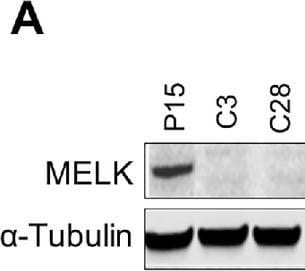
Detection of MELK by Western Blot
Effect of inhibition of MELK signaling on tumor growth and lung metastasis in TNBC xenograft mouse models. A, MELK expression in Cas9-p15 (P15) and MELK KO MDA-MB-231 (C3 and C28) cells. alpha -Tubulin was used as a loading control. B–F, MELK KO significantly suppressed lung metastases in an MDA-MB-231 xenograft mouse model. Female athymic nude mice were injected intravenously with luciferase-transfected Cas9-p15 or MELK KO MDA-MB-231-Luc-GFP stable cells. Metastatic tumors were measured weekly for 7 weeks by whole-body luciferase imaging using an IVIS 100 Imaging System. Shown are mouse whole-body luciferase images (B), photon counts per area (C), lung weight per mouse measured at week 7 following cell inoculation (D), mouse OS over a period of 80 days following cell inoculation (E), and IHC staining for hematoxylin and eosin (H&E), MELK, proliferation (Ki67), and mesenchymal markers (vimentin and fibronectin; F) in mice inoculated with Cas9-p15 or MELK KO MDA-MB-231 cells. Images were taken under 200 × magnification. G, MELK-In-17 significantly suppressed tumor growth in a 4T1 xenograft mouse model (P < 0.05). Murine 4T1 TNBC cells were injected into the mammary fat pads of female BALB/c mice. When tumor size reached 75–150 mm3, grouped mice were treated with vehicle or MELK-In-17 at 5 or 10 mg/kg via intraperitoneal injections daily for 25 days. In C–G, data are presented as mean ± SD. *, P < 0.05; **, P < 0.01. Image collected and cropped by CiteAb from the following open publication (https://pubmed.ncbi.nlm.nih.gov/37377604), licensed under a CC-BY license. Not internally tested by R&D Systems.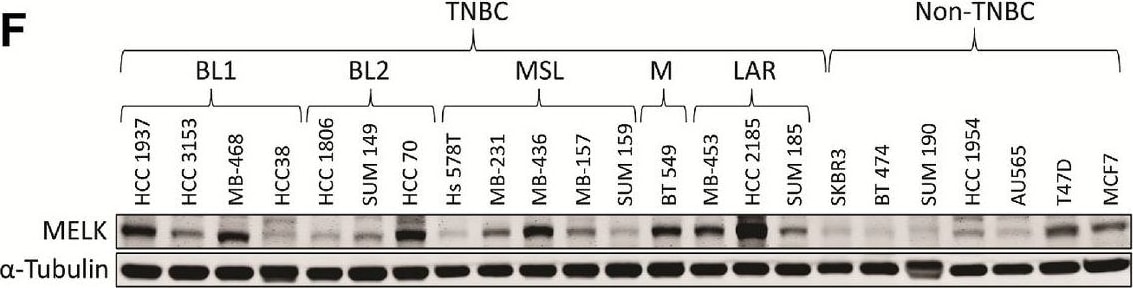
Detection of MELK by Western Blot
Clinical relevance of MELK in breast cancer and expression of MELK in breast cancer cell lines. A,MELK mRNA levels in HR−HER2+, HR+HER2−, HR+HER2+, and TNBC tumors in the World Consortium IBC dataset, analyzed by multiple comparison using a general linear model. Data are presented as mean ± SD. – represents median, X represents mean. B, IHC images (200× magnification) showing MELK protein expression in normal epithelial tissue and luminal, HER2+, and TNBC breast tumors. Correlation between MELK mRNA levels (<7 or ≥7) and OS, PFS, and DMFS in patients in the overall cohort (C) and among those with TNBC (D), determined by the Kaplan–Meier method. MELK mRNA levels (E) and protein levels (F) in TNBC and non-TNBC cells. Inset, correlation between MELK mRNA and protein levels in TNBC cell lines. In F, alpha -tubulin was used as a loading control. MELK mRNA levels were determined using quantitative reverse transcriptase PCR. Image collected and cropped by CiteAb from the following open publication (https://pubmed.ncbi.nlm.nih.gov/37377604), licensed under a CC-BY license. Not internally tested by R&D Systems.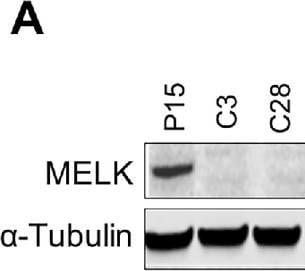
Detection of MELK by Western Blot
Effect of inhibition of MELK signaling on tumor growth and lung metastasis in TNBC xenograft mouse models. A, MELK expression in Cas9-p15 (P15) and MELK KO MDA-MB-231 (C3 and C28) cells. alpha -Tubulin was used as a loading control. B–F, MELK KO significantly suppressed lung metastases in an MDA-MB-231 xenograft mouse model. Female athymic nude mice were injected intravenously with luciferase-transfected Cas9-p15 or MELK KO MDA-MB-231-Luc-GFP stable cells. Metastatic tumors were measured weekly for 7 weeks by whole-body luciferase imaging using an IVIS 100 Imaging System. Shown are mouse whole-body luciferase images (B), photon counts per area (C), lung weight per mouse measured at week 7 following cell inoculation (D), mouse OS over a period of 80 days following cell inoculation (E), and IHC staining for hematoxylin and eosin (H&E), MELK, proliferation (Ki67), and mesenchymal markers (vimentin and fibronectin; F) in mice inoculated with Cas9-p15 or MELK KO MDA-MB-231 cells. Images were taken under 200 × magnification. G, MELK-In-17 significantly suppressed tumor growth in a 4T1 xenograft mouse model (P < 0.05). Murine 4T1 TNBC cells were injected into the mammary fat pads of female BALB/c mice. When tumor size reached 75–150 mm3, grouped mice were treated with vehicle or MELK-In-17 at 5 or 10 mg/kg via intraperitoneal injections daily for 25 days. In C–G, data are presented as mean ± SD. *, P < 0.05; **, P < 0.01. Image collected and cropped by CiteAb from the following open publication (https://pubmed.ncbi.nlm.nih.gov/37377604), licensed under a CC-BY license. Not internally tested by R&D Systems.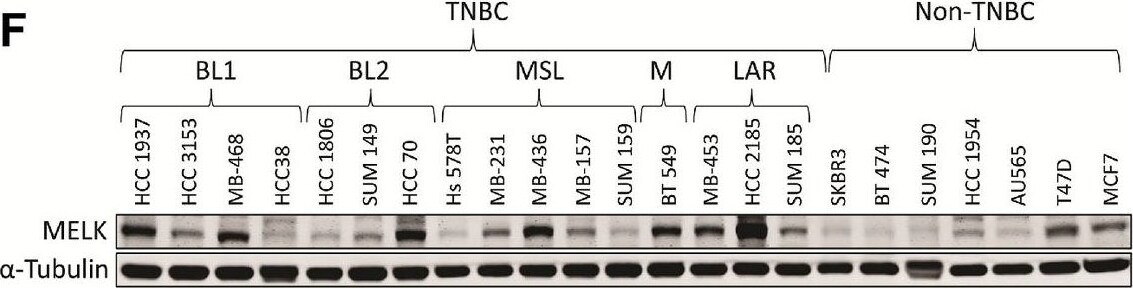
Detection of MELK by Western Blot
Clinical relevance of MELK in breast cancer and expression of MELK in breast cancer cell lines. A,MELK mRNA levels in HR−HER2+, HR+HER2−, HR+HER2+, and TNBC tumors in the World Consortium IBC dataset, analyzed by multiple comparison using a general linear model. Data are presented as mean ± SD. – represents median, X represents mean. B, IHC images (200× magnification) showing MELK protein expression in normal epithelial tissue and luminal, HER2+, and TNBC breast tumors. Correlation between MELK mRNA levels (<7 or ≥7) and OS, PFS, and DMFS in patients in the overall cohort (C) and among those with TNBC (D), determined by the Kaplan–Meier method. MELK mRNA levels (E) and protein levels (F) in TNBC and non-TNBC cells. Inset, correlation between MELK mRNA and protein levels in TNBC cell lines. In F, alpha -tubulin was used as a loading control. MELK mRNA levels were determined using quantitative reverse transcriptase PCR. Image collected and cropped by CiteAb from the following open publication (https://pubmed.ncbi.nlm.nih.gov/37377604), licensed under a CC-BY license. Not internally tested by R&D Systems.Applications for Human MELK Antibody
Immunohistochemistry
Sample: Immersion fixed paraffin-embedded sections of human breast cancer tissue
Western Blot
Sample: Huh‑7 human hepatoma cell line, MO7e human megakaryocytic leukemic cell line, and THP‑1 human acute monocytic leukemia cell line
Formulation, Preparation, and Storage
Purification
Reconstitution
Reconstitute at 0.2 mg/mL in sterile PBS. For liquid material, refer to CoA for concentration.
Formulation
Shipping
Stability & Storage
- 12 months from date of receipt, -20 to -70 °C as supplied.
- 1 month, 2 to 8 °C under sterile conditions after reconstitution.
- 6 months, -20 to -70 °C under sterile conditions after reconstitution.
Calculators
Background: MELK
Long Name
Alternate Names
Entrez Gene IDs
Gene Symbol
UniProt
Additional MELK Products
Product Documents for Human MELK Antibody
Certificate of Analysis
To download a Certificate of Analysis, please enter a lot or batch number in the search box below.
Note: Certificate of Analysis not available for kit components.
Product Specific Notices for Human MELK Antibody
For research use only
Related Research Areas
Citations for Human MELK Antibody
 Powered by Bioz
Customer Reviews for Human MELK Antibody
There are currently no reviews for this product. Be the first to review Human MELK Antibody and earn rewards!
Have you used Human MELK Antibody?
Submit a review and receive an Amazon gift card!
$25/€18/£15/$25CAN/¥2500 for a review with an image
$10/€7/£6/$10CAN/¥1110 for a review without an image
Submit a review
Protocols
Find general support by application which include: protocols, troubleshooting, illustrated assays, videos and webinars.
- Antigen Retrieval Protocol (PIER)
- Antigen Retrieval for Frozen Sections Protocol
- Appropriate Fixation of IHC/ICC Samples
- Cellular Response to Hypoxia Protocols
- Chromogenic IHC Staining of Formalin-Fixed Paraffin-Embedded (FFPE) Tissue Protocol
- Chromogenic Immunohistochemistry Staining of Frozen Tissue
- ClariTSA™ Fluorophore Kits
- Detection & Visualization of Antibody Binding
- Fluorescent IHC Staining of Frozen Tissue Protocol
- Graphic Protocol for Heat-induced Epitope Retrieval
- Graphic Protocol for the Preparation and Fluorescent IHC Staining of Frozen Tissue Sections
- Graphic Protocol for the Preparation and Fluorescent IHC Staining of Paraffin-embedded Tissue Sections
- Graphic Protocol for the Preparation of Gelatin-coated Slides for Histological Tissue Sections
- IHC Sample Preparation (Frozen sections vs Paraffin)
- Immunofluorescent IHC Staining of Formalin-Fixed Paraffin-Embedded (FFPE) Tissue Protocol
- Immunohistochemistry (IHC) and Immunocytochemistry (ICC) Protocols
- Immunohistochemistry Frozen Troubleshooting
- Immunohistochemistry Paraffin Troubleshooting
- Preparing Samples for IHC/ICC Experiments
- Preventing Non-Specific Staining (Non-Specific Binding)
- Primary Antibody Selection & Optimization
- Protocol for Heat-Induced Epitope Retrieval (HIER)
- Protocol for Making a 4% Formaldehyde Solution in PBS
- Protocol for VisUCyte™ HRP Polymer Detection Reagent
- Protocol for the Preparation & Fixation of Cells on Coverslips
- Protocol for the Preparation and Chromogenic IHC Staining of Frozen Tissue Sections
- Protocol for the Preparation and Chromogenic IHC Staining of Frozen Tissue Sections - Graphic
- Protocol for the Preparation and Chromogenic IHC Staining of Paraffin-embedded Tissue Sections
- Protocol for the Preparation and Chromogenic IHC Staining of Paraffin-embedded Tissue Sections - Graphic
- Protocol for the Preparation and Fluorescent IHC Staining of Frozen Tissue Sections
- Protocol for the Preparation and Fluorescent IHC Staining of Paraffin-embedded Tissue Sections
- Protocol for the Preparation of Gelatin-coated Slides for Histological Tissue Sections
- R&D Systems Quality Control Western Blot Protocol
- TUNEL and Active Caspase-3 Detection by IHC/ICC Protocol
- The Importance of IHC/ICC Controls
- Troubleshooting Guide: Immunohistochemistry
- Troubleshooting Guide: Western Blot Figures
- Western Blot Conditions
- Western Blot Protocol
- Western Blot Protocol for Cell Lysates
- Western Blot Troubleshooting
- Western Blot Troubleshooting Guide
- View all Protocols, Troubleshooting, Illustrated assays and Webinars